The difference between “queue” and “que” reflects how people experience waiting. This blog explores the meaning, psychology, and ethics of queues, and why clear, well-managed queues create trust, reduce confusion, and improve visitor and workplace experiences.


Published on: Thu, Dec 18, 2025
Read in 6 minutes
Ever stood in a ridiculously long queue and instinctively thought, “Que?” as in, “What is happening here?!”
You’re not alone! It turns out, the simple act of waiting in line, and the word we use for it, has a surprisingly twisty past.
Let’s dive into why “queue” isn’t “que,” and how technology is making sure you never have to utter that confused “what?” again when you’re just trying to get your coffee.
Our buddy “queue” actually started its journey from the Old French word “cue” or “coe,” meaning “tail.”
Think about it: a line of people is a human tail! Over time, this “tail” got busy. It became a literal hairstyle, like the braided ponytails sported by 18th-century soldiers. It popped up in fancy heraldry to describe an animal’s tail.
Around 1837, it officially settled into its most famous role: a line of people or cars waiting for something. Fast forward to today, and “queue” is even a VIP in computer science, describing how data waits in line (first-in, first-out, naturally!). Etymologically speaking, we can trace “queue” even further back, to the Latin words “coda” or “cauda,” which also mean “tail,” completing a rather elegant, if somewhat obscure, linguistic loop.
While “queue” was busy building its English empire, “que” was thriving elsewhere. Primarily found in Spanish, Portuguese, and Latin, it takes on a variety of roles. In Spanish, it’s a workhorse: “that,” “which,” “who.” But add an accent “que” and suddenly it’s a sassy “WHAT?!” or “HOW?!” It’s a transformation worthy of a seasoned thespian, showcasing the power of a single diacritic mark.
In Latin, the little “que” means “and,” a simple conjunction that quietly holds sentences together. And, okay, in some super niche English spots, it might be shorthand for Quebec or the letter “Q,” or even “barbecue” if you’re feeling extra casual in California. But mostly, it’s just not an English word. It exists in the periphery, a linguistic tourist perpetually mistaken for a local.
Let’s be real, traditional queues are the absolute worst. Endless waiting leads to frustration, boredom, and that awful feeling of wasted time. Americans, for instance, collectively fritter away billions of hours annually standing in lines, a staggering figure that speaks volumes about our collective agony. People bail, leave bad reviews, and vow never to return. There’s no transparency, no control just pure annoyance.
The data is clear: customers may abandon a purchase if they have to wait more than five to eight minutes, a testament to our collective impatience. Employees aren’t having a party either. Chaotic lines mean stressed-out staff, inefficient use of time, and less focus on actually helping you. It’s a lose-lose, a difficult task played out in retail spaces and government offices worldwide.
Thank goodness, smart folks decided enough was enough!
Modern queue management systems (QMS) are stepping in to rescue us from the dreaded line. People are ready for a smarter, smoother, and less stressful waiting game. We’re talking virtual lines joined from smartphones, real-time updates, and the sweet liberation of not being physically tethered to a queue. This evolution isn’t just about convenience; it’s a fundamental shift in how we perceive and value our time, a rebellion against the tyranny of the traditional queue.
The goal of modern queue design, physical or digital is simple:
Eliminate the need to ask questions while waiting.
This is achieved through:
When people understand what’s happening, waiting becomes tolerable even acceptable.
Get ready, because the future of waiting in line is looking seriously cool!
Say goodbye to standing around! Join lines from your phone, get real-time updates, and wait wherever you’re comfy (or productive!). Artificial intelligence is stepping up, predicting peak times, suggesting staff levels, and even giving you super accurate wait time forecasts. Cloud-based systems mean seamless updates and control for businesses, no matter how many locations they have. Kiosks are making check-ins quick and easy, often with multilingual options.
Businesses will be swimming in data about customer flow, helping them run smoother than ever. Imagine a queue system that knows your preferences and offers you tailored info or promotions while you wait. Digital receipts and paperless check-ins are making waiting a little greener. Soon, queue systems will talk to smart devices and even let you pre-pay! The omnichannel experience will be seamless, supporting customer journeys across in-person interactions, mobile apps, websites, and even social media check-ins.
So, whether you’re pondering the ancient origins of a word or marveling at the tech that’s finally making waiting less terrible, it’s clear: the “queue” has come a long way. From a simple word about tails to complex, AI-powered systems, managing our time (and sanity!) is a global pursuit. Here’s to a future where “Que?!” is just a question, not a frustration you feel while stuck in line!
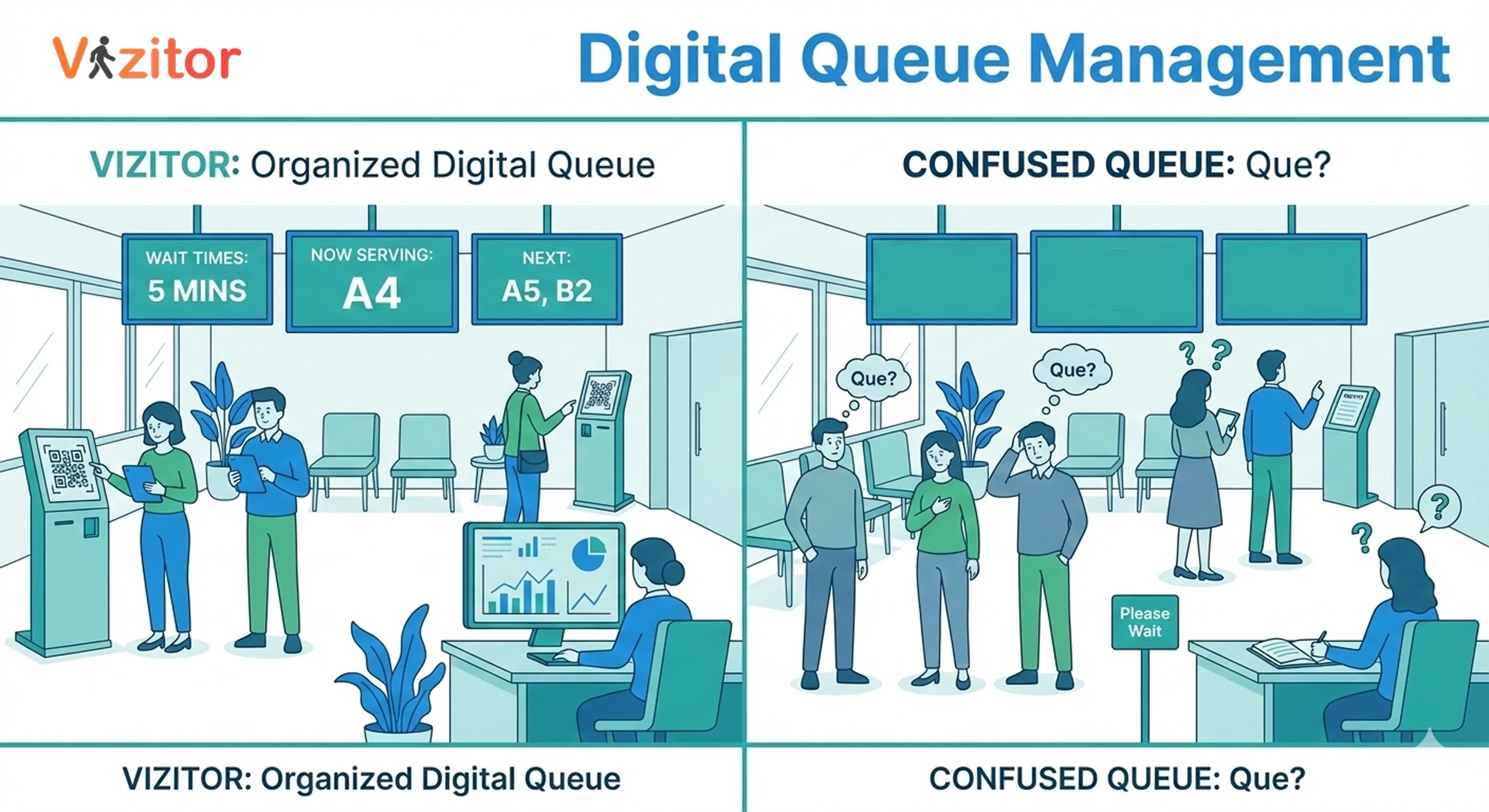
A “queue” represents order.
“Que?" represents doubt.
The difference between the two defines how people perceive time, fairness, and professionalism.
Whether in offices, services, or digital systems, the best experiences aren’t the ones with no waiting, they’re the ones with no confusion.
Because when a queue is clear, transparent, and fair,
no one needs to ask “what’s happening?”
And that’s when waiting finally works.
When waiting makes people ask “que?”, it’s time for a better system.
Discover Vizitor’s Queue Management.
A queue is an ordered line where people or requests wait their turn. Que means “what” in languages like Spanish and French and often reflects confusion when used in English.
Frustration arises when wait times are unclear, rules feel unfair, or people don’t know their position in the line. Uncertainty makes waiting feel longer.
Clear queue management provides transparency, predictable wait times, and fairness, helping visitors feel informed and respected.
A digital or virtual queue allows people to wait remotely, receive real-time updates, and be notified when it’s their turn, reducing physical congestion.
Queues operate on trust. When people believe the system is fair and consistent, they are more patient and satisfied, even during longer waits.
Digital queues manage tasks, data requests, and system processes behind the scenes, ensuring stability, scalability, and smooth performance.
A queue turns into “que?” when there is a lack of communication, unclear rules, or invisible progress, leading to confusion and frustration.
By using clear signage, real-time updates, structured workflows, and digital queue management systems, businesses can eliminate uncertainty.
Yes, Queues help maintain order and fairness. Modern systems focus on making queues transparent and efficient rather than eliminating them entirely.
Effective queue management reduces waiting time, prevents bottlenecks, improves staff productivity, and creates smoother visitor and employee experiences.