A Comprehensive Guide to Workplace Management Systems
A workplace management system (WMS) is software that centralizes your office operations, visitor check-in, room booking, desk reservation, attendance tracking, mailroom management, and space management, into one platform. Organizations using a WMS report up to 30% lower space costs, 40% less admin time, and significantly higher employee satisfaction. This guide covers all 6 core modules, how to choose the right software in 2026, hybrid work support, ROI benchmarks, and a step-by-step implementation checklist


Table of Content
Try Vizitor for Free!
Did you know? Companies with strong workplace systems see up to 25% higher productivity. In today’s dynamic work environment, a well-managed workplace is no longer a luxury, it’s a necessity. A quality workplace empowers your team to thrive, fosters collaboration, and ultimately drives business success. But how do you achieve this ideal state? Enter the workplace management system (WMS).

Most facility managers are all too familiar with this situation: a visitor shows up without warning, three teams are fighting over one conference room, a package is sitting at reception waiting to be picked up, and HR is manually reconciling attendance sheets,all before 10 AM. This isn’t a problem with staffing. It’s a problem with the system. A workplace management system (WMS) gets rid of this mess by linking all the moving parts of your office into one smart platform. Companies that use a modern WMS say that their space costs go down by up to 30%, their administrative costs go down by 40%, and their employees are happier.
What is a Workplace Management System?
A workplace management system is a software platform that brings together all the tasks that need to be done in a physical workspace. It connects and automates things that happen every day, like checking in visitors, making reservations for meeting rooms and desks, keeping track of attendance, managing deliveries, and analyzing how space is used. You could think of it as the office’s operating system. A WMS works like a smartphone OS to coordinate all the touchpoints that employees, visitors, and facilities teams use every day.
What About IWMS (Integrated Workplace Management System)?
An IWMS is a more advanced version of a basic WMS that is made for businesses. It combines managing a real estate portfolio, running a facility, managing a capital project, and making sure the environment stays healthy into one platform. Large companies that run multiple buildings or campuses usually use it.

Why Workplace Management Matters More Than Ever in 2026
Statistics speak volumes about the impact of a well-managed workplace:
A Globoforce study reveals that a strong workplace culture can boost productivity by up to 25%.
Steelcase research indicates that satisfied employees are 21% more productive.
The modern office has fundamentally changed. With hybrid work now the dominant model, 52% of remote-capable U.S. employees work hybrid (Gallup, 2025), managing a workplace is no longer just about keeping the lights on. It’s about:
- Making unpredictable occupancy patterns manageable
- Justifying every square foot of leased space to CFOs
- Creating an employee experience compelling enough to bring people in voluntarily
- Maintaining security and compliance across flexible access points
The cost of poor workplace management is measurable:
- The national US office vacancy rate reached 20.5% by end of 2025, meaning 1 in 5 square feet sits empty (Cushman & Wakefield Q4 2025 Office Report)
- 58% of organizations now use a flexible hybrid model (Zoom Hybrid Work Survey), yet most lack the space data to manage it effectively
- Global employee disengagement costs the world economy an estimated $10 trillion in lost productivity, its lowest engagement level since 2020 (Gallup State of the Global Workplace, 2026)
These figures paint a clear picture: neglecting workplace management can have a significant negative impact on your bottom line.
A WMS tackles this challenge head-on by streamlining operations across various aspects of your physical workspace. Here’s a breakdown of the key benefits:
Enhanced Security: A WMS bolsters security protocols through features like visitor management systems, access control, and automated ID verification. This safeguards your employees, assets, and intellectual property.
Space Optimization: Inefficient use of space can lead to employee dissatisfaction and hinder productivity. A WMS empowers you to analyze space utilization and implement solutions like hoteling or activity-based working to optimize your layout.
Improved Employee Experience: A WMS fosters a positive employee experience by streamlining processes like meeting room booking, desk reservation, and even delivery management. This empowers employees to focus on core tasks without wasting time on logistical hurdles.
Cost Savings: By optimizing space usage and automating tasks, a WMS can lead to significant cost reductions in areas like rent, utilities, and manpower.
Increased Agility: The modern workplace demands flexibility. A WMS equips you to adapt to changing work styles and business needs through features like hot desking and integrated technology.
Modules of a Workplace Management System
A robust WMS is an ecosystem of interconnected modules, each addressing specific aspects of workplace management. Let’s delve into the key modules that make up a winning WMS:

1. Visitor Management System
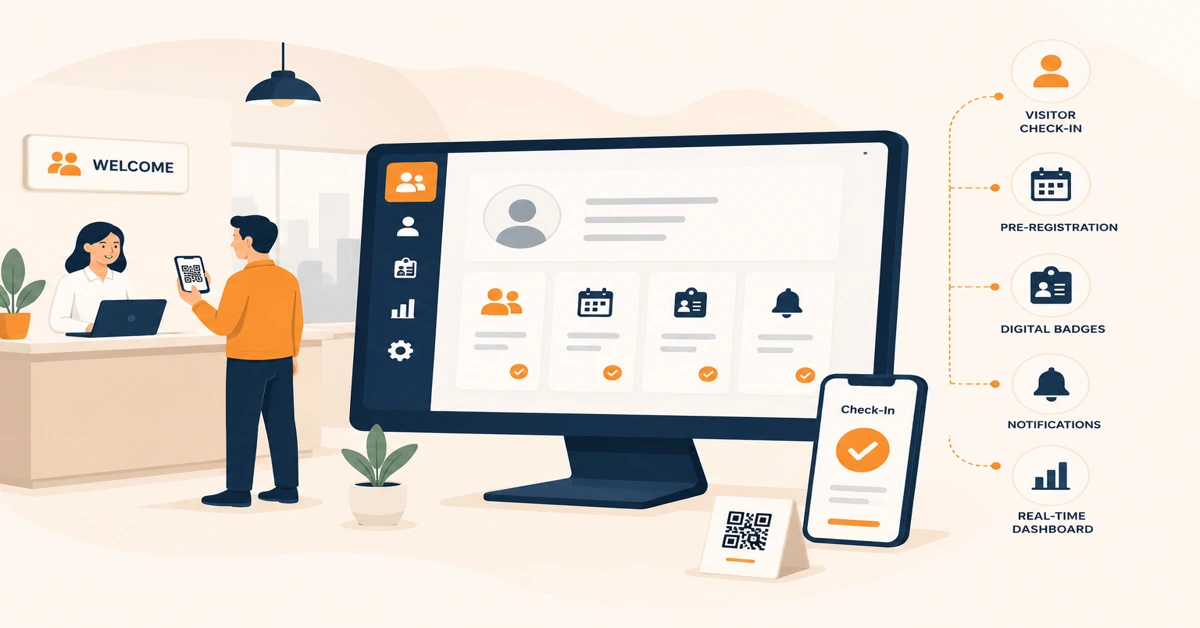
What it does: Replaces the paper sign-in book with a fully digital, touchless experience. Visitors pre-register online, receive a QR code, scan in at arrival, print a badge, and trigger automatic host notifications.
Why it matters: Your reception desk is the first impression of your brand. A digital visitor management system signals professionalism, reinforces security, and eliminates the risk of confidential visitor data sitting in an open logbook.
Key features to look for:
- Pre-registration and invite links
- Watchlist / blocklist screening
- NDA and document signing at check-in
- Photo capture and badge printing
- Multi-location support
- Audit trails for compliance
Vizitor’s Visitor Management System supports all of the above, including WhatsApp and SMS host notifications.
2. Meeting Room Booking System
What it does: Provides a real-time calendar of available meeting spaces, allows instant or advance booking, sends reminders, and automatically releases rooms if a meeting is abandoned (no-show detection).
Why it matters: Meeting room conflicts are among the top complaints in office environments. Double-bookings, “ghost meetings” where rooms sit empty, and the endless “has anyone seen a free room?” Slack thread, a room booking system eliminates all of it.
Key features to look for:
- Real-time availability display (calendar + floor map view)
- No-show auto-release
- Outlook and Google Calendar integration
- Capacity and amenity filters (AV, whiteboard, phone)
- Usage analytics
3. Space Management System
What it does: Tracks how physical space is being used across your office; which desks, floors, and zones are occupied vs. empty, and at what times.
Why it matters: With the US office vacancy rate at a historic 20.5% (Cushman & Wakefield, Q4 2025), most companies are already paying for space they don’t use. Space management data is the business case for smarter real estate decisions.
Key features to look for:
- Interactive floor plan with real-time occupancy
- Hot desking and desk hoteling tools
- Utilization heatmaps and trend reports
- Neighbouhood/team zone management
- Sensor integration (optional, for advanced tracking)
4. Attendance Management System
What it does: Automates employee check-in/check-out, tracks working hours, flags absences, and generates reports for payroll and HR teams.
Why it matters: Manual timesheets are error-prone and time-consuming for both employees and HR. An automated attendance system eliminates disputes, integrates with payroll, and gives managers real visibility into workforce patterns.
Key features to look for:
- Touchless check-in (QR code, mobile app)
- Shift and schedule management
- Leave integration
- Payroll-ready export formats
- Remote and hybrid attendance tracking
5. Mailroom Management Software
What it does: Logs incoming packages, notifies recipients instantly, tracks delivery status, and maintains a chain-of-custody log.
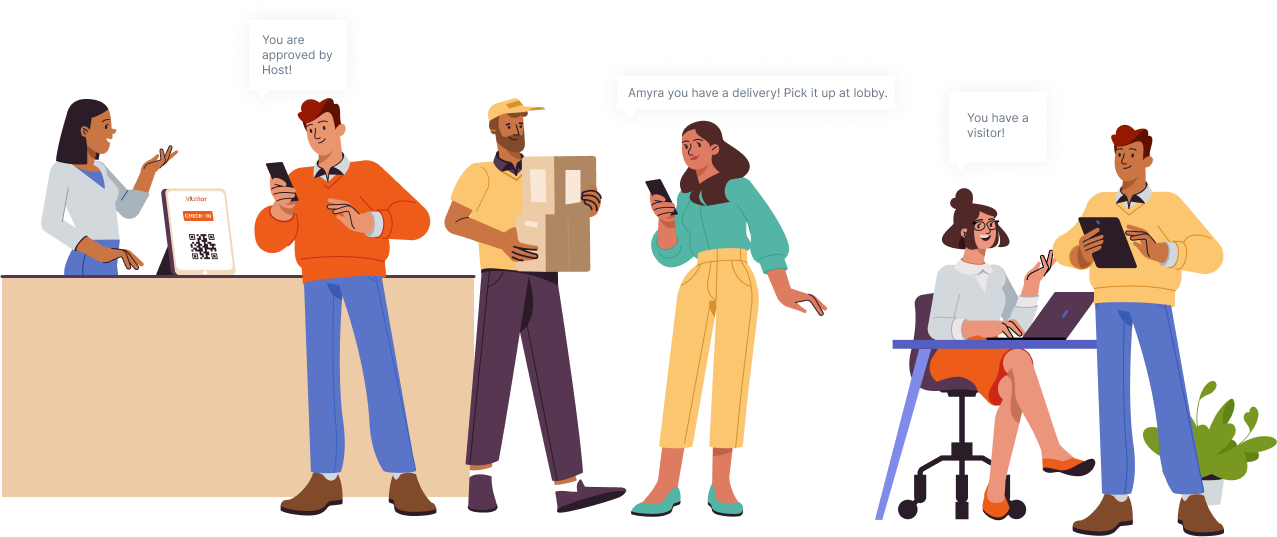
Why it matters: As employees increasingly ship personal and work packages to the office, mailrooms are overwhelmed. Unclaimed deliveries pile up, items get lost, and reception staff spend hours on manual tracking. A mailroom management system solves this in minutes, as this step-by-step mailroom management guide shows.
Key features to look for:
- Barcode / QR scanning on arrival
- Automated recipient notifications (email, SMS, WhatsApp)
- Photo capture at receipt
- Pickup confirmation and digital signatures
- Delivery analytics
6. Queue Management System
What it does: Organizes and manages waiting lines in high-traffic service areas, reception desks, HR counters, service centres, healthcare waiting rooms.
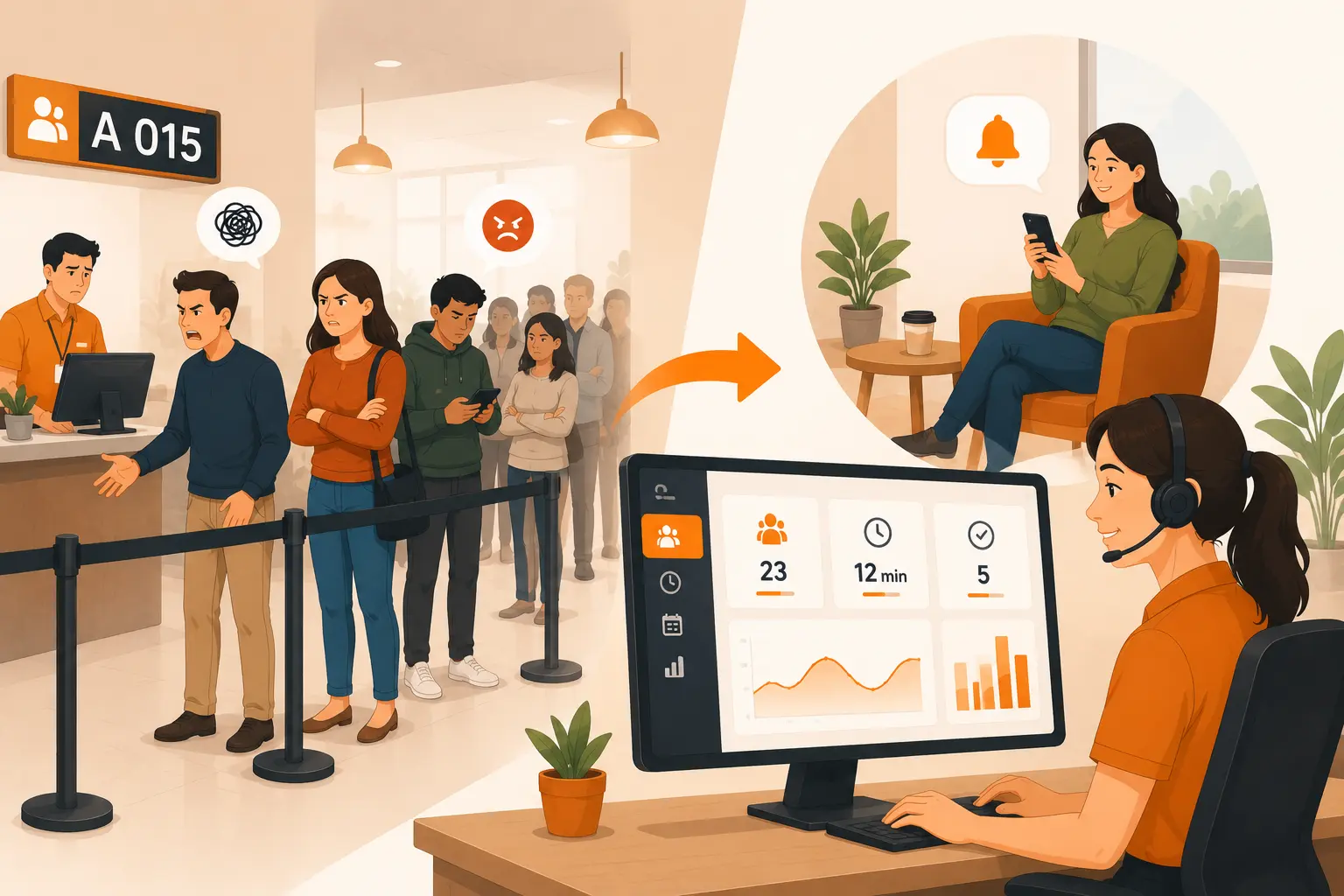
Why it matters: Nobody likes to wait, but disorganised waiting is even more frustrating. A digital queue system reduces perceived wait time, improves service flow, and gives managers data on peak service hours, which also matters for lobby management.
Key features to look for:
- Digital token issuance (kiosk, mobile, web)
- Real-time queue display
- Multi-counter support
- Wait time analytics
- SMS/screen notifications when it’s your turn
Core Benefits of a Workplace Management System
1. Enhanced Security and Compliance
A WMS replaces paper visitor logs and manual ID checks with digital workflows: pre-registration, photo capture, NDA sign-offs, watchlist screening, and auto-generated audit trails. For industries with compliance requirements, healthcare, finance, education, this isn’t optional. It’s essential.
GDPR note: Modern WMS platforms include data retention controls and consent management, helping you stay compliant with privacy regulations across regions.
2. Space Optimization and Cost Reduction
Real estate is typically an organization’s second-largest expense after payroll. With the US office vacancy rate at a record 20.5% (Cushman & Wakefield, Q4 2025), most companies are already paying for more space than they use. A WMS gives you live occupancy data which desks are booked, which rooms are used, which floors are ghost towns at 2 PM on Fridays. This data drives real decisions: downsizing underused floors, reconfiguring layouts, eliminating redundant reservations.
Organizations using comprehensive workplace management systems typically report a 30% reduction in real estate costs within 12–18 months of implementation.
3. Improved Employee Experience
Friction kills morale. When employees waste 15 minutes finding an available desk, show up to a double-booked room, or can’t locate a delivery, it signals that the organization doesn’t value their time. A WMS removes that friction. Employees book spaces in seconds, visitors check in without waiting, and packages are tracked the moment they arrive.
A Steelcase study found that employees with better control over their work environment are 88% more engaged, engagement that directly correlates with productivity and retention.
4. Data-Driven Workplace Strategy
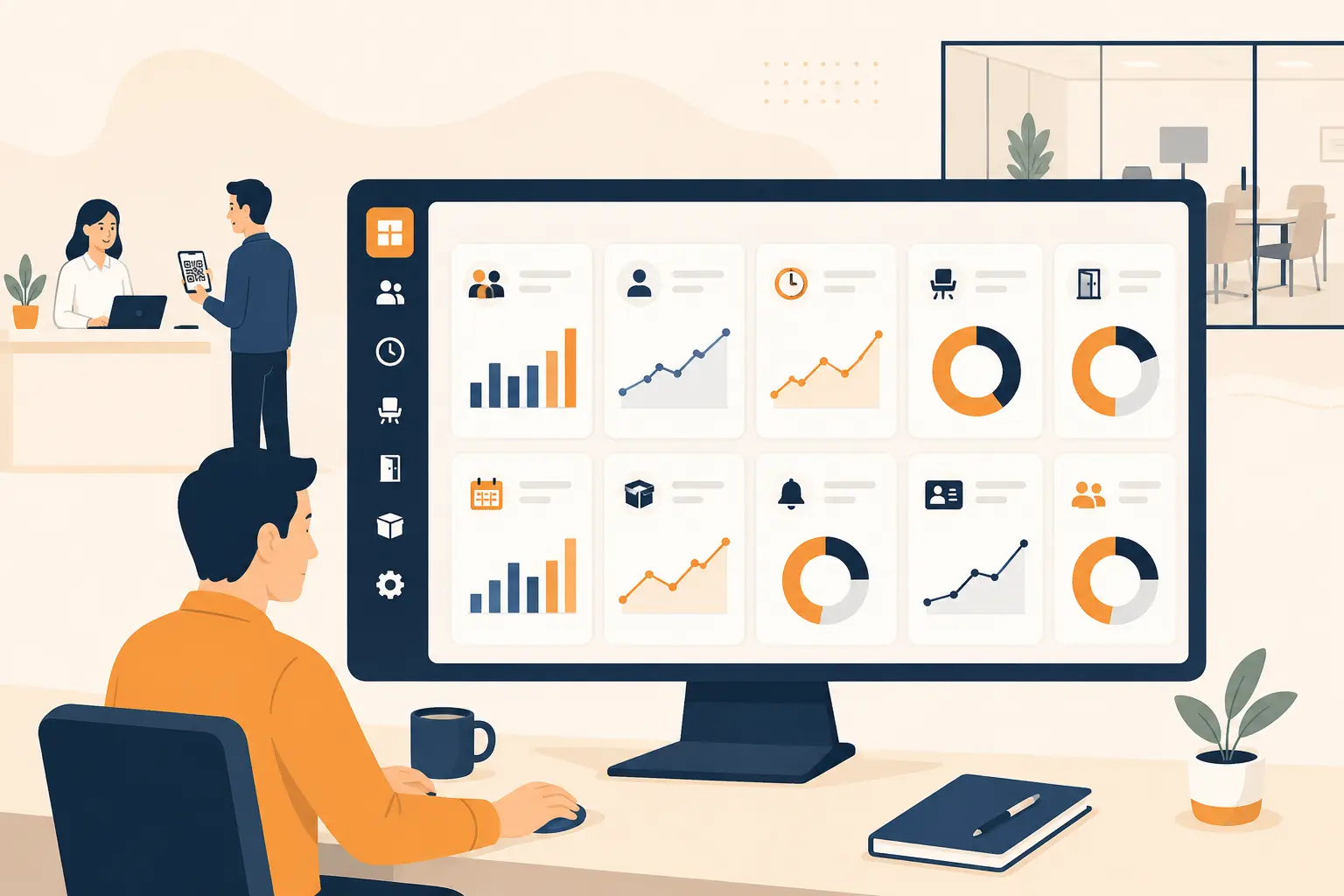
A WMS turns your office into a data source. Space utilization heatmaps, visitor traffic patterns, peak occupancy hours, meeting room usage rates, this is the intelligence workplace leaders need to make confident decisions about headcount, layout, and lease renewals. Without this data, you’re guessing.
5. Seamless Hybrid Work Support
With 52% of remote-capable employees working hybrid (Gallup, 2025) and 64% of employees saying their company operates on a hybrid model (Zoom, 2025), hot desking, desk hoteling, neighborhood booking, and remote check-in are no longer optional features, they’re baseline requirements. A WMS is built for the reality that not everyone comes to the office every day. Employees can see who’s coming in, book their preferred spot in advance, and coordinate with their team, all from a mobile app.
Before vs. After: What a WMS Actually Changes
| Scenario | Without WMS | With WMS |
|---|---|---|
| Visitor arrives | Paper logbook, manual host call | Pre-registered QR check-in, instant notification |
| Meeting room needed | Email chain, Outlook conflicts | One-click booking, no-show auto-release |
| Desk in hybrid office | Arrive and hope a desk is free | Book preferred desk the night before from mobile |
| Package delivered | Sitting unclaimed at reception | Recipient gets WhatsApp notification immediately |
| Attendance for payroll | Manual timesheets, reconciliation disputes | Auto-generated attendance report, payroll-ready |
| Compliance audit | Digging through paper logs | One-click audit trail export |
| Space utilisation | Gut feel and guesswork | Real-time heatmaps, occupancy trends |
| Security incident | No log of who was in the building | Time-stamped digital record of every visit |
Want to experience the ‘After’? Try Vizitor WMS today →
How to Choose the Right Workplace Management Software
With dozens of tools on the market, here’s a practical framework for evaluating your options:
Step 1: Audit Your Current Pain Points
Start by listing your top 3-5 workplace frustrations. Is it visitor chaos? Wasted meeting rooms? Payroll errors from manual attendance? Your biggest pain points should drive your feature prioritisation not a vendor’s feature checklist.
Step 2: Define Your Workplace Model
Are you fully in-office, hybrid, or managing multiple locations? Your workplace model determines which modules are essential. Multi-location companies need centralised dashboards and role-based access controls.
Step 3: Evaluate Integration Compatibility
A WMS that doesn’t talk to your existing tools creates new silos. Before committing, verify integrations with:
- Your calendar platform (Google Workspace or Microsoft 365)
- HR and payroll systems
- Customizations
Step 4: Prioritise User Adoption
The best WMS in the world fails if employees don’t use it. Look for platforms with intuitive mobile apps, minimal training requirements, and setup times measured in minutes not months.
Step 5: Check Security and Compliance Standards
Confirm the platform offers encrypted data storage, GDPR-compliant data handling, configurable retention policies, and audit logs. If you operate in regulated industries, ask specifically about VAPT, ISO 27001, AES 256.
Step 6: Start With a Free Trial
No demo can replace hands-on experience. Most modern WMS platforms offer free trials, use them. Involve a cross-functional team (HR, IT, facilities, a few end-users) in the evaluation to get diverse feedback.
The ROI of a Workplace Management System
Justifying the investment is easier when you know what to measure:
| ROI Dimension | Typical Impact |
|---|---|
| Space cost reduction | 20-30% through right-sizing and utilisation data |
| Admin time saved | Up to 40% reduction in manual reception and HR tasks |
| Meeting room efficiency | 25-35% improvement in room utilisation rates |
| Visitor experience | Check-in time reduced from 5-8 minutes to under 60 seconds |
| Employee satisfaction | Measurable lift in eNPS for companies with strong workplace tech |
| Compliance risk reduction | Near-zero audit-trail gaps vs. paper-based systems |
For a 200-person office, even a conservative 15% reduction in wasted space and 30 minutes/day saved per admin team member typically results in ROI within 6 months of implementation.
Conclusion: Your Office Deserves a System That Works as Hard as Your Team
A workplace management system isn’t overhead, it’s infrastructure. The organisations winning on employee experience, operational efficiency, and cost management in 2026 are the ones that have replaced guesswork with data, manual processes with automation, and fragmented tools with unified platforms.
Whether you’re managing a 30-person startup office or a 5,000-seat corporate campus, the right WMS makes your space work smarter, your team feel supported, and your leadership team confident in every space decision they make.
Ready to see what a modern workplace management system looks like in action? [](/signup/)
Start your free Vizitor trial.
No credit card required. Setup in under 5 minutes.
Frequently Asked Questions
A workplace management system (WMS) is an integrated software platform that automates and connects core office operations including visitor check-in, room booking, desk reservation, attendance tracking, mailroom management, and space management into a single, centralised tool.
Any organization with a physical workspace can benefit from a WMS, including corporate offices, hospitals, schools, co-working spaces, and government facilities. Whether you manage 20 employees or 2,000, a WMS can scale to meet your needs.
Key modules typically include: * Visitor Management * Meeting Room Booking * Space Management * Mailroom Management Software * Attendance Tracking * Queue Management These components work together to simplify operations and enhance employee experience.
A WMS reduces friction in everyday tasks like booking desks or checking in guests. This saves employees time and enhances workplace satisfaction by allowing them to focus on their core responsibilities rather than logistics.
Yes. Most modern WMS platforms offer enterprise-grade security features, such as: * Encrypted data storage * Access control systems * Audit trails and logs * Secure visitor and delivery tracking These measures help protect sensitive information and ensure compliance.
Absolutely. WMS systems are built to support hot desking, hoteling, remote coordination, and space usage analysis making them perfect for today’s evolving workplace models.
A well-implemented WMS can lead to: * Up to 30% reduction in space-related costs * 25% boost in employee productivity * Better decision-making with real-time workplace data * Enhanced employee engagement and retention
Yes. The best WMS solutions integrate smooth with: * HR systems * Payroll and attendance software * Calendar apps (Google, Outlook) * Whatsapp * Access control systems\ This avoids data silos and ensures smooth operations.
Start by: 1. Identifying your workplace challenges 2. Prioritizing features (e.g. visitor management, space tracking) 3. Evaluating usability and scalability 4. Looking for integration options 5. Ensuring strong support and data security Try a few demos or trials, like [Vizitor’s Workplace Management System](/) to see what fits best.
Yes! WMS platforms like Vizitor are scalable and user-friendly, making them perfect for small to medium-sized enterprises that want to grow efficiently and professionally.
See Vizitor in action check-in a visitor in under 30 seconds
Trusted by 500+ businesses. QR check-in, badge printing, NDA signing. Plans from $36/mo.