20 Proven Strategies for Enhancing Customer Experience



Table of Content
Try Vizitor for Free!
The first impression your visitors form of your organization happens before they sit down in a conference room or speak to anyone meaningful.
It happens at reception.
How long did they wait? Did someone acknowledge them? Was the check-in process frustrating or fast? Did they feel watched, or welcomed? These early moments set the emotional tone for everything that follows. A visitor who arrives at a well-run, digitally managed front desk is already predisposed to view your organization positively. A visitor who waited 10 minutes to write their name in a paper logbook while the receptionist searched for someone to call is starting the meeting with residual friction.
Visitor flow management and digital check-in are not back-office operational upgrades. They are direct inputs to customer experience. This guide covers 20 specific strategies for improving that experience, all connected to how visitors move through your organization and interact with your reception and check-in processes.
Why Visitor Flow Management Is a Customer Experience Function
Most organizations treat visitor management as a security or compliance function. Sign everyone in, verify who they are, issue a badge, maintain a record. Done.
That framing misses the value.
A visitor management system that is well-implemented does all of the above and also:
- Creates a positive, branded first impression
- Reduces wait anxiety through real-time status updates
- Delivers personalized greetings that make visitors feel expected rather than random
- Captures data that enables continuous improvement of the visit experience
- Automates host notification so visitors are never left waiting unnecessarily
These are customer experience functions. They directly affect how visitors feel about your organization, and that feeling influences purchasing decisions, retention, and referrals.
The 20 strategies below address every stage of the visitor journey: before arrival, at the front desk, during the visit, and after departure.
Before Arrival: Setting the Stage
1. Send Pre-Registration Invites
The visitor experience starts with the invitation. A pre-registration invite sent before the visit allows guests to complete their information, sign any required documents, and receive directions and arrival instructions in advance.
This has two effects. Practically, it reduces check-in time at reception from several minutes to under 30 seconds. Experientially, it signals to the visitor that you expected them and prepared for their arrival.
Pre-registration invites can be sent automatically when a host creates a meeting in your calendar system. Visitors click a link, complete their details on their phone or computer, and arrive ready to check in with a QR code.
Compare this to the alternative: a visitor arrives with no prior contact from reception, fills out a paper form at the desk, waits while someone calls to find the host, and stands in the lobby for five minutes. The difference in experience is significant, and all of it comes from whether you sent that pre-registration link.
2. Provide Clear Arrival Information
Parking instructions, entrance location, which door to use, whether to call ahead, what to bring. These details reduce arrival stress enormously.
Visitors who arrive anxious about where to park or which entrance to use carry that stress into the meeting. Visitors who received clear, comprehensive arrival information arrive calm and focused.
Include arrival information in the pre-registration email. Keep it specific to your actual location, not generic directions that leave visitors guessing once they’re in your car park.
3. Set Visit Expectations in Advance
For meetings with significant agenda, briefing visitors in advance on what to expect signals preparation and respect for their time. A short note in the pre-registration email covering the meeting format, who they’ll meet, how long it will take, and what they need to bring removes uncertainty.
Uncertainty is the enemy of a good first impression. Remove as much of it as possible before they arrive.
4. Collect Required Documents Before the Visit
NDAs, confidentiality agreements, health declarations, and access authorization forms are standard requirements in many organizations. Collecting these at the front desk is slow, creates paper waste, and forces visitors to read and sign documents before they’ve even sat down.
Pre-registration enables digital document signing in advance. By the time the visitor arrives, all required documents are signed and stored. The check-in process covers identity verification only, and the visitor is through the door in seconds.
At the Front Desk: The Critical First Moments
5. Eliminate Paper Sign-In Books
A paper sign-in book at a reception desk communicates to visitors that your organization hasn’t updated its processes since 1995. Practically, it creates unsecured personal data visible to every subsequent visitor, provides no notification capability, and generates records that are useless for analysis.
Digital check-in via a tablet kiosk captures the same information securely, triggers host notification automatically, prints a visitor badge, and stores the record in a searchable database. The experience for the visitor is faster, more professional, and more secure.
6. Enable Touchless Check-In
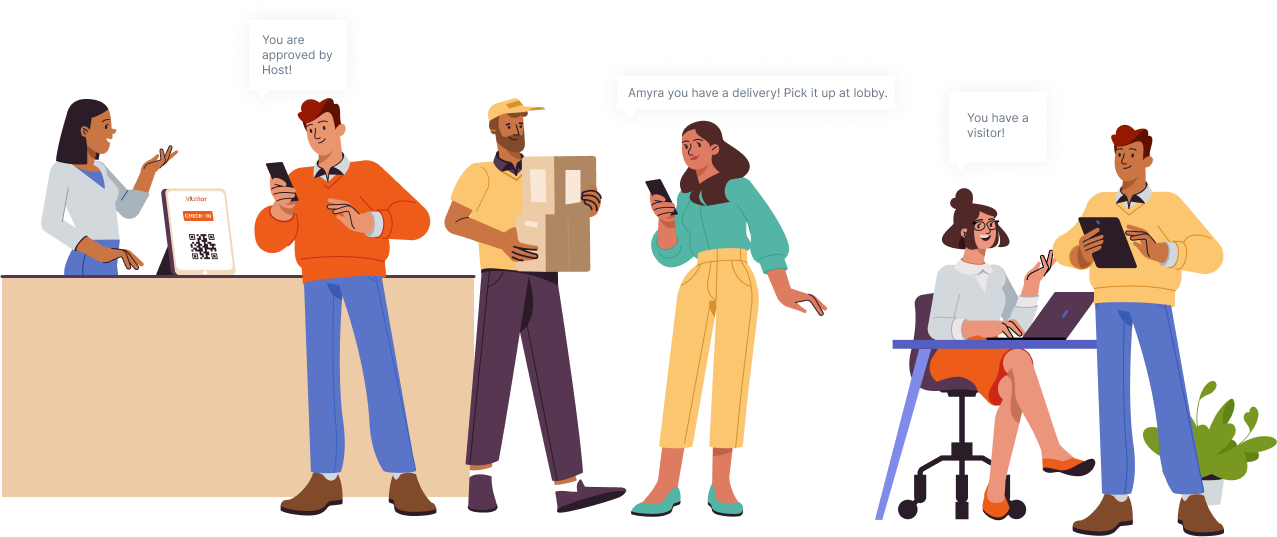
Touchless check-in allows visitors to complete the entire process on their own device via a QR code. No shared touchscreen, no physical forms, no contact with reception staff unless needed.
Beyond the hygiene benefit, touchless check-in is faster for high-volume reception environments. When multiple visitors arrive simultaneously, the self-directed touchless process prevents bottlenecks at a shared kiosk. Each visitor processes independently and in parallel.
7. Personalize the Greeting
A system that recognizes returning visitors and surfaces their name and previous visit history to the receptionist enables a genuinely personalized welcome. “Good morning, Mr. Chen, welcome back. James is expecting you” is a categorically different experience from “Can I take your name?”
This isn’t about performance. Visitors who are recognized feel that their relationship with the organization is remembered and valued. That feeling persists through the rest of the visit and influences how they remember the overall interaction.
8. Automate Host Notification
The most common source of lobby wait time is the delay between a visitor arriving and their host being notified. Receptionists get busy, calls go unanswered, and visitors stand in the lobby wondering if anyone knows they’re there.
Automated host notification, triggered the moment a visitor completes check-in, eliminates this delay. The host receives an SMS or app notification with the visitor’s name, arrival time, and purpose of visit. They respond or dispatch someone to collect the visitor immediately.
The visitor experiences zero perceptible wait caused by the notification process. Any remaining wait is the host’s travel time from their desk to reception, which is unavoidable. But they know they’ve been acknowledged.
9. Issue Professional Visitor Badges
A printed visitor badge with the visitor’s name, photo, host name, visit date, and company branding serves a practical security function and also communicates organization. Visitors who wear a professional badge feel formally welcomed. Staff who see a clearly badged visitor feel confident about who is on site.
Visitor badges can also carry additional information, such as WiFi credentials or building access level, reducing the number of separate interactions needed during check-in.
10. Provide WiFi Access Without Friction
Visitors who need internet access during their visit typically have to ask for the WiFi password, then re-ask after forgetting it, then ask again when their phone disconnects. This is a small but persistent friction point.
Print WiFi credentials on the visitor badge, or include them in the pre-arrival email. Removing this friction is a micro-improvement that, combined with everything else, contributes to a smoother overall experience.
See how Vizitor handles visitor flow and check-in
Join 2,000+ workplaces using Vizitor to improve first impressions and reduce wait times. Free trial, no credit card required.
Book a DemoDuring the Visit: Keeping the Experience Smooth
11. Respect Visitor Time at Every Stage
When a visitor arrives, notify the host immediately. When the host is delayed, communicate that to the visitor with an update. Do not leave visitors in the lobby with no information.
The principle is that visitors should never be uncertain about what is happening. They should always have a status: their host is on the way, their host will be 5 minutes, please take a seat in the waiting area. Uncertainty is the source of frustration, not the wait itself.
12. Maintain a Clean, Well-Organized Reception Area
Reception communicates organizational standards before any meeting begins. A cluttered, poorly maintained lobby suggests that the organization is disorganized in other ways too.
This doesn’t require expensive redesign. It requires maintenance: no packages stacked by the door, no outdated brochures on the table, no broken furniture, clean floors, adequate lighting. These are basic signals that the organization is run well.
Digital visitor management contributes here by eliminating the physical clutter associated with paper-based check-in: the sign-in books, the printed visitor badges scattered across the desk, the filing of paper records.
13. Handle Belongings and Logistics Professionally
Visitors arriving with coats, bags, or equipment should be directed to a secure spot. This keeps reception tidy, prevents accidents, and signals that you anticipated their practical needs.
A brief verbal acknowledgment, “Can I take your coat?” or “You’re welcome to leave your bag here at reception,” is a low-cost gesture that communicates attentiveness.
14. Offer Refreshments During Waits
Any wait, even a short one, is improved by the offer of water, coffee, or tea. The gesture communicates hospitality and redirects the visitor’s attention from the wait itself to the interaction with your staff.
This doesn’t need to be elaborate. A self-service water station or a brief offer from the receptionist is sufficient. The symbolism matters more than the provision.
15. Prepare Meeting Rooms in Advance
Visitors who are shown to a conference room that is already set up, with the right technology connected and working, receive a signal about operational competence. Visitors who wait while someone finds the right cable or figures out the screen share process get the opposite signal.
Meeting room booking integrated with visitor management ensures that rooms are reserved, prepared, and ready before the visitor arrives. The host knows which room they’re in. Reception knows which room to direct visitors to. There is no last-minute scramble.
16. Use the Visit to Demonstrate Relevant Work
For professional services firms, agencies, and B2B businesses, the visit is an opportunity to show what you do. A brief walk past a relevant project display, a reference to a case study visible on the wall, or a comment that connects something you’re working on to the visitor’s known interests is a natural and effective sales tool.
This requires preparation: knowing who is visiting, what they care about, and what in your environment is most relevant to them. Visitor management data supports this by surfacing the visitor’s previous visit history and the purpose of the current visit.
After the Visit: Turning Interactions into Intelligence
17. Send a Follow-Up and Gather Feedback
A brief follow-up message after the visit serves two purposes. It closes the interaction professionally, reinforcing the positive impression from the visit. And it creates an opportunity to gather structured feedback on the experience.
A two-question survey, “How would you rate the arrival experience?” and “Is there anything we could have done better?", takes less than 30 seconds for the visitor to complete and provides data you can actually act on.
Without follow-up feedback collection, you’re improving the visitor experience based on staff observation alone. With systematic feedback data, you can identify specific friction points, track improvement over time, and demonstrate to leadership that visitor experience is being actively managed.
18. Track NPS for Visitor Experience Specifically
Net Promoter Score is typically measured at the product or relationship level. But visitor experience NPS, measuring specifically how likely a visitor is to recommend visiting your office as a positive experience, is a useful leading indicator of broader relationship health.
Visitors who rate the arrival and lobby experience highly are more likely to view the overall business relationship positively. Tracking this separately from product NPS allows you to identify cases where a strong relationship is being undermined by a poor physical visit experience, or vice versa.
19. Use Visit Data to Identify Your Most Important Relationships
Visit frequency and recency data from your visitor management system shows you which relationships are most active. Which clients visit most often? Which prospects have toured your facility and not yet converted? Which partners attend your events consistently?
This data is useful for CRM and account management. A client who visited six times last year and has not visited in three months may be disengaging. A prospect who has visited twice is warmer than one who has never been to your office. The data tells you something that call logs and email activity alone cannot.
20. Continuously Improve Based on Analytics
The visitor experience is not a one-time project. It’s an ongoing operational function that should improve over time based on data.
Monthly review of visitor analytics should cover: average check-in time, host notification response time, lobby wait time, visitor feedback scores, and documentation completion rates for pre-registered vs. walk-in visitors.
These metrics tell you where the process is working and where it’s creating friction. Improvements informed by this data compound over time. A front desk that systematically reviews and improves its visitor experience every month will look dramatically different in two years than one that set up a system and left it running.
For a broader look at how technology supports each stage of the visitor journey, see the guide to creating an effortless visitor experience with technology. For implementation detail on the underlying system, the complete guide to visitor management systems covers all the key decision points.
The Compounding Effect of Getting This Right
Each of these 20 strategies improves the visitor experience by a measurable amount. But the more important point is that they compound.
A visitor who received a pre-registration invite, arrived with clear directions, checked in in under 30 seconds, was greeted by name, and found their host waiting for them has experienced a sequence of small positives. Each one reinforces the impression that your organization is competent, prepared, and respectful of their time.
That impression is the foundation of a business relationship. It influences the visitor’s confidence in your ability to deliver on commitments, their willingness to refer others, and their likelihood of returning. It’s created not by a single grand gesture, but by many small operational decisions that prioritize the visitor’s experience from first contact to final departure.
FAQ
What is visitor flow management?
Visitor flow management covers the systems and processes that organize how visitors enter, move through, and exit your premises. It includes pre-registration, digital check-in, host notification, badge issuance, and visit record-keeping. When done well, it makes every stage of the visit faster, more professional, and more secure.
How does digital check-in improve customer experience?
Digital check-in eliminates the friction of paper forms and manual processes at reception. Visitors complete check-in in seconds, receive professional badges, and are matched to their host automatically. The experience communicates organizational competence from the first moment of the visit.
What is pre-registration and why does it matter?
Pre-registration allows visitors to complete check-in information, sign required documents, and receive arrival instructions before they arrive. It reduces front-desk processing time to under 30 seconds, eliminates paper document collection, and signals to visitors that they were expected and prepared for.
How do I measure the quality of my visitor experience?
Track these metrics: average check-in processing time, host notification response time, lobby wait time, visitor feedback scores from post-visit surveys, and pre-registration completion rates. Reviewing these monthly reveals patterns and informs specific improvements.
Can visitor management data improve sales and account management?
Yes. Visit frequency, recency, and purpose data shows which client and prospect relationships are most active. This information complements CRM data and helps account managers prioritize outreach and identify relationships that may be disengaging.
How much does a visitor management system cost?
Vizitor starts at $20 per month with a free trial and no credit card required. For most organizations, the combination of staff time saved at reception, improved security and compliance, and demonstrable improvement in visitor experience metrics makes the ROI straightforward to calculate.
Try Vizitor Free
No credit card required. Setup in under 5 minutes. Manage visitors, queues, meeting rooms, and more.
Start Free TrialSee Vizitor in action check-in a visitor in under 30 seconds
Trusted by 500+ businesses. QR check-in, badge printing, NDA signing. Plans from $36/mo.