Screenshot

Employer of Record vs Local Entity: Which Is Best for Global Expansion?

By Lori Naranjo.

linkedin whatapp
Try Vizitor for Free!
Employer of Record vs Local Entity: Which Is Best for Global Expansion?

Published on: Tue, Mar 3, 2026

Read in 4 minutes

Scaling Your Startup Globally: When to Use an Employer of Record vs. Opening a Local Entity

Country borders that once limited the potential growth of a startup have largely disappeared due to modern changes in the business world.

Global expansion is now a realistic goal for startups of all sizes. Founders can access top-tier talent worldwide and build remote teams across continents. However, maintaining compliance while fostering a productive and engaged workforce requires choosing the right structural approach.

Should you use an Employer of Record (EOR), or open a local entity?


1. The Global Growth Decision Every Startup Faces

Modern startups no longer need to wait for physical expansion to reach international markets. Digitalization allows even small teams to:

  • Reach customers globally
  • Hire remote talent across multiple countries
  • Access specialized skills worldwide

While this provides a significant competitive advantage, hiring abroad also introduces complex legal and compliance challenges.

The core question becomes:

Should you use an EOR or open a local entity — and how will that decision impact your global workforce management strategy?


2. What It Means to Open a Local Entity

Opening a local entity means establishing a formal subsidiary in a foreign country.

This typically requires:

  • Registering with local government authorities
  • Tax department registration
  • Opening a local bank account
  • Appointing a resident director
  • Ongoing tax and labor law compliance filings

Setting up an entity often takes several months and requires substantial upfront investment in legal, accounting, and administrative costs.


3. What Is an Employer of Record (EOR)?

An Employer of Record (EOR) is a third-party service provider that legally employs workers on your company’s behalf.

With an EOR:

  • The EOR becomes the legal employer
  • You manage day-to-day work and performance
  • Payroll, tax withholding, and compliance are handled for you
  • Employment contracts comply with local labor laws

This model allows startups to hire internationally without creating a legal entity.

EORs are increasingly popular because they enable rapid, low-risk international hiring.


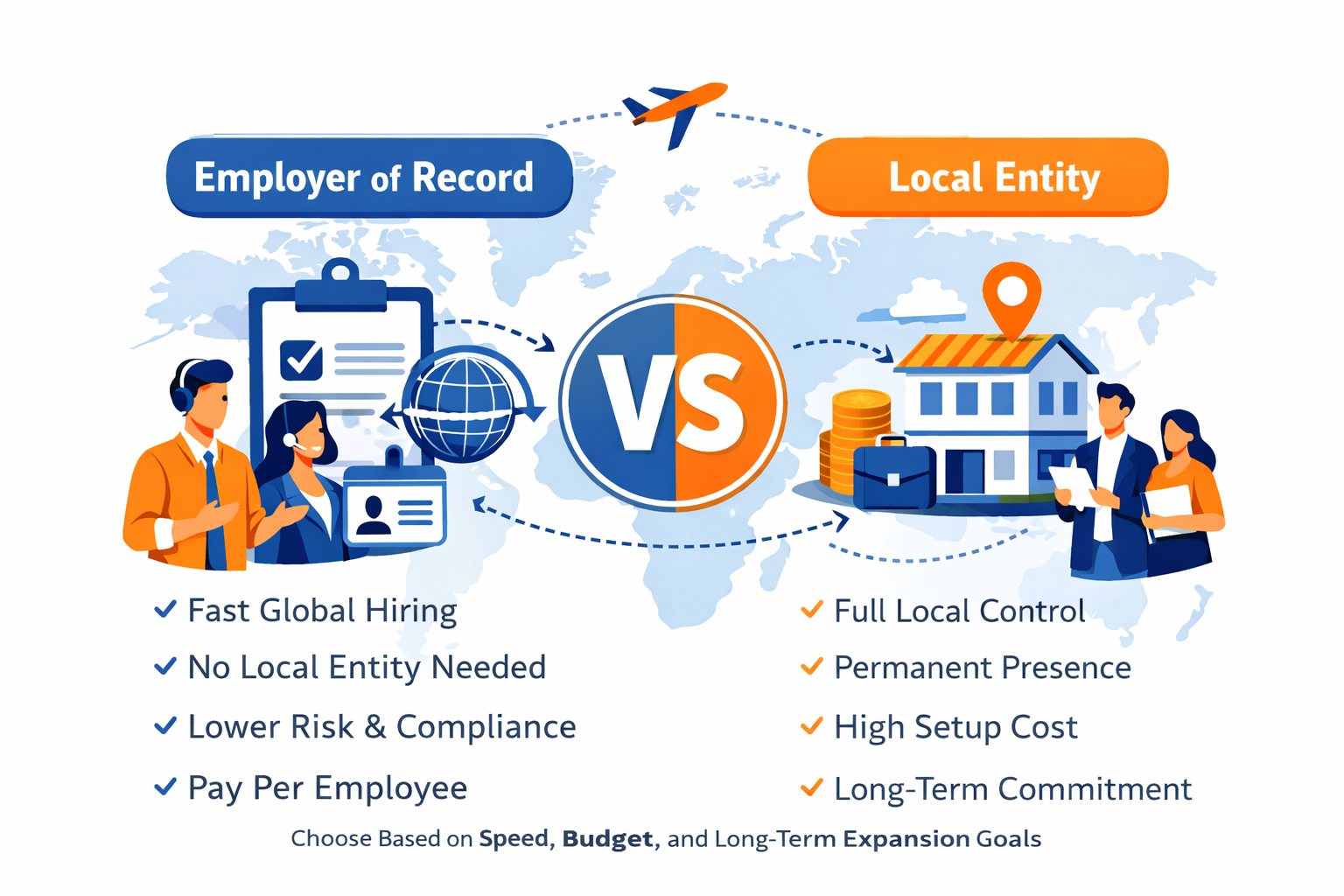
4. Comparing the Two Approaches: Entity vs. EOR

A. Speed of Market Entry

  • Local Entity: Slow setup with bureaucratic processes
  • EOR: Hire employees in days

B. Cost Structure

  • Local Entity: High incorporation costs + ongoing accounting/legal fees
  • EOR: Predictable monthly cost per employee

C. Risk and Compliance

  • Local Entity: Direct responsibility for labor law compliance
  • EOR: Reduced risk through expert compliance management

D. Scalability

EORs allow startups to test new markets without long-term commitments or heavy infrastructure investments.


5. When Should Startups Use an EOR?

An EOR is ideal when:

  • Hiring 1–2 employees in a new country
  • Expanding into multiple countries simultaneously
  • Avoiding fixed setup costs
  • Needing fast, compliant hiring
  • Testing new markets

For early-stage startups focused on agility, EORs provide flexibility and speed.


6. When Opening a Local Entity Makes More Sense

Opening a local entity is more suitable when:

  • Building a large, permanent team in one country
  • Planning long-term investment in a specific market
  • Operating in highly regulated industries
  • Investors require a formal local presence
  • Full operational control is necessary

However, founders must be ready to manage the administrative complexity.


7. Evaluating EOR Providers: What to Look For

When selecting an EOR partner, consider:

  • Global coverage in target markets
  • Deep compliance expertise
  • Transparent pricing structure
  • Strong payroll automation
  • Detailed reporting capabilities
  • Seamless employee experience

Many founders compare different providers to optimize cost and flexibility before making a decision.


8. Hybrid Approach: Start with an EOR, Transition Later

Many startups adopt a hybrid strategy:

  1. Use an EOR to enter a market quickly
  2. Validate market demand
  3. Transition to a local entity once headcount grows

This approach minimizes upfront risk while preserving long-term scalability.


9. Best Practices for Global Expansion Planning

Before expanding internationally:

  • Research country-specific labor laws
  • Forecast long-term hiring needs
  • Align HR, legal, and finance teams
  • Build scalable global payroll systems
  • Plan for compliance from day one

Strategic preparation reduces risk and ensures smoother global operations.


10. Conclusion: Choosing the Right Model for Your Startup

There is no universal solution.

  • EORs provide speed, flexibility, and lower initial risk.
  • Local entities offer greater control and long-term infrastructure.

The right choice depends on:

  • Budget
  • Growth stage
  • Hiring volume
  • Risk tolerance
  • Long-term expansion goals

Strategic global expansion requires balancing speed, compliance, cost, and future scalability.


Final Thought:
Start lean, expand smart, and build the infrastructure that matches your current growth stage.