Startups Choosing Between an Employer of Record and a Local Entity
This article compares Employer of Record (EOR) services against opening a local entity for startups expanding globally, covering cost, compliance, hiring speed, and headcount thresholds. It also explains how to transition employees from an EOR to a local entity and how attendance tracking works independently of the EOR relationship.


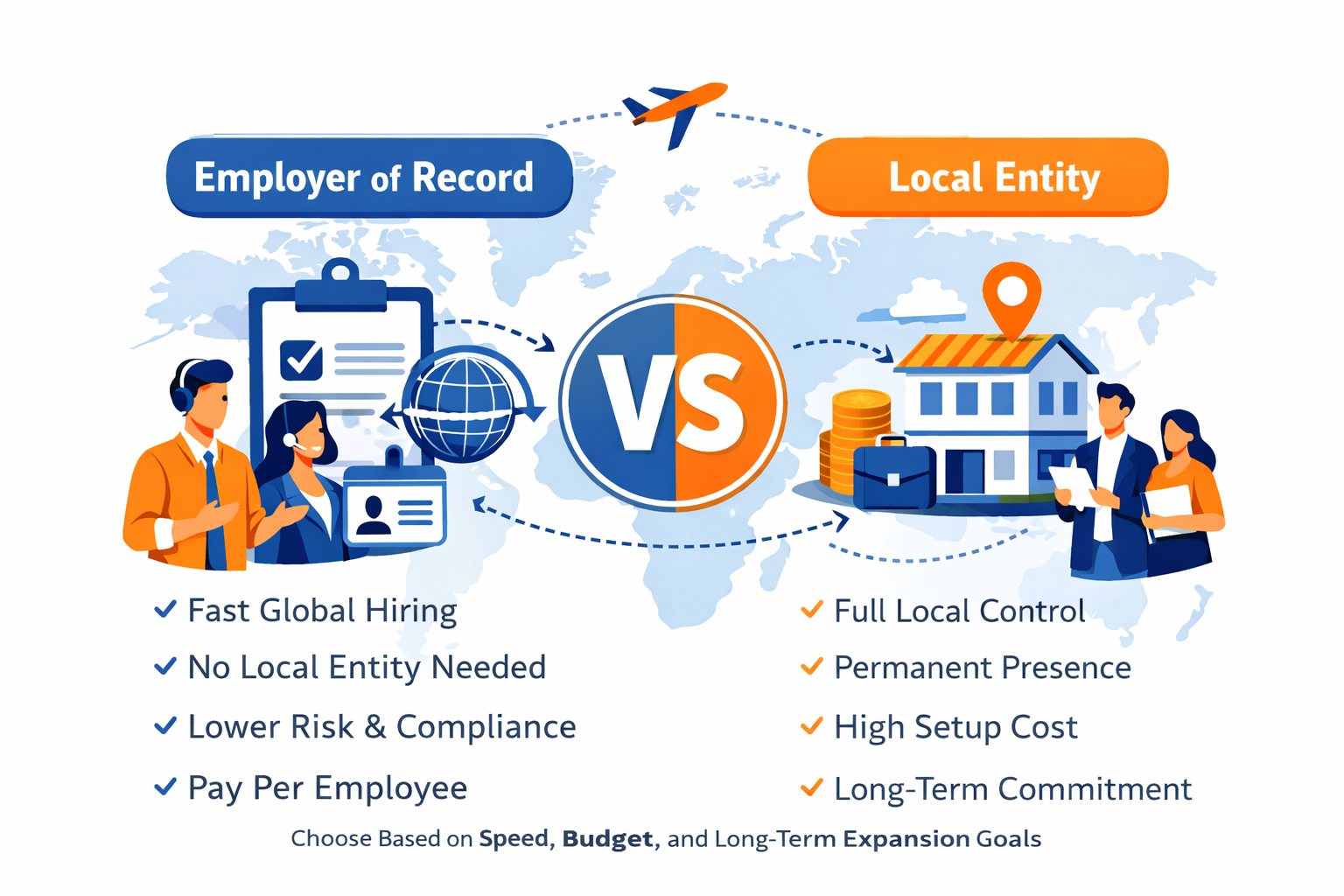
Table of Content
Try Vizitor for Free!
Country borders that once limited startup growth have largely ceased to be the barrier they once were. Founders with a compelling product and a functioning internet connection can now hire talent from any continent, serve customers across time zones, and scale operations without waiting until they can afford a physical office in every target market.
But global expansion creates a structural decision that many startups face too late, often after they have already hired their first international employee without a proper legal framework. The question is whether to use an Employer of Record (EOR) or open a local entity in the target country. The answer depends on your headcount, your timeline, your risk tolerance, and your long-term commitment to each market.
This guide breaks down both approaches, compares them across the dimensions that matter to early-stage and growth-stage companies, and covers the workforce management considerations that apply once you have made your choice.
1. The Global Growth Decision Every Startup Faces
Digitalization has made global hiring accessible to organizations that would have been constrained to local talent pools a decade ago. Even small teams can reach customers and hire specialists across continents. A software company in Europe can employ an engineering team in India, a sales lead in the US, and a customer success manager in Australia without any of those employees being in the same room.
This creates real competitive advantages. Access to specialized skills at different compensation levels, coverage across time zones, and the ability to hire the best person for a role regardless of their location are genuine operational benefits.
However, employing someone in a foreign country triggers local labor law obligations. Every country has its own employment contracts, payroll tax structures, social security requirements, termination rules, mandatory benefits, and compliance filings. Handling this complexity is the central challenge of global expansion, and the choice between an EOR and a local entity is fundamentally a choice about how you manage that complexity.
2. What It Means to Open a Local Entity
Opening a local entity means establishing a formal subsidiary or branch within a specific foreign country. This is the traditional approach to operating in a new market: become a recognized legal entity under that country’s corporate law and employ workers directly through that entity.
What the process involves:
- Registering officially with local government authorities, tax departments, and corporate registries
- Opening a local bank account and appointing a resident director in jurisdictions that require one
- Setting up local payroll processing, social security contributions, and tax withholding
- Complying with ongoing corporate filings: annual reports, tax returns, labor law documentation
- Maintaining registered office address and meeting other operational presence requirements
The timeline and cost:
Entity formation typically takes between one and six months depending on the jurisdiction. Upfront legal and administrative costs commonly range from $5,000 to $25,000 or more, varying substantially by country. Ongoing maintenance costs include local accounting, legal counsel, payroll processing, and compliance filings. For most countries, annual maintenance costs for a simple subsidiary run $10,000 to $30,000 before any employee compensation.
What an entity gives you:
Full operational control over your local presence. Complete flexibility on how you structure employment contracts. The ability to build a local brand identity. Eligibility for certain local government programs, contracts, and incentives that require a registered local entity.
3. What Is an Employer of Record (EOR)?
An Employer of Record is a service provider that legally employs workers on behalf of another company. The EOR is the legal employer of record in the target country. Your company directs the day-to-day work of those employees, but the EOR handles all the legal and administrative aspects of employing them under local law.
What the EOR handles:
- Drafting and maintaining locally compliant employment contracts
- Running payroll with correct local tax withholdings and social contributions
- Administering mandatory benefits including health insurance, pension, and paid leave
- Filing all required employment-related tax reports with local authorities
- Managing compliance with local labor regulations including termination procedures
What you handle:
- Selecting the employees and directing their work
- Setting compensation and role responsibilities
- Managing performance and day-to-day operations
The timeline and cost:
An EOR can have an employee set up and legally employed in a new country within days to a few weeks, compared to months for entity formation. EOR pricing is typically a monthly fee per employee, commonly ranging from $500 to $1,500 per employee per month depending on the country and provider. This makes costs predictable and directly tied to headcount rather than incurred regardless of whether you are actively hiring.
4. Comparing the Two Approaches
Speed of Market Entry
Entity formation is slow. Bureaucratic processing times, notarization requirements, and sequential dependencies in the registration process mean that months can pass between the decision to enter a market and the ability to legally employ someone there.
An EOR compresses this to weeks or days. If you have identified a candidate and want to move quickly, an EOR enables you to make a compliant job offer before a competitor does.
Cost Structure
Entities require high upfront incorporation costs and carry ongoing fixed maintenance expenses that persist whether you have five employees or zero. If you are testing a market with two hires and the market does not develop as expected, you have still spent on legal fees, registration costs, and annual compliance filings.
EOR costs are variable and headcount-tied. You pay per active employee. If a hire does not work out, you are not left with a legal entity that costs money to maintain and potentially more money to wind down.
Risk and Compliance Exposure
Managing employment law compliance in a foreign jurisdiction independently requires either deep local expertise on your team or ongoing legal counsel in each country. Labor law violations carry financial penalties, and in some jurisdictions, personal liability for company directors.
EOR providers specialize in exactly this compliance expertise. Their core value proposition is absorbing the risk of local employment law complexity so you do not have to develop that expertise in-house. A reputable EOR stays current on regulatory changes and updates employment contracts and payroll calculations accordingly.
Control and Flexibility
Local entities provide more operational control: over how benefits are structured, how the employment relationship is defined, and how the local team is organized. There is no intermediary in the employment relationship.
EOR arrangements introduce a layer between the employer and the local employee. For most operational purposes this is invisible, but in some situations, including complex severance negotiations or highly customized compensation structures, it can create friction.
Scalability and Market Testing
An EOR is the ideal vehicle for testing a market before committing to a permanent presence. You can hire one or two employees, evaluate the opportunity, and either scale through the EOR or transition to a local entity once the market is validated and headcount justifies the investment.
Manage your global workforce attendance with Vizitor
Whether your team is local or global, Vizitor's attendance management system gives you real-time visibility, payroll-ready exports, and compliance documentation. Free trial.
Book a Demo5. When to Use an EOR
An EOR is the right choice in the following situations:
Testing a new market: You want to hire one or two employees in a new country to validate whether the market opportunity justifies a deeper commitment. An EOR lets you do this without the cost or timeline of entity formation.
Speed is critical: You have identified the right candidate and want to move before a competitor does. An EOR can have the person legally employed in days.
Small headcount, multiple countries: Managing multiple local entities across several countries is administratively complex and expensive. An EOR with multi-country coverage consolidates this complexity into a single vendor relationship.
Early-stage company managing costs: Upfront entity formation costs and ongoing fixed maintenance are a meaningful budget line for an early-stage startup. EOR costs scale with headcount, matching your cost structure to your actual hiring.
Avoiding long-term commitment: If there is uncertainty about whether a market will develop, an EOR allows you to hire without creating a legal structure that takes time and money to wind down if the opportunity does not materialize.
6. When Opening a Local Entity Makes More Sense
A local entity becomes the more sensible choice in these circumstances:
Large, permanent local team: Once you are hiring a substantial and growing team in one country, the per-employee EOR cost typically exceeds the annualized fixed cost of maintaining a local entity. The break-even point varies by country and provider but is commonly in the range of 10 to 20 employees.
Strategic long-term commitment to a market: If a country is central to your long-term strategy and you intend to build a significant presence there indefinitely, the additional control and flexibility of a local entity justifies the setup investment.
Regulatory requirements for local presence: Some industries and some government contracts require a registered local entity. Certain regulated sectors, particularly financial services and healthcare, may not allow EOR arrangements for specific roles.
Investor or partner requirements: Some institutional investors and strategic partners require a formal local entity as a condition of investment or partnership in certain jurisdictions.
7. How to Evaluate EOR Providers
The quality difference between EOR providers is significant. When evaluating options:
Geographic coverage: Confirm the provider has deep, in-country expertise in your specific target markets, not just a reseller relationship with local partners. In-country legal counsel and established payroll infrastructure are important signals.
Transparent pricing: Some providers charge a flat monthly fee per employee. Others add fees for specific services like benefits administration, document preparation, or termination support. Understand the full cost before committing.
Compliance track record: Ask about how the provider has handled major labor law changes in your target markets. Their ability to adapt quickly to regulatory changes affects your compliance exposure.
Employee experience quality: Your employees, though legally employed by the EOR, will interact with the EOR for payroll questions, benefits administration, and HR matters. A poor EOR experience affects your ability to retain good people.
Platform and reporting capabilities: For workforce management, a good EOR platform provides reporting on headcount, payroll costs, and compliance status across all countries in a format your finance and HR teams can actually use.
Many founders find themselves evaluating multiple providers, comparing Deel alternatives and Rippling alternatives to find the right balance of geographic coverage, pricing, and platform quality for their specific market footprint.
8. Workforce Management Considerations for Global Teams
Whether you use an EOR or a local entity, managing a distributed global workforce requires more than just the legal employment structure. The operational tools that govern how work is tracked, reported, and compensated need to work across time zones and local regulatory contexts.
Attendance and time tracking: For global teams, you need an attendance management system that handles multiple time zones, local holiday calendars, and jurisdiction-specific working time rules. Vizitor’s attendance management system provides geo-fencing for field employees, mobile clock-in for remote teams, and configurable rules that can be applied differently by country or location.
Payroll-ready reporting: Whether your EOR or local entity handles payroll processing, your attendance data needs to feed into that process accurately. Clean, structured exports with overtime and leave pre-calculated reduce the friction of cross-border payroll significantly.
Leave management: Different countries have different mandatory paid leave entitlements, public holiday schedules, and leave types. A centralized leave management system that can be configured per jurisdiction, similar to how businesses track FMLA leave without a compliance nightmare, keeps your HR team from manually managing these differences in spreadsheets.
Documentation for compliance: EORs handle employment compliance, but you still need your own records of employee time and attendance for operational and financial management. A proper attendance platform provides the audit trail you need independently of what the EOR maintains.
9. The Hybrid Approach: Starting with an EOR and Transitioning Later
Many successful global companies use an EOR as a bridge strategy rather than a permanent operating model. The approach is:
Phase 1, market validation: Enter with one or two hires through an EOR. Validate the market opportunity and build initial team capability.
Phase 2, scaling through EOR: As headcount grows and the market proves out, continue hiring through the EOR. The cost is higher per employee than a local entity, but the flexibility is valuable while the market is still being validated.
Phase 3, entity formation and transition: Once headcount reaches the threshold where a local entity is cost-effective, and once strategic commitment to the market is established, form the entity and transfer employment contracts from the EOR.
This transition is operationally straightforward with a good EOR provider. Employment contracts are novated from the EOR to the new local entity, and the employees’ terms are preserved. The administrative burden is manageable compared to forming an entity from scratch without existing employees.
The key planning consideration is giving yourself enough lead time. Entity formation takes months in most jurisdictions. If you wait until the EOR cost is already painful, you will be managing the entity formation process under pressure.
10. Best Practices for Global Expansion Planning
Do country-specific research before hiring: Labor laws vary enormously between jurisdictions. Employment contract requirements, mandatory benefits, termination procedures, and notice periods that seem straightforward in your home country may have counterintuitive rules elsewhere. Know the key requirements before you hire.
Forecast your headcount trajectory: If your model projects 15 employees in Germany in 18 months, begin entity formation now so the structure is ready when you need it. If growth is uncertain, an EOR preserves flexibility while you gather data.
Align your finance, HR, and legal teams on the strategy: Global expansion decisions have implications for financial reporting, HR operations, and legal risk management. Making the EOR vs. entity decision without involving all three functions creates execution problems downstream.
Build scalable payroll infrastructure early: The complexity of global payroll grows faster than headcount. Establishing clean data flows between your attendance system, EOR or entity payroll, and your financial reporting before you have dozens of employees in multiple countries makes scaling significantly less painful.
Document everything: Employment records, attendance logs, leave approvals, and payroll calculations should all be maintained in systems that produce auditable records. EORs maintain their own records, but your operational tools should independently capture the data you need for management reporting.
Frequently Asked Questions
See Vizitor in action check-in a visitor in under 30 seconds
Trusted by 500+ businesses. QR check-in, badge printing, NDA signing. Plans from $36/mo.