Workplace Management Trends in 2026: What Is Actually Changing


Table of Content
Try Vizitor for Free!
Beyond the Buzzwords: Workplace Management Trends That Actually Matter
Every year brings a new wave of “workplace trend” predictions. Most are repackaged versions of the same themes - hybrid work, employee wellness, flexible spaces. While these topics remain relevant, the most impactful trends in 2026 are more specific, more operational, and more measurable than broad narratives suggest.
This guide focuses on workplace management trends that are changing how facilities actually operate - not aspirational visions, but shifts that organizations are implementing today.
Definition: Workplace management trends refer to the emerging patterns in how organizations plan, operate, and optimize their physical work environments through technology, policy, and design. In 2026, these trends are characterized by a move toward integrated platforms, data-driven decision making, and automated operational workflows.
A 2026 CBRE Global Workplace Survey found that 68% of organizations plan to increase their investment in workplace technology this year, with integrated management platforms being the top spending priority. That shift - from point solutions to platforms - is perhaps the most significant trend of all.
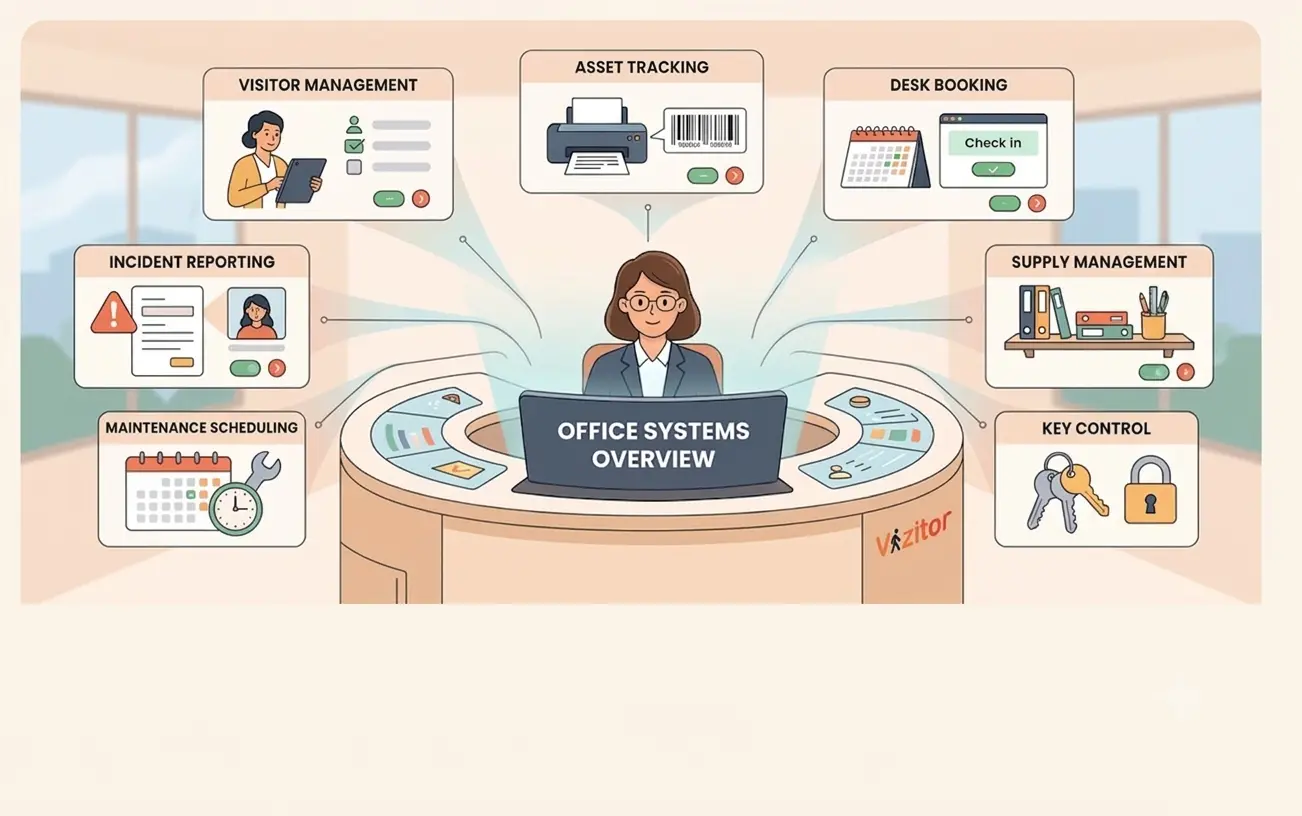
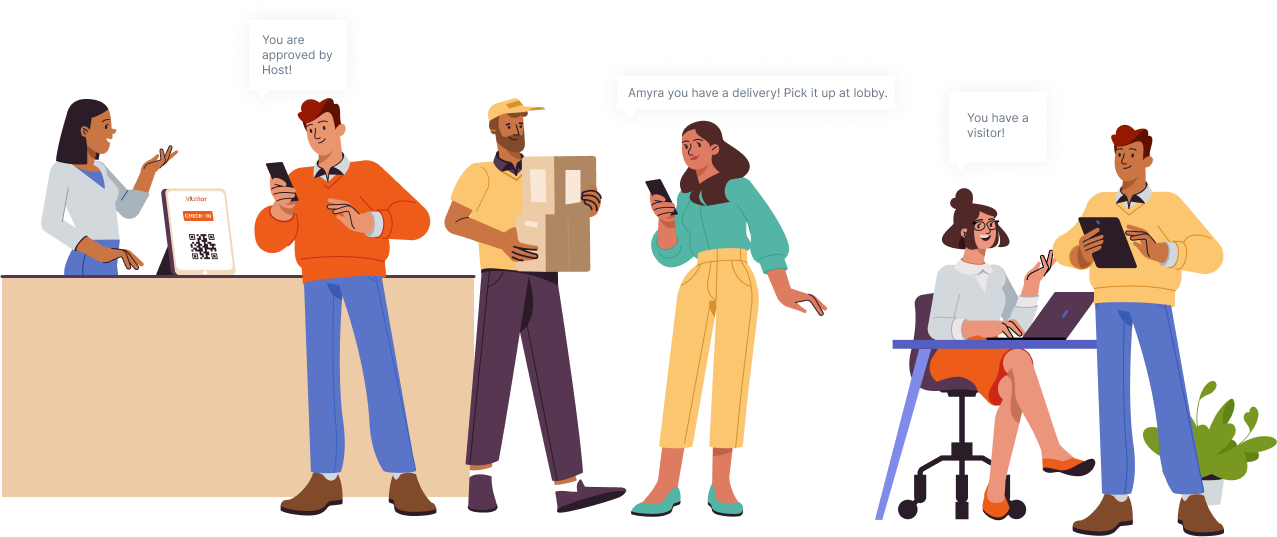
The Vizitor Workplace Management Platform represents exactly this trend: a unified system that connects visitor management, space booking, attendance tracking, delivery management, and security into a single operational layer.
Trend 1: The Shift from Point Solutions to Integrated Platforms
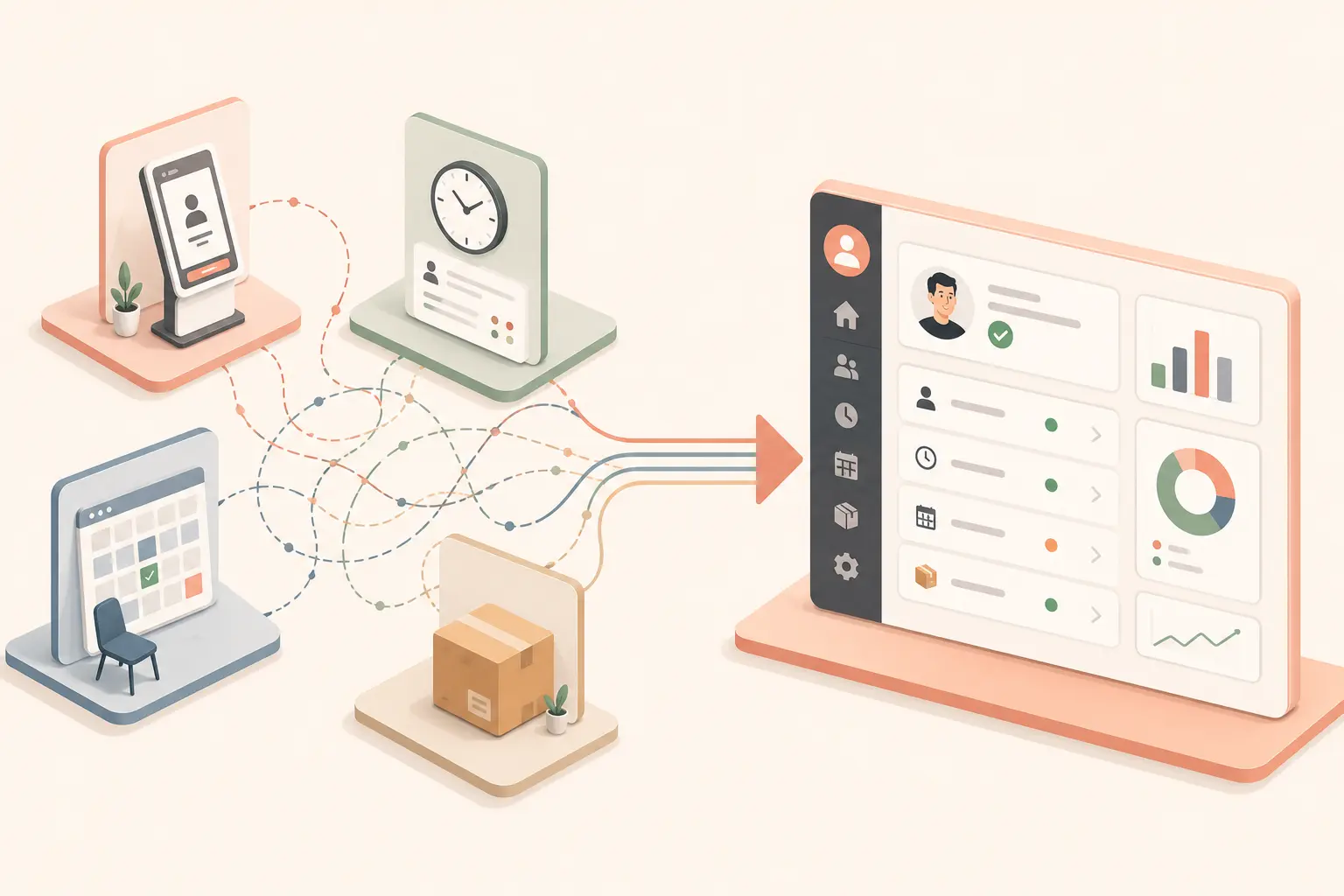
For the past decade, organizations have accumulated a collection of standalone tools: one for visitor management, another for room booking, a third for attendance, a fourth for deliveries. Each tool works reasonably well in isolation. Together, they create operational silos, duplicate data entry, and make holistic reporting nearly impossible.
In 2026, the decisive shift is toward integrated workplace management platforms that handle multiple functions from a single system.
Why this matters:
- A single data model across all workplace operations enables cross-functional analytics
- Employees and facility teams interact with one interface rather than five
- Integration costs and vendor management overhead decrease dramatically
- Real-time operational views become possible when data is not spread across disconnected systems
This trend directly reflects the growing recognition that workplace operations are interconnected. A visitor arrival affects meeting room occupancy, which affects desk availability, which affects HVAC demand. Only a connected system can optimize across these relationships.
Read our detailed comparison: Workplace Platform vs. Point Solutions.
Trend 2: AI-Powered Operational Automation
Artificial intelligence in workplace management has moved beyond the experimental phase. In 2026, AI is handling specific, high-value operational tasks:
- Predictive occupancy modeling. AI analyzes historical attendance data, calendar entries, and seasonal patterns to forecast daily occupancy. This drives smarter HVAC scheduling, cleaning crew allocation, and space preparation.
- Automated space optimization. Based on booking patterns and actual utilization data, AI recommends floor layouts, desk-to-employee ratios, and meeting room configurations.
- Smart visitor routing. When a visitor checks in through a Visitor Management System, AI determines the optimal route to their meeting room based on building occupancy and elevator availability.
- Anomaly detection for security. AI flags unusual access patterns - an employee badging in at an unusual hour, a visitor lingering in restricted areas - through Workplace Security Management integration.
The key shift is that AI in 2026 is operational rather than strategic. It is not generating workplace strategy documents. It is making hundreds of small decisions per day that collectively improve how facilities run.
Trend 3: Employee Experience as a Measurable Metric
Employee experience was a vague concept for years. In 2026, it is becoming a measured, managed, and optimized outcome of workplace operations.
Organizations are tracking:
- Time-to-desk (how long it takes an employee to settle into a workspace after arriving)
- Meeting room acquisition time (how quickly an employee can find and book a space)
- Service response time (how quickly facility issues are resolved)
- Queue and wait times at shared services
These metrics feed into broader employee experience scores that HR and facility teams review monthly.
The tools making this measurable include:
- Desk Booking System data showing booking-to-usage patterns
- Meeting Room Booking System analytics on room utilization and no-show rates
- Queue Management System data on wait times at cafeterias, IT help desks, and service counters
- Attendance Management System data correlating on-site presence with collaboration patterns
For a deeper exploration, see our guide on workplace management and employee experience.
Trend 4: Sustainability-Driven Workplace Operations
Sustainability in workplace management has shifted from a nice-to-have to a regulatory and stakeholder requirement. In 2026, organizations face:
- ESG reporting mandates that require quantifiable data on energy consumption, space utilization, and waste reduction
- Carbon footprint targets that demand optimized HVAC, lighting, and occupancy-based energy management
- Stakeholder expectations from employees, investors, and customers who expect demonstrable sustainability commitments
Workplace management platforms contribute by providing:
- Occupancy-based HVAC and lighting automation (only conditioning occupied floors)
- Space utilization data that identifies opportunities to consolidate and reduce real estate footprint
- Paper elimination through digital visitor management, digital attendance, and digital delivery tracking
- Waste reduction through optimized space planning and resource allocation
For more on this trend, read our guide on workplace management and sustainability.
Trend 5: Hybrid Work Optimization Beyond Flexibility
The hybrid work conversation has matured. In 2026, the question is no longer “should we allow hybrid work?” but “how do we make hybrid work operationally excellent?”
This means:
- Dynamic space allocation that adjusts daily based on who is coming in (not static desk assignments that sit empty 60% of the time)
- Coordination tools that help teams book adjacent desks when they plan to collaborate in person
- Occupancy-based services that scale cleaning, catering, and security staffing to actual daily attendance
- Equitable resource access ensuring that employees who come in less frequently still have access to quality spaces when they do
The data infrastructure for hybrid optimization comes from attendance management and desk booking systems that track not just who is present but how spaces are actually being used.
Trend 6: Security as an Integrated Layer
Physical workplace security is merging with operational workplace management. Rather than being a separate function managed by a separate team with separate tools, security is becoming an integrated layer within the workplace management platform.
This integration looks like:
- Visitor check-in that automatically triggers badge printing and access control activation
- Attendance data that informs building occupancy for emergency management
- Desk and room booking data that activates zone-specific security protocols
- Delivery Management System tracking that monitors package chain-of-custody
Read more in our detailed guide on workplace security integration.
Trend 7: Data-Driven Real Estate Decisions
The most expensive line item in most organizations’ budgets (after payroll) is real estate. In 2026, workplace management data is directly informing real estate strategy.
Organizations are using utilization data to:
- Rightsize their office portfolio based on actual usage rather than headcount
- Negotiate lease terms based on demonstrated occupancy patterns
- Make build-vs-lease decisions informed by growth projections and current utilization
- Identify opportunities to consolidate locations without impacting productivity
A JLL 2025 report found that organizations using workplace utilization data reduced their real estate costs by an average of 15-20%. For a company spending $5M annually on office space, that represents $750K-$1M in savings.
For organizations focused on this outcome, our guide on workplace management cost reduction provides a detailed framework.
Comparison: 2024 Trends vs. 2026 Trends
| Dimension | 2024 Focus | 2026 Focus |
|---|---|---|
| Technology strategy | Best-of-breed point solutions | Integrated workplace platforms |
| AI application | Experimental chatbots and pilots | Operational automation (occupancy prediction, routing, anomaly detection) |
| Employee experience | Qualitative surveys and perks | Measurable operational metrics (time-to-desk, queue times) |
| Sustainability | Voluntary initiatives | ESG-mandated reporting with quantifiable data |
| Hybrid work | Policy design and flexibility | Operational optimization and dynamic space management |
| Security | Standalone access control systems | Integrated security layer within workplace management |
| Real estate strategy | Headcount-based planning | Data-driven rightsizing based on actual utilization |
How to Prepare for These Trends
Organizations looking to stay current with workplace management trends in 2026 should:
- Audit your current technology stack. Identify how many separate tools manage workplace operations and where data silos exist.
- Evaluate integrated platforms. If you are managing five or more point solutions, the total cost of ownership for a unified platform is likely lower.
- Start measuring. If you cannot quantify visitor processing time, room utilization rate, or average employee time-to-desk, begin instrumenting these metrics now.
- Build the business case for consolidation. Use cost data from vendor management overhead, integration maintenance, and operational gaps to justify platform investment.
- Pilot with one function. Start by consolidating visitor management and desk booking into a single platform, then expand to attendance, deliveries, and security.
Frequently Asked Questions
Which workplace management trend will have the biggest impact in 2026? The shift from point solutions to integrated platforms. This trend underpins almost every other trend - AI automation, employee experience measurement, sustainability reporting, and security integration all work better when data flows through a single connected system.
How quickly are organizations adopting AI in workplace management? Rapidly for specific operational use cases. A 2026 Gartner report found that 45% of large enterprises have deployed at least one AI feature in their workplace management stack, primarily for occupancy prediction and space optimization. Full AI adoption across all workplace functions remains in earlier stages.
Are these trends relevant for mid-size companies, or only enterprises? These trends apply across company sizes, though the implementation scale differs. A 50-person company benefits from integrated visitor management and desk booking just as much as a 5,000-person enterprise. Cloud-based platforms have made these capabilities accessible and cost-effective for mid-size organizations.
How does sustainability reporting connect to workplace management? Workplace management platforms generate the operational data that sustainability reports require: energy consumption correlated with occupancy, space utilization rates, paper elimination metrics, and waste reduction data. Without this data, ESG reporting relies on estimates rather than measurements.
What is the risk of not keeping up with these trends? The primary risks are operational inefficiency (higher costs per employee), talent retention challenges (employees expect modern workplace experiences), compliance gaps (especially around sustainability reporting), and competitive disadvantage in attracting clients and partners who evaluate operational maturity.
Positioning Your Organization
The workplace management trends of 2026 share a common theme: integration. Integrated platforms. Integrated data. Integrated operations. Organizations that continue to manage workplace functions in silos will find it increasingly difficult to compete for talent, meet compliance requirements, and operate cost-effectively.
The Vizitor Workplace Management Platform is designed for this integrated future. Book a demo to see how a unified platform handles visitor management, space booking, attendance, deliveries, and security, or review pricing for your organization size.
For a deeper look at specific trends covered here, explore our guides on workplace digital transformation, integrated workplace management systems, and workplace vendor comparison.
Try Vizitor Free
No credit card required. Setup in under 5 minutes. Manage visitors, queues, meeting rooms, and more.
Start Free TrialSee Vizitor in action check-in a visitor in under 30 seconds
Trusted by 500+ businesses. QR check-in, badge printing, NDA signing. Plans from $36/mo.