Workplace Management Vendor Comparison


Table of Content
Try Vizitor for Free!
Why Vendor Selection Matters More Than Ever
The workplace management platform market has grown rapidly. In 2026, organizations evaluating solutions face a crowded landscape with vendors ranging from legacy facility management providers to modern cloud-native platforms, from narrow point solutions to broad integrated suites.
Making the wrong choice is expensive. Not just in licensing costs, but in implementation time, integration overhead, employee adoption challenges, and the operational gaps that emerge when a platform does not fit your actual needs.
Definition: A workplace management vendor comparison is a structured evaluation of software platforms that manage physical workplace operations - including visitor management, space booking, attendance tracking, delivery management, and security. Effective comparisons evaluate functional coverage, architectural approach, pricing models, integration capabilities, implementation methodology, and customer support quality.
According to a 2025 Gartner survey, 42% of organizations that purchased workplace management software in the previous three years were dissatisfied with their choice, primarily due to inadequate feature depth, poor integration capabilities, and higher-than-expected total cost of ownership. A structured comparison process significantly reduces this risk.
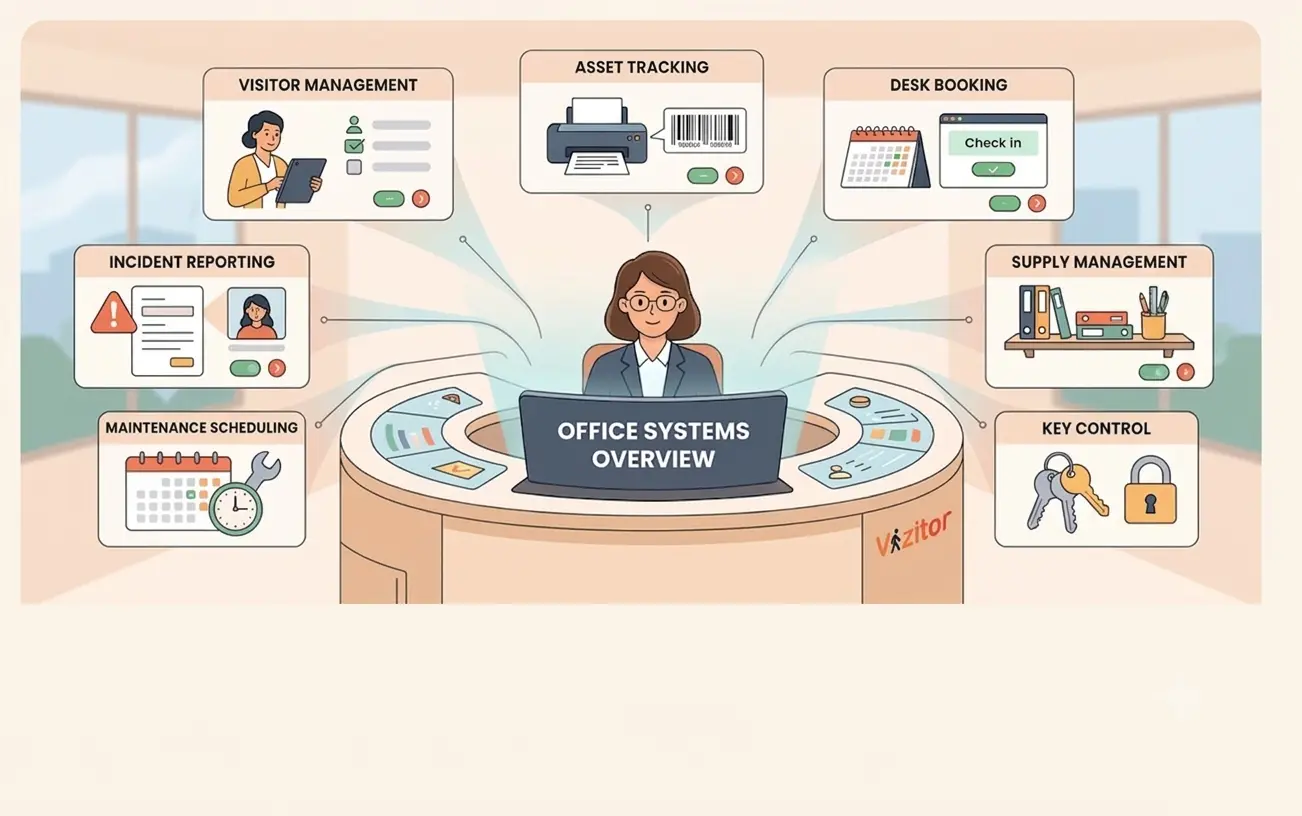
The Vizitor Workplace Management Platform is designed as a unified system covering visitor management, space booking, attendance, deliveries, and security. This guide provides a fair, comprehensive framework for evaluating Vizitor alongside other options in the market.
The Evaluation Framework
Category 1: Functional Coverage
The first and most important question is whether the platform covers the functions you need.
| Function | Questions to Ask |
|---|---|
| Visitor Management | Does it support pre-registration, kiosk check-in, watchlist screening, badge printing, host notification, and multi-visitor-type workflows? |
| Meeting Room Booking | Does it offer real-time availability, auto-release for no-shows, room equipment visibility, and utilization analytics? |
| Desk Booking | Does it support floor maps, team-based booking, amenity filtering, and neighborhood assignment? |
| Attendance Management | Does it handle multiple check-in methods, shift management, multi-location consolidation, and leave integration? |
| Delivery Management | Does it track packages, notify recipients, log chain-of-custody, and provide delivery analytics? |
| Workplace Security | Does it integrate with access control hardware, support zone management, provide emergency tools, and enable incident logging? |
Red flag: If a vendor claims to “cover” a function but the actual feature set is shallow (e.g., “visitor management” that is just a digital sign-in form without pre-registration, screening, or analytics), the coverage is nominal rather than real.
Category 2: Architectural Approach
How the platform is built matters as much as what it does.
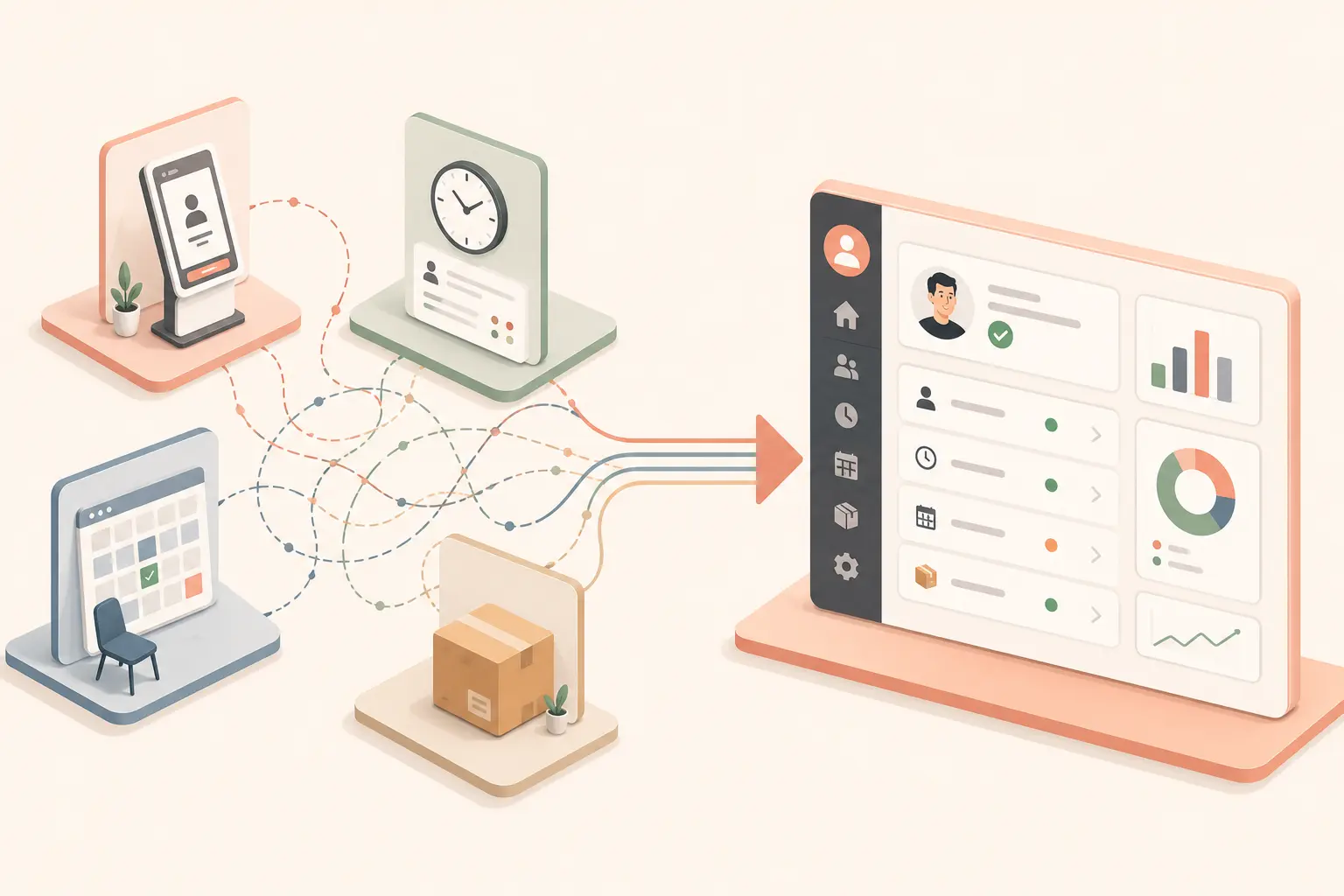
Integrated vs. aggregated: Some vendors build a truly integrated platform where all modules share a single data model. Others aggregate separate products under a unified brand, with data passing between modules through internal APIs. The difference shows up in reporting, automation, and user experience.
Cloud-native vs. cloud-hosted: Cloud-native platforms were designed for cloud from the start. Cloud-hosted platforms were originally built for on-premise deployment and later moved to cloud. Cloud-native platforms typically offer faster updates, better scalability, and lower IT overhead.
Multi-tenant vs. single-tenant: Multi-tenant architectures (one platform instance serving many customers with data isolation) offer cost efficiency and faster updates. Single-tenant (dedicated instance per customer) offers more isolation but at higher cost and slower update cycles.
Category 3: Integration Capabilities
No workplace platform operates in isolation. Evaluate:
- Pre-built integrations: Connectors for common tools (Google Workspace, Microsoft 365, Slack, Teams, major HR platforms, major access control hardware brands)
- API quality: Well-documented REST APIs with webhooks for real-time event triggers
- SSO support: SAML 2.0 and OAuth 2.0 for enterprise single sign-on
- Calendar integration: Bidirectional sync with Google Calendar and Outlook
- Access control integration: Support for standard protocols (Wiegand, OSDP) and major hardware vendors
Category 4: Multi-Site and Scalability
For organizations with multiple locations:
- Can the platform manage all locations from a single dashboard?
- Can each location have customized configurations (visitor workflows, booking rules, security policies)?
- Does pricing scale linearly or does it include volume discounts for additional locations?
- Is the platform architecturally capable of handling your 3-year growth projection?
Category 5: Pricing Model
Workplace management pricing varies significantly across vendors:
| Pricing Model | Description | Watch Out For |
|---|---|---|
| Per-user/per-month | Charged based on number of active users | Cost escalates rapidly as headcount grows |
| Per-location/per-month | Flat fee per site regardless of user count | May be expensive for small sites, cost-effective for large ones |
| Module-based | Base platform plus additional charges per module | Total cost can be much higher than initial quotes suggest |
| All-inclusive | Single price for all modules and features | Best value if you use most features; may include functions you do not need |
| Usage-based | Charged based on check-ins, bookings, or transactions | Unpredictable costs that spike during busy periods |
Always calculate total cost of ownership (TCO): Include licensing, implementation, integration development, training, ongoing support, and anticipated growth over 3 years. A platform that appears cheaper in year one may be significantly more expensive over three years.
Category 6: Implementation and Support
- Implementation timeline: How long from contract to full deployment? Benchmark is 4-12 weeks for single-site.
- Implementation methodology: Does the vendor have a structured deployment process with clear milestones?
- Training: What training resources are available (live sessions, documentation, video tutorials)?
- Support model: Response time SLAs, support channels (chat, email, phone), dedicated account management
- Customer success: Does the vendor provide ongoing optimization guidance or just break-fix support?
Vendor Category Comparison
The market includes several categories of vendors, each with different strengths and limitations:
Legacy Facility Management Platforms
Examples: IBM TRIRIGA, Planon, Archibus
Strengths: Deep facility and maintenance management, real estate portfolio management, enterprise-grade architecture
Limitations: Often weak on people-facing functions (visitor management, desk booking), complex implementation, high cost, less intuitive user experience, slower innovation cycles
Best for: Large enterprises where facility and real estate management is the primary need, and people-facing features are secondary
Modern Workplace Experience Platforms
Examples: Vizitor, Robin, Envoy, OfficeSpace
Strengths: Strong people-facing features (visitor management, desk booking, room booking), modern user experience, faster implementation, cloud-native architecture
Limitations: May have lighter facility maintenance capabilities, newer market presence
Best for: Organizations prioritizing employee and visitor experience, hybrid workplace management, and operational efficiency
Narrow Point Solutions
Examples: Single-function tools for visitor management, desk booking, or attendance only
Strengths: Deep functionality in one area, often lower entry price
Limitations: No cross-functional integration, creates data silos, requires multiple vendors to cover all needs, higher total cost when you add integration overhead
Best for: Organizations with a single, isolated need that is unlikely to expand. Read more in our analysis of platform vs. point solutions.
IT Service Management Platforms Adding Workplace Features
Examples: ServiceNow (Workplace Service Delivery), Atlassian
Strengths: Deep ITSM and service management, strong ticketing and workflow engines, existing enterprise deployment
Limitations: Workplace features are additions to a platform designed for IT, often requiring significant customization. Visitor management and space booking may be basic compared to dedicated platforms.
Best for: Organizations heavily invested in ITSM platforms looking to extend to workplace management without adding a new vendor
What Makes Vizitor Different
Vizitor is positioned as a modern, integrated workplace management platform with several distinguishing characteristics:
- True integration: Visitor management, desk booking, room booking, attendance, delivery management, and security operate on a single data model with native cross-functional automation
- Breadth and depth: Each module is fully featured, not a checkbox feature. The visitor management system supports pre-registration, kiosk check-in, watchlist screening, multi-visitor types, and analytics - not just a digital sign-in form.
- Cloud-native architecture: Fast deployment, automatic updates, and scalability without infrastructure investment
- Accessible pricing: Designed to be cost-effective for mid-size organizations, not just enterprises
- Multi-geography support: Built for organizations operating across countries with support for regional compliance requirements (GDPR, DPDP Act, HIPAA)
Decision-Making Methodology
Step 1: Define Requirements (2 weeks)
Document your needs across all functional categories. Prioritize them as must-have, nice-to-have, and future-need. Include requirements from facility management, HR, IT, security, and leadership.
Step 2: Long List (1 week)
Identify 5-8 vendors that appear to match your requirements based on their published capabilities and market position.
Step 3: RFI/RFP (3-4 weeks)
Send a structured request for information to your long-list vendors. Include specific scenarios that test depth, not just breadth. For example: “Describe the workflow when a visitor arrives for a meeting that has been cancelled after their pre-registration was sent.”
Step 4: Short List and Demo (2-3 weeks)
Narrow to 2-3 finalists. Conduct detailed demonstrations using your actual use cases, not the vendor’s standard demo script.
Step 5: Reference Checks (1-2 weeks)
Speak with existing customers - ideally in your industry and of similar size. Ask about implementation experience, ongoing support quality, and any surprises after purchase.
Step 6: TCO Analysis (1 week)
Build a 3-year total cost model for each finalist, including all licensing, implementation, integration, training, and support costs.
Step 7: Decision (1 week)
Score each finalist against your prioritized requirements, weighting must-have criteria higher than nice-to-have.
Frequently Asked Questions
How many vendors should we evaluate? Start with 5-8 on the long list, narrow to 2-3 for detailed evaluation. Evaluating more than 3 finalists creates decision fatigue without adding meaningful insight. The key is ensuring your long list covers different vendor categories (legacy, modern, point solutions) to avoid bias.
Should we prioritize feature completeness or ease of use? Both matter, but ease of use is often undervalued. A feature-rich platform that employees refuse to use is worse than a simpler platform with high adoption. During demos, pay close attention to the user experience for daily tasks (booking a desk, checking in a visitor) rather than focusing only on admin dashboards and configuration screens.
How important is the vendor’s company size and financial stability? It matters, especially for enterprise purchases. A vendor that closes or gets acquired can disrupt your operations. Look for vendors with clear growth trajectories, strong customer retention, and sustainable business models. However, do not dismiss smaller vendors solely based on size - they often innovate faster and provide more responsive support.
What is the typical contract length for workplace management platforms? Annual contracts are standard, with discounts available for multi-year commitments (typically 10-20% for 3-year terms). Avoid committing to multi-year contracts before the platform is proven in your environment. Start with an annual contract and extend after successful deployment.
How do we handle the transition from our current tools to a new platform? Plan for a parallel running period (typically 2-4 weeks) where both old and new systems operate simultaneously. Migrate data in phases, starting with employee directories and space inventories. Decommission old tools only after the new platform is validated. See our guide on workplace change management for detailed transition strategies.
Making the Right Choice
Selecting a workplace management platform is a decision that will shape your operations for years. Take the time to evaluate thoroughly, but do not let the evaluation process become an excuse for inaction. The cost of continuing with manual processes and fragmented tools compounds every month.
The Vizitor Workplace Management Platform welcomes rigorous evaluation. Book a demo to see the platform against your specific use cases, or review pricing to include Vizitor in your TCO analysis.
For more context on the decision, explore our guides on integrated workplace management systems, workplace management trends in 2026, and workplace platform vs. point solutions.
Try Vizitor Free
No credit card required. Setup in under 5 minutes. Manage visitors, queues, meeting rooms, and more.
Start Free TrialSee Vizitor in action check-in a visitor in under 30 seconds
Trusted by 500+ businesses. QR check-in, badge printing, NDA signing. Plans from $36/mo.