Workplace Management Platform vs. Point Solutions


Table of Content
Try Vizitor for Free!
The Architecture Decision That Shapes Everything
When organizations set out to digitize their workplace operations, they face a fundamental architectural decision: build a stack of specialized point solutions (one tool per function) or adopt an integrated platform that handles multiple functions in a single system.
This is not a minor technical choice. It shapes total cost of ownership, data quality, user experience, security posture, and the organization’s ability to evolve its workplace operations over time. Getting it right saves years of friction. Getting it wrong creates technical and operational debt that compounds with every passing quarter.
Definition: A workplace management platform is a single, integrated software system that manages multiple workplace operational functions - including visitor management, space booking, attendance tracking, delivery management, and security - through a shared data model and unified user experience. Point solutions are standalone tools that each handle a single function independently, requiring separate procurement, management, and integration.
A 2025 Forrester study found that organizations using integrated workplace platforms spent 31% less on total workplace technology costs compared to those running equivalent functionality through point solutions. The savings came primarily from eliminated integration costs, reduced vendor management overhead, and lower administrative labor.
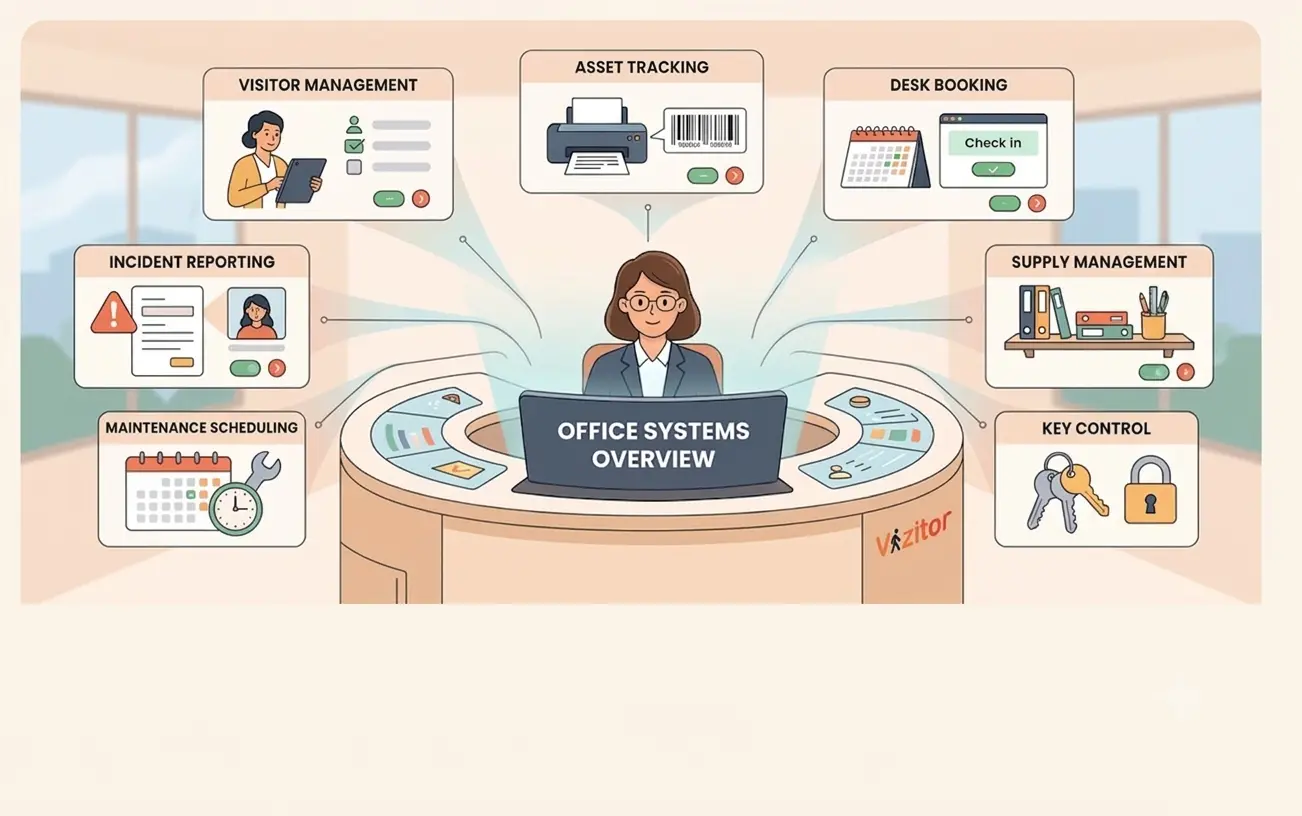
The Vizitor Workplace Management Platform is built as a true integrated platform - visitor management, space booking, attendance, deliveries, and security sharing a single data model with native cross-functional automation.
The Point Solutions Approach
How It Works
In a point solutions approach, the organization selects the best available tool for each function:
- Tool A for visitor management
- Tool B for meeting room booking
- Tool C for desk booking
- Tool D for attendance management
- Tool E for delivery management
- Tool F for workplace security
Each tool is selected independently, often by different teams (facilities selects the visitor tool, IT selects the desk booking tool, HR selects the attendance tool).
Advantages of Point Solutions
- Best-in-class functionality. Each tool is designed exclusively for its function and may offer deeper features in that specific area.
- Lower initial cost per tool. Individual tool licenses appear cost-effective when evaluated in isolation.
- Departmental autonomy. Each department selects the tool that best fits their specific needs.
- Reduced switching risk. Replacing one tool in the stack does not require changing the entire system.
Disadvantages of Point Solutions
- Data silos. Each tool has its own database. Cross-functional questions (“how does visitor volume correlate with meeting room usage on the same day?") require manual data extraction from multiple sources.
- Integration burden. Connecting tools through APIs requires initial development, ongoing maintenance, and troubleshooting when vendor updates break connections.
- User experience fragmentation. Employees interact with multiple interfaces, each with different designs, login credentials, and mobile apps.
- Higher total cost. When you add all licenses, integration costs, vendor management overhead, and the productivity cost of switching between tools, point solutions typically cost more than integrated platforms.
- Security surface expansion. Each tool represents a separate security surface to monitor, audit, and protect.
- Reporting limitations. No single dashboard provides a complete view of workplace operations.
The Integrated Platform Approach
How It Works
An integrated platform provides all workplace management functions within a single system:
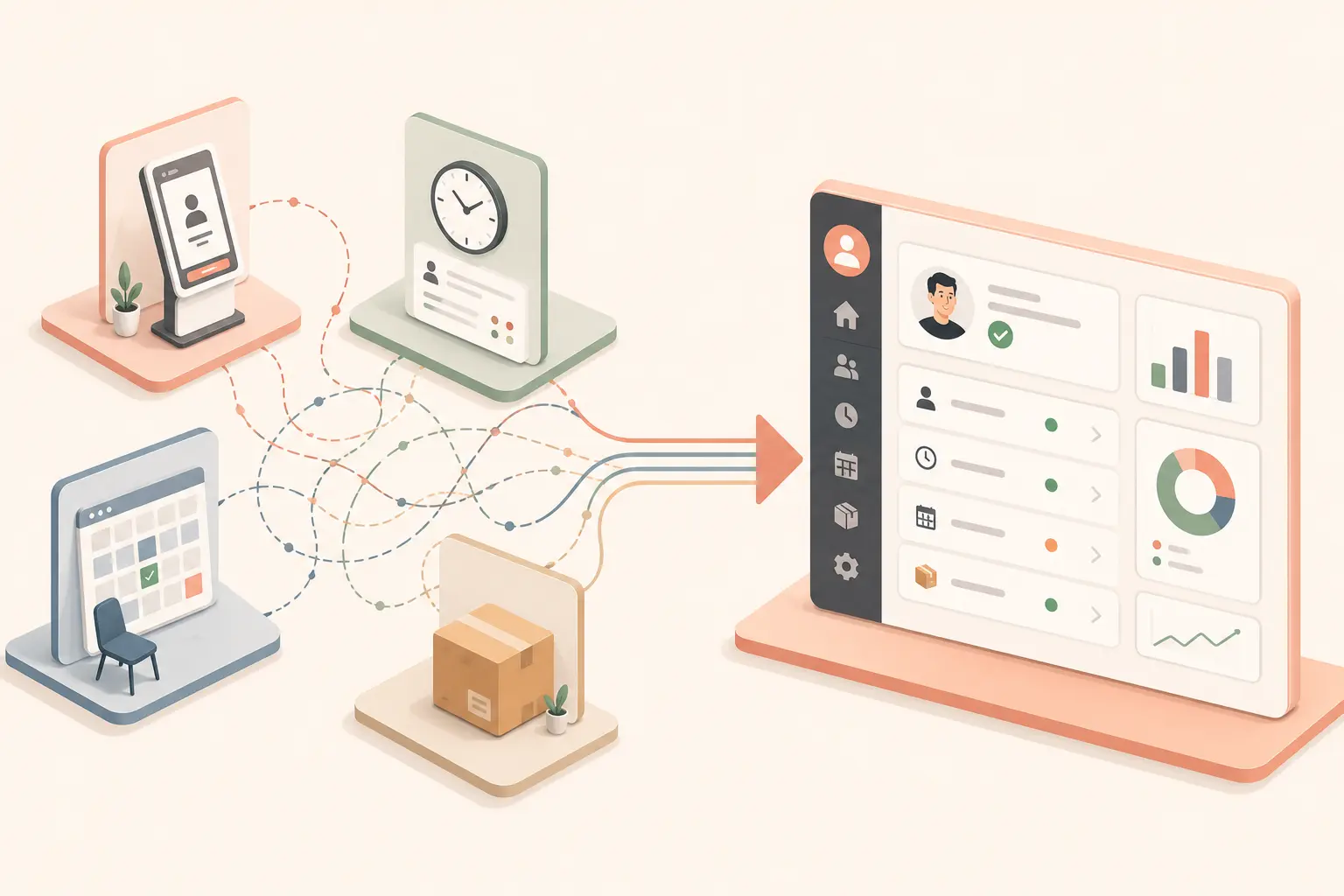
- Visitor management, space booking, attendance, deliveries, and security share one data model
- One user interface for employees, one admin dashboard for facility managers
- Native automation across functions (a visitor check-in triggers room confirmation, security access, and occupancy updates)
- Unified reporting across all operational data
Advantages of Integrated Platforms
- Connected data. All operational data lives in a single database, enabling cross-functional analytics and automation.
- Consistent user experience. One interface, one login, one mobile app for all workplace interactions.
- Lower total cost. Single license, no integration costs, reduced vendor management overhead.
- Native automation. Cross-functional workflows operate without custom integration development.
- Unified security. One platform to secure, audit, and monitor.
- Holistic reporting. Complete operational visibility from a single dashboard.
Disadvantages of Integrated Platforms
- Feature depth. An integrated platform may not match the depth of a dedicated point solution in every single function. However, this gap has narrowed significantly as platforms mature.
- Vendor concentration. Relying on a single vendor increases switching costs and dependency.
- Migration complexity. Moving from multiple point solutions to a platform requires a coordinated transition plan.
Head-to-Head Comparison
| Dimension | Point Solutions (5-6 tools) | Integrated Platform |
|---|---|---|
| Initial license cost | $3,000-$15,000 per tool = $15,000-$90,000 total | $15,000-$60,000 for all functions |
| Integration costs | $5,000-$20,000 for initial API connections | $0 (functions are natively connected) |
| Annual integration maintenance | $3,000-$10,000 (API updates, break fixes) | $0 |
| Vendor management overhead | 5-6 contracts, renewals, support channels | 1 contract, 1 support channel |
| User training | Train on 5-6 separate interfaces | Train on 1 interface |
| Data reporting | Manual data extraction from multiple sources | Single unified dashboard |
| Cross-functional automation | Custom development required for each workflow | Native, configurable without code |
| Security audit scope | 5-6 separate platforms to evaluate | 1 platform to evaluate |
| Scalability | Must evaluate and scale each tool independently | Scale once for all functions |
| 3-year total cost | Typically 30-50% higher when all costs included | Lower with comprehensive functionality |
Total Cost of Ownership: A Worked Example
Scenario: 300-employee organization, 2 locations
Point Solutions Approach:
| Cost Category | Annual Cost |
|---|---|
| Visitor management tool license | $8,000 |
| Desk booking tool license | $10,000 |
| Meeting room booking tool license | $6,000 |
| Attendance management tool license | $7,000 |
| Delivery management tool license | $4,000 |
| Security integration tool license | $12,000 |
| Total licenses | $47,000 |
| Initial integration development (amortized over 3 years) | $5,000/year |
| Ongoing integration maintenance | $6,000 |
| Additional admin time managing 6 vendors (estimated 5 hrs/month) | $3,600 |
| Total annual cost | $61,600 |
| 3-year total | $184,800 |
Integrated Platform Approach:
| Cost Category | Annual Cost |
|---|---|
| Platform license (all modules, 2 locations) | $36,000 |
| Initial implementation (amortized over 3 years) | $3,000/year |
| Vendor management (1 vendor, estimated 1 hr/month) | $720 |
| Total annual cost | $39,720 |
| 3-year total | $119,160 |
3-year savings with integrated platform: $65,640 (35%)
This calculation does not include the productivity value of better data, faster reporting, and cross-functional automation - which are difficult to quantify but consistently cited by organizations that have made the switch.
When Point Solutions Make Sense
Despite the advantages of integrated platforms, there are scenarios where point solutions are the better choice:
-
Single, isolated need. If your organization genuinely needs only visitor management and nothing else, a dedicated visitor management tool may offer more depth than a platform’s visitor module. However, needs rarely stay isolated as organizations grow.
-
Existing deep investment. If you have already invested heavily in a specific tool (multi-year contract, extensive customization, deep user adoption), replacing it may not be worth the switching cost until the contract term ends.
-
Specialized requirements. Some industries have highly specialized needs in one area (e.g., pharmaceutical-grade delivery tracking, government-classified-area security) that may exceed what a general-purpose platform provides.
-
Organizational structure. If departments operate with complete autonomy and there is no mandate for operational integration, point solutions aligned to each department may face less organizational resistance.
When Integrated Platforms Win
Integrated platforms are the better choice when:
-
You need three or more functions. Once you are managing three or more workplace functions digitally, the integration costs and data silos of point solutions exceed the cost of an integrated platform.
-
Cross-functional visibility matters. If leadership wants operational dashboards that span visitor management, space utilization, attendance, and security, only an integrated platform can provide this natively.
-
You are growing. Organizations in growth mode need systems that scale together. Adding a new location on a platform means configuring one system. Adding a location across five point solutions means configuring five systems and ensuring all integrations work at the new site.
-
Budget is constrained. Counter-intuitively, the lower entry cost of individual point solutions often leads to higher total spending. Platforms offer better value when you calculate total cost of ownership.
-
IT resources are limited. Point solutions require IT involvement for integration development and maintenance. Platforms minimize IT overhead by handling cross-functional connectivity internally.
Making the Transition from Point Solutions to Platform
If your organization currently runs point solutions and wants to move to an integrated platform, here is a practical approach:
Step 1: Inventory Current Stack
Document every tool currently in use for workplace operations, including: vendor name, annual cost, contract end date, integration dependencies, and user adoption level.
Step 2: Prioritize Migration
Rank tools by contract end date and pain level. Migrate the tools causing the most operational friction first, especially those with expiring contracts.
Step 3: Plan Data Migration
Determine what data needs to transfer (employee directories, visitor watchlists, historical booking data, attendance records) and what can start fresh.
Step 4: Run in Parallel
During transition, run the new platform alongside existing tools for 2-4 weeks. This reduces risk and allows users to build confidence before the old tools are retired.
Step 5: Retire Decisively
Once the platform is validated, retire old tools completely. Do not maintain parallel systems indefinitely. This is critical for driving adoption. See our guide on change management for workplace technology for detailed transition strategies.
Frequently Asked Questions
Is an integrated platform just a collection of mediocre tools bundled together? Not if the platform is built on a unified architecture. Legacy “suite” products that were assembled through acquisitions can feel like bundled tools with a shared logo. Modern platforms like Vizitor, built from the ground up with a single data model, provide deep functionality across modules because they share infrastructure, data, and design patterns. Evaluate depth within each module during demos rather than assuming integration equals compromise.
What if the platform is strong in some areas but weak in others? This is a legitimate concern and should be evaluated during the selection process. Map your requirements by priority (must-have, nice-to-have, future-need) and assess platform depth in your must-have areas specifically. If a platform is strong in four of five functions but genuinely weak in one critical area, that is a meaningful gap worth discussing with the vendor.
How do we justify the switch to leadership when individual tools are already paid for? Build the total cost of ownership comparison showing all costs: licenses, integration maintenance, vendor management overhead, and the productivity cost of data silos. Present the 3-year view rather than the immediate switching cost. Most leadership teams find the long-term savings compelling, especially when paired with the operational benefits of integrated data and automation.
Can we migrate gradually or do we have to switch everything at once? Gradual migration is not only possible but recommended. Start by deploying the platform’s visitor management and desk booking modules (often the easiest to adopt and highest in visible impact). Add attendance, deliveries, and security modules in subsequent phases. This phased approach reduces change management burden and builds organizational confidence.
What happens if we outgrow the platform? Choose a platform that has demonstrated scalability to organizations significantly larger than yours. Ask the vendor for reference customers who are 3-5x your size. Cloud-native platforms built on scalable infrastructure (like Vizitor) handle growth without architectural constraints.
The Architecture Shapes the Experience
The platform-vs-point-solutions decision is ultimately about what kind of workplace experience you want to create. Point solutions create a fragmented experience - different interfaces, disconnected data, manual processes bridging the gaps between tools. An integrated platform creates a connected experience - one system that understands the complete context of workplace operations.
For most organizations managing three or more workplace functions, the integrated platform delivers lower cost, better data, smoother user experience, and stronger operational outcomes.
The Vizitor Workplace Management Platform is designed to replace the complexity of multiple point solutions with a single, connected system. Book a demo to evaluate it against your current stack, or review pricing to build your total cost of ownership comparison.
For related analysis, explore our guides on integrated workplace management systems, workplace management vendor comparison, and workplace management cost reduction.
Try Vizitor Free
No credit card required. Setup in under 5 minutes. Manage visitors, queues, meeting rooms, and more.
Start Free TrialSee Vizitor in action check-in a visitor in under 30 seconds
Trusted by 500+ businesses. QR check-in, badge printing, NDA signing. Plans from $36/mo.