Workplace Security Integration


Table of Content
Try Vizitor for Free!
Why Security Must Be Integrated, Not Isolated
For decades, physical security has operated as a standalone function. Security teams managed their own access control systems, visitor logs, CCTV cameras, and incident reports - entirely separate from the platforms managing workspace booking, attendance, deliveries, and facility operations.
This separation made sense when workplaces were simpler. But in 2026, with hybrid work, fluctuating occupancy, and increasingly complex compliance requirements, isolated security creates dangerous blind spots.
When the security system does not know that a meeting was cancelled, the visitor badge it issued is still active. When the attendance system does not share data with emergency management, evacuation headcounts are incomplete. When the delivery system does not connect to security, packages enter restricted areas without additional verification.
Definition: Workplace security integration is the practice of connecting physical security systems - access control, visitor screening, CCTV, and incident management - with operational workplace management platforms - desk booking, attendance tracking, meeting room scheduling, and delivery management - to create a unified security layer that operates with complete situational awareness.
According to a 2025 ASIS International report, organizations with integrated security and workplace management systems experienced 47% fewer security incidents and 62% faster incident response times compared to those running isolated security systems.
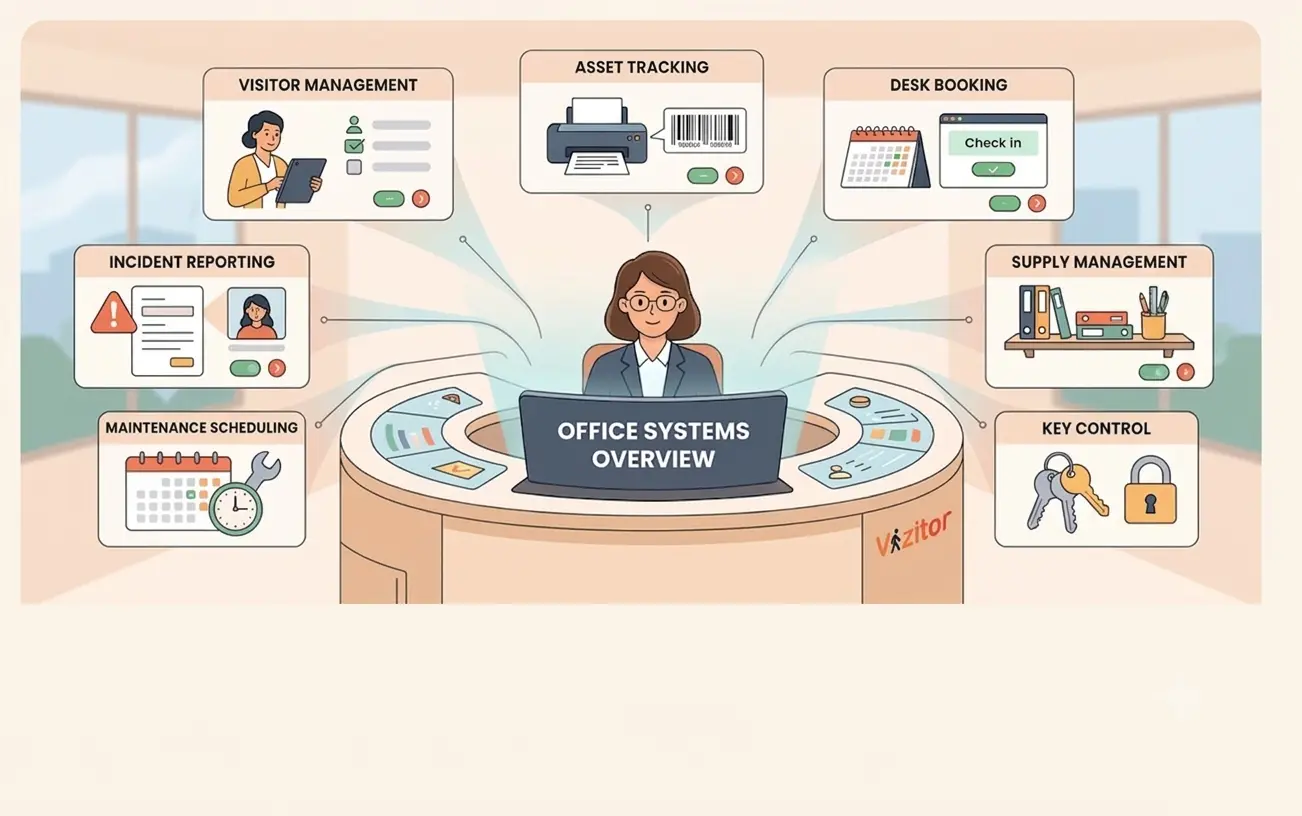
The Vizitor Workplace Management Platform is designed with security integration as a core architectural principle, not an add-on. Visitor management, attendance, space booking, and delivery tracking all feed into a unified security layer that provides real-time situational awareness.
The Problem with Isolated Security
Blind Spots
When security operates in isolation, it lacks the context that workplace operations data provides:
- A visitor checks in but security does not know which meeting they are attending or when it ends
- An employee badges into the building but the desk booking system shows no reservation - is this normal or suspicious?
- A delivery arrives for a restricted area but security has no automated way to apply additional verification
- An emergency occurs but security cannot instantly identify who is in the building because attendance data lives in a separate HR system
Delayed Response
Isolated systems require manual information gathering during incidents. Security teams must call reception to identify a visitor, check with HR for employee lists, and manually compile occupancy data during evacuations. This manual overhead adds critical minutes to incident response.
Compliance Gaps
Regulatory frameworks increasingly require integrated security documentation. Audit trails that span visitor management, access control, and incident response must be connected and coherent. Isolated systems produce fragmented records that are difficult to present during audits.
The Integrated Security Model
An integrated model connects security with every operational touchpoint:
| Workplace Function | Security Integration Point |
|---|---|
| Visitor check-in via Visitor Management System | Automatic watchlist screening, badge issuance with zone restrictions, access expiry at meeting end time |
| Desk booking via Desk Booking System | Zone-specific access activation, occupancy data for emergency management |
| Meeting room booking via Meeting Room Booking System | Room access activation at booking time, automatic deactivation after meeting |
| Attendance via Attendance Management System | Real-time building occupancy for evacuation management, anomaly detection for unusual patterns |
| Delivery tracking via Delivery Management System | Enhanced verification for restricted area deliveries, chain-of-custody documentation |
| Workplace Security Management | Centralized dashboard combining all data sources for real-time situational awareness |
Key Integration Capabilities
1. Unified Access Control
When a visitor pre-registers for a meeting through the visitor management system, the integrated platform can:
- Screen the visitor against watchlists before they arrive
- Generate a time-limited digital badge
- Activate building access for the specific floors and zones the visitor needs
- Automatically deactivate access when the meeting ends or the visitor checks out
For employees, desk and room bookings can trigger zone-specific access. An employee who books a desk on Floor 3 receives Floor 3 access. An employee working from home does not.
2. Real-Time Occupancy Awareness
Security teams need to know who is in the building at any given moment. In an integrated system, this data comes from:
- Employee attendance check-ins
- Visitor check-in and check-out records
- Desk and room booking check-ins
- Delivery personnel entry and exit logs
This aggregated data provides a real-time headcount by zone that is invaluable during emergencies and useful for daily security operations.
3. Anomaly Detection
When security has access to operational data, it can identify unusual patterns:
- An employee badging in at 3 AM when they have no overnight booking or shift scheduled
- A visitor who checked in 4 hours ago but has not checked out and whose meeting ended 3 hours ago
- A delivery personnel accessing areas beyond the receiving dock
- A spike in visitor registrations from an unknown organization
These anomalies can trigger automated alerts to security teams for investigation.
4. Emergency Response
During evacuations or lockdowns, integrated systems provide:
- Instant headcounts by building, floor, and zone - combining employee attendance data, visitor records, and delivery personnel logs
- Targeted notifications to all occupants via the workplace management app
- Assembly point tracking as people check in at muster points
- Real-time reconciliation identifying who has been accounted for and who has not
Compare this to manual roll calls, which can take 15-20 minutes for a 500-person building. An integrated system provides the same information in seconds.
5. Incident Documentation
When security incidents occur, the integrated platform automatically captures:
- Who was in the building and where (from attendance and booking data)
- Which visitors were present and who hosted them (from visitor management)
- Access log entries for all affected areas
- Timeline reconstruction from multiple data sources
This documentation is generated automatically rather than compiled manually after the fact.
Integration Architecture
Hardware Integration
Modern workplace security platforms integrate with:
- Access control panels (badge readers, turnstiles, door controllers)
- CCTV systems (camera feeds linked to visitor check-in events)
- Biometric devices (fingerprint and facial recognition for employee attendance)
- Intercom and PA systems (for emergency notifications)
- IoT sensors (occupancy sensors, door sensors, environmental monitors)
Software Integration
On the software side, key integrations include:
- HR systems for employee directory, role-based access policies, and organizational structure
- Calendar systems (Google Calendar, Microsoft Outlook) for meeting-triggered access
- Communication platforms (Slack, Teams) for security alerts and notifications
- Building management systems for occupancy-based HVAC and lighting control
- Compliance and audit platforms for regulatory reporting
Data Flow
In an integrated architecture, data flows bidirectionally:
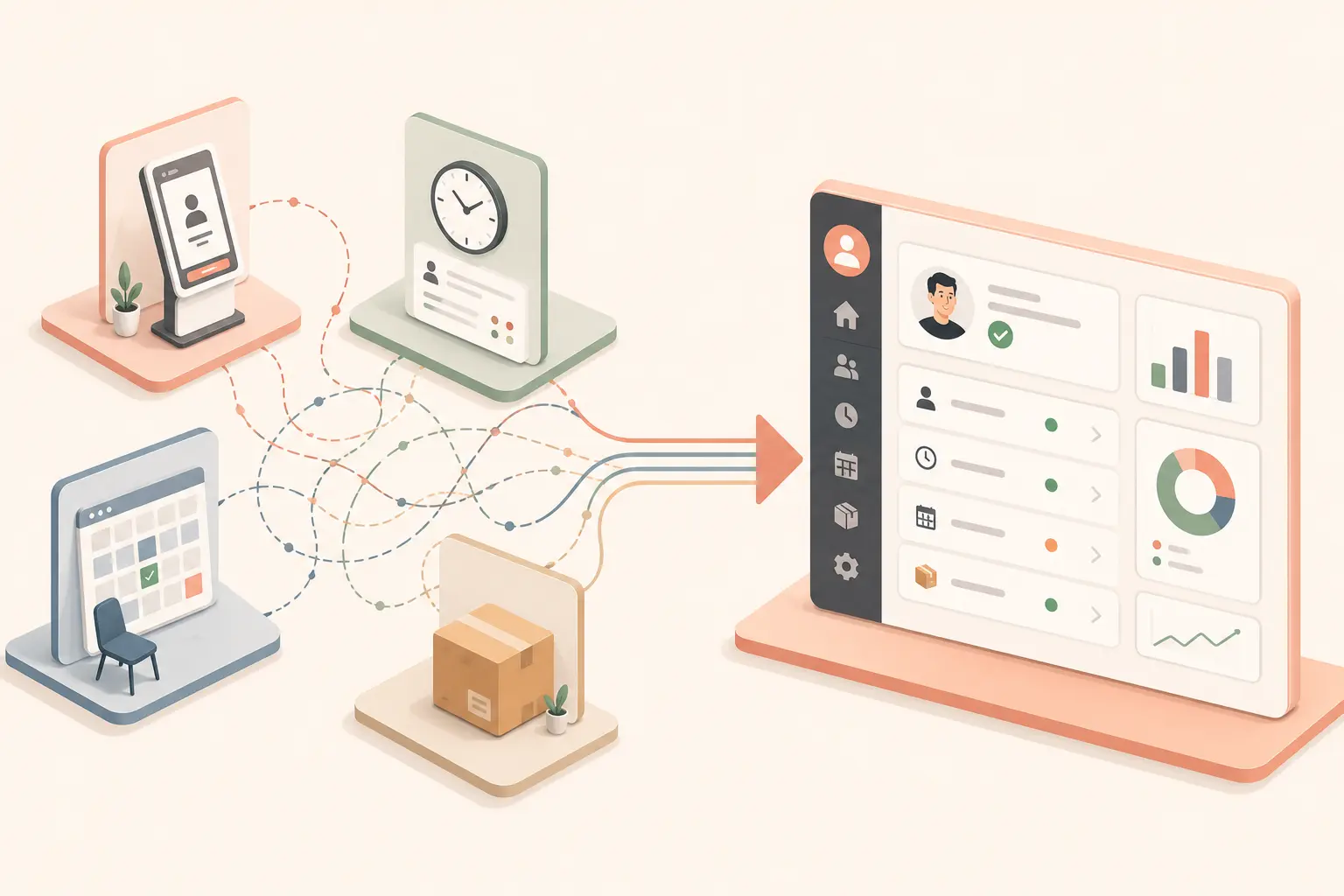
- Workplace operations data (visitor check-ins, bookings, attendance) flows to security for situational awareness
- Security data (access events, alerts, incidents) flows to workplace operations for context
This bidirectional flow creates a complete operational picture that neither system could provide alone.
Implementation Approach
Phase 1: Assess Current Security Architecture (Weeks 1-4)
- Inventory all existing security systems (access control, CCTV, visitor logs)
- Map data flows between security and operational systems (or identify their absence)
- Identify the top 5 security blind spots created by system isolation
- Document compliance requirements that demand integrated security data
Phase 2: Deploy Integrated Platform (Weeks 5-12)
- Implement the workplace management platform with security integration enabled
- Configure visitor screening workflows with watchlist integration
- Set up zone-based access policies linked to booking and attendance data
- Connect existing access control hardware through available integrations
Phase 3: Activate Advanced Capabilities (Weeks 13-20)
- Enable anomaly detection rules based on operational data patterns
- Configure emergency response workflows (evacuation headcounts, lockdown procedures)
- Set up automated incident documentation
- Train security teams on integrated dashboards and alert management
Phase 4: Optimize (Ongoing)
- Review security incidents for integration gaps
- Adjust anomaly detection thresholds based on false positive/negative rates
- Expand integration to additional hardware and software systems
- Conduct regular emergency drills using integrated response tools
Compliance Benefits of Integration
Integrated security simplifies compliance across multiple frameworks:
- ISO 27001: Physical security controls documented through integrated access logs
- SOC 2: Visitor screening and access control evidence from a single source of truth
- GDPR / DPDP Act: Data protection controls applied consistently across visitor, employee, and security data
- Industry-specific regulations (HIPAA for healthcare, FERPA for education): integrated audit trails that demonstrate control over physical access to sensitive areas
Frequently Asked Questions
Does integration require replacing our existing access control hardware? In most cases, no. Modern workplace management platforms integrate with existing access control infrastructure through standard protocols (Wiegand, OSDP) and vendor-specific APIs. Your existing badge readers, turnstiles, and controllers can typically continue operating while gaining the data integration benefits of the platform.
How does integrated security handle multi-site organizations? The platform provides centralized security management with location-specific configurations. Security policies, watchlists, and emergency procedures can be standardized across all sites while allowing local variations. A single dashboard provides multi-site visibility for security leadership.
What about privacy concerns with integrated data? Integration must be designed with privacy controls. Role-based access ensures that security teams see only security-relevant data, not personal employee information. Visitor data is retained only as long as needed and protected by the same privacy controls as all other platform data. Transparency with employees and visitors about data usage is essential.
Can the system work without internet connectivity? Yes. The platform supports offline operation for core security functions - access control continues operating, check-in data is stored locally, and emergency features remain functional. Data syncs when connectivity is restored. This is critical for security systems where downtime is not acceptable.
How does integrated security improve insurance and liability posture? Comprehensive, integrated security documentation demonstrates due diligence in protecting people and assets. Many insurance providers offer reduced premiums for organizations with documented, auditable security management. In liability situations, timestamped, cross-referenced security data provides stronger evidence than fragmented manual records.
Security as a Foundation, Not an Overlay
Workplace security works best when it is woven into the fabric of workplace operations rather than bolted on as a separate layer. When visitor management, space booking, attendance, and delivery systems share data with security, the result is a workplace that is both more secure and more efficient.
The Vizitor Workplace Management Platform integrates security into every operational module. Book a demo to see how integrated security works in practice, or review pricing to understand the investment for your organization.
For further reading, explore our guides on workplace digital transformation, integrated workplace management systems, and workplace management for government (where security requirements are especially stringent).
Try Vizitor Free
No credit card required. Setup in under 5 minutes. Manage visitors, queues, meeting rooms, and more.
Start Free TrialSee Vizitor in action check-in a visitor in under 30 seconds
Trusted by 500+ businesses. QR check-in, badge printing, NDA signing. Plans from $36/mo.