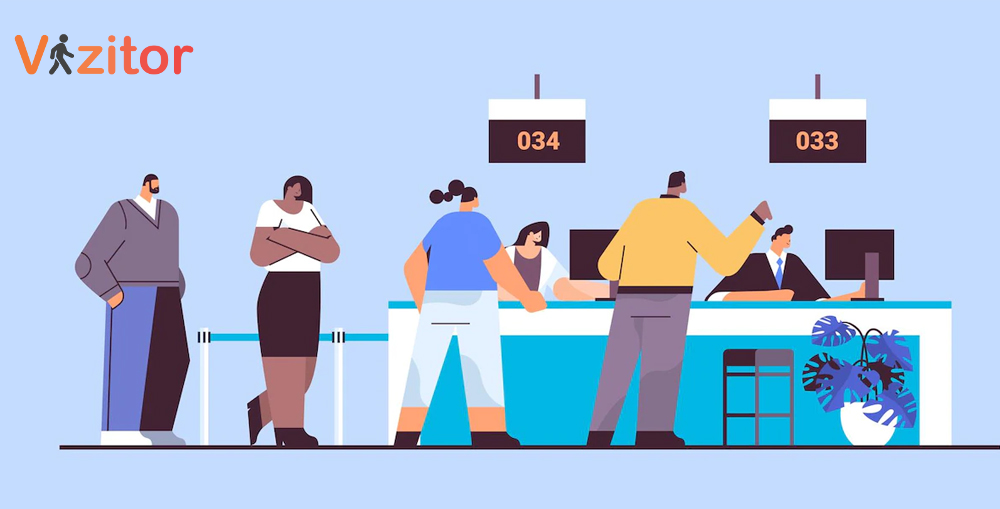
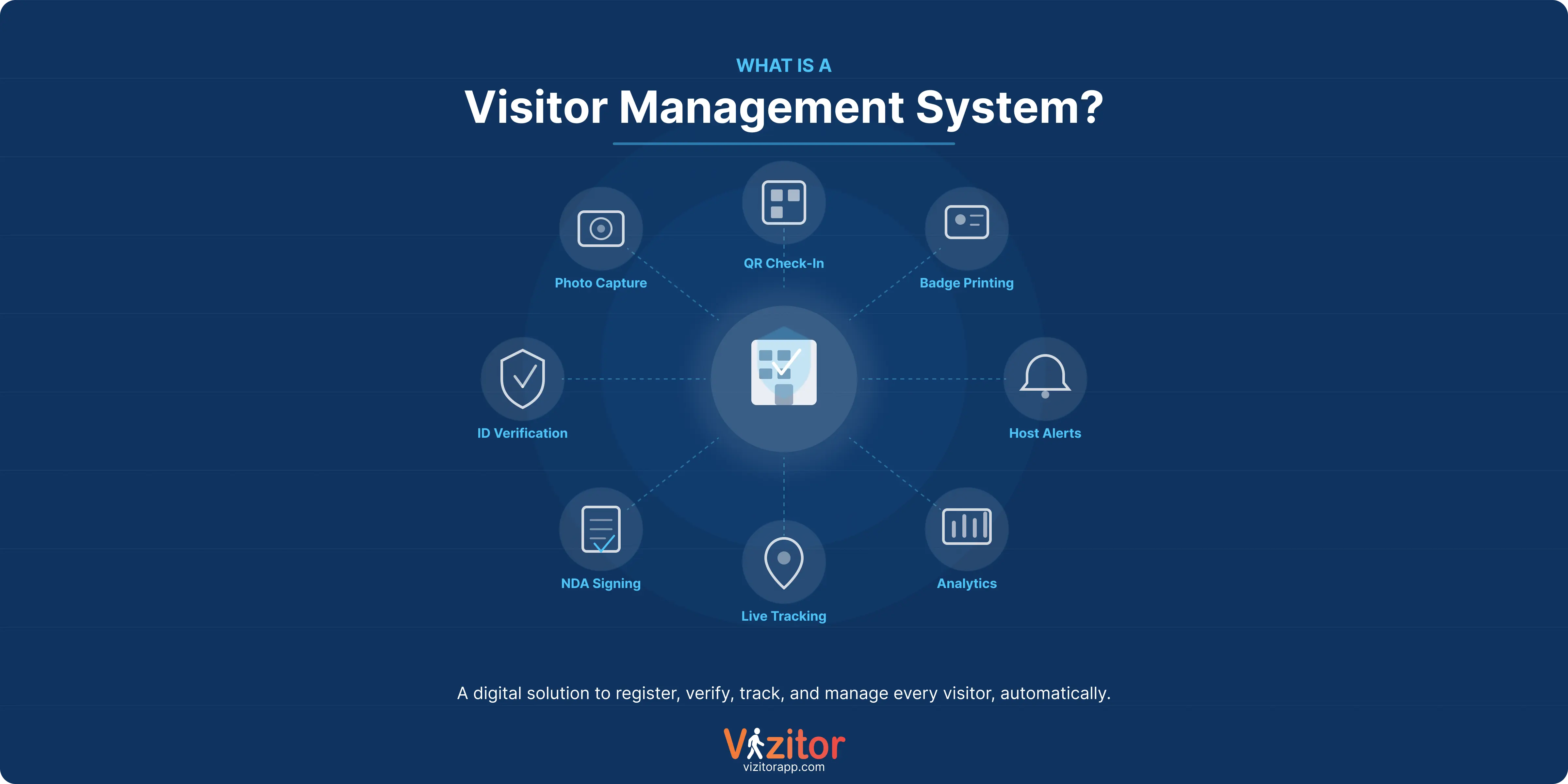
A visitor management system (VMS) is a digital solution that automates the process of registering, tracking, and managing every person who enters a facility. It replaces traditional paper logbooks with touchless check-ins, QR code entry, ID verification, badge printing, and real-time host notifications, giving businesses complete control over who is on their premises at any given moment.


Published on: Tue, Feb 17, 2026
Read in 14 minutes
Think about the last time you walked into a corporate office, a hospital, or even a co-working space. Were you handed a crumbling paper register and a chewed-up pen? Or did you scan a QR code, get a digital badge, and walk in within 30 seconds?
That difference is a visitor management system at work.
The global VMS market was valued at approximately $1.7 billion in 2025 and is projected to reach $6 billion by 2035, growing at a CAGR of over 13%. In India, the adoption rate is even steeper driven by the Digital India initiative, rising security concerns, and the explosive growth of IT parks, corporate campuses, and gated communities across tier-1 and tier-2 cities.
Whether you manage a 10-person startup in Chandigarh or a 5,000 employee campus in Bangalore, this guide will give you everything you need to understand visitor management systems; how they work, what features to look for, which industries benefit most, and how to choose the right one for your organization.
A visitor management system is software typically cloud-based that digitizes the entire lifecycle of a visitor’s interaction with your facility. From the moment a guest is invited, to check-in, to their time on-premises, to check-out, a VMS handles every step automatically.
At its core, a VMS answers three critical questions for any organization:
1. Who is on our premises right now?
2. Why are they here, and who are they meeting?
3. When did they arrive, and when did they leave?
Traditional paper logbooks technically answered these questions too but with illegible handwriting, no verification, no real-time alerts, and zero data security. A modern VMS transforms visitor management from a passive, unreliable process into an active, intelligent security layer.
In the Indian context, where facilities range from high-security IT corridors to residential societies and government buildings, a VMS is no longer a luxury, it’s a compliance and security necessity.
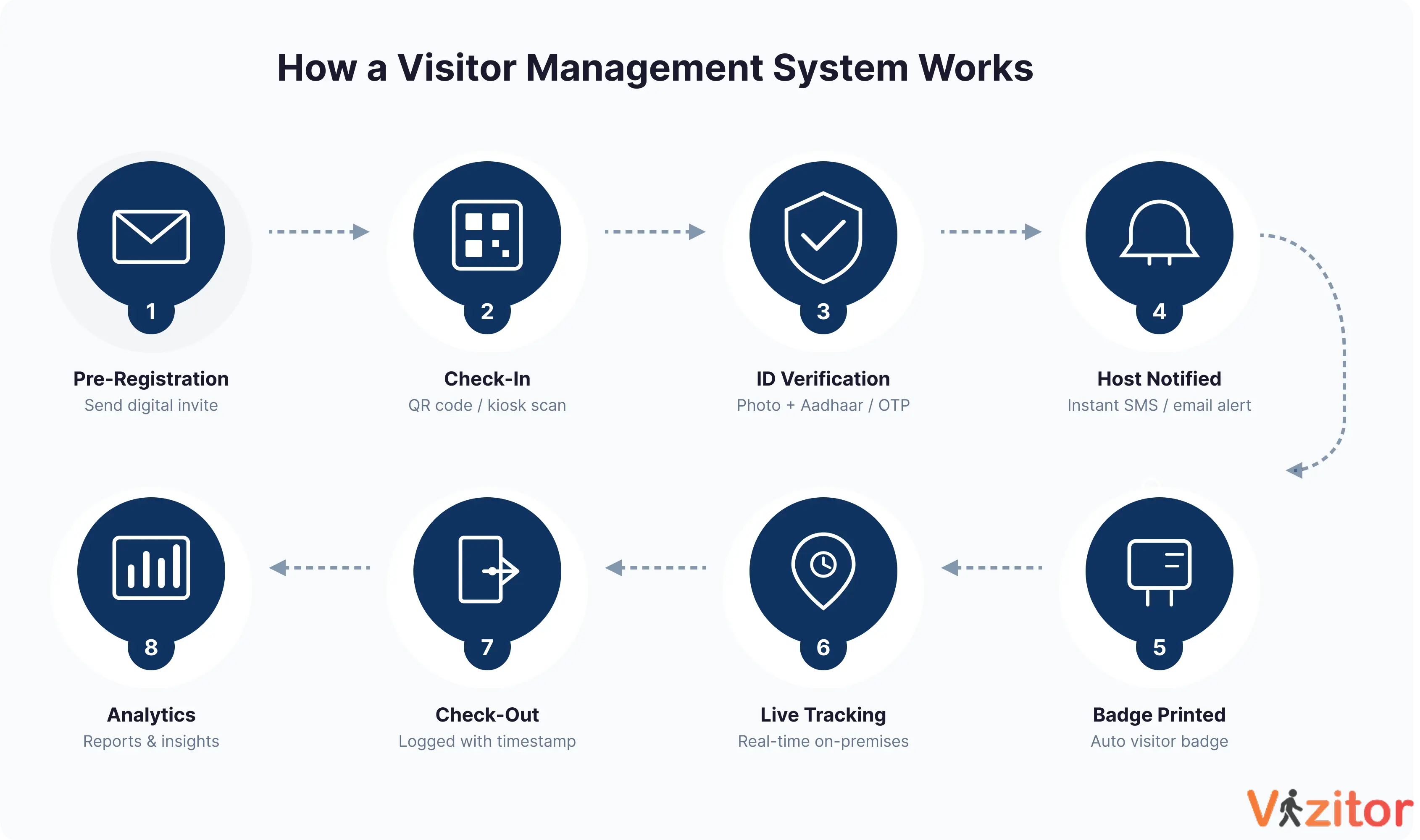
A visitor management system follows a structured workflow that covers the complete visitor journey. Here’s how it works, step by step:
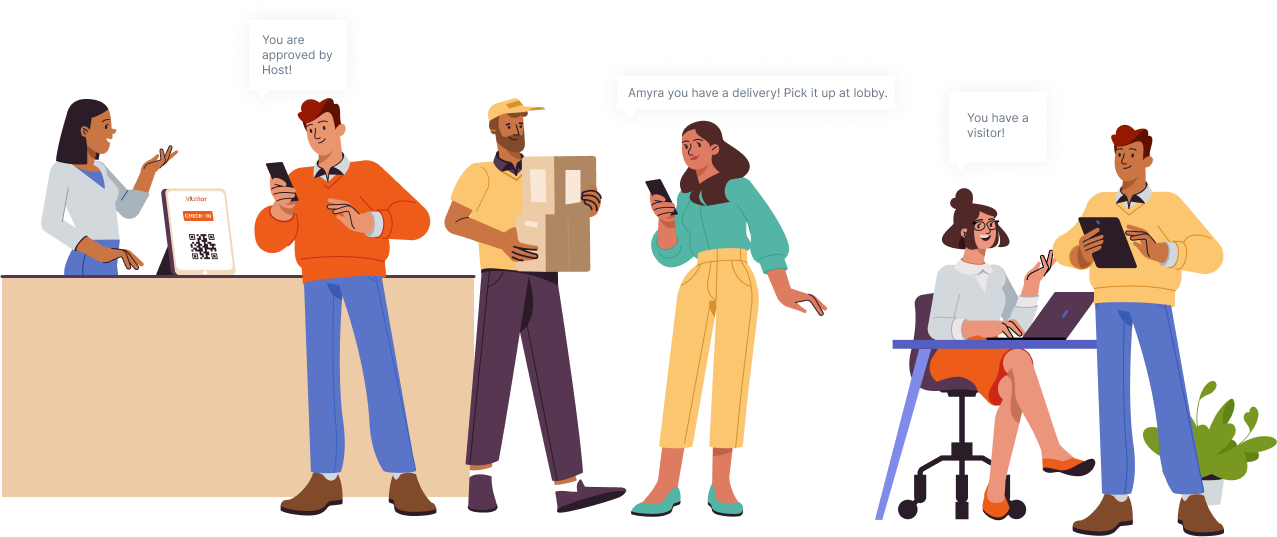
The host sends a digital invitation to the expected visitor via email, SMS, or WhatsApp. The invite contains the visit date, time, host details, and a unique QR code. For scheduled meetings, this eliminates front-desk bottlenecks entirely.
When the visitor arrives, they check in using one of several methods: scanning the pre-sent QR code on a kiosk or tablet, entering their details on a self-service touchscreen, or using a mobile app. The system captures their photo, purpose of visit, and ID details automatically.
Depending on the security level required, the VMS can verify the visitor’s identity through government ID scanning (Aadhaar, PAN, driving licence in India), facial recognition, OTP-based mobile verification, or manual approval by the host.
The moment check-in is complete, the host receives an instant notification via SMS, email, app push notification, or even WhatsApp that their visitor has arrived. No more calling reception to ask if your 3 PM meeting has shown up.
The system automatically prints a visitor badge with their name, photo, host name, date, and access level. This makes it easy for security and employees to identify authorised visitors on the premises.
The VMS tracks the visitor’s presence in real time. If a visitor overstays their expected duration, the system can send overstay alerts to the admin or security team. This is critical for compliance-heavy environments like hospitals, data centres, and government facilities.
When the visitor leaves, they check out through the app, kiosk, or are manually checked out by reception. The system logs the exact departure time, completing the visit record.
Every visit is permanently logged in a searchable cloud database. Admins can pull reports on visitor volume, peak hours, frequent visitors, average visit duration, and host-wise analytics, all from a single dashboard.
Not all visitor management systems are created equal. Here are the features that separate a professional-grade VMS from a basic digital register:
| Feature | What It Does |
|---|---|
| Touchless / QR Code Check-In | Visitors scan a QR code to check in without touching any shared device; faster, safer, and more hygienic |
| Visitor Pre-Registration | Hosts invite guests in advance so they can skip the front desk queue entirely on arrival |
| Instant Host Notifications | Automatic SMS, email, or WhatsApp alerts to the host the moment a visitor checks in |
| Badge Printing | Auto-generates visitor badges with photo, name, host, and access level for easy identification |
| Digital Document Signing | Visitors can sign NDAs, waivers, safety agreements, or health declarations digitally during check-in |
| Photo Capture & ID Verification | Captures visitor photo and can verify identity through Aadhaar, PAN, or other government ID in India |
| Real-Time Dashboard | Live view of all visitors currently on premises, with search, filter, and export capabilities |
| Multi-Location Support | Centralised management of visitor data across multiple offices, branches, or campuses from one dashboard |
| Analytics & Reporting | Detailed reports on visitor volume, peak hours, host activity, and visit trends for data-driven decisions |
| Integration Capabilities | Connects with access control systems, CCTV, HR software, CRM, and building management tools |
Explore Visitor Management System
Visitor management solutions come in different deployment models. The right choice depends on your organization’s size, security requirements, budget, and IT infrastructure.
The most popular option in 2026. The software is hosted on the vendor’s servers, and you access it through a web browser or mobile app. There’s no hardware to maintain, updates are automatic, and you can manage multiple locations from anywhere. This is ideal for SMBs, startups, co-working spaces, and organizations with multiple branches. Vizitor is a cloud-based VMS, which means you can get started in minutes without any IT overhead.
The software is installed on your own servers within your facility. This gives you complete control over data but requires in-house IT resources for maintenance, updates, and security. This model is typically chosen by government facilities, defence installations, and organizations with strict data residency requirements.
Combines cloud and on-premise elements. For example, core visitor data stays on local servers while analytics and reporting run in the cloud. This suits large enterprises that want the flexibility of cloud with the data control of on-premise.
Uses self-service kiosks (often iPads or Android tablets) placed at reception. Visitors interact with the kiosk directly for check-in, photo capture, and badge printing. This works well for high-traffic lobbies, hospitals, and event venues where a dedicated receptionist may not always be available.
Relies entirely on mobile apps for both visitors and hosts. The visitor receives an invite with a QR code, checks in via their phone, and the host manages everything from their app. This is the most contactless option and is growing rapidly in post-COVID workplaces across India.
Switching from a paper logbook to a digital VMS isn’t just an upgrade, it’s a transformation in how your organization handles security, compliance, and first impressions. Here are the key benefits:
A VMS creates a verified, auditable record of every person who enters your facility. With features like ID verification, photo capture, and watchlist screening, you know exactly who is on your premises and can flag unauthorized individuals instantly. For Indian organizations dealing with sensitive data; IT companies, financial institutions, healthcare facilities, this level of security is non-negotiable.
Manual sign-ins take an average of 2-3 minutes per visitor. A QR code-based check-in takes under 15 seconds. For a facility receiving 50 visitors a day, that’s over 2 hours of cumulative time saved daily for both visitors and front-desk staff.
No more reception staff calling around to find the host, no more visitors waiting awkwardly in the lobby. The moment a guest checks in, the host is notified instantly. This alone transforms the visitor experience and reduces reception workload dramatically.
Regulatory bodies and corporate auditors increasingly require accurate visitor records. A VMS maintains timestamped, tamper-proof digital logs that can be retrieved in seconds. Whether it’s ISO certification, fire safety compliance, or data protection regulations, a VMS keeps you audit-ready at all times.
Your reception is your brand’s handshake. A sleek digital check-in with a branded kiosk, a personalised welcome message, and an instantly printed badge creates a professional, modern impression that a dog-eared paper register simply cannot match.
Post-COVID, the demand for contactless interactions hasn’t faded, it’s become a permanent expectation. QR code check-ins and app-based entry ensure visitors never have to touch shared devices, reducing health risks in the workplace.
A digital VMS doesn’t just log visits, it analyses them. You can track visitor volume trends, identify peak hours, see which departments receive the most guests, and optimize your front-desk staffing and resource allocation accordingly.
Eliminating paper registers, reducing reception headcount needs, preventing security breaches, and streamlining compliance, the ROI of a VMS compounds over time. For most Indian businesses, a VMS pays for itself within the first 3 months of deployment.
Visitor management systems are used across virtually every industry that receives external guests. Here are the most common use cases in India:
| Industry | Why VMS is Critical | Key Feature Needed |
|---|---|---|
| Corporate Offices & IT Parks | High visitor volume, NDA requirements, access control for sensitive areas | Pre-registration, NDA signing, multi-floor access management |
| Schools & Universities | Child safety, parent tracking, contractor verification | Watchlist alerts, parent notification, visitor badge printing |
| Hospitals & Healthcare | Patient queue management, queue control, regulatory compliance | Health screening, time-limited access, emergency evacuation lists |
| Residential Societies | Delivery tracking, domestic help management, guest entry for residents | Resident approval workflow, delivery logging, gate pass system |
| Hotels & Hospitality | Guest experience, fast check-in, VIP management | Personalised welcome, digital document signing, loyalty integration |
| Co-Working Spaces | High turnover of visitors, shared amenity access, billing for guest usage | Multi-tenant management, meeting room booking integration, QR check-in |
| Manufacturing & Factories | Safety compliance, contractor management, restricted zone access | Safety induction signing, PPE acknowledgment, zone-based access control |
| Government Offices | Public accountability, high traffic, security protocols | Aadhaar/ID verification, audit trails, appointment scheduling |
Many Indian organizations especially smaller offices, societies, and local businesses still rely on paper registers. Here’s a direct comparison:
| Parameter | Paper Register | Digital VMS |
|---|---|---|
| Check-in speed | 2-3 minutes per visitor | Under 15 seconds |
| Data accuracy | Illegible handwriting, fake entries common | Verified, structured digital data |
| Security | No identity verification | Photo, ID scan, OTP, watchlist checks |
| Host notification | Receptionist calls manually | Instant automated alerts (SMS/email/app) |
| Data retrieval | Flip through pages; often impossible | Instant search in cloud database |
| Compliance | No audit trail, no timestamping | Complete, tamper-proof digital records |
| Touchless option | Not possible | QR code, app-based, contactless |
| Cost | Low upfront, high hidden costs (time, risk) | Varies according to plan |
The bottom line: paper registers create an illusion of security. A digital visitor management system provides actual security.
With dozens of VMS options available in India, selecting the right one requires evaluating several factors:
Can your receptionist, security guard, and visitors use it without training? The best VMS should be intuitive enough to deploy in a single day.
For most Indian businesses, cloud-based is the way to go, no IT overhead, automatic updates, accessible from anywhere.
Both iOS and Android apps should be available for hosts and visitors. Check that the app works well on low-end smartphones common in India.
Can you customize the check-in form, add your company logo, choose which fields to capture, and configure different workflows for different visitor types?
If you have multiple offices or branches, choose a VMS that lets you manage them all from a centralised dashboard.
Check whether the VMS integrates with your existing access control, CCTV, HR, or property management systems.
Ensure the VMS encrypts visitor data, complies with data protection norms, and offers role-based access for admins.
Avoid vendors with hidden costs. Look for clear per-location or per-feature pricing. A free trial is a strong sign of confidence.
Local Support: For Indian businesses, having local customer support (in your timezone, ideally in your language) makes a real difference during onboarding and troubleshooting.
Vizitor is a cloud-based, contactless visitor management system built specifically for the needs of Indian workplaces. Trusted by brands like Hard Rock, Veolia, Shiprocket, and Digicel, it offers a complete workplace platform that goes beyond visitor management.
Here’s what makes Vizitor different:
Visitors scan a QR code from their phone, no shared devices, no queues, no germs.
Hosts get real-time alerts via SMS, email, WhatsApp, or the Vizitor app the moment their guest arrives.
Professional visitor badges with photo, name, and access details printed in seconds.
Visitors sign NDAs, health declarations, and waivers digitally during check-in.
Hosts invite visitors in advance so they walk in without any front-desk friction.
Available on Web, iOS, and Android; manage your workplace from any device.
Vizitor also offers attendance management, delivery management, meeting room booking, space management, and queue management; all from a single platform.
A visitor management system is no longer a nice-to-have. In 2026, it is fundamental infrastructure for any organization that takes security, efficiency, and professionalism seriously.
Whether you run a 10-person office or a 10-building campus, the shift from paper to digital visitor management is one of the highest-ROI technology investments you can make. The check-in experience is often the very first interaction a person has with your organization, make it count.
Ready to upgrade your visitor management?
Start your free trial with Vizitor today.
A visitor management system (VMS) is a digital tool that automates the process of registering, verifying, tracking, and managing visitors at a facility. It replaces paper logbooks with features like QR code check-in, badge printing, real-time host notifications, and searchable visitor logs.
Key benefits include enhanced workplace security, faster check-ins (under 15 seconds vs 2-3 minutes with paper), instant host notifications, compliance with audit and safety regulations, touchless and hygienic entry, professional first impressions, and data-driven visitor analytics.
Yes, Small businesses are often more vulnerable to security lapses because they lack dedicated security teams. A cloud-based VMS like Vizitor is cost-effective, requires no IT infrastructure, and can be set up in under 10 minutes, making it ideal for small offices, clinics, and startups.
An access control system manages who can enter specific areas using keycards, biometrics, or PINs primarily for employees. A visitor management system focuses on external guests: registration, verification, host notification, and visit logging. The best setups integrate both for complete security.
Absolutely, VMS is increasingly popular in Indian housing societies for managing guest entries, delivery tracking, domestic help verification, and gate pass management. Vizitor offers a dedicated solution for residential societies with resident approval workflows.
Yes, Vizitor has apps on both Google Play Store and Apple App Store for visitors and hosts. The admin dashboard is also accessible via any web browser.
A touchless VMS allows visitors to check in without touching any shared surface. This is achieved through QR code scanning from the visitor’s own phone, mobile app check-in, or pre-registration links sent via email or WhatsApp.
A VMS improves security by verifying visitor identity (photo, ID scan, OTP), maintaining a real-time log of everyone on premises, sending instant alerts to hosts, enabling watchlist screening, and providing emergency evacuation lists with exact visitor counts.
Yes, Vizitor offers a free trial with full access to all features. No credit card is required. You can sign up at vizitorapp.com/signup and have your digital visitor management system running within minutes.
Try Vizitor Free
No credit card required. Setup in under 5 minutes. Manage visitors, queues, meeting rooms, and more.
Start Free Trial