Attendance Management for Multi-Location Businesses


Table of Content
Try Vizitor for Free!
The Multi-Location Attendance Challenge
Managing attendance at a single location is straightforward. Managing it across 5, 50, or 500 locations introduces challenges that multiply with every site you add: inconsistent policies, fragmented data, varying compliance requirements, and limited visibility for central management.
A retail chain with 80 stores. A healthcare network with 12 clinics. A construction company with 40 active project sites. A corporation with offices in 15 cities. Each faces the same fundamental problem: how do you maintain consistent, accurate attendance tracking across distributed operations?
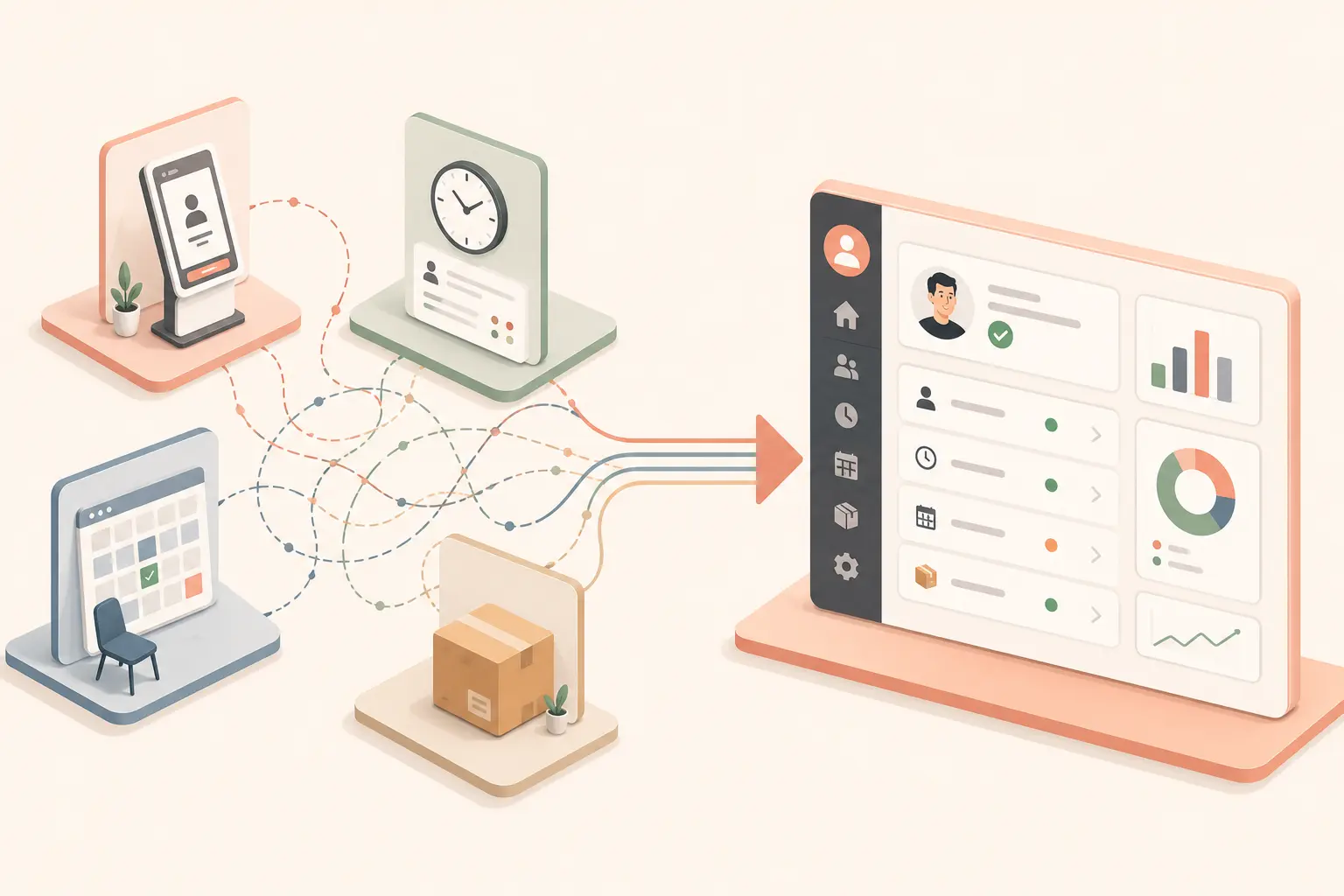
The answer is a centralized attendance management system that connects every location to a single platform. Employees clock in at their respective sites using whatever method suits the environment - biometric terminals, mobile apps, web portals, or geofencing - and all data flows into unified dashboards where managers at every level see exactly what they need.
According to Deloitte’s Global Human Capital Trends report, organizations with centralized workforce management across locations achieve 23% better labor cost optimization compared to those using fragmented, site-level systems.
Definition: Multi-location attendance management is the practice of tracking and managing employee time and attendance across multiple business sites, offices, or work locations using a centralized platform that provides unified data, consistent policies, and location-specific reporting while accommodating the unique requirements of each site.
Key Challenges and Solutions
| Challenge | Impact | Solution |
|---|---|---|
| Inconsistent policies | Compliance risk, unfair treatment | Centralized policy engine with location overrides |
| Fragmented data | No enterprise-wide visibility | Cloud platform with unified database |
| Different time zones | Scheduling and reporting confusion | Time zone-aware system |
| Varying compliance rules | Multi-jurisdiction legal risk | Location-specific compliance configuration |
| Different site environments | One tracking method does not fit all | Multi-method support per location |
| Local manager autonomy | Need for site control within corporate rules | Role-based access with hierarchical permissions |
| Employee transfers | Hours must follow the employee, not the site | Centralized employee records |
| Consolidated reporting | Corporate needs org-wide data | Multi-level reporting (site, region, org) |
Architecture of a Multi-Location Attendance System
Centralized Platform, Distributed Execution
The system should follow a hub-and-spoke model:
Central Hub (Cloud):
- Master employee database
- Corporate attendance policies
- Consolidated dashboards and reports
- Payroll integration for all locations
- Compliance rule engine
- User management and access controls
Location Spokes (On-Site):
- Clock-in devices appropriate for the site
- Local dashboards for site managers
- Site-specific policy configurations (within corporate rules)
- Offline capability for connectivity issues
- Real-time data sync to central platform
Multi-Level Hierarchy
Configure the system to reflect your organizational structure:
- Corporate level: Organization-wide policies, consolidated reporting, strategic analytics
- Regional level: Regional policy variations, regional dashboards, cross-site comparisons
- Site level: Local schedules, site manager dashboards, daily operations
- Department level: Team-specific views within each site
Configuring Policies Across Locations
Policy Layers
| Layer | Example | Managed By |
|---|---|---|
| Corporate baseline | Grace period: 10 minutes; overtime threshold: 40 hours/week | Corporate HR |
| Regional variation | California: daily OT after 8 hours | Regional compliance |
| Site-specific | Factory: shift schedules; Office: flex time | Site managers |
| Exception | Temporary policy during construction phase | Local manager + corporate approval |
Policy Inheritance
The best systems support policy inheritance: site policies inherit corporate defaults and only specify differences. This means:
- A new location automatically gets all corporate policies
- Changes to corporate policy propagate to all sites
- Sites can override specific settings with proper authorization
- Audit trails track who changed what and when
Handling Different Compliance Jurisdictions
For organizations spanning multiple states or countries, configure compliance rules per location:
- Overtime calculation method (daily vs. weekly vs. both)
- Break time requirements
- Maximum working hours
- Leave entitlements
- Record retention periods
The system applies the correct rules automatically based on where each employee works.
Tracking Methods by Location Type
Different locations may need different clock-in methods:
| Location Type | Recommended Methods | Why |
|---|---|---|
| Corporate office | Facial recognition + web portal | Professional, fast, clean |
| Retail store | Tablet kiosk + PIN | Shared device, multiple employees |
| Manufacturing plant | Fingerprint terminals | Identity verification, rugged environment |
| Construction site | Mobile GPS + geofencing | Temporary location, no infrastructure |
| Remote/home office | Mobile app + web portal | No on-site devices needed |
| Healthcare facility | Facial recognition + badge | Contactless, integrates with access control |
| Warehouse | Biometric kiosk | High-traffic entry points |
All methods feed into the same centralized platform, creating a unified dataset regardless of how each location captures time.
Reporting for Multi-Location Operations
Corporate-Level Reports
- Organization summary: Total headcount, attendance rate, overtime hours across all locations
- Location comparison: Side-by-side metrics for all sites (absenteeism, overtime, compliance)
- Cost analysis: Labor cost breakdown by location for budget management
- Trend analysis: 12-month trends across the organization
- ROI tracking: System performance metrics
Regional Reports
- Regional headcount and attendance
- Cross-location staffing (employees working at multiple sites)
- Regional compliance dashboard
- Overtime distribution across the region
Site-Level Reports
- Daily attendance summary
- Shift adherence for the site
- Overtime tracking for the location
- Leave calendar for the team
- Exception and anomaly reports
All reports should be accessible through role-based dashboards - each user sees only the data relevant to their responsibility level. See our reporting and analytics guide for deeper coverage.
Managing Employee Transfers Between Locations
When employees move between sites - temporarily or permanently - the system must:
- Maintain continuous records: Hours at the old and new location appear in a single employee timeline
- Apply correct policies: Overtime, pay rates, and compliance rules update to reflect the new location
- Update reporting: The employee counts toward the correct location’s headcount
- Preserve history: Historical data remains accessible for compliance and analysis
For employees who regularly work at multiple locations (field service, floating staff, multi-site healthcare workers), the system should track location per clock-in event rather than per employee assignment.
Implementation for Multi-Location Rollout
Phase 1: Pilot (4-6 Weeks)
- Select 2-3 representative locations for pilot
- Include different location types (office, field, retail) if applicable
- Configure corporate policies and location-specific settings
- Install hardware and enroll employees
- Run parallel with existing systems
Phase 2: Regional Rollout (4-8 Weeks)
- Expand to all locations in one region
- Refine configuration based on pilot learnings
- Train regional managers on dashboards and reporting
- Verify payroll integration across all pilot sites
Phase 3: Full Deployment (8-16 Weeks)
- Roll out to remaining regions
- Stagger by 2-3 locations per week to manage support load
- Conduct location-by-location verification
- Retire legacy systems region by region
Phase 4: Optimization (Ongoing)
- Analyze cross-location performance data
- Identify and share best practices from top-performing sites
- Refine policies based on real-world data
- Add new locations as the organization grows
For general guidance, see our system implementation guide.
Integration with Workplace Systems
Multi-location attendance management reaches full potential when integrated with:
- Payroll systems: Location-specific pay rates and tax calculations
- HR platforms: Employee records, transfers, and org structure
- Visitor management: Complete premises visibility at every location
- Workplace security: Access control aligned with attendance across sites
- Workplace management platform: Unified operations for all locations
- ERP systems: Labor cost allocation by location and cost center
Frequently Asked Questions
Can one system really handle all our different location types?
Yes. Modern cloud platforms support multiple tracking methods, policy configurations, and reporting structures within a single system. The key is choosing a platform designed for multi-location deployment, not a single-site solution stretched beyond its design.
How do we handle different time zones across locations?
The system stores all timestamps in UTC and displays them in each location’s local time zone. Reports can be generated in UTC, local time, or headquarters time depending on the audience. Scheduling respects local time zones automatically.
What if some locations have poor internet connectivity?
Choose a platform with robust offline mode. On-site terminals store data locally and sync when connected. Mobile apps buffer clock events and upload when connectivity returns. No data is lost during outages.
How do we maintain consistency while allowing local flexibility?
Use a policy inheritance model: corporate sets baseline rules that apply everywhere, and locations can adjust specific parameters (schedules, grace periods) within corporate boundaries. The system enforces the hierarchy, preventing local changes that would violate corporate policy.
What is the typical cost for a multi-location attendance deployment?
Costs scale primarily with employee count, not location count. Most cloud platforms charge per employee ($3-10/month). Hardware costs are per location (1-3 terminals per site at $300-$800 each). A 500-employee, 10-location deployment typically costs $25,000-$60,000 in Year 1 and $18,000-$60,000 annually thereafter.
Unify Attendance Across All Your Locations
Vizitor’s multi-location attendance platform provides centralized management with location-specific flexibility. Deploy biometric terminals, mobile apps, and geofencing across all your sites while maintaining unified dashboards, consistent policies, and consolidated reporting.
Combined with visitor management and workplace security in a comprehensive workplace management platform, Vizitor scales with your organization.
Schedule a demo to see multi-location management in action, or explore pricing designed for distributed operations.
Try Vizitor Free
No credit card required. Setup in under 5 minutes. Manage visitors, queues, meeting rooms, and more.
Start Free TrialSee Vizitor in action check-in a visitor in under 30 seconds
Trusted by 500+ businesses. QR check-in, badge printing, NDA signing. Plans from $36/mo.