Attendance Management and Payroll Integration


Table of Content
Try Vizitor for Free!
Why Attendance-Payroll Integration Is Non-Negotiable
The entire purpose of tracking attendance is, at its core, to pay people accurately. Every clock-in, clock-out, overtime hour, leave day, and shift differential ultimately flows into one destination: payroll. When that flow requires manual intervention - exporting data from one system, reformatting it, and entering it into another - errors are inevitable.
The American Payroll Association estimates that manual payroll processing has an error rate of 1-8% of total payroll. For an organization spending $5 million annually on payroll, that represents $50,000 to $400,000 in errors - overpayments that are difficult to recover, underpayments that damage employee trust, and correction cycles that consume HR time.
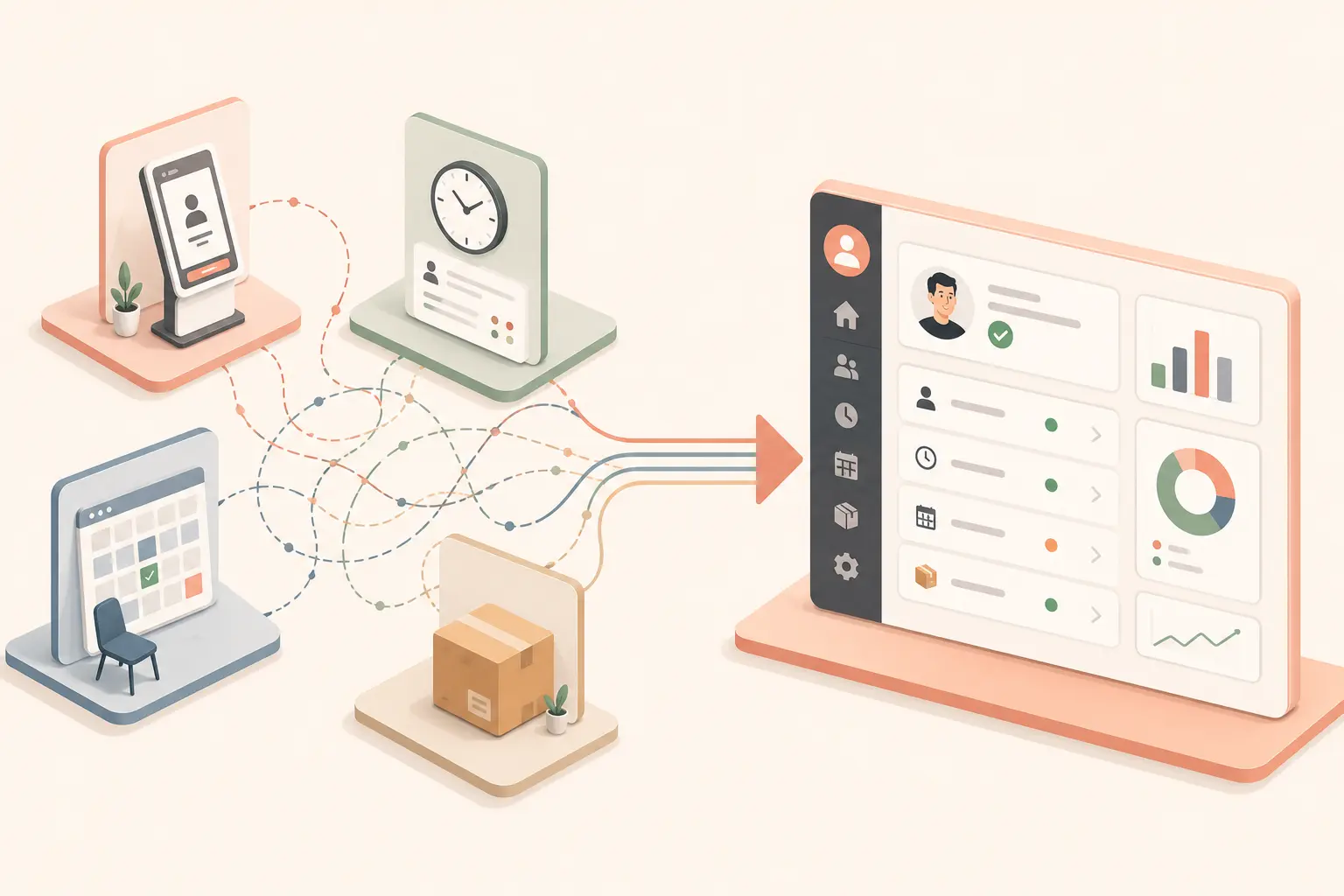
A direct integration between your attendance management system and payroll platform eliminates this gap. Verified attendance data flows automatically into payroll calculations without human hands touching the data. The result is faster processing, fewer errors, and happier employees.
Definition: Attendance-payroll integration is the automated connection between an attendance management system and a payroll processing platform that enables verified time data (regular hours, overtime, leave, shift differentials) to flow directly into payroll calculations without manual data entry or file transfer.
How Integration Works
Integration Methods
| Method | Description | Best For | Complexity |
|---|---|---|---|
| Direct API | Real-time data exchange between systems | Organizations wanting smooth automation | Medium |
| File export/import | Attendance exports CSV/Excel that payroll imports | Simple setups, batch processing | Low |
| Middleware/iPaaS | Third-party connector (Zapier, Workato) | Systems without native integration | Medium |
| Unified platform | Single system handles both functions | Organizations wanting one vendor | Low |
| Custom integration | Built-to-spec connector | Unique requirements | High |
Data Flow
The typical integration passes these data points from attendance to payroll:
Employee identification: Employee ID, name, department, cost center
Time data:
- Regular hours worked per pay period
- Overtime hours (daily, weekly, or both)
- Holiday hours worked
- Weekend hours worked
- Shift differential hours
Absence data:
- Paid leave days by type
- Unpaid leave days
- Sick leave days
- Other absence categories
Special calculations:
- On-call hours and callback time
- Travel time
- Split-shift premiums
- Night shift differentials
Benefits of Integration
1. Elimination of Data Entry Errors
Manual transfer between systems introduces errors at every step: reading the attendance report wrong, typing a number incorrectly, misclassifying overtime, or forgetting to include a late adjustment. Integration removes every one of these error opportunities.
Impact: Payroll error rates drop from 1-8% to less than 0.2%.
2. Dramatic Time Savings
| Task | Without Integration | With Integration | Time Saved |
|---|---|---|---|
| Export attendance data | 30-60 min | Automatic | 30-60 min |
| Reformat for payroll | 60-120 min | Automatic | 60-120 min |
| Enter into payroll | 60-180 min | Automatic | 60-180 min |
| Verify and reconcile | 60-120 min | 15-30 min | 45-90 min |
| Handle exceptions | 60-120 min | 30-60 min | 30-60 min |
| Total per pay period | 4.5-10 hours | 45-90 min | 3.75-8.5 hours |
For organizations processing payroll bi-weekly, that is 97-221 hours saved annually.
3. Faster Pay Cycles
When data flows automatically, payroll can be processed and distributed faster. Employees get paid on time every time, and the payroll team is not scrambling on the last day before payday.
4. Better Compliance
Integrated systems apply compliance rules consistently. Overtime calculations follow the correct rules for each jurisdiction. Break time deductions are accurate. Record-keeping requirements are met automatically.
5. Improved Employee Trust
Employees who experience frequent pay errors lose trust in the organization. Accurate, timely payments strengthen the employer-employee relationship. Self-service access to attendance records through the attendance system and pay stubs through payroll creates full transparency.
6. Audit Readiness
The integration creates a documented data trail from clock-in to paycheck. Auditors can trace any pay amount back to specific attendance events. This trail satisfies compliance requirements and simplifies audit responses.
Common Integration Challenges and Solutions
Challenge: Data Format Mismatch
Attendance and payroll systems may use different data formats, codes, or structures.
Solution: During integration setup, create a mapping table that translates attendance system codes to payroll codes. For example, overtime code “OT1” in the attendance system maps to “OVERTIME_15X” in payroll. Most integration tools include mapping configurators.
Challenge: Timing Synchronization
Attendance data may be available in real-time, but payroll processes on a specific schedule.
Solution: Configure the integration to push a finalized data set at a scheduled time before payroll processing. Include a lock-out period where attendance managers verify and approve the data before it reaches payroll.
Challenge: Exception Handling
Not every attendance scenario fits neatly into automated rules - manual corrections, special approvals, and one-time adjustments need a pathway.
Solution: Build an exception workflow where attendance managers can flag records for manual review, approve corrections, and push adjusted data to payroll. The system should log all manual interventions for audit purposes.
Challenge: Multiple Pay Rates
Organizations with complex pay structures (shift differentials, hazard pay, multi-rate employees) need the integration to handle rate variations.
Solution: Ensure the attendance system captures the context needed for rate determination - which shift, which location, which project. Map each context to the appropriate payroll rate code.
Challenge: Retroactive Adjustments
Sometimes attendance corrections need to be made after payroll has already processed.
Solution: The integration should support adjustment entries that correct the next pay period. The attendance system logs the original and corrected data, and the payroll adjustment is documented for both records.
Integration by Payroll Platform
Popular Payroll Systems and Integration Options
| Payroll Platform | API Available | File Import | Middleware Support | Notes |
|---|---|---|---|---|
| ADP | Yes | Yes | Yes | Extensive API ecosystem |
| Gusto | Yes | Yes | Yes | Modern API, SMB-focused |
| Paychex | Yes | Yes | Yes | Strong mid-market integration |
| QuickBooks Payroll | Yes | Yes | Yes | Popular for small business |
| SAP SuccessFactors | Yes | Yes | Yes | Enterprise-grade |
| Workday | Yes | Yes | Yes | Enterprise-grade |
| Paylocity | Yes | Yes | Yes | Mid-market strength |
| BambooHR Payroll | Yes | Yes | Limited | Bundled with HR suite |
Implementation Steps
Step 1: Map Data Requirements
Document every data point payroll needs from attendance:
- Which fields are required?
- What format does each field need?
- What calculations must happen before data reaches payroll?
- What codes and categories are used?
Step 2: Configure the Attendance System
Ensure the attendance platform captures all necessary data:
- Overtime tracking with correct calculation rules
- Leave management with proper categorization
- Shift differentials recorded by shift type
- Project or cost center allocation if needed
Step 3: Build the Integration
Depending on the method chosen:
- API: Configure endpoints, authentication, and data mapping
- File-based: Set up scheduled export with correct formatting
- Middleware: Configure the connector with transformation rules
Step 4: Test Thoroughly
Run parallel processing for 2-3 pay periods:
- Process payroll using both the old manual method and the new integration
- Compare outputs line by line
- Identify and resolve discrepancies
- Test edge cases (overtime, multiple rates, mid-period changes)
Step 5: Go Live
Once parallel testing confirms accuracy:
- Switch to integrated processing
- Maintain the manual process as backup for one additional period
- Monitor the first few live pay periods closely
For broader implementation guidance, see our system implementation guide.
ROI of Payroll Integration
For a 300-employee organization:
| Benefit | Annual Value |
|---|---|
| HR time savings (payroll processing) | $15,000 - $25,000 |
| Payroll error reduction | $25,000 - $100,000 |
| Compliance risk reduction | $5,000 - $50,000 |
| Faster pay cycle (employee satisfaction) | Qualitative |
| Audit preparation savings | $3,000 - $8,000 |
| Total estimated annual benefit | $48,000 - $183,000 |
Integration costs are typically included in the attendance platform subscription or require a modest one-time setup fee ($1,000-$5,000).
For detailed ROI analysis, see our attendance management ROI guide.
Best Practices for Ongoing Management
-
Review mapping quarterly. As pay structures change (new shift premiums, rate adjustments, new leave types), update the integration mapping accordingly.
-
Audit monthly. Spot-check a sample of employees each month, tracing their attendance data through to payroll output to verify accuracy.
-
Document exceptions. Every manual intervention should be logged with a reason, approver, and timestamp. This creates the audit trail needed for compliance.
-
Keep systems synchronized. When new employees are added, departments change, or cost centers are restructured, update both systems promptly.
-
Use analytics proactively. Monitor integration health metrics: error rates, exception volumes, processing times. Rising exception counts may signal configuration issues.
Frequently Asked Questions
What if our attendance and payroll systems do not have a direct integration?
File-based integration (CSV export from attendance, import to payroll) works with virtually any system combination. Middleware platforms like Zapier, Workato, or custom scripts can bridge the gap between systems without native API connections. The key is consistent data formatting and scheduled transfers.
How do we handle employees with multiple pay rates?
Configure the attendance system to capture the context that determines the rate - shift type, location, project, or job code. The integration maps each context to the appropriate payroll rate. For example, an employee working Day Shift at Location A earns Rate X, while Night Shift at Location B earns Rate Y.
Can the integration handle mid-period rate changes?
Yes, if both systems support effective-dated rate changes. The attendance system applies the correct rate based on the date of each time entry, and the integration passes the pre-calculated hours at each rate to payroll. Test this scenario thoroughly during implementation.
What level of IT involvement is needed for integration?
Cloud-to-cloud integrations using native connectors or middleware require minimal IT involvement - typically initial setup (a few hours) and periodic maintenance. Custom API integrations require more IT support. File-based integrations require almost no IT involvement.
How do we manage the transition from manual to integrated payroll?
Run parallel for 2-3 pay periods: process payroll using both the old manual method and the new integration simultaneously. Compare results, resolve discrepancies, and build confidence before fully transitioning. Maintain the ability to revert to manual processing for one additional period as a safety net.
Connect Attendance to Payroll Smooth
Vizitor’s attendance platform integrates with leading payroll systems through API connections, file exports, and middleware connectors. Combined with biometric tracking, mobile attendance, cloud dashboards, visitor management, and workplace security within a unified workplace management platform, Vizitor delivers clean, verified data directly to your payroll system.
Schedule a demo to see payroll integration in action, or explore pricing for plans that include smooth payroll connectivity.
Try Vizitor Free
No credit card required. Setup in under 5 minutes. Manage visitors, queues, meeting rooms, and more.
Start Free TrialSee Vizitor in action check-in a visitor in under 30 seconds
Trusted by 500+ businesses. QR check-in, badge printing, NDA signing. Plans from $36/mo.