Attendance Management Reports and Analytics


Table of Content
Try Vizitor for Free!
Why Attendance Analytics Matters
Collecting attendance data is only the first step. The real value emerges when that data is analyzed, visualized, and used to drive better workforce decisions. Without analytics, your attendance management system is a record keeper. With analytics, it becomes a strategic tool.
Consider two scenarios. In the first, HR generates a monthly report showing total hours worked and sends it to payroll. In the second, HR analyzes attendance patterns to discover that Tuesday absenteeism in the warehouse has increased 40% over three months, correlating with a new shift schedule - and adjusts the schedule before productivity drops further.
The second scenario represents the true potential of attendance analytics. It transforms reactive administration into proactive management.
Organizations that use workforce analytics are 3.1 times more likely to outperform their peers financially (Deloitte Human Capital Trends, 2024). Attendance data - when analyzed properly - contributes directly to workforce optimization, cost control, and employee experience improvement.
Definition: Attendance analytics is the systematic analysis of employee time and attendance data to identify patterns, trends, and anomalies that inform workforce management decisions. It encompasses standard reporting (historical data summary), dashboards (real-time monitoring), and advanced analytics (predictive modeling and trend analysis).
Essential Attendance Reports
Daily Attendance Report
Purpose: Real-time snapshot of who is present, absent, late, or on leave today.
Key data points:
- Total headcount vs. present count
- Late arrivals with variance from schedule
- Absent employees (planned vs. unplanned)
- Employees currently on overtime
- Department-level summaries
Used by: Operations managers, team leads, front-line supervisors
Weekly Attendance Summary
Purpose: Week-level view of attendance patterns across the organization.
Key data points:
- Total hours worked by department
- Overtime hours by department and individual
- Absence rate comparison across teams
- Late arrival frequency
- Leave utilization for the week
Used by: Department managers, HR operations
Monthly Attendance Report
Purpose: Comprehensive monthly summary for payroll processing and management review.
Key data points:
- Total regular hours per employee
- Total overtime hours per employee
- Leave days taken by type
- Absenteeism rate
- Compliance metrics (break adherence, hour limits)
- Payroll-ready data export
Used by: Payroll team, HR leadership, finance
Overtime Report
Purpose: Detailed analysis of overtime patterns for cost control and compliance.
Key data points:
- Overtime hours by employee, department, and period
- Overtime cost analysis
- Employees approaching overtime thresholds
- Authorized vs. unauthorized overtime
- Overtime trend (increasing, decreasing, stable)
Used by: Operations management, finance, compliance
Absence Trend Report
Purpose: Identify patterns in employee absences that signal deeper issues.
Key data points:
- Absence rate over time (monthly trend)
- Absence by type (sick, personal, unplanned)
- Department comparison
- Day-of-week patterns (Monday/Friday trends)
- Seasonal patterns
- Individual absence frequency ranking
Used by: HR leadership, department managers
Key Performance Indicators (KPIs)
Track these metrics to measure workforce attendance health:
| KPI | Formula | Healthy Range | Warning Level |
|---|---|---|---|
| Absenteeism rate | (Absent days / Total working days) x 100 | 1.5-3% | >5% |
| Tardiness rate | (Late arrivals / Total expected arrivals) x 100 | <3% | >8% |
| Overtime ratio | Overtime hours / Regular hours | <5% | >10% |
| Schedule adherence | Actual start within 5 min of scheduled / Total shifts | >95% | <85% |
| Leave utilization | Leave taken / Leave entitled | 80-95% | <60% or >100% |
| Time-to-fill vacancy | Days to fill open shifts | <4 hours | >24 hours |
| Payroll accuracy | Correct pay runs / Total pay runs | >99.5% | <98% |
Dashboard Design Principles
Real-Time Operations Dashboard
For managers who need to see the current state of attendance:
Include:
- Today’s headcount (present/absent/late) with percentage
- Color-coded department status (green/yellow/red)
- Real-time alerts for exceptions
- Shift coverage status
- Quick access to individual employee status
Design tips:
- Default to today’s view
- Use traffic-light color coding
- Show actionable items prominently
- Allow drill-down from summary to detail
Strategic Analytics Dashboard
For HR and leadership who need trend analysis:
Include:
- 12-month absenteeism trend line
- Overtime cost trend
- Department comparison charts
- Year-over-year comparisons
- Compliance scorecard
Design tips:
- Default to monthly/quarterly views
- Use comparative visualizations
- Highlight significant changes
- Include benchmarks for context
Advanced Analytics Capabilities
Predictive Absenteeism Modeling
AI-powered systems can predict likely absenteeism based on:
- Historical patterns (seasonal, day-of-week, post-holiday)
- Weather forecasts
- Local event calendars
- Individual employee history
This enables proactive scheduling - adding backup staff on predicted high-absence days.
Cost Impact Analysis
Connect attendance data to financial data to understand:
- Cost of absenteeism per department per month
- Overtime cost trends and drivers
- ROI of attendance management investments
- Labor cost per unit of output
Anomaly Detection
AI algorithms flag unusual patterns that manual review would miss:
- Sudden increase in absences for a specific team
- Individual patterns suggesting abuse (consistent Friday absences)
- Overtime clustering in specific periods
- Clock-in time shifts suggesting schedule gaming
Correlation Analysis
Identify relationships between attendance patterns and other business metrics:
- Attendance vs. production output
- Absenteeism vs. employee satisfaction scores
- Overtime vs. quality defect rates
- Tardiness vs. customer satisfaction
Using Analytics for Decision Making
Staffing Optimization
Question: Are we overstaffed or understaffed?
Data to analyze: Compare scheduled headcount against actual attendance patterns. If you consistently schedule 50 but only 42 show up, you have a chronic coverage problem. If you schedule 50 and always have 50 present with minimal overtime, your scheduling is efficient.
Action: Adjust staffing models based on actual attendance rates rather than theoretical capacity.
Overtime Management
Question: Is our overtime cost justified?
Data to analyze: Break down overtime by cause - understaffing, project demands, employee choice, poor scheduling. Each cause has a different solution.
Action: If overtime is driven by chronic understaffing, hire additional staff. If driven by poor scheduling, optimize shift management. If driven by employee preference, ensure it is authorized and compliant.
Employee Engagement
Question: Are attendance patterns signaling engagement problems?
Data to analyze: Rising absenteeism in a specific department, increasing tardiness for a team, or declining leave utilization (employees not taking breaks) can all signal engagement issues.
Action: Investigate root causes through conversations and surveys. Address workload, management, or environmental factors.
Compliance Monitoring
Question: Are we meeting all labor law requirements?
Data to analyze: Track overtime compliance, break adherence, maximum hour limits, and record completeness across all locations and employee types.
Action: Address violations immediately. Implement system alerts for threshold warnings.
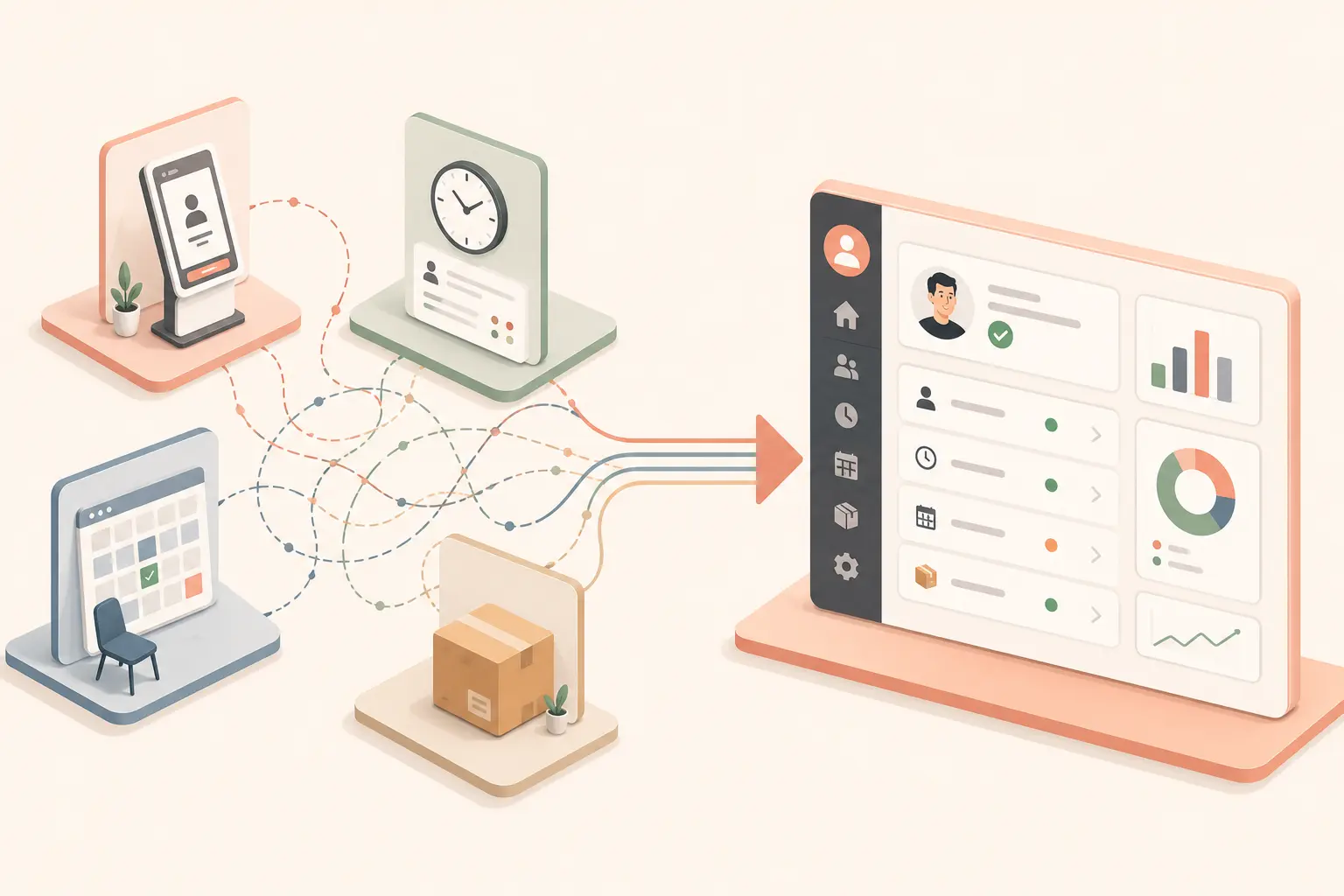
Integration with Other Data Sources
Attendance analytics become more powerful when combined with data from:
- Payroll systems: Connect hours to costs for true financial analysis
- HR platforms: Correlate attendance with performance, engagement, and turnover
- Production systems: Link attendance to output for manufacturing analytics
- Visitor management: Combine employee and visitor data for complete premises analytics
- Workplace management platform: Unified analytics across all workplace operations
- Business intelligence tools: Export data for advanced analysis and custom dashboards
Reporting Best Practices
-
Automate distribution. Schedule reports to be generated and emailed automatically. Managers should not need to log in to get routine reports.
-
Match report frequency to audience. Operations managers need daily reports. HR needs weekly. Leadership needs monthly. Do not overwhelm anyone with more data than they can act on.
-
Focus on exceptions. The most useful reports highlight what is unusual, not what is normal. A report that says “everything is fine” is less valuable than one that says “Department X absenteeism is 150% above average.”
-
Include context. Raw numbers without context are misleading. Show trends, comparisons, and benchmarks alongside the data.
-
Make it actionable. Every report should suggest or enable a specific action. If the overtime report shows a spike, it should be easy to see why and take corrective steps.
-
Secure sensitive data. Attendance data is personal information. Apply role-based access controls to reports and dashboards. Use our cloud security features to protect data.
Frequently Asked Questions
What reports should we start with?
Begin with three core reports: a daily attendance summary (for operations), a monthly payroll-ready report (for HR), and an overtime tracking report (for finance). These cover immediate operational needs. Add trend analysis and advanced analytics as you become comfortable with the data.
How do we ensure report accuracy?
Report accuracy depends on data accuracy. Implement reliable tracking methods (biometric, GPS), establish clear exception handling processes, and audit a sample of records monthly. If input data is clean, reports will be accurate.
Can non-technical managers use attendance analytics?
Yes, if the system is well-designed. Modern dashboards use visual formats (charts, color coding, heat maps) that communicate insights without requiring data analysis skills. The platform should enable drill-down from summary to detail without technical knowledge.
How far back should we analyze attendance data?
For trend analysis, 12-24 months of data provides meaningful patterns. For compliance auditing, maintain records for the legally required retention period (typically 3-7 years). Cloud platforms store historical data indefinitely without additional storage costs.
What is the difference between reports and analytics?
Reports summarize what happened (descriptive). Analytics explain why it happened (diagnostic) and predict what will happen next (predictive). Both are valuable. Reports serve day-to-day operations; analytics support strategic decision making.
Transform Attendance Data into Decisions
Vizitor’s analytics and reporting capabilities include real-time dashboards, automated report scheduling, trend analysis, and anomaly detection - all within a unified workplace management platform that also covers visitor management and workplace security.
Request a demo to explore attendance analytics firsthand, or view pricing for plans that include advanced reporting features.
Try Vizitor Free
No credit card required. Setup in under 5 minutes. Manage visitors, queues, meeting rooms, and more.
Start Free TrialSee Vizitor in action check-in a visitor in under 30 seconds
Trusted by 500+ businesses. QR check-in, badge printing, NDA signing. Plans from $36/mo.