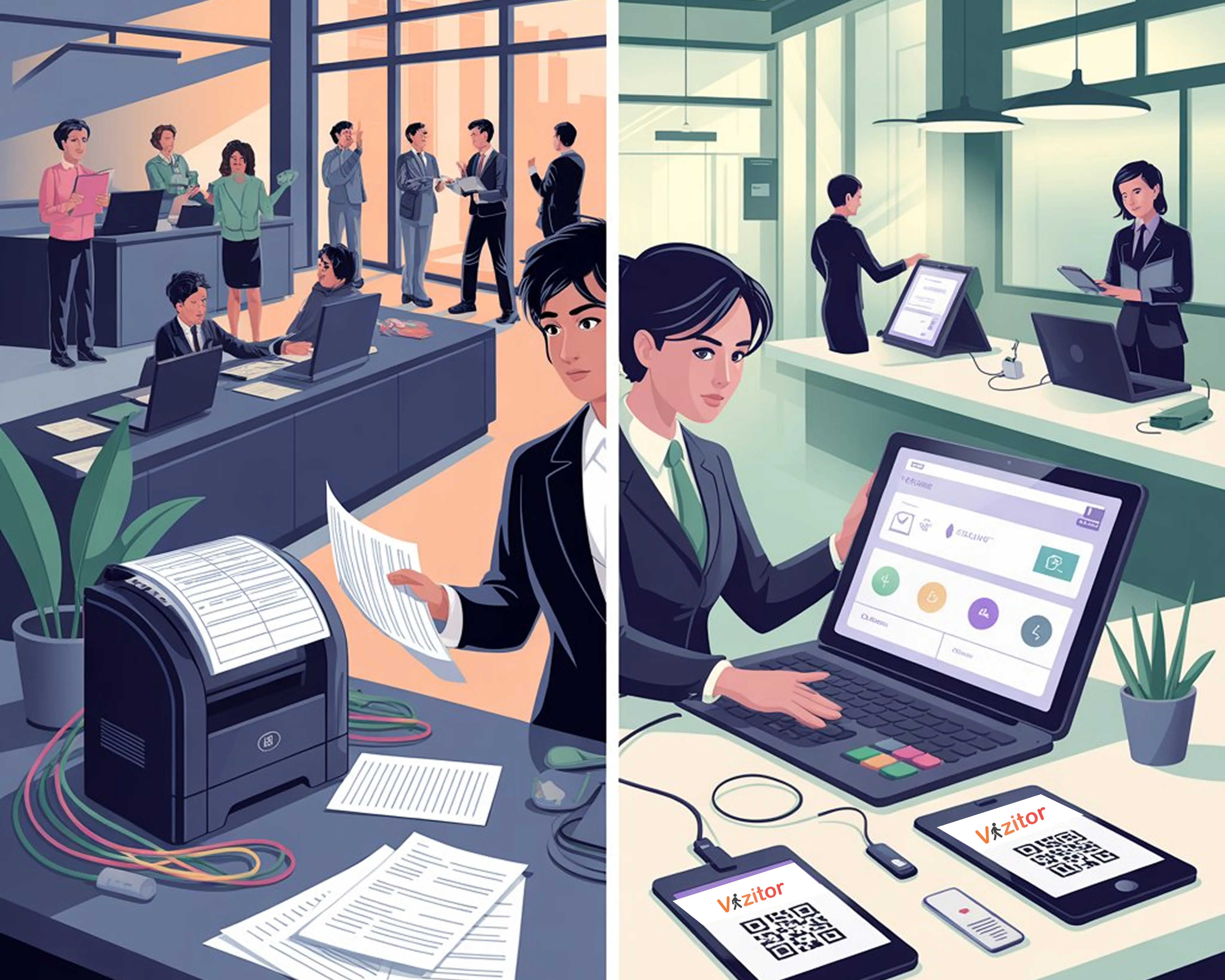
Many businesses rush into buying visitor management software without fully understanding their workplace needs; leading to poor security, wasted money, and inefficient visitor entry processes. This blog highlights the five most common mistakes companies make when choosing a system, such as ignoring compliance, underestimating visitor registration needs, focusing only on price, or overlooking scalability. It also explains how smart, cloud-based tools like Vizitor help enterprises manage multi-location visitor tracking, badge printing, and data security. By avoiding these pitfalls, organizations can select the right solution to enhance safety, compliance, and guest experience from the front desk to every entry point.


Published on: Mon, Nov 10, 2025
Last updated: 2026-04-05
Read in 9 minutes
Your front desk isn’t just about greetings. It’s about security, compliance, and first impressions.
Every day, businesses welcome dozens of visitors: clients, vendors, interviewees, delivery agents, and contractors. Managing this flow efficiently is crucial, and that’s where visitor management software (VMS) comes in.
But with so many tools promising “smart check-ins” and “easy setup,” businesses often make costly mistakes during selection. The wrong choice leads to security gaps, hidden costs, and poor visitor experiences that reflect badly on your brand.
This post covers the five most common mistakes businesses make when purchasing visitor management software, and exactly what to do instead.
The biggest mistake most businesses make is jumping straight into software selection without clearly defining their visitor entry goals.
Every workplace is unique. Some need fast, contactless entry for high traffic. Others need detailed visitor logs for compliance and safety. A manufacturing plant has very different requirements from a co-working space or a law firm.
When you skip the needs assessment, you end up with a tool that’s either overcomplicated or underpowered for your actual situation.
Create a short checklist of your entry requirements before comparing tools. It will save you from long-term mismatches and vendor lock-in. The process of writing out your requirements also surfaces hidden needs you hadn’t considered, like the fact that your compliance team wants audit-ready logs, or that your security team needs watchlist screening.
Don’t let a flashy demo substitute for a requirements conversation with everyone who touches the front desk: reception staff, IT, security, HR, and facilities management all have legitimate input.
A visitor management system collects and stores sensitive data: names, contact details, photos, ID scans, signed documents, and visit records. That’s a significant data liability if handled poorly.
Many businesses choose lower-cost tools that lack data encryption, access control, or compliance certifications. This can trigger serious legal exposure, especially for organizations operating under GDPR, HIPAA, or other data protection frameworks.
According to industry research, 44% of data breaches involve unauthorized physical access, and the average cost of a data breach reached $4.44 million in 2025. Your front desk is a direct contributor to that risk if visitor data isn’t managed properly.
Understanding the complete visitor management system picture means understanding that compliance isn’t optional in 2026. It’s a core requirement that affects your procurement decision, not an add-on feature.
Don’t just ask vendors whether they’re compliant. Ask for documentation. Ask which specific regulations they support. Ask how they handle data deletion requests. A vendor who can’t answer these questions clearly isn’t ready for enterprise deployment.
Think about who your visitors are: clients, partners, job applicants, contractors, auditors. If your visitor registration process feels slow, confusing, or outdated, it leaves a poor first impression before the meeting even starts.
This matters more than most businesses realize. A visitor’s experience at your reception shapes their perception of your entire organization. If the check-in process is slow and manual, they arrive at your meeting room already slightly frustrated.
Vizitor’s digital registration tools create this experience without requiring expensive hardware or complex IT setup. You can go live on an existing Android or iOS tablet, with visitors self-checking in and hosts notified automatically.
For a deeper look at what a modern process should include, see our guide on what makes a visitor management system complete.
See how Vizitor handles visitor management
Join 2,000+ workplaces using Vizitor to manage visitors securely. Free trial, no credit card required.
Book a DemoBudget matters. But buying visitor management software based solely on upfront cost is a long-term mistake that often costs more in the end.
Many low-cost tools lack essential features like multi-location management, badge printing, or analytics dashboards. When you outgrow a cheap tool in six months, you pay switching costs: migration, retraining, integration work, and the productivity hit during transition.
The right way to evaluate cost is total cost of ownership over 24 months, not the monthly subscription line item.
Another dimension: what is the cost of your current process? If your receptionist spends 2-3 minutes per visitor and you have 40 visitors per day, that’s roughly 2 hours of staff time daily, or 40 hours per month, just on manual check-ins. A digital system that costs $50/month but saves 40 hours of staff time monthly is an obvious win on ROI alone.
Always request a demo and transparent pricing breakdown before committing to a long-term plan. Any vendor unwilling to share clear pricing is a vendor you should approach with caution.
Workplaces evolve. What works for one office today may fail for five offices tomorrow. What works for 20 daily visitors may break at 200.
A common mistake is choosing software that can’t scale with growth or integrate with your existing workplace systems. When your visitor management system lives in a silo, you create manual work: someone has to cross-reference visitor logs with access control systems, manually update host lists from your HRMS, and export data to spreadsheets for compliance reports.
When evaluating scalability, ask vendors specifically: “If we add three more offices in 18 months, what does that process look like?” and “How does the pricing change?” The answers tell you a lot about whether the vendor is genuinely built for enterprise growth or just hoping you’ll stay small.
For organizations with multiple sites already in play, see our breakdown of enterprise visitor management for multi-site offices.
Given these five mistakes, here’s a practical framework for making a better buying decision:
Week 1: Define requirements. Document your current process, identify your pain points, and get input from all stakeholders. Create a written list of must-have and nice-to-have features.
Week 2: Shortlist vendors. Identify 3-4 vendors who meet your must-have criteria. Request demos with your actual use cases, not canned demos.
Week 3: Test in context. Run a free trial with real visitors if possible. Check whether the system handles your specific visitor types, notification channels, and compliance requirements.
Week 4: Evaluate support and scalability. Talk to the vendor’s support team, not just sales. Ask about onboarding, training, and what happens when something breaks.
Decision point: Choose the system that solves your core problems cleanly, integrates with what you already have, and has a clear upgrade path.
A well-chosen visitor management system does several things consistently:
Vizitor is built to deliver all of this, starting at $20/month with a free trial that requires no credit card. You can test the full system on your existing hardware before you commit.
Q1. What is the biggest mistake companies make when buying visitor management software? The most common mistake is evaluating only on price without considering scalability, compliance, and integration needs. A cheap system that you replace in a year costs more than a well-chosen system that lasts five years.
Q2. Why is visitor registration important for offices? Visitor registration improves accuracy, compliance, and security while making the check-in process faster and more professional. It creates a record you can audit, report on, and use for emergency management.
Q3. How much does visitor management software cost? Pricing depends on the number of locations, features, and automation levels. Vizitor starts at $20/month. Enterprise plans are scoped based on location count and feature requirements. Always request a full pricing breakdown before committing.
Q4. Can visitor management systems handle multiple locations? Yes. Modern systems like Vizitor provide a centralized dashboard for managing visitor registration, analytics, and security logs from all branches in real time, with standardized processes across every site.
Q5. What integrations should I look for in a visitor management system? Prioritize integrations with your access control system, HR/employee directory, calendar tools, and communication platforms (Slack, Teams, email). The more the system connects to your existing infrastructure, the less manual work your team carries.
Q6. How long does it take to implement a visitor management system? Most organizations can configure and go live with Vizitor in a single afternoon. The setup time is primarily spent uploading NDAs, configuring visitor types, and building the host list, not technical deployment. See our migration guide from sign-in sheet to smart office for a step-by-step walkthrough.
Try Vizitor Free
No credit card required. Setup in under 5 minutes. Manage visitors, queues, meeting rooms, and more.
Start Free Trial