Workplace Management for Healthcare


Table of Content
Try Vizitor for Free!
Why Healthcare Needs Purpose-Built Workplace Management
Healthcare facilities operate under a unique set of constraints that general office management tools were never designed to handle. Hospitals, clinics, and diagnostic centers must simultaneously manage patient flow, staff scheduling across shifts, visitor screening, regulatory compliance, emergency protocols, and physical security - often across sprawling multi-building campuses.
The stakes are higher, too. A missed visitor screening in a corporate office is an inconvenience. In a hospital, it can be an infection control failure.
Definition: Workplace management for healthcare refers to the coordinated use of digital systems to manage the flow of people, spaces, and operations within healthcare facilities - including patient visitors, staff attendance, room utilization, deliveries, and security - while maintaining strict compliance with healthcare regulations.
According to a 2025 study published in the Journal of Healthcare Management, hospitals that implemented integrated workplace management systems reduced patient wait times by 24% and visitor processing times by 67%. Those numbers translate directly into better patient outcomes and higher satisfaction scores.
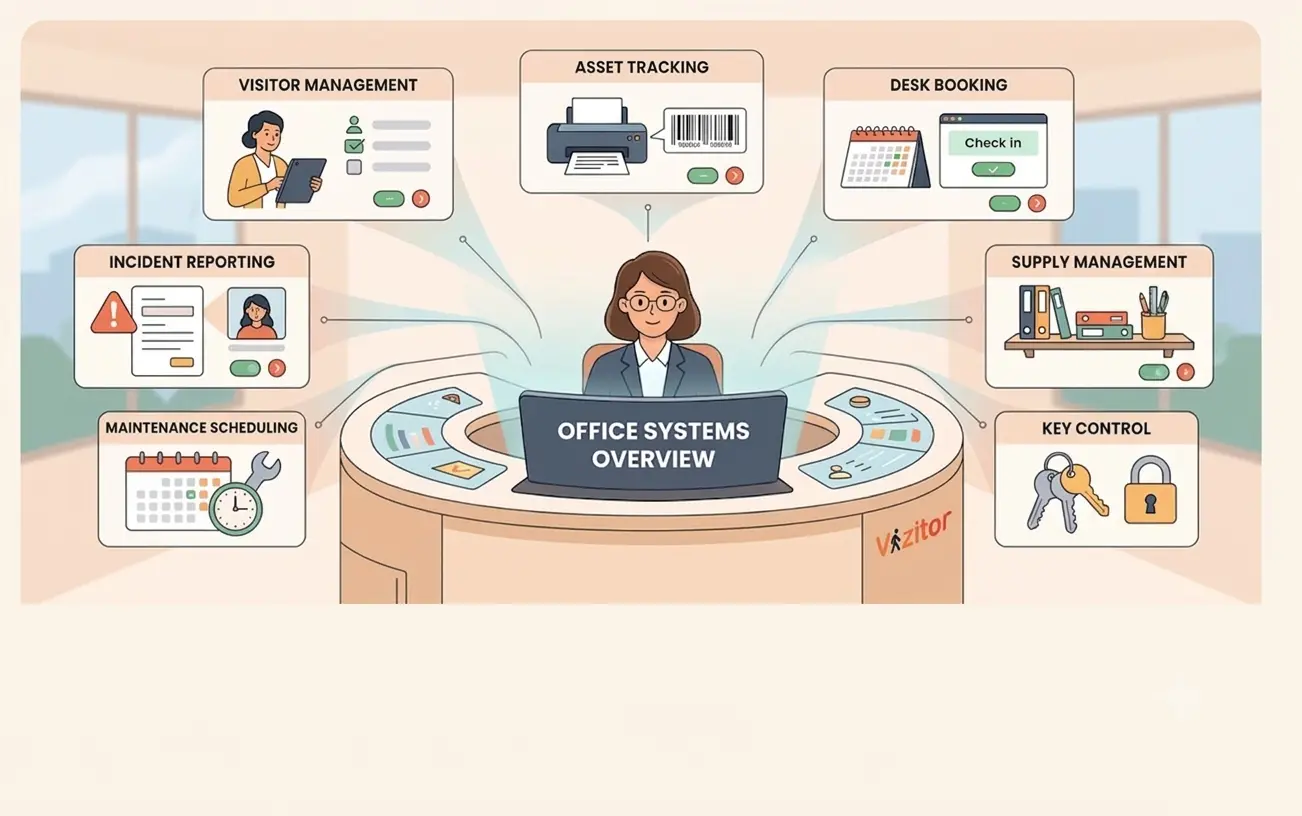
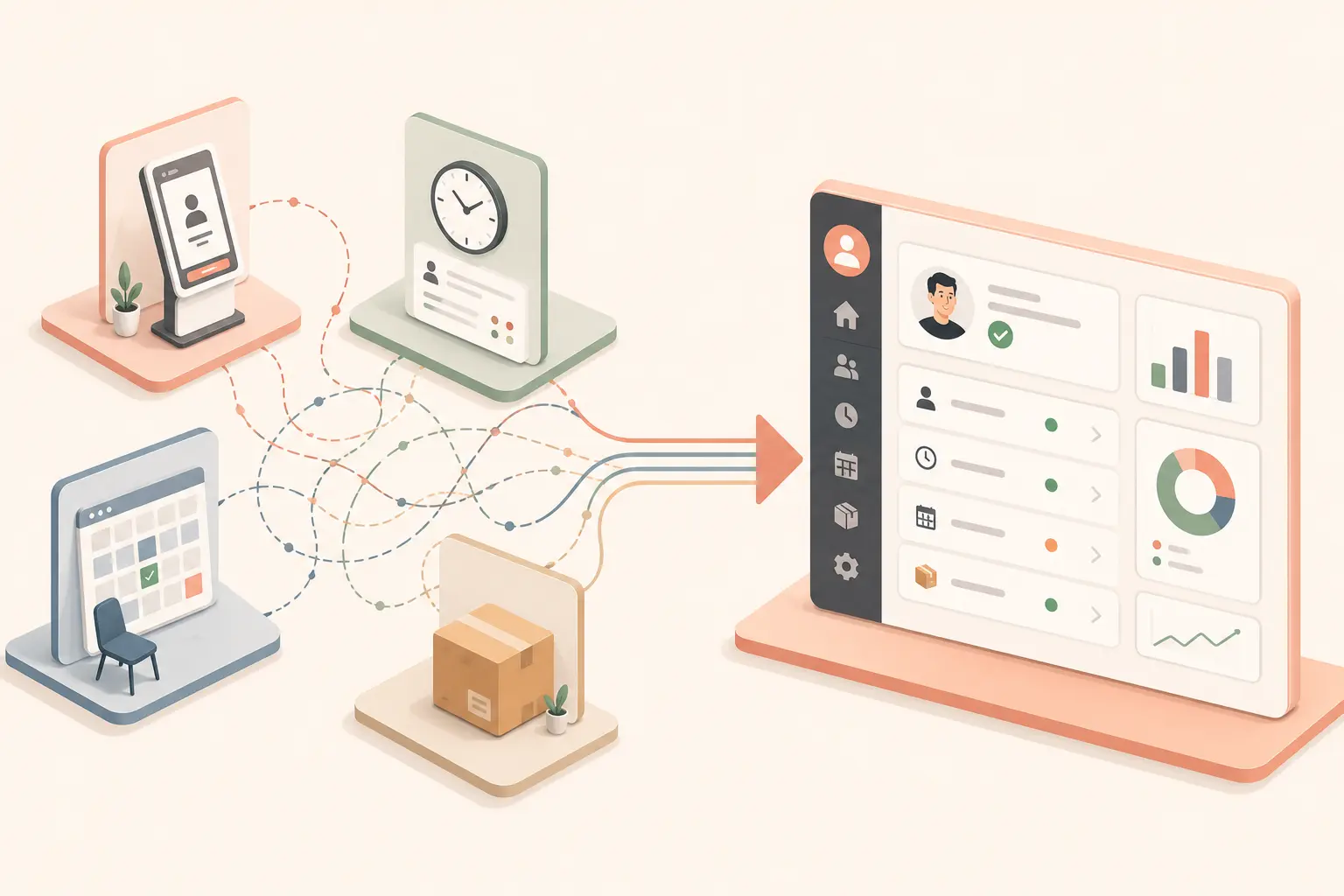
For healthcare organizations evaluating a comprehensive approach, the Vizitor Workplace Management Platform provides a unified system designed to handle the specific demands of healthcare environments - from visitor screening and queue management to staff attendance and facility security.
Core Challenges in Healthcare Workplace Management
1. Visitor Volume and Screening Complexity
A mid-size hospital may process 500-1,000 visitors daily. Each visitor may need to be screened for health conditions, verified against patient records, assigned to specific wards, and tracked throughout their visit. Paper-based systems cannot handle this volume without creating bottlenecks at reception.
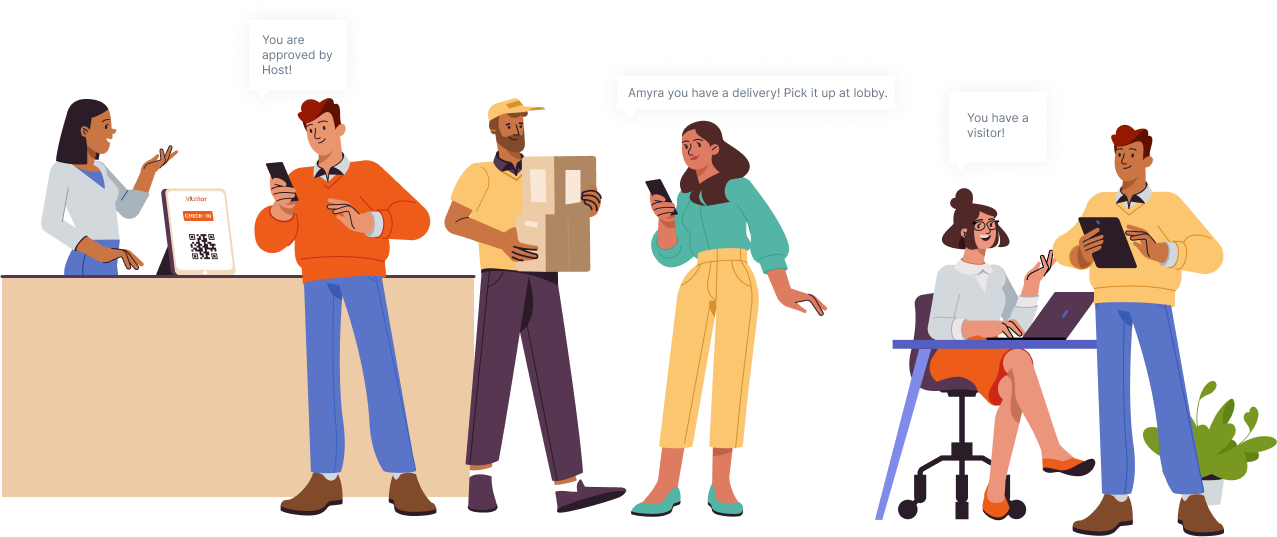
A digital Visitor Management System designed for healthcare can automate pre-registration, health screening questionnaires, ID verification, and ward assignment - reducing check-in time from several minutes to under 30 seconds.
2. Patient Queue Management
Long wait times are the single most common patient complaint across healthcare facilities. Patients waiting without visibility into their queue position experience higher anxiety, lower satisfaction, and in some cases, leave before being seen.
A Queue Management System provides real-time queue tracking, estimated wait time displays, SMS notifications when a patient’s turn approaches, and the ability to triage and prioritize based on urgency rather than arrival order.
3. Staff Attendance and Shift Management
Healthcare operates 24/7. Tracking attendance across multiple shifts, departments, and locations - while accounting for on-call staff, overtime regulations, and credential requirements - is a significant operational challenge.
An Attendance Management System built for healthcare handles shift-based check-ins, integrates with scheduling platforms, and provides real-time visibility into staffing levels across departments.
4. Facility Space Utilization
Operating rooms, consultation rooms, diagnostic suites, and administrative offices all compete for limited space. Without utilization data, healthcare facilities routinely under-use expensive clinical spaces while overcrowding others.
5. Supply and Pharmaceutical Deliveries
Medical supplies, lab samples, and pharmaceutical deliveries require careful chain-of-custody tracking. A Delivery Management System ensures every package is logged, routed to the correct department, and acknowledged by the right person.
6. Security and Access Control
Healthcare facilities must control access to sensitive areas - pharmacies, neonatal units, psychiatric wards, server rooms - while keeping public areas accessible. This requires layered security that is strict without being oppressive.
How an Integrated Platform Addresses Healthcare Challenges
| Healthcare Challenge | Traditional Approach | Integrated Platform Approach |
|---|---|---|
| Visitor screening | Manual forms at reception, long queues | Pre-registration with digital health screening, sub-30-second check-in |
| Patient wait times | Take-a-number systems, no visibility | Real-time queue with estimated wait times and SMS alerts |
| Staff attendance | Paper registers, buddy punching risk | Biometric or app-based check-in with shift validation |
| Room utilization | Static scheduling, no usage tracking | Real-time booking with auto-release via Meeting Room Booking System |
| Delivery tracking | Manual logbooks at receiving dock | Digital chain-of-custody with department routing |
| Security | Guard-based, manual visitor badges | Integrated access control via Workplace Security Management |
Implementation Areas for Healthcare
Emergency Department Flow
Emergency departments present the most intense workplace management challenge in healthcare. Patients arrive unpredictably, acuity levels vary wildly, and every minute of wait time carries clinical risk.
Digital queue management in EDs enables:
- Triage-based prioritization rather than first-come-first-served
- Real-time visibility into bed availability and patient status
- Automated notifications to on-call specialists
- Wait time communication to patients and families
Outpatient Clinics
Outpatient clinics benefit enormously from pre-registration workflows. When patients complete registration forms, insurance verification, and intake questionnaires before arriving, clinic throughput can increase by 30-40%.
Combined with desk booking for hot-desking physicians and a digital room booking system for consultation rooms, clinics can maximize the use of limited physical space.
Diagnostic Centers
Diagnostic centers manage a specific flow: patient arrives, checks in, waits for the test, undergoes the procedure, and departs with follow-up instructions. Each step has timing dependencies (fasting requirements, preparation protocols) that a digital queue and scheduling system can coordinate automatically.
Administrative and Back-Office Areas
Healthcare is not only clinical spaces. Administrative staff, billing departments, HR teams, and IT operations also need workplace management - desk booking for hybrid administrative staff, meeting room management for departmental coordination, and visitor management for vendors and auditors.
Compliance and Regulatory Considerations
Healthcare workplace management must account for:
- HIPAA (US) / DPDP Act (India): Patient and visitor data must be encrypted, access-controlled, and retained according to regulatory timelines
- Joint Commission Standards: Visitor identification, emergency preparedness, and security protocols must be documented and auditable
- NABH (India): Hospital accreditation requires systematic visitor management, incident documentation, and safety protocols
- Infection Control Protocols: Visitor screening for symptoms, vaccination status, and exposure history must be enforceable and documentable
A workplace management platform designed for healthcare handles these requirements through configurable screening workflows, automatic data retention policies, and audit-ready reporting.
Measurable Outcomes
Healthcare organizations that implement integrated workplace management typically see:
- 67% reduction in visitor check-in time (from 5+ minutes to under 2 minutes)
- 24% reduction in patient wait times through better queue management
- 35% improvement in room utilization through real-time booking and auto-release
- 40% reduction in administrative time spent on attendance reconciliation
- Near-elimination of manual delivery tracking errors
Building the Case for Healthcare Workplace Management
For healthcare administrators building an internal business case, the financial argument is straightforward:
- Staff time savings. If reception staff spend 3 hours per day on manual visitor processing, and digital check-in reduces that to 30 minutes, you recover 2.5 hours of productive time daily.
- Space cost optimization. If utilization data reveals that 30% of bookable rooms are reserved but unused, auto-release policies recover that capacity without adding square footage.
- Compliance risk reduction. A single compliance violation can cost tens of thousands in fines. Automated audit trails reduce that risk substantially.
- Patient satisfaction improvement. Higher HCAHPS scores (or equivalent satisfaction metrics) directly impact reimbursement rates and reputation.
Frequently Asked Questions
Can a workplace management platform integrate with our existing Hospital Information System (HIS)? Yes. Modern platforms like Vizitor offer API-based integrations that connect with major HIS, EHR, and scheduling systems. This allows visitor and queue data to flow into clinical workflows without manual re-entry.
How does digital visitor management handle infection control screening? Visitors complete configurable health screening questionnaires during pre-registration or at check-in kiosks. The system can flag responses that indicate risk, deny entry, or route the visitor to a screening area - all automatically and with a full audit trail.
Is the platform compliant with healthcare data protection regulations? Vizitor supports compliance with HIPAA, DPDP Act, and other healthcare data regulations through end-to-end encryption, role-based access controls, configurable data retention policies, and audit logging of all data access events.
What happens during system downtime or network outages? Healthcare cannot afford system failures. Look for platforms with offline capability that continue to function during network outages and sync data when connectivity is restored. Redundancy and uptime guarantees (99.9%+) are essential evaluation criteria.
How long does implementation take in a healthcare setting? A single-site implementation typically takes 4-8 weeks, including configuration, integration with existing systems, staff training, and pilot testing. Multi-site rollouts can be phased over 3-6 months.
Next Steps
Healthcare facilities that continue relying on manual processes for visitor management, patient queuing, staff attendance, and facility operations are leaving measurable improvements on the table - in efficiency, compliance, patient satisfaction, and cost control.
The Vizitor Workplace Management Platform is built to handle the specific demands of healthcare environments. Book a demo to see how it works in a clinical setting, or review pricing to understand the investment for your facility size.
For related reading, explore how workplace management applies to other regulated industries: education, government, and retail.
Try Vizitor Free
No credit card required. Setup in under 5 minutes. Manage visitors, queues, meeting rooms, and more.
Start Free TrialSee Vizitor in action check-in a visitor in under 30 seconds
Trusted by 500+ businesses. QR check-in, badge printing, NDA signing. Plans from $36/mo.