Facility Management vs. Workplace Management


Table of Content
Try Vizitor for Free!
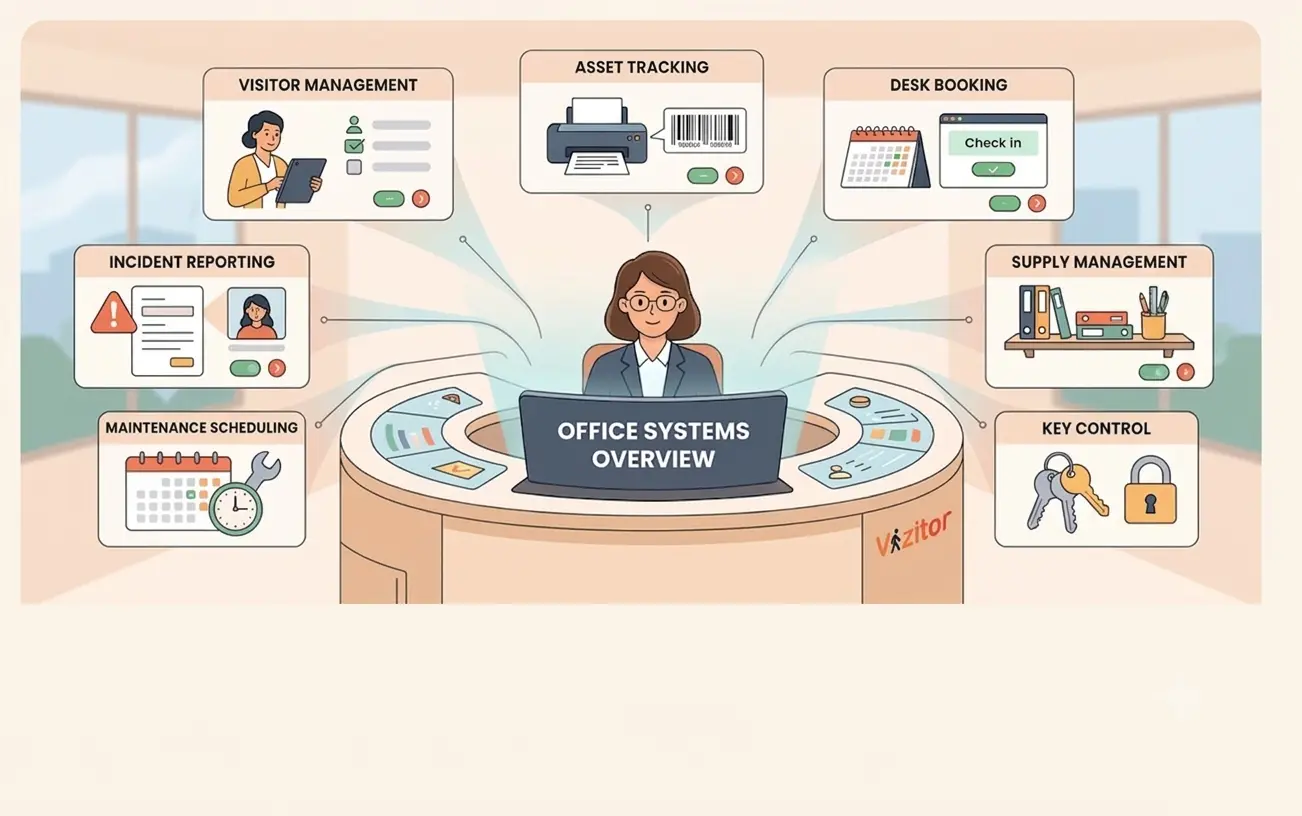
Facility management is the discipline focused on maintaining and operating the physical building infrastructure, including HVAC, plumbing, electrical systems, structural maintenance, cleaning, security hardware, and vendor contracts. Workplace management is the broader discipline of coordinating all operational, experiential, and technological elements that determine how people use and experience a work environment. Workplace management encompasses facility management but adds people-centric functions like visitor management, space booking, queue management, attendance tracking, and workplace experience design.
Why the Distinction Matters
Facility management and workplace management are often used interchangeably, but they represent different scopes, different priorities, and increasingly different technology stacks. Confusing them leads to gaps in operational coverage or investments that miss the mark.
Understanding the boundary between these disciplines helps organizations make better staffing decisions, technology investments, and strategic plans. It also helps professionals in both fields communicate their scope and value more clearly.
A workplace management platform typically covers the workplace management scope rather than the facility management scope, though the two increasingly overlap in areas like space utilization and environmental monitoring. Knowing which discipline a given tool or initiative serves helps you evaluate its relevance and ROI.
According to IFMA’s 2025 Industry Report, 64% of facility management professionals now have workplace management responsibilities in addition to their traditional building operations duties, reflecting the convergence of these disciplines (IFMA, 2025).
Defining Facility Management
Facility management is the older and more established discipline. Defined by the International Facility Management Association (IFMA) as “the practice of coordinating the physical workplace with the people and work of an organization,” its operational focus has traditionally centered on the building itself.
Core Functions of Facility Management
Building maintenance. Reactive repairs (fixing a broken elevator) and preventive maintenance (quarterly HVAC filter replacements) for all building systems.
Infrastructure operations. Managing HVAC, electrical, plumbing, fire suppression, elevators, and building automation systems.
Cleaning and janitorial services. Scheduling and overseeing cleaning contracts, waste management, and sanitation.
Physical security hardware. Managing badge readers, CCTV cameras, turnstiles, access gates, and alarm systems.
Vendor management. Coordinating external service providers for specialized maintenance, landscaping, security guards, and construction.
Safety and regulatory compliance. Fire code compliance, building inspections, ADA accessibility, and environmental regulations.
Capital planning. Long-term planning for building renovations, equipment replacement, and infrastructure upgrades.
Technology in Facility Management
The core technology for facility management is a Computerized Maintenance Management System (CMMS) or an Integrated Workplace Management System (IWMS). These systems handle work orders, asset tracking, preventive maintenance schedules, vendor contracts, and capital planning.
Defining Workplace Management
Workplace management is a newer, broader discipline that has emerged as work environments became more than just buildings to maintain.
Core Functions of Workplace Management
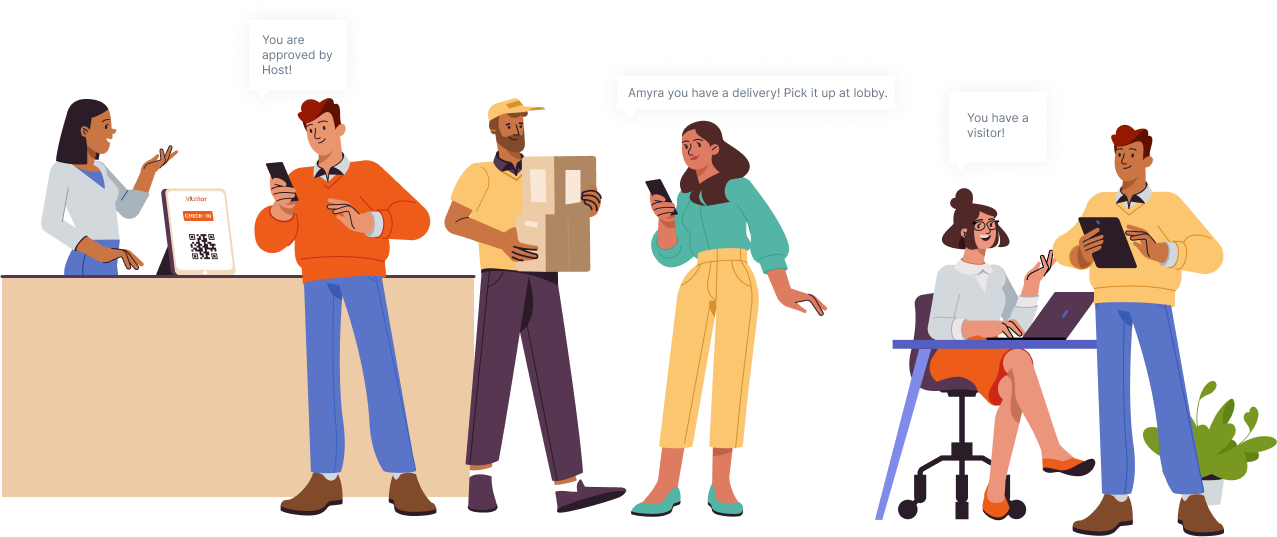
People flow management. Managing visitors (check-in, badge issuance, compliance), employees (attendance, access), and service queues (virtual queuing, wait time management).
Space management. Desk booking, meeting room booking, space utilization analytics, floor plan management, and neighborhood planning.
Operational logistics. Delivery management, mailroom management, equipment booking, and supply management.
Workplace experience design. Creating an environment that supports employee satisfaction, productivity, and retention through thoughtful space planning, smooth processes, and intuitive technology.
Workplace security and compliance. Workplace security management including access policies, visitor screening, emergency evacuation lists, and audit-ready compliance documentation.
Workplace analytics. Collecting and analyzing data from all operational functions to inform strategic decisions about space, staffing, and investment.
Technology in Workplace Management
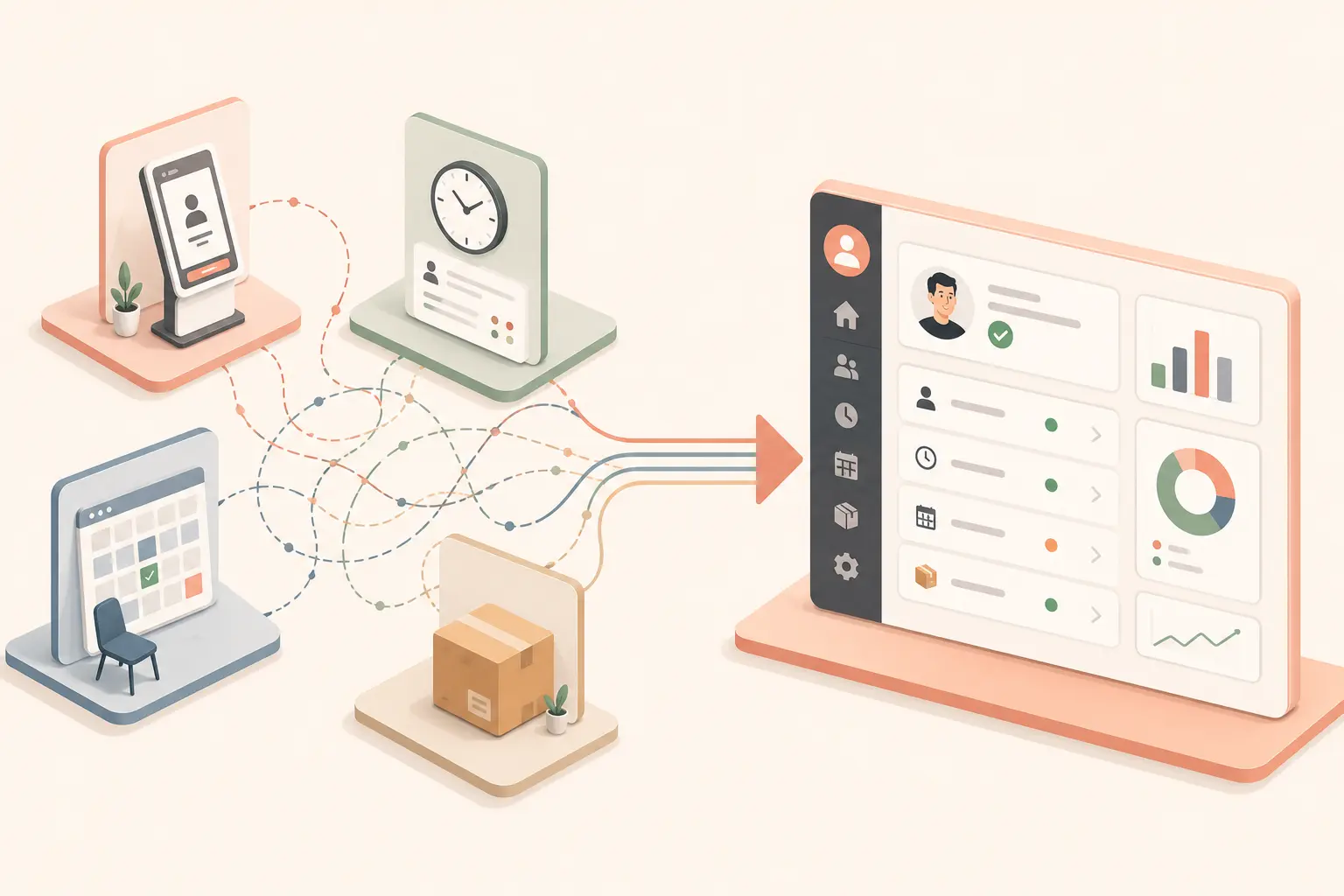
The core technology for workplace management is a workplace management platform that unifies visitor management, desk and room booking, attendance tracking, delivery management, queue management, and space analytics in a single system.
Key Differences: Facility Management vs. Workplace Management
| Dimension | Facility Management | Workplace Management |
|---|---|---|
| Primary focus | The building and its systems | The people and how they use the space |
| Core question | “Is the building functioning properly?” | “Is the workplace working well for everyone?” |
| Scope | Physical infrastructure | Infrastructure + people flow + space utilization + experience |
| Time horizon | Immediate (repairs) and long-term (capital planning) | Daily operations + strategic space optimization |
| Key stakeholders | Building owners, maintenance teams | Employees, visitors, HR, security, leadership |
| Success metric | Uptime, compliance, maintenance cost | Utilization, satisfaction, operational efficiency |
| Technology | CMMS/IWMS | Workplace management platform |
| Visitor management | Limited (physical security hardware) | Comprehensive (digital check-in, compliance, experience) |
| Space booking | Not typically included | Core function (desks, rooms, zones) |
| Queue management | Not included | Core or adjacent function |
| Employee facing | Minimal (maintenance requests) | Extensive (booking, check-in, notifications) |
| Data use | Maintenance optimization | Space planning, real estate decisions, experience improvement |
Where Facility Management and Workplace Management Overlap
Despite their differences, these disciplines share several areas of overlap.
Space Management
Both disciplines have a stake in how space is used. Facility management tracks space inventory and plans for moves, adds, and changes. Workplace management tracks space utilization through booking data and sensors to optimize how space is allocated and used daily. Effective organizations ensure these perspectives inform each other.
Safety and Compliance
Facility management handles building safety (fire codes, structural integrity, hazardous materials). Workplace management handles operational safety (visitor screening, emergency evacuation lists, health compliance). Both contribute to the overall safety posture of the organization.
Environmental Monitoring
Facility management monitors building systems (HVAC performance, energy consumption). Workplace management monitors environmental conditions that affect occupants (air quality, temperature, noise). IoT sensors increasingly serve both purposes, feeding data to both facility and workplace management systems.
Vendor Management
Both disciplines manage external vendors, though different types. Facility management coordinates building maintenance vendors. Workplace management coordinates workplace technology vendors, service providers, and experience-related suppliers.
Sustainability
Sustainability reporting requires data from both disciplines. Facility management provides building energy consumption, water usage, and waste data. Workplace management provides space utilization data that reveals opportunities to reduce the environmental footprint through right-sizing.
When to Prioritize Facility Management
Facility management takes priority when:
- Your building has aging infrastructure that requires significant maintenance investment.
- You are planning a major renovation or construction project.
- Building compliance issues (fire code, ADA, environmental) need immediate attention.
- You own the building and are responsible for all physical infrastructure.
- Energy costs are a dominant operating expense and need optimization at the building system level.
When to Prioritize Workplace Management
Workplace management takes priority when:
- You are managing a hybrid workforce and need dynamic space management.
- Employee experience and retention are strategic priorities.
- You need to optimize how existing space is used (rather than maintaining the building itself).
- You have multiple locations that need standardized operations.
- Visitor management, queue management, or compliance documentation are pain points.
- You want data-driven insights for real estate planning decisions.
- You are in a leased building where the landlord handles physical maintenance.
A Practical Example
Consider a 200-person company in a leased office building. The landlord handles HVAC maintenance, plumbing, and structural issues (facility management). The company’s workplace operations team handles visitor check-in, room and desk booking, attendance tracking, delivery coordination, and space planning (workplace management).
For this company, investing in a CMMS for building maintenance makes no sense because the landlord manages the building. But investing in a workplace management platform that handles visitor management, desk booking, room booking, and space analytics directly addresses their daily operational needs and generates data for lease negotiation.
Conversely, a property management company that owns and operates ten commercial buildings needs robust facility management tools (CMMS, building automation, maintenance scheduling) as a primary investment, with workplace management as a value-added service layer for tenants.
The Convergence Trend
The boundary between facility management and workplace management is blurring. Several factors are driving convergence.
Shared data infrastructure. IoT sensors, occupancy data, and environmental monitoring serve both disciplines. Organizations are building shared data platforms rather than separate systems.
Expanding job scope. Facility managers are increasingly taking on workplace management responsibilities. The IFMA statistic cited earlier (64% of facility managers now handle workplace management duties) reflects this expansion.
Unified vendor solutions. Technology vendors are building platforms that serve both disciplines. A workplace management platform with IoT sensor integration and environmental monitoring bridges the gap between building operations and workplace experience.
Strategic elevation. As the workplace becomes a strategic asset (for talent attraction, culture building, and cost optimization), leadership expects a unified view of both building operations and workplace performance.
Building a Combined Approach
Organizations that effectively combine facility management and workplace management follow these principles.
Shared data, separate workflows. Both disciplines can share a data platform (occupancy data, environmental data, space inventory) while maintaining separate operational workflows for their distinct responsibilities.
Clear ownership boundaries. Define which team owns building maintenance (facility) versus which team owns booking systems, visitor management, and experience (workplace). Clear boundaries prevent gaps and duplication.
Unified reporting. Leadership should receive a combined view that includes both building performance (uptime, energy, maintenance) and workplace performance (utilization, satisfaction, efficiency).
Technology integration. Connect the CMMS/IWMS (facility management) with the workplace management platform through APIs. When a meeting room sensor detects an HVAC issue, the workplace management system can proactively flag the room as uncomfortable, while the facility management system generates a work order.
Frequently Asked Questions
Is facility management part of workplace management?
Facility management and workplace management are related but distinct disciplines. Facility management is focused on building infrastructure and maintenance. Workplace management is broader, encompassing people flow, space utilization, experience design, and operational technology in addition to building operations. In practice, workplace management often includes or depends on facility management, but the reverse is not always true. Many organizations treat facility management as a subset of their broader workplace management strategy.
Do I need separate software for facility management and workplace management?
In most cases, yes. Facility management typically requires a CMMS or IWMS for work orders, asset management, and preventive maintenance. Workplace management requires a workplace management platform for visitor management, desk and room booking, attendance, and space analytics. The two systems should integrate (sharing space inventory and occupancy data), but they serve different operational needs. Some enterprise platforms offer both capabilities, but depth in both areas from a single vendor is still uncommon.
What is the career path for workplace management professionals?
Workplace management is an emerging professional discipline. Common titles include Workplace Manager, Director of Workplace Experience, Head of Workplace Operations, and VP of Workplace. The career path often starts in facility management, office management, or HR operations and evolves toward the broader workplace scope. Professional certifications include IFMA’s Facility Management Professional (FMP) and Workplace Management certifications.
How does hybrid work affect the balance between facility and workplace management?
Hybrid work shifts emphasis toward workplace management. When employees come to the office two to three days per week, the building still needs maintenance (facility management), but the operational complexity of managing variable occupancy, dynamic desk booking, and fluctuating room demand falls squarely in the workplace management domain. Organizations adopting hybrid models typically invest more in workplace management technology and less in expanding facility management scope.
Choose the Right Approach for Your Organization
Understanding the difference between facility management and workplace management helps you invest in the right tools, hire the right people, and set the right priorities. For most organizations with hybrid workforces and leased spaces, workplace management represents the higher-impact investment opportunity.
Vizitor’s workplace management platform covers the full scope of workplace management, from visitor check-in to space analytics, while integrating with your existing facility management systems.
Try Vizitor Free
No credit card required. Setup in under 5 minutes. Manage visitors, queues, meeting rooms, and more.
Start Free TrialSee Vizitor in action check-in a visitor in under 30 seconds
Trusted by 500+ businesses. QR check-in, badge printing, NDA signing. Plans from $36/mo.