Workplace Management for Startups


Table of Content
Try Vizitor for Free!
Why Startups Should Care About Workplace Management
When you are building a product, raising funding, and hiring your first team members, workplace management feels like a problem for larger organizations. There are more pressing priorities. The visitor log can wait.
Until it cannot.
The investor who visits your office and spends 10 minutes waiting at an unmanned reception desk while someone tracks down the founder. The candidate who arrives for an interview and finds no one expecting them. The delivery that contains critical hardware, sitting unclaimed in a shared building lobby for three days. The meeting room double-booked because three people used different methods to reserve it.
These moments are not just inconveniences. For startups, where every impression matters and every hour of productivity counts, they are operational debt accumulating with interest.
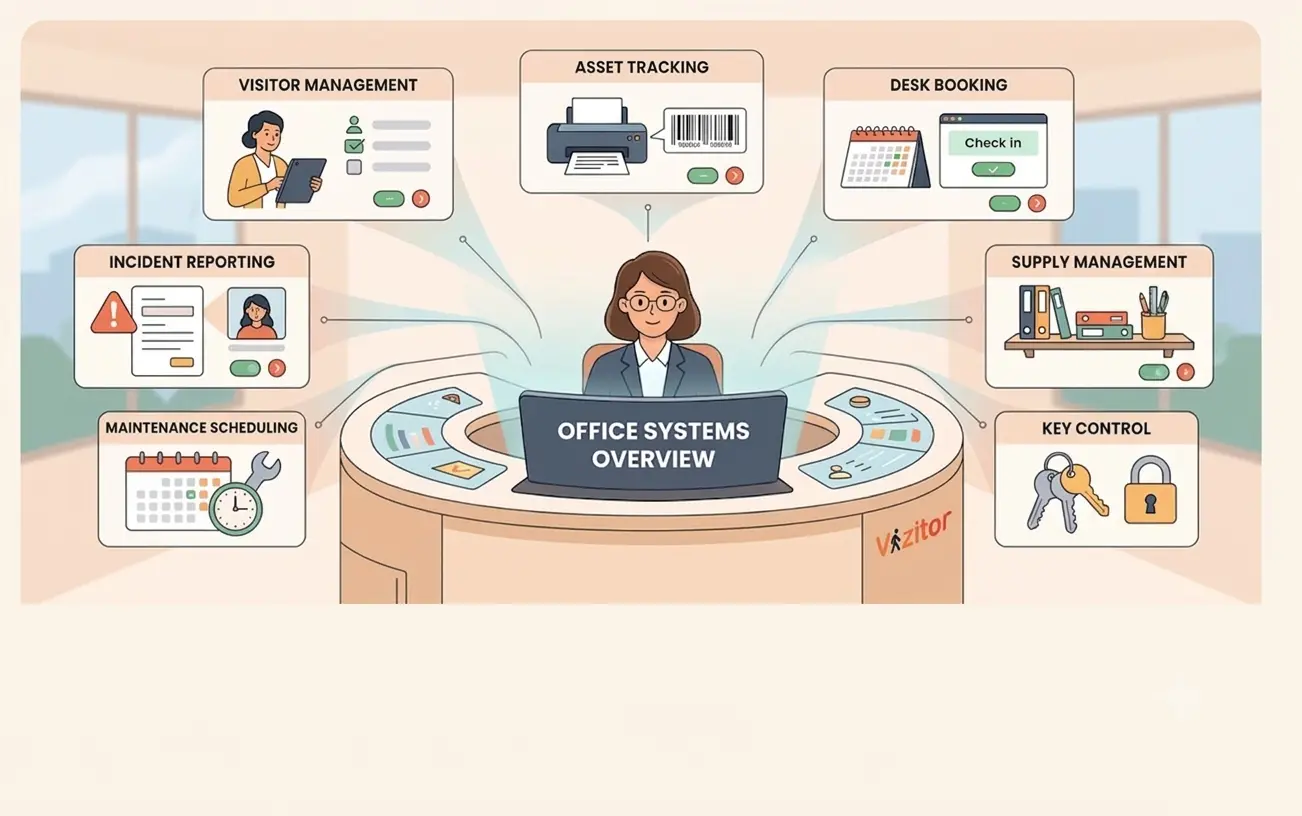
Definition: Workplace management for startups is the early-stage implementation of digital systems to manage the operational aspects of physical workspaces - including visitor registration, meeting room booking, team attendance coordination, and delivery tracking - designed to scale as the company grows without requiring significant re-implementation at each growth stage.
A 2025 survey by First Round Capital found that 67% of startup founders who had scaled past 50 employees wished they had implemented workplace management systems earlier, citing “operational chaos during growth phases” as a consistent pain point.
The Vizitor Workplace Management Platform offers plans designed for growing companies - cost-effective entry points with the ability to scale as headcount and locations expand, without platform migration.
The Startup Workplace Management Timeline
Stage 1: Pre-Seed to Seed (5-15 people)
At this stage, you probably do not need a full workplace management suite. But you do need:
- A digital visitor system. Even with 5 people, investors, candidates, partners, and clients visit. A Visitor Management System with pre-registration and instant host notification replaces the awkward “wait here while I find someone” experience with a professional check-in process.
- A meeting room booking tool. If you share a co-working space or have even one meeting room, double-bookings are a daily frustration. A simple Meeting Room Booking System eliminates this immediately.
Investment at this stage: Minimal. Cloud-based platforms offer starter plans that cost less than a team lunch.
Stage 2: Series A (15-50 people)
This is where operational complexity starts compounding:
- Multiple teams competing for meeting rooms
- Frequent candidate interviews requiring coordinated visitor handling
- Deliveries increasing as the office grows
- First conversations about attendance and remote work policies
At this stage, add:
- Desk booking if you are running a hybrid or flexible seating model through a Desk Booking System
- Delivery management to track packages arriving at the office via a Delivery Management System
- Basic attendance tracking for visibility into who is in the office on a given day through an Attendance Management System
Stage 3: Series B and Beyond (50-200+ people)
This is when operational gaps become expensive:
- Multiple floors or locations to coordinate
- Compliance requirements from enterprise customers or regulators
- Security needs escalating as the team and office grow
- Real estate decisions requiring utilization data
At this stage, you need the full platform:
- Integrated Workplace Security Management with access control
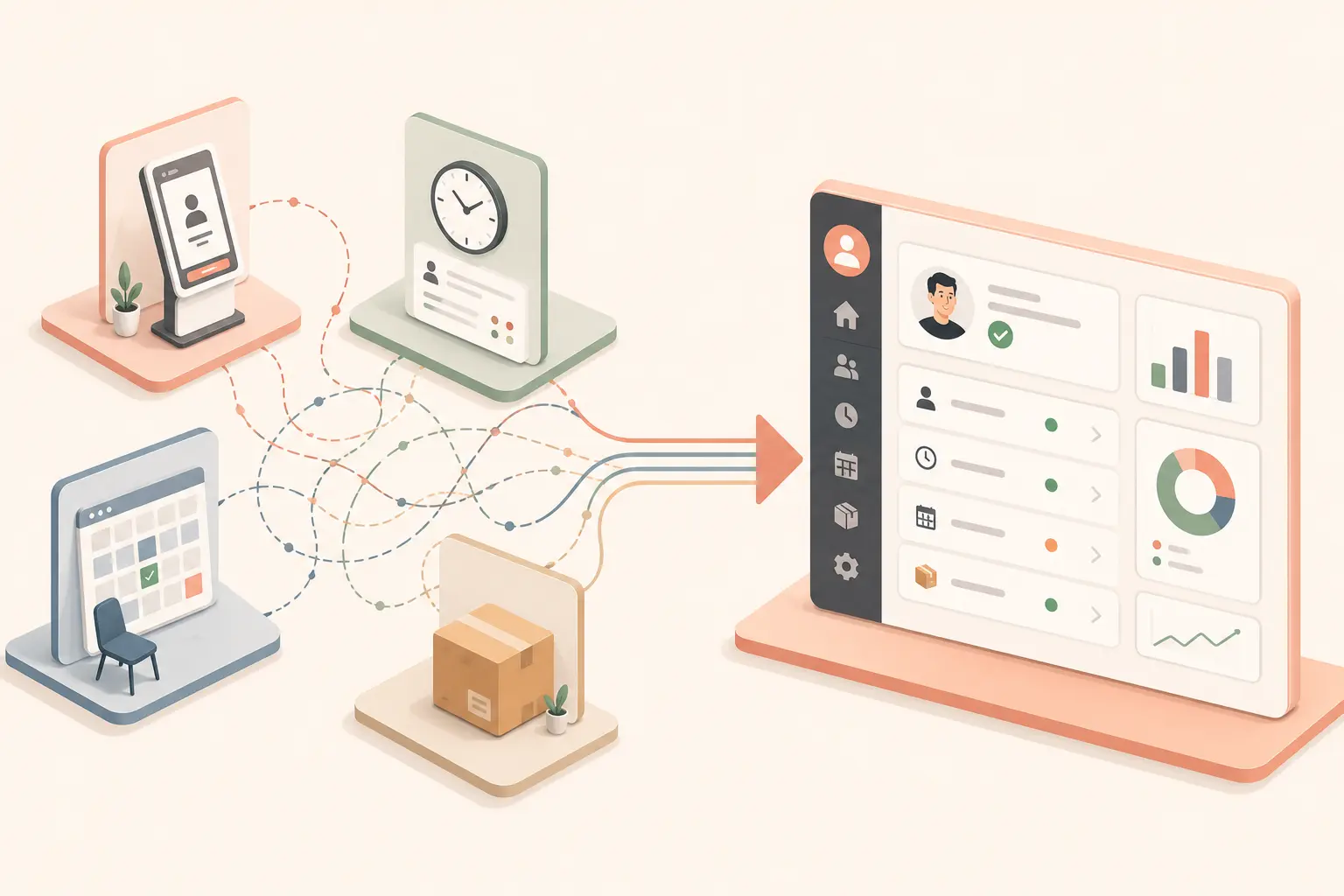
- Multi-location management from a single dashboard
- Utilization analytics for real estate planning
- Compliance-ready audit trails for visitor and attendance records
Why Starting Early Matters
Avoiding Operational Debt
Operational debt works like technical debt. When you use manual processes because “we are too small to need a system,” those processes accumulate workarounds, inconsistencies, and knowledge trapped in individuals’ heads. When you eventually do need a system, you must first untangle the manual mess before you can digitize.
Organizations that implement simple workplace management early avoid this debt. The system grows with them, and they never face the painful “we need to completely overhaul our operations” moment that usually hits between 30 and 100 employees.
Making Every Visit Count
Startups have a disproportionate number of high-stakes visits: investors evaluating the company, enterprise customers conducting due diligence, candidates deciding whether to join, partners exploring collaboration.
Each of these visitors forms an impression in the first 60 seconds. A professional, smooth digital check-in signals operational maturity. A confused receptionist flipping through a paper notebook signals the opposite.
Building Culture Through Operations
The operational tools you choose shape your company culture. A workplace that runs on shared spreadsheets and shouted meeting room reservations develops a culture of informality and chaos. A workplace with clear, simple digital systems develops a culture of organization and respect for each other’s time.
What Startups Actually Need (and What They Do Not)
| Feature | Do You Need It? | When? |
|---|---|---|
| Digital visitor check-in | Yes | Day 1 |
| Meeting room booking | Yes | As soon as you have shared spaces |
| Desk booking | Maybe | When you adopt hybrid or flexible seating (usually 15+ people) |
| Delivery tracking | Helpful | When you receive regular deliveries (usually 20+ people) |
| Attendance management | Helpful | When you need team coordination or policy enforcement (usually 25+ people) |
| Access control integration | Not yet | When security becomes a formal requirement (usually 50+ people) |
| Multi-site management | Not yet | When you open a second location |
| Advanced analytics | Not yet | When you have enough data to make it meaningful (usually 50+ people) |
The key is to choose a platform that supports all of these features, so you can activate them as needed without switching platforms.
Comparison: Common Startup Approaches
| Approach | Pros | Cons |
|---|---|---|
| No system (manual everything) | Zero cost, zero setup time | Unprofessional visitor experience, no data, does not scale |
| Free tools and spreadsheets | Low cost, familiar | Fragmented, no integration, breaks at 20+ people |
| Consumer apps repurposed | Low cost, easy to start | Not designed for workplace management, security and compliance gaps |
| Point solutions (one per function) | Good functionality per tool | Expensive when combined, data silos, multiple vendors |
| Integrated platform (like Vizitor) | Scales with growth, connected data, single vendor | Slightly higher initial investment than free alternatives |
Budget Considerations for Startups
Startup budgets are tight. Here is how to think about workplace management investment:
The cost of not having a system:
- 15 minutes lost per visitor interaction (no pre-registration, manual processing) = 2.5 hours/week at 10 visitors/week
- 30 minutes lost per day to meeting room conflicts = 2.5 hours/week
- 1-2 hours/week tracking deliveries manually
- Total: 5-7 hours/week of productivity lost to manual workplace operations
At an average startup employee cost of $50/hour, that is $250-$350/week or $13,000-$18,000/year in productivity cost.
The cost of a system: Cloud-based workplace management platforms for small teams typically range from $100-$500/month, or $1,200-$6,000/year.
The math is straightforward: even a basic system pays for itself within months.
Setting Up for Investor and Client Visits
One of the most immediate benefits for startups is the impression created during investor and client visits.
A professional visitor experience includes:
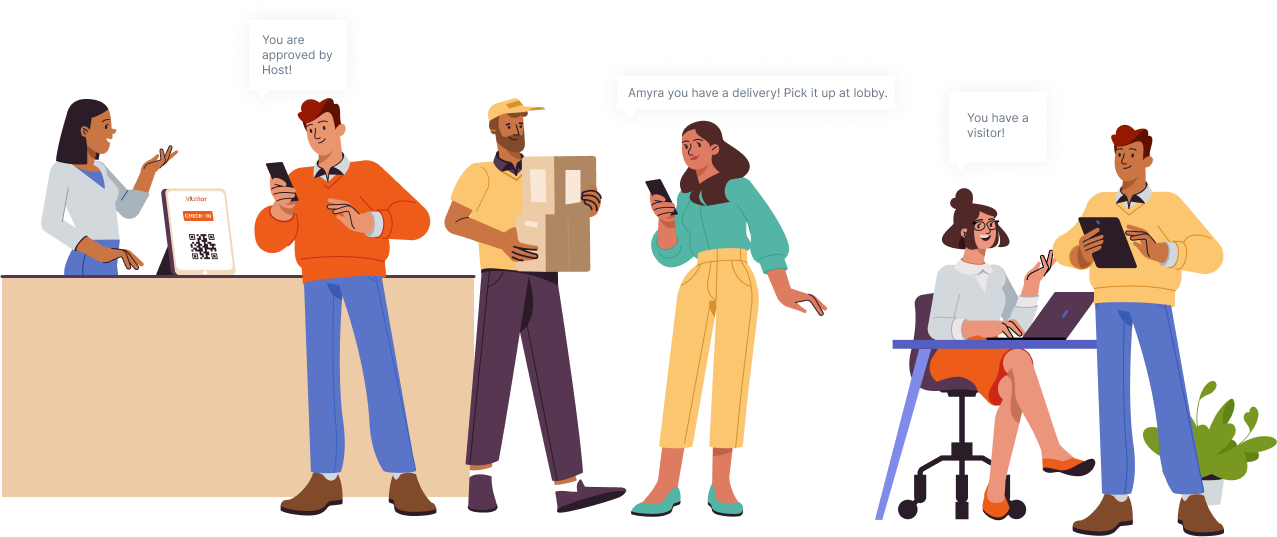
- Pre-visit: Visitor receives an email with the office address, parking instructions, and a QR code for check-in
- Arrival: Visitor scans the QR code at a tablet kiosk, their photo is captured, and a digital badge is issued
- Notification: The host receives an instant push notification that their visitor has arrived
- Check-out: Visitor checks out (or is automatically checked out after a set period), and the visit is logged for records
This entire flow can be configured in under an hour on a platform like Vizitor.
Compare this to: visitor arrives, looks around for someone, finally finds an employee who calls the founder, founder emerges 8 minutes later, visitor has been standing awkwardly in the lobby.
Scaling Without Re-Implementation
The biggest risk in choosing a workplace management approach as a startup is picking something that does not scale. If you start with a free tool or consumer app that breaks at 30 people, you face a painful migration right when the company can least afford operational disruption.
Choose a platform based on where you will be in 2-3 years, not just where you are today:
- Can it handle 10x your current headcount?
- Does it support multiple locations?
- Does it include compliance and security features you will need as you mature?
- Is the pricing model transparent and predictable as you scale?
Frequently Asked Questions
Is workplace management overkill for a 10-person startup? Not if you receive visitors (investors, candidates, clients, partners). The visitor management component alone pays for itself through time savings and professional impression. You do not need to activate every feature on day one - start with visitor management and meeting room booking, then expand.
How long does it take to set up a workplace management platform for a small team? Most cloud-based platforms can be configured for a small team in 1-2 hours. Upload your team directory, configure your visitor workflow, set up your meeting rooms, and you are operational. No IT department required.
Should we use a free tool to start? Free tools work for the simplest use cases, but they typically lack integration, security features, and scalability. If you plan to grow beyond 20 people within a year, starting with a scalable platform (even on a basic paid plan) avoids the pain of migration later.
How does workplace management help with hiring? Candidates form impressions during their interview visit. A smooth check-in process, a well-managed meeting room, and a clear post-visit follow-up signal that the company is organized and professional. In competitive hiring markets, these operational details influence candidate decisions.
What if we move offices frequently as we grow? Cloud-based platforms are location-independent. When you move, you update your floor plans and room configurations in the platform. No reinstallation, no hardware migration, no data loss. This flexibility is ideal for startups that relocate as they scale.
Start Small, Scale Confidently
The best time to implement workplace management is before you desperately need it. Starting with basic visitor management and meeting room booking when you are small builds the operational habits that scale smoothly as you grow.
The Vizitor Workplace Management Platform offers plans designed for startups and growing companies - start with the features you need today and activate additional modules as your organization evolves. Book a demo to see the platform, or review pricing to find the right starting point.
For more on scaling workplace operations, explore our guides on workplace management cost reduction, workplace digital transformation, and integrated workplace management systems.
Try Vizitor Free
No credit card required. Setup in under 5 minutes. Manage visitors, queues, meeting rooms, and more.
Start Free TrialSee Vizitor in action check-in a visitor in under 30 seconds
Trusted by 500+ businesses. QR check-in, badge printing, NDA signing. Plans from $36/mo.