Workplace Management for Mid-Size Companies


Table of Content
Try Vizitor for Free!
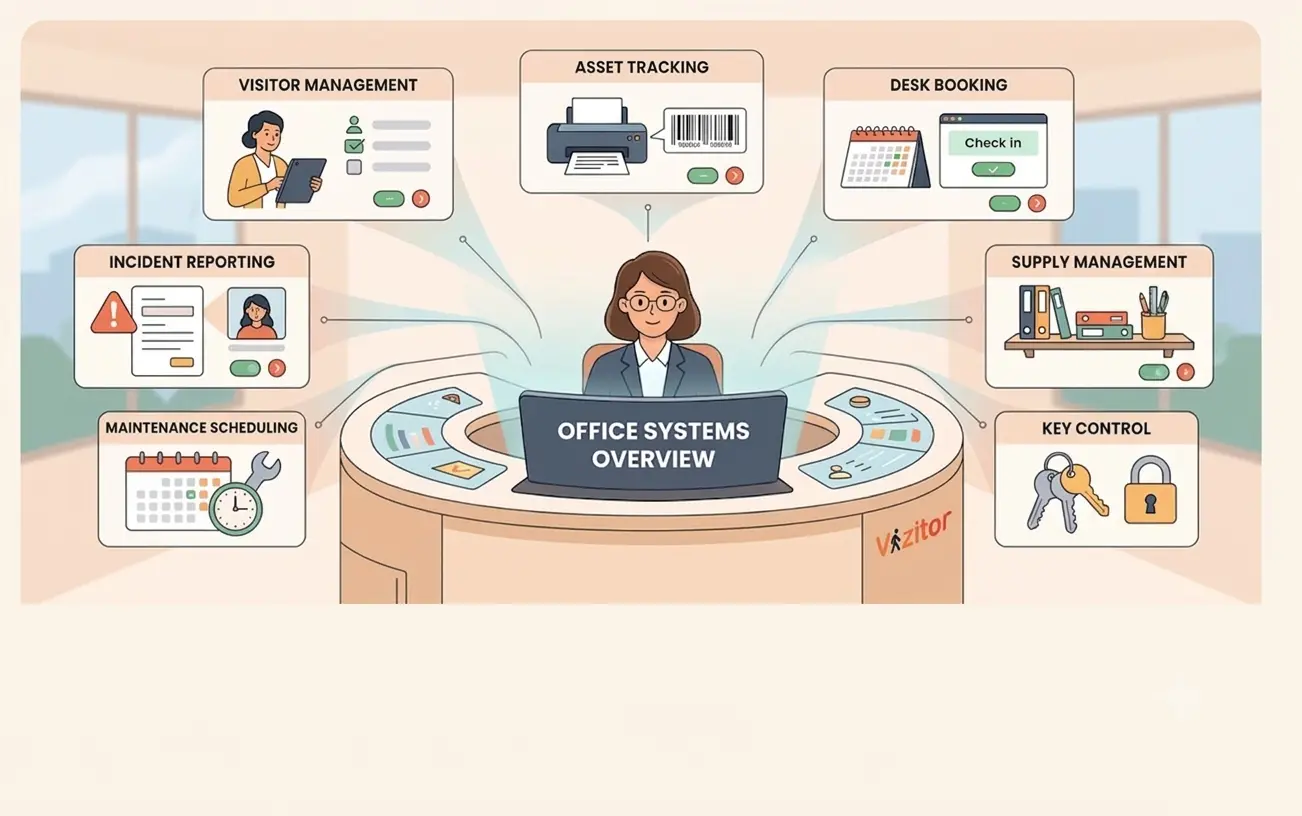
Workplace management for mid-size companies refers to the practice of managing physical workplace operations (visitors, spaces, attendance, deliveries, queues, and compliance) in organizations with 50 to 500 employees. Mid-size companies face unique workplace management challenges: they are large enough to need structured systems but often lack the dedicated teams and budgets of enterprises. Effective workplace management for mid-size companies balances essential operational needs with budget constraints, prioritizing solutions that deliver immediate value and scale with growth.
Why Mid-Size Is Different
Mid-size companies occupy a specific position in the workplace management landscape. They are not small enough to manage everything informally (whiteboards, spreadsheets, and verbal coordination), and they are not large enough to justify dedicated workplace operations teams with six-figure technology budgets.
This creates a set of distinct challenges that workplace management solutions must address.
Resource constraints. Most mid-size companies do not have a dedicated Workplace Manager or Director of Facilities. Workplace operations are handled by office managers, HR generalists, or administrative assistants who juggle multiple responsibilities.
Budget sensitivity. Every technology purchase competes with hiring, product development, and marketing for budget. Workplace management investments need to show clear, fast ROI to get approved.
Growth uncertainty. Mid-size companies are in transition. They may double in size within two years or consolidate. Workplace management solutions must flex with this uncertainty.
Increasing complexity. What worked at 30 employees breaks at 100. The shift from “everyone knows everyone” to “we need systems for this” is abrupt. Visitor management, room booking, and attendance tracking become essential almost overnight when the organization crosses a size threshold.
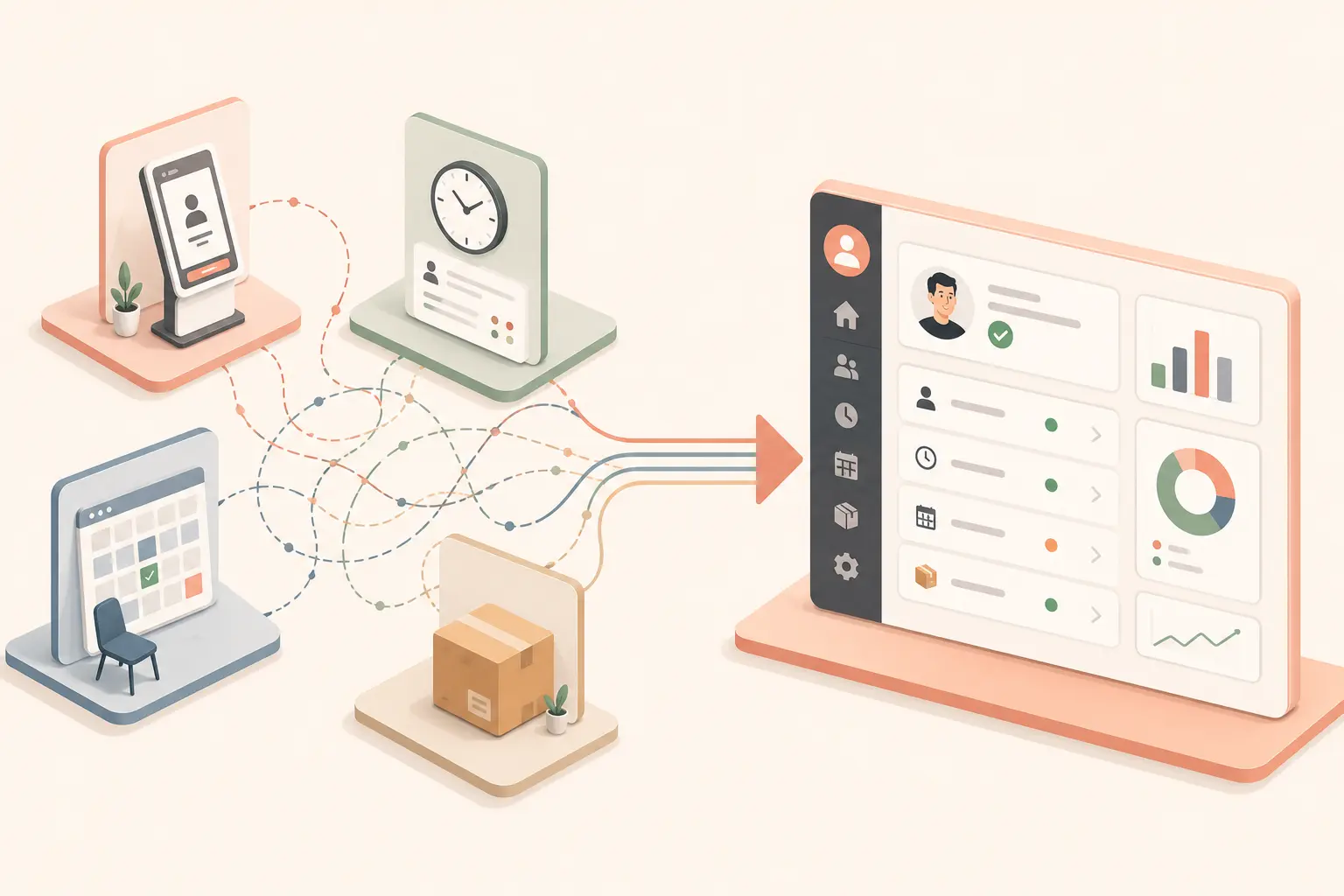
A workplace management platform designed for mid-size companies addresses these challenges by providing modular functionality (start with what you need), scalable pricing (pay for your current size), and simplicity (no dedicated IT team required for management).
According to Deloitte’s 2025 Mid-Market Technology Adoption Survey, 67% of mid-size companies identify “workplace experience technology” as a top-five technology investment priority for 2026, up from 38% in 2023 (Deloitte, 2025).
The Budget-Conscious Approach
Mid-size companies cannot afford the enterprise approach of buying everything at once. A phased, budget-conscious strategy delivers value incrementally.
Phase 1: Essential Operations (Months 1 to 2)
Start with the two functions that deliver the most immediate value.
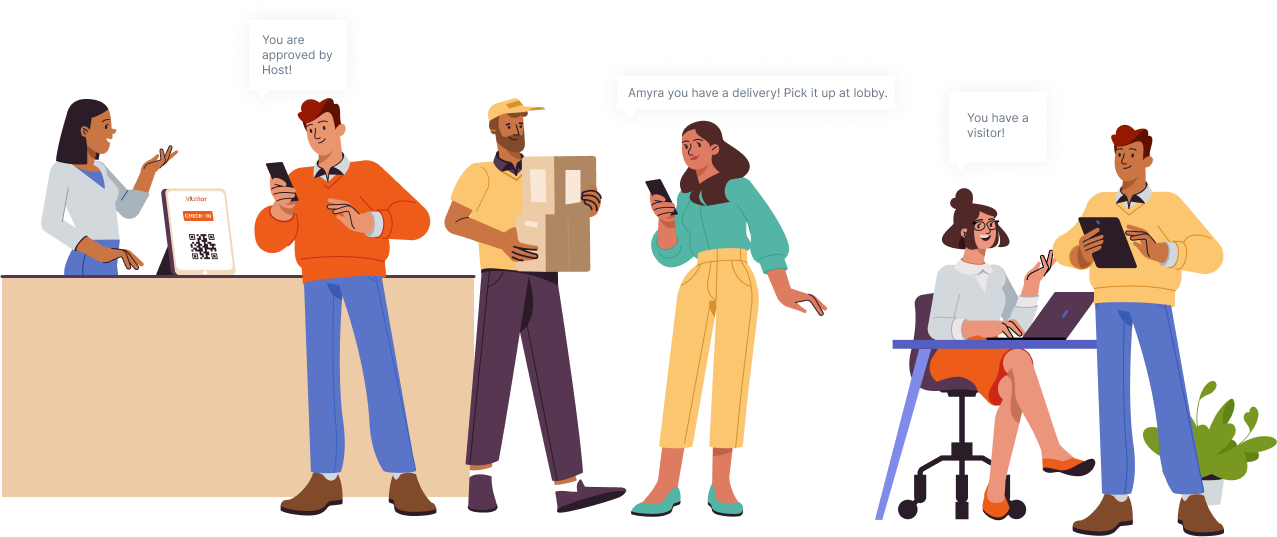
Visitor management. This addresses the most visible operational gap. Paper visitor logs create compliance risk, slow down check-in, and project an unprofessional image. A digital visitor management system with QR check-in, host notifications, and compliance logging can be deployed in days and transforms the front desk experience immediately.
Meeting room booking. Conference room conflicts are a universal mid-size company pain point. A booking system with calendar integration eliminates double-bookings, reduces meeting room hunting, and provides utilization data.
Budget estimate: $200 to $500 per month for both functions.
Phase 2: Space Optimization (Months 3 to 6)
Once visitor management and room booking are running, add space-related functions.
Desk booking. If you have adopted hybrid work, desk booking replaces the chaos of “is that desk taken?” with a structured reservation system. Even if you are not hybrid, desk booking provides utilization data that informs future space decisions.
Basic space analytics. Utilization data from room and desk bookings shows which spaces are overused, which are underused, and whether your floor plan matches how people actually work.
Budget estimate: Additional $100 to $300 per month.
Phase 3: Operational Efficiency (Months 6 to 12)
With the foundation in place, add operational efficiency modules.
Attendance management. Digital check-in replaces manual timesheets and provides accurate attendance data for HR, payroll, and space planning.
Delivery management. As the organization grows, package volume increases. Automated delivery logging and recipient notification prevents the mailroom from becoming a bottleneck.
Queue management. If your organization provides internal services (IT help desk, HR counter, facilities requests) with walk-in availability, queue management reduces wait times and improves service delivery.
Budget estimate: Additional $200 to $500 per month.
Total Budget Trajectory
| Phase | Functions | Monthly Cost Range | Cumulative Monthly |
|---|---|---|---|
| Phase 1 (Month 1 to 2) | Visitor management, room booking | $200 to $500 | $200 to $500 |
| Phase 2 (Month 3 to 6) | Desk booking, basic analytics | $100 to $300 | $300 to $800 |
| Phase 3 (Month 6 to 12) | Attendance, delivery, queue | $200 to $500 | $500 to $1,300 |
This phased approach keeps monthly costs manageable while building toward a comprehensive workplace management platform over time.
Essential vs. Enterprise Features
Mid-size companies do not need every feature an enterprise platform offers. Understanding which features are essential for your size and which are enterprise-grade helps you avoid overpaying for capabilities you will not use for years.
Essential for Mid-Size Companies
| Feature | Why It Is Essential |
|---|---|
| QR code visitor check-in | Fast, contactless, professional visitor experience |
| Host notification (email, SMS, Slack) | Ensures visitors are not left waiting |
| Meeting room booking with calendar sync | Eliminates double-bookings and room conflicts |
| Desk booking with floor map | Supports hybrid work, provides utilization data |
| Mobile app for employees | Self-service booking and notifications |
| Basic analytics (utilization reports) | Data for space planning decisions |
| Compliance visitor logs | Audit-ready records for regulatory requirements |
| Role-based access control | Different permissions for admin, front desk, employees |
| Multi-site support (2 to 5 locations) | Manages multiple offices from one platform |
Enterprise-Grade (Defer for Now)
| Feature | When You Might Need It |
|---|---|
| IoT sensor integration | When you have 500+ employees and need passive occupancy data |
| AI-powered space recommendations | When you have 12+ months of utilization data to train models |
| Custom API marketplace | When you need deep integration with custom enterprise systems |
| Move management | When you regularly reconfigure floors (large enterprise scale) |
| Scenario planning / what-if modeling | When making multi-million-dollar real estate decisions |
| White-label / full custom branding | When workplace technology is part of your brand identity |
| SSO with complex identity providers | When IT mandates enterprise identity management |
| Dedicated customer success manager | When platform spend justifies dedicated vendor support |
The key principle: choose a platform that offers the essential features today and the enterprise features as add-ons you can activate later. You should not have to migrate to a different platform as you grow.
Choosing the Right Platform for Mid-Size Companies
Selection Criteria
Ease of setup. Mid-size companies cannot afford months-long implementations. The platform should be deployable in days to weeks, not months. Self-serve configuration with guided setup wizards is ideal.
Modular pricing. Pay for the modules you use. Do not pay for a full enterprise suite when you need two functions. As you add modules, pricing should scale predictably.
Intuitive for non-specialist users. The person managing your workplace operations is probably also handling other responsibilities. The platform must be intuitive enough for a generalist, not just a specialist.
Strong visitor management foundation. For mid-size companies, visitor management is typically the first and most critical module. Ensure the platform excels here, not just checks the box.
Scalability. The platform should handle your growth without re-implementation. Adding employees, rooms, desks, and locations should be simple configuration changes, not major projects.
Responsive support. Mid-size companies need responsive vendor support because they lack internal IT teams to troubleshoot issues independently. Evaluate support response times, channels (chat, email, phone), and availability.
Comparison: Platform Approaches for Mid-Size Companies
| Approach | Pros | Cons | Best For |
|---|---|---|---|
| Free/basic tools (Google Sheets, paper) | Zero cost | No scalability, no analytics, compliance risk | Under 20 employees |
| Individual point solutions | Deep single-function features | Tool sprawl, no cross-function data, multiple vendors | Single specific need |
| Mid-market workplace platform | Balanced features, scalable pricing, unified data | May lack some enterprise depth | 50 to 500 employees (ideal) |
| Enterprise platform | Maximum features and scale | Over-engineered, expensive, slow to implement | 500+ employees |
Common Mistakes Mid-Size Companies Make
Mistake 1: Waiting Too Long to Implement Systems
Many mid-size companies delay implementing workplace management systems until problems are acute. By that point, they have accumulated years of compliance gaps, wasted space, and frustrated employees. Implementing systems proactively, before the pain is severe, is significantly smoother and more effective.
Mistake 2: Choosing Based on Price Alone
The cheapest option often costs more in the long run. Free tools lack compliance features, analytics, and scalability. Budget tools may not integrate with your calendar or communication systems. Evaluate total value, not just the subscription price.
Mistake 3: Over-Engineering the Solution
The opposite mistake is equally common: buying an enterprise-grade platform with capabilities far beyond current needs. The result is a complex system that is underutilized, overpriced, and difficult to manage without dedicated staff.
Mistake 4: Ignoring the Employee Experience
Choosing a platform based solely on admin capabilities while neglecting the employee-facing experience leads to poor adoption. If employees find the desk booking app confusing or the visitor notification unreliable, the platform fails regardless of its backend features.
Mistake 5: Not Planning for Growth
Selecting a tool that works for your current size but cannot scale forces a painful migration in 18 to 24 months. Choose a platform that handles your current needs and your needs at two to three times your current size.
Vizitor for Mid-Size Companies
Vizitor was built with mid-size organizations in mind. The platform provides:
- Modular adoption: Start with visitor management and room booking. Add desk booking, attendance, delivery management, queue management, and space analytics as your needs grow.
- Simple setup: Deploy in days, not months. Self-serve configuration with guided onboarding.
- Cost-effective pricing: Scaled for mid-size budgets with transparent, modular pricing.
- Multi-site ready: Manage two offices or twenty from a single dashboard.
- Depth in visitor management: Industry-leading visitor management that does not sacrifice depth for breadth.
- Mobile-first employee experience: An intuitive mobile app that employees actually use.
- Workplace security and compliance: Audit-ready visitor logs, role-based access, and data retention policies built in.
Frequently Asked Questions
When should a mid-size company invest in workplace management?
The right time is when manual processes start creating visible problems: visitors waiting because the receptionist is busy, meeting room conflicts, no reliable data on who is in the building, compliance concerns about visitor records, or space that feels either too crowded or too empty. For most companies, this threshold is around 50 to 75 employees. Investing proactively at this stage is less disruptive than waiting until problems are severe.
How much should a mid-size company budget for workplace management?
A practical starting budget is $200 to $500 per month for core functions (visitor management and room booking), scaling to $500 to $1,500 per month for a comprehensive platform covering five or more modules. This represents a fraction of the cost of the operational inefficiencies and compliance risks that the platform addresses. Most mid-size companies achieve positive ROI within three to six months.
Can a mid-size company use the same platform as an enterprise?
In some cases, yes, but it is often not the best fit. Enterprise platforms are designed for large-scale, complex deployments with dedicated IT teams. They tend to be more expensive, more complex to configure, and slower to implement. Mid-size companies benefit from platforms that are simpler to deploy and manage while still offering the depth and scalability needed for growth.
What is the biggest ROI driver for mid-size companies?
For mid-size companies, the biggest ROI driver is typically administrative efficiency. When a single office manager handles visitor check-in, room booking, delivery coordination, and compliance logging manually, automating these tasks with a workplace management platform returns significant time. Real estate optimization becomes a larger ROI driver as the organization grows and occupies more space.
Should a mid-size company start with visitor management or desk booking?
Start with visitor management if you have regular external visitors and compliance requirements. Start with desk booking if you have adopted hybrid work and are struggling with space utilization. If both apply, visitor management is typically the better starting point because it addresses security, compliance, and first impressions simultaneously, and it is the fastest module to deploy and see results from.
Start Where You Are, Scale as You Grow
Mid-size companies do not need enterprise complexity. They need workplace management that is simple to deploy, cost-effective to maintain, and smart enough to grow with them. Start with the functions that solve your most pressing problems, build the data foundation for future optimization, and expand your platform as your organization evolves.
Try Vizitor Free
No credit card required. Setup in under 5 minutes. Manage visitors, queues, meeting rooms, and more.
Start Free TrialSee Vizitor in action check-in a visitor in under 30 seconds
Trusted by 500+ businesses. QR check-in, badge printing, NDA signing. Plans from $36/mo.