Multi-Site Workplace Management


Table of Content
Try Vizitor for Free!
Multi-site workplace management is the practice of coordinating workplace operations across two or more physical locations under a unified operational framework. It involves standardizing processes (visitor check-in, desk booking, room management, compliance) across sites while accommodating local differences, providing centralized visibility through a single dashboard, and enabling portfolio-level analytics for strategic real estate and operational decisions. Multi-site workplace management requires technology that supports location hierarchies, role-based access by site, and cross-site reporting.
Why Multi-Site Workplace Management Is Uniquely Challenging
Managing a single office is complex enough. Managing five, ten, or fifty locations multiplies that complexity in ways that are not always obvious.
The fundamental challenge of multi-site workplace management is balancing standardization with localization. Your organization needs consistent visitor check-in procedures, uniform compliance documentation, and comparable analytics across all sites. But each site has different floor plans, different local regulations, different cultural norms, and different operational nuances.
Without a deliberate multi-site management strategy, each location develops its own processes, selects its own tools, and generates its own data in its own format. This fragmentation makes it impossible to answer basic questions: “What is our average space utilization across all offices?” or “Are our visitor check-in procedures compliant at every site?”
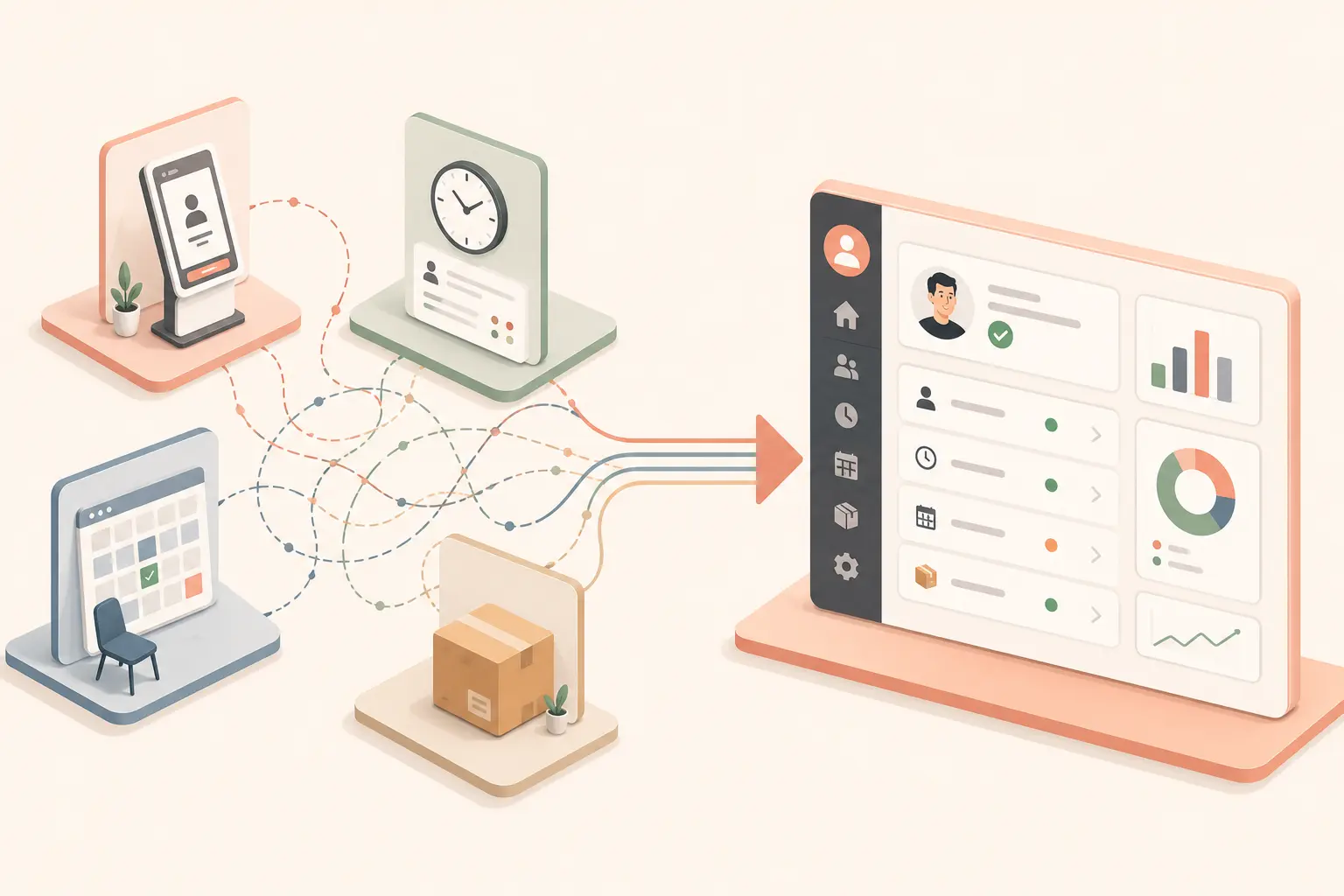
A workplace management platform designed for multi-site operations solves this by providing a single system with location-specific configurations. Every site uses the same platform, follows the same core processes, and reports into the same analytics dashboard, while retaining the flexibility to adapt to local needs.
According to JLL’s 2025 Corporate Real Estate Report, organizations managing ten or more locations with fragmented workplace tools spend 35% more on workplace operations per employee compared to those using unified multi-site platforms (JLL, 2025).
Key Challenges of Multi-Site Workplace Management
Process Inconsistency
When each site manages operations independently, processes diverge over time. One office uses a digital visitor management system, while another still uses a paper logbook. One site enforces room booking auto-release; another does not. One location tracks deliveries digitally; another relies on email.
This inconsistency creates compliance risk (different sites meeting different standards), employee confusion (different experiences at each location), and management blind spots (incomparable data).
Technology Fragmentation
Multi-site organizations often accumulate different tools at different locations. Site A uses one room booking system; Site B uses another. The corporate HQ has a full workplace management platform, but satellite offices use spreadsheets.
This fragmentation means multiple vendor contracts, multiple support relationships, multiple training programs, and zero cross-site data integration.
Data Silos
When each site runs its own systems, data stays local. You cannot compare visitor volume trends across sites, analyze portfolio-wide space utilization, or identify which locations are performing above or below average.
Without portfolio-level data, strategic decisions about real estate (which leases to renew, where to expand, where to consolidate) rely on incomplete information.
Local Compliance Variation
Different jurisdictions have different compliance requirements. GDPR applies to European offices but not necessarily to U.S. locations. Local fire codes, health regulations, and labor laws vary by city and country. Multi-site workplace management must enforce global standards while accommodating local regulatory requirements.
Cultural and Operational Differences
Offices in different regions may have different work cultures, different peak hours, different meeting norms, and different expectations for workplace services. A multi-site management approach must be flexible enough to respect these differences while maintaining operational consistency.
Resource Distribution
Not every site has a dedicated facility manager or workplace operations team. Satellite offices and smaller locations often rely on office managers or administrative staff who handle workplace operations as one of many responsibilities. Multi-site workplace management technology must be simple enough for non-specialist users.
Standardization Framework for Multi-Site Operations
Effective multi-site workplace management standardizes what should be consistent while leaving room for local adaptation.
Tier 1: Global Standards (Mandatory at Every Site)
These processes must be identical across all locations to ensure compliance, security, and data consistency.
- Visitor check-in procedures. Every site uses the same visitor management system with the same identity verification, NDA capture, and compliance screening requirements.
- Data privacy and retention. Consistent data handling practices across all sites, compliant with the strictest applicable regulation (usually GDPR).
- Security and access control. Standardized access policies with consistent audit trail requirements.
- Reporting format. Consistent data definitions and reporting templates so cross-site comparison is meaningful.
- Compliance documentation. Uniform record-keeping for regulatory audits.
Tier 2: Regional Adaptations (Configurable per Region)
These settings vary by region or country but follow a consistent framework.
- Language and localization. Visitor check-in and employee booking interfaces in local languages.
- Regulatory compliance. Region-specific data consent flows, retention periods, and reporting requirements.
- Working hours. Different standard operating hours and holiday calendars by region.
- Cultural norms. Visitor hospitality customs, meeting etiquette expectations, and service standards.
Tier 3: Site-Specific Configuration (Unique per Location)
These elements are inherently location-specific.
- Floor plans and space inventory. Each site has its own physical layout.
- Desk and room configuration. Different numbers of desks, rooms, and amenities per location.
- Local vendors. Cleaning, security, and maintenance vendors are location-specific.
- Service offerings. Cafeteria availability, parking, gym access, and other on-site services.
Technology Requirements for Multi-Site Workplace Management
Location Hierarchy
The platform must support a structured hierarchy: organization, region, country, city, building, floor, zone. Each level in the hierarchy should support its own configuration (policies, schedules, branding) while inheriting defaults from the parent level.
Centralized Dashboard with Site Drill-Down
Administrators need a single dashboard that shows portfolio-level metrics (total visitors this month, average utilization across all sites, compliance status by region) with the ability to drill down to any specific site for detailed analysis.
Role-Based Access by Location
Different administrators manage different sites. The platform must support role-based access that limits each administrator to their assigned locations while providing global visibility to portfolio managers and leadership.
Cross-Site Reporting
Standard reports should aggregate data across all sites for portfolio-level analysis: total visitor volume by site, space utilization by region, queue wait times by location, and attendance patterns by office.
Local Configuration Flexibility
While core processes are standardized, the platform must allow site-specific configurations: custom check-in flows, local language options, site-specific compliance rules, and location-specific branding.
Offline Capability
Sites in regions with unreliable internet connectivity need the platform to function offline for critical operations (visitor check-in, attendance logging) and sync data when connectivity is restored.
Scalable Architecture
The platform must scale efficiently as new sites are added. Onboarding a new location should take days, not weeks. Configuration templates from existing sites should be reusable.
Comparison: Fragmented vs. Unified Multi-Site Management
| Dimension | Fragmented (Different Tools per Site) | Unified (Single Platform, All Sites) |
|---|---|---|
| Vendor contracts | 5 to 20+ per site | 1 for all sites |
| Cross-site data | Not available (siloed) | Native (shared data model) |
| Process consistency | Low (each site is different) | High (global standards enforced) |
| Compliance risk | High (inconsistent practices) | Low (standardized, auditable) |
| New site onboarding | Weeks to months | Days to weeks |
| Portfolio analytics | Manual spreadsheet compilation | Real-time dashboard |
| Admin overhead | High (per-site management) | Low (centralized management) |
| Employee experience | Inconsistent across locations | Consistent mobile app experience |
| Cost | Higher total (multiple licenses, integrations) | Lower total (single platform) |
| Training | Per-tool, per-site | Standardized, reusable |
Implementation Strategy for Multi-Site Rollout
Phase 1: Pilot at Two to Three Sites (Weeks 1 to 6)
Select two to three sites that represent your diversity: one large HQ, one mid-size regional office, and one small satellite office. Deploy the workplace management platform at these pilot sites. Test the standardization framework, gather feedback, and identify configuration adjustments.
Phase 2: Refine and Template (Weeks 7 to 8)
Based on pilot learnings, refine global standards, regional adaptations, and site-specific configurations. Create templates that can be applied to remaining sites efficiently.
Phase 3: Wave-Based Rollout (Weeks 9 to 18)
Deploy to remaining sites in waves of three to five locations. Each wave benefits from the templates and learnings of previous waves. Allow one to two weeks per wave for configuration, training, and go-live support.
Phase 4: Portfolio Optimization (Ongoing)
Once all sites are on the platform, activate portfolio-level analytics. Compare space utilization, visitor volumes, queue performance, and compliance status across all locations. Use this data to identify optimization opportunities and guide real estate strategy.
Multi-Site Analytics: What to Measure Across Your Portfolio
With all sites on a unified platform, you gain access to portfolio-level analytics that are impossible with fragmented tools.
Cross-site utilization comparison. Compare average desk and room utilization rates across all locations. Identify high-performing sites (where space is well-utilized) and underperforming sites (where space is wasted). Use top-performing sites as models for others.
Visitor volume distribution. Understand how visitor traffic distributes across your portfolio. Sites with high visitor volume may need more front desk resources, while sites with low volume may be candidates for unmanned, kiosk-based check-in.
Compliance consistency scores. Measure compliance adherence across all sites: percentage of visitors with completed NDAs, percentage of check-ins with identity verification, and percentage of accurate evacuation lists. Identify sites that need additional compliance training or process reinforcement.
Cost per utilized seat by location. Calculate the real estate cost per actually-occupied seat at each site. This metric reveals which locations offer the best value and which are candidates for consolidation or right-sizing. It also provides data for lease renegotiation conversations.
Service level comparison. Compare queue wait times, delivery pickup times, and visitor check-in times across locations to identify operational excellence and areas needing improvement.
Frequently Asked Questions
What is multi-site workplace management?
Multi-site workplace management is the practice of coordinating workplace operations across two or more physical office locations using a unified approach. It involves standardizing core processes like visitor check-in, desk and room booking, and compliance documentation across all sites, while accommodating local differences in floor plans, regulations, and culture. The goal is to achieve operational consistency, portfolio-level visibility, and economies of scale that are impossible when each site operates independently.
How do I ensure consistent operations across multiple offices?
Consistency starts with a standardization framework that defines which processes must be identical everywhere (visitor check-in, compliance documentation), which can vary by region (language, regulations), and which are unique per site (floor plans, room inventory). A unified workplace management platform enforces global standards while allowing local configuration. Regular audits of process adherence, combined with cross-site analytics, help maintain consistency over time.
What is the biggest cost of fragmented multi-site management?
The biggest cost is typically the inability to optimize real estate across the portfolio. Without comparable space utilization data from all sites, organizations cannot identify which locations are underutilized, which lease renewals should be renegotiated, and where consolidation opportunities exist. For organizations with ten or more sites, this data gap can result in millions of dollars in avoidable real estate expenses annually.
Can I roll out a workplace management platform to all sites at once?
A simultaneous rollout across all sites is technically possible but practically risky. It concentrates risk (if something goes wrong, it affects everyone), overloads the implementation team, and provides no opportunity to learn and iterate. A phased approach, starting with two to three pilot sites and expanding in waves, is more reliable and produces better outcomes. Each wave benefits from the lessons of the previous one.
How do I handle different regulations at different sites?
Your workplace management platform should support location-specific compliance configurations. For example, European sites can have GDPR consent flows enabled, while sites in other regions follow local data privacy requirements. Visitor screening rules, data retention periods, and security policies should all be configurable at the regional or site level within the global standardization framework.
Unify Your Multi-Site Operations
Multi-site workplace management is not about imposing rigid uniformity. It is about creating a framework that ensures consistency where it matters, flexibility where it is needed, and visibility everywhere. The right technology platform makes this achievable even for organizations with dozens or hundreds of locations.
Vizitor’s workplace management platform is built for multi-site operations, with location hierarchies, centralized analytics, site-specific configuration, and a consistent employee experience across every office.
Try Vizitor Free
No credit card required. Setup in under 5 minutes. Manage visitors, queues, meeting rooms, and more.
Start Free TrialSee Vizitor in action check-in a visitor in under 30 seconds
Trusted by 500+ businesses. QR check-in, badge printing, NDA signing. Plans from $36/mo.