What Meeting Room Data Reveals About Office Space Use
Meeting room analytics reveal how rooms are used in real time; highlighting no-shows, peak demand, and space inefficiencies. With smart meeting room management systems, enterprises improve room allocation, reduce conflicts, cut costs, and optimize workplace space.


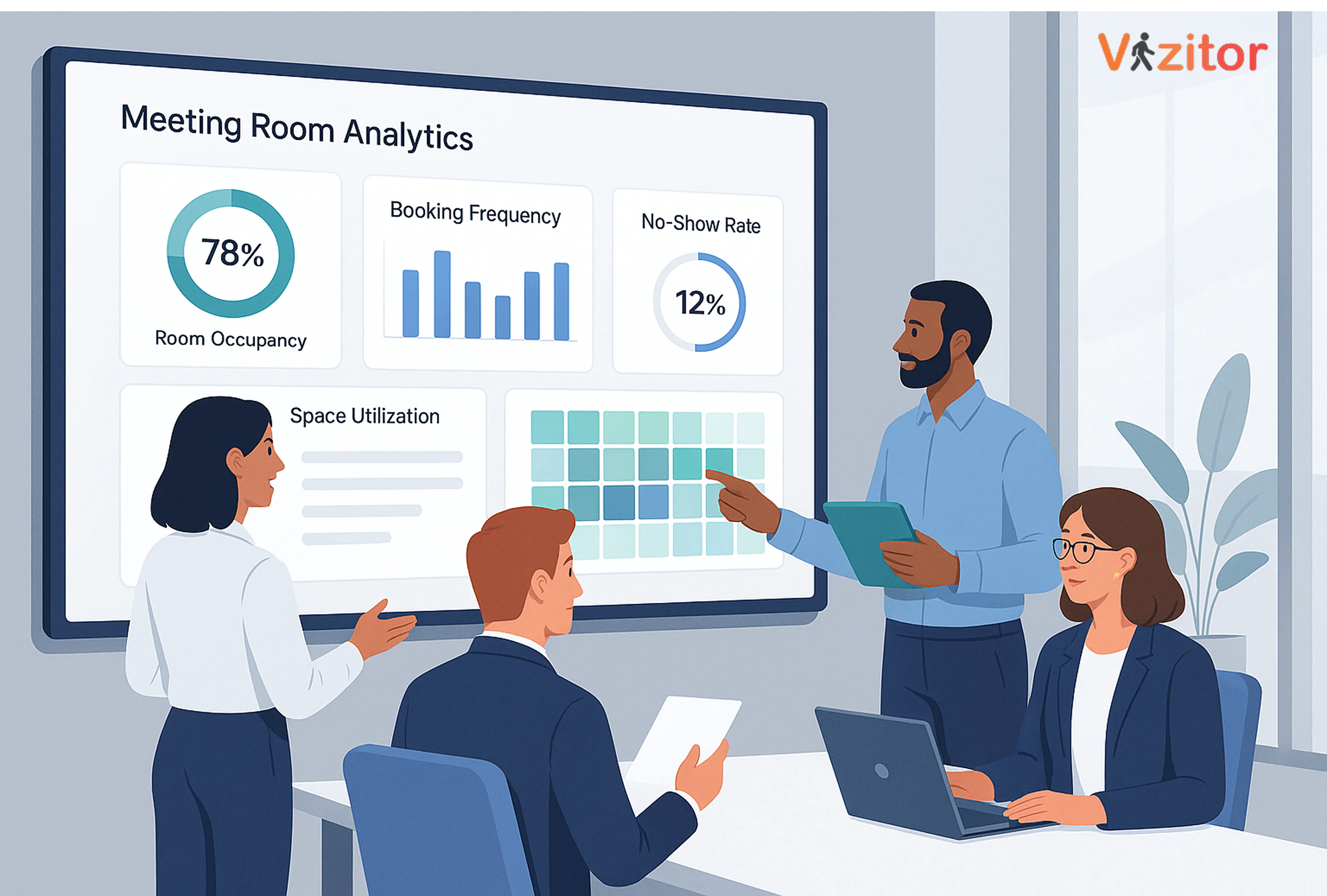
Table of Content
Try Vizitor for Free!
INTRODUCTION
Walk into any enterprise office and you’ll notice one thing almost instantly, meeting rooms are always in demand, yet always mismanaged.
Some rooms stay booked all day but sit empty half the time. Others are overcrowded. Teams fight over availability. And facilities struggle to understand what’s actually happening behind all those bookings.
This is where meeting room analytics change the game.
Enterprises that once relied on guesswork now depend on real-time meeting room management systems to understand how their spaces are actually being used, not how they think they’re being used.
The result? More efficient use of office space, reduced operational waste, and a workplace that runs smoother than ever.
In this blog, we’ll break down:
- What meeting room analytics really are
- Why they matter for modern workplaces
- The biggest inefficiencies they uncover
- How analytics boost space utilization
- The role of workplace management dashboards like Vizitor
- How enterprises use this data for long-term workspace planning
What Are Meeting Room Analytics?
Meeting room analytics refer to the data insights generated by a meeting room management system, covering:
- Room occupancy patterns
- Booking frequency
- No-show rates
- High-demand time slots
- Actual vs scheduled meeting duration
- Equipment usage
- Team or department booking trends
- Space utilization across floors or buildings
This data is collected in real time and displayed on a workplace management dashboard, giving admins, HR, and facilities teams visibility they never had before.
Why Meeting Room Analytics Matter More Than Ever
Hybrid work, distributed teams, and flexible schedules have reshaped how workplaces function. Office usage is inconsistent and without analytics, most enterprises overestimate how much space they need or underestimate how inefficiently they’re using it.
Meeting room analytics bring clarity on:
✔ How many rooms the company actually needs
✔ Which room sizes are overbooked or underused
✔ How to reduce no-shows
✔ How often meetings end early or never happen
✔ How to align real estate costs with actual usage
✔ How to eliminate friction in room booking
In short: analytics replace guesswork with predictable, measurable insights.
Common Meeting Room Inefficiencies Analytics Reveal
Before adopting analytics, enterprises consistently run into problems like:
1. High No-Show Rates
People reserve rooms “just in case” and never use them.
2. Wrong-Sized Rooms
A 12-seater room gets booked for a 1:1 discussion, wasted space.
3. Double Bookings & Conflicts
Teams fight for rooms because they don’t know what’s available in real time.
4. Underused Spaces
Some rooms stay idle for hours while others remain fully booked.
5. Meeting Overruns
Teams forget to end their booking, causing a domino effect of delays.
6. Lack of Equipment Insights
No visibility into which rooms need maintenance or equipment upgrades.
Meeting room analytics expose these inefficiencies instantly.
How Meeting Room Analytics Improve Space Utilization
Let’s break down the most impactful improvements enterprises experience.
1. Eliminating No-Shows and Ghost Bookings
Data tells you:
- Which rooms are consistently booked but unused
- Which teams or departments create most no-shows
- Peak hours where ghost bookings block real usage
With automated reminders, auto-release features, and check-in requirements, ghost bookings and no-shows get reduced dramatically.
Impact: Rooms become available to the people who actually need them.
2. Matching Room Size to Meeting Size
Analytics show:
- How many people typically attend meetings
- When large rooms are underused
- Where smaller rooms are overloaded
Enterprises can reorganize rooms, add huddle spaces, or convert underutilized zones into more productive areas.
Impact: Space is aligned with real-world needs instead of assumptions.
3. Predicting Peak Usage Hours
Meeting room management systems highlight:
- High-demand time periods
- Recurring busy days (usually Tue–Thu)
- Time slots when meeting volume dips
Facilities teams can adjust cleaning, maintenance, and staffing based on real patterns.
Impact: Productivity increases because teams can plan better.
4. Reducing Booking Conflicts
Live occupancy data prevents:
- Double bookings
- Overlapping reservations
- Miscommunication between departments
Employees instantly see which rooms are free or busy.
Impact: Less friction, fewer arguments, smoother operations. Pairing this data with a clear meeting room booking process is what actually makes the rules stick.
5. Improving Equipment & Room Quality
Analytics show:
- Rooms that frequently face equipment failures
- Rooms that get booked more due to better setups
- Rooms that need upgrades or reconfiguration
This allows proactive maintenance instead of “surprise” failures.
Impact: Every room maintains a consistent standard.
6. Supporting Hybrid Work Planning
Meeting room analytics help answer:
- How many rooms should stay operational on hybrid days?
- Do we need more small rooms for virtual calls?
- Are collaboration zones underused?
Enterprises use this data to redesign floor layouts for hybrid needs.
Impact: Offices remain agile and adaptable.
7. Reducing Real Estate Costs
Meeting room analytics reveal:
- Which spaces can be reassigned
- Areas where demand is consistently low
- Opportunities to optimize or downsize floors
For enterprises, real estate is one of the highest operational costs, and the same desk-to-employee ratio thinking used to calculate hot desking ROI applies just as well to meeting rooms.
Impact: Better space utilization = direct cost savings.
The Vizitor Advantage: Smarter Meeting Room Management
Most organizations use separate software for visitors, meeting rooms, attendance, deliveries, and queues. This scatters data across tools, making decision-making harder.
Vizitor brings everything together in one dashboard.
With Vizitor, companies get:
✔ Meeting room booking system
✔ Real-time occupancy display
✔ Auto-no-show release
✔ Equipment tracking
✔ Multi-floor availability
✔ Smart booking rules
✔ Visitor insights
✔ Attendance management data
✔ Queue management system analytics
✔ Mailroom Management System logs
✔ Space utilization heatmaps
When all workplace data flows into one command center, enterprises unlock complete operational clarity.
Conclusion: Meeting Room Analytics Are Essential for Modern Workplaces
Meeting rooms are no longer simple enclosed spaces, they’re strategic assets.
Without analytics, they’re misused, underutilized, and costly to maintain.
But with the right meeting room management system, enterprises gain:
- High space utilization
- Lower operational costs
- Faster decision-making
- More efficient collaboration
- Better hybrid work planning
- A smarter, more predictable workplace
Meeting room analytics aren’t just a feature, they’re an operational advantage.
Want to See Vizitor’s Meeting Room Dashboard in Action?
👉 Book a Free Demo
👉 See How Real-Time Analytics Improve Space Utilization
Frequently Asked Questions
See Vizitor in action check-in a visitor in under 30 seconds
Trusted by 500+ businesses. QR check-in, badge printing, NDA signing. Plans from $36/mo.