Enterprise Delivery Management


Table of Content
Try Vizitor for Free!
Managing deliveries for a 50-person office is a logistics challenge. Managing deliveries for an enterprise with thousands of employees across dozens of locations is an operational program that requires purpose-built technology, standardized processes, and centralized oversight.
Definition: Enterprise delivery management is a scalable, multi-site approach to tracking, routing, and documenting all packages and deliveries across a large organization’s facilities, supported by centralized governance, integrations, and analytics.
Enterprise delivery management addresses the unique challenges that large organizations face: inconsistent processes across sites, lack of centralized visibility, complex compliance requirements, and the sheer volume of packages flowing through multiple entry points every day.
This guide covers what makes enterprise delivery management different from standard office solutions, the capabilities to look for, how to evaluate vendors, and how to implement a system that scales with your organization. Vizitor’s delivery management system is built for enterprise scale, with multi-site management, centralized reporting, and integration capabilities that connect with your existing mailroom management software and workplace tools.
What Makes Enterprise Delivery Management Different
Scale
Enterprise organizations handle hundreds to thousands of packages daily across multiple locations. The system must handle peak volumes without degradation and scale linearly as locations are added.
Multi-Site Complexity
Each site may have different physical layouts, staff structures, carrier relationships, and local regulations. The system must accommodate local variations while maintaining consistent standards.
Compliance Requirements
Enterprises, especially in regulated industries, face audit requirements that demand documented chain of custody, data retention, and privacy controls. According to Deloitte’s 2024 Global Risk Management Survey, 78% of enterprises cite regulatory compliance as a primary driver for digitizing operational processes (Source: Deloitte, 2024 Global Risk Management Survey).
Integration Depth
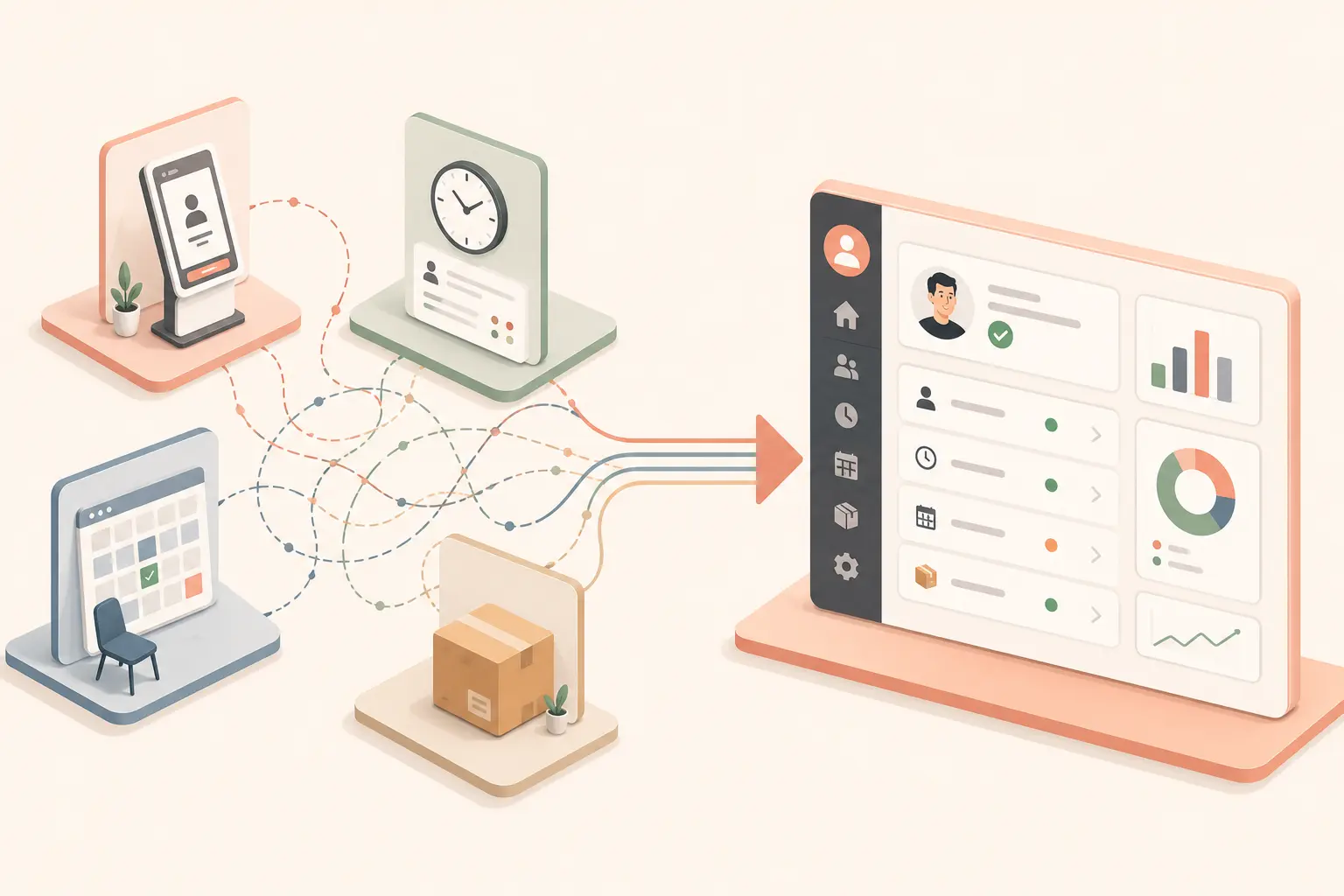
Enterprise systems do not operate in isolation. Delivery management must integrate with HRIS platforms, Active Directory, SSO providers, communication tools, ERP systems, and workplace management platforms.
Governance
Centralized administration, role-based access control, and audit logging are essential for enterprise governance. IT and facilities teams need to manage the system without involving vendor support for routine changes.
Core Capabilities for Enterprise Delivery Management
| Capability | Why Enterprises Need It | Standard Office Solution | Enterprise Solution |
|---|---|---|---|
| Multi-site management | Centralized control, local execution | Single location | Unlimited locations, centralized dashboard |
| Role-based access control | Security and governance | Basic admin/user | Granular roles per site, department, function |
| SSO integration | Simplified employee access | Username/password | SAML, OAuth, Active Directory |
| Centralized reporting | Cross-site visibility | Site-level reports | Consolidated dashboards with drill-down |
| SLA management | Accountability for internal operations | None | Configurable SLAs with automated alerts |
| API access | Custom integrations | Limited or none | Full REST API |
| Data residency options | Compliance with regional regulations | Vendor-determined | Configurable by region |
| Custom workflows | Accommodate site-specific needs | Standard workflow | Configurable per site or item type |
| Bulk operations | Efficiency at scale | One-at-a-time | Batch scanning, bulk notifications |
| Uptime SLA | Operational reliability | Best effort | 99.9%+ with support SLA |
Enterprise Deployment Models
Centralized Management, Local Execution
The most common model. Corporate IT and facilities teams manage the system configuration, policies, and reporting centrally. Local mailroom and front desk staff execute daily operations within the established framework.
This model ensures consistency while allowing site-level flexibility for physical layouts and local staffing.
Federated Management
Each site or region manages its own configuration within corporate-defined guardrails. This works well for organizations with strong regional autonomy where local facilities teams need the flexibility to adapt processes.
Fully Centralized
A central team manages all aspects of the system, including site-level configurations. This works for organizations with a strong shared services model and centralized facilities management.
Enterprise Integration Architecture
Employee Directory
Sync with Active Directory, Azure AD, or your HRIS to automatically maintain the employee database. New hires are available for recipient matching immediately. Departing employees are flagged automatically.
Communication Platforms
Enterprise-grade Slack and Microsoft Teams integrations ensure notifications reach employees through the tools they use daily. Configurable per site or per user.
Access Control and Security
Integration with physical access control systems and workplace security management platforms enables badge-based pickup verification and coordinated security protocols.
Visitor Management
When delivery drivers arrive at enterprise facilities, they should be processed through the visitor management system for security and compliance. Native integration creates a smooth front desk experience.
ERP and Procurement
For business deliveries tied to purchase orders, integration with ERP systems (SAP, Oracle, Workday) enables automatic matching of deliveries to orders and three-way matching for accounts payable.
Facilities Management
Delivery data feeds into facilities management platforms, informing decisions about mailroom staffing, storage capacity, and space allocation.
Implementing Enterprise Delivery Management
Phase 1: Discovery and Planning (Weeks 1-4)
Conduct a thorough assessment across all sites. Document current processes, volumes, pain points, and technology landscape. Identify priority sites for initial deployment.
Engage stakeholders from facilities, IT, security, compliance, and HR. Define project goals, success metrics, and governance structure.
Phase 2: Pilot Deployment (Weeks 5-8)
Deploy at 2-3 representative sites. Include at least one high-volume site and one site with unique requirements. Configure the system, train staff, and run the pilot for 3-4 weeks.
Gather data on processing times, adoption rates, and user feedback. Identify configuration changes needed before broader rollout.
Phase 3: Phased Rollout (Weeks 9-20)
Deploy to remaining sites in waves of 3-5 locations. Each wave follows a repeatable playbook: configure, train, launch, monitor. Adjust the playbook based on lessons from each wave.
Phase 4: Optimization (Ongoing)
Use centralized reporting to compare performance across sites. Identify best practices at top-performing sites and propagate them. Continuously refine workflows, notification strategies, and integration configurations.
Enterprise Best Practices
Standardize, then customize. Define a standard process that applies to all sites, then allow controlled customization for site-specific needs. This prevents fragmentation while respecting local requirements.
Invest in training. Enterprise rollouts involve more people and more complexity than single-site deployments. Develop role-based training materials (mailroom staff, front desk, employees, administrators) and deliver them systematically.
Establish clear governance. Define who can modify system configurations, who reviews analytics, and who approves process changes. Without governance, enterprise systems drift toward inconsistency.
Monitor proactively. Do not wait for complaints. Use dashboards to monitor processing times, notification delivery rates, and uncollected item rates across all sites daily.
Plan for mergers and acquisitions. Enterprises frequently acquire new locations. Your delivery management system should accommodate new sites quickly, ideally within days.
Integrate security from day one. Enterprise facilities often have specific security requirements. Connect delivery management with workplace security management during initial deployment, not as an afterthought.
Vendor Evaluation Criteria
When evaluating enterprise delivery management solutions, assess these dimensions:
Scalability: Can the system handle your current and projected volumes across all sites without performance degradation?
Multi-site architecture: Does the system support centralized management with site-level configuration, or is each site a separate instance?
Integration ecosystem: Does the vendor offer native integrations with your existing tools (AD, Slack, Teams, ERP), or will you need middleware?
Security and compliance: Does the vendor meet your security requirements (SOC 2, ISO 27001, GDPR, HIPAA)?
Support model: What level of support is included? Enterprise deployments need dedicated support, not just a help center.
Roadmap alignment: Does the vendor’s product roadmap align with your future needs?
Total cost of ownership: Consider licensing, implementation services, integration development, training, and ongoing support costs.
Frequently Asked Questions
How long does an enterprise deployment take?
A typical enterprise deployment with 10-50 sites takes 3-6 months from project kickoff to full rollout. The timeline depends on the number of sites, integration complexity, and organizational change management capacity.
Can we migrate from our existing system?
Yes. Most enterprise delivery management platforms, including Vizitor, support data migration from existing systems. Historical data (package records, analytics) can typically be imported to maintain continuity.
How do we handle sites in different countries?
Vizitor’s delivery management system supports multi-language notifications, local time zones, and configurable data residency options. Each site can be configured to comply with local regulations while rolling up to global reporting.
What is the typical ROI for enterprise delivery management?
Enterprise organizations typically see ROI through reduced staff time (1-3 hours saved per site per day), eliminated lost packages (averaging $50-200 per incident in replacement costs and employee time), and compliance cost avoidance. Most deployments achieve positive ROI within 6-12 months.
How does enterprise delivery management integrate with a queue management system?
In large facilities where package pickup creates congestion, integration with a queue management system enables scheduled pickup times, real-time queue monitoring, and traffic distribution throughout the day.
Conclusion
Enterprise delivery management is not simply scaling up an office solution. It requires purpose-built architecture, enterprise-grade integrations, centralized governance, and a deployment methodology that works across dozens or hundreds of locations.
Vizitor’s delivery management system is designed for enterprise organizations, with multi-site management, comprehensive integration capabilities, and the scalability to handle growing volumes and new locations. Combined with our mailroom management software and visitor management system, it provides a unified platform for managing everything that enters your facilities.
Ready to scale your delivery operations? Request a demo to see Vizitor’s enterprise capabilities, or visit our pricing page to discuss enterprise plans.
Try Vizitor Free
No credit card required. Setup in under 5 minutes. Manage visitors, queues, meeting rooms, and more.
Start Free TrialSee Vizitor in action check-in a visitor in under 30 seconds
Trusted by 500+ businesses. QR check-in, badge printing, NDA signing. Plans from $36/mo.