Visitor Management for Law Firms


Table of Content
Try Vizitor for Free!
Law firms exist to protect their clients’ interests, and that obligation begins the moment someone walks through the front door. Every visitor, whether a client, opposing counsel, expert witness, court reporter, or delivery person, represents a potential point where confidential information could be exposed.
Yet many law firms still rely on a receptionist with a paper logbook. In a profession built on precision and documentation, this gap is both surprising and risky.
A 2024 survey by the American Bar Association found that 29% of law firms had experienced some form of security breach in the prior year, with unauthorized physical access cited as a contributing factor in multiple incidents. (Source: ABA Legal Technology Survey Report 2024)
What is visitor management for law firms? Visitor management for law firms is the structured process of registering, screening, and tracking every person who enters a legal office. It includes identity verification, NDA or confidentiality agreement signing, host notification, and the creation of audit-ready visit logs that support compliance with legal ethics rules and data protection regulations.
This guide covers why law firms need specialized visitor management, the challenges unique to legal practices, and how a modern visitor management system addresses them.
Why Law Firms Cannot Afford Weak Visitor Management
Attorney-Client Privilege
Attorney-client privilege is the bedrock of legal practice. If a client visits a law firm and encounters another client’s name on an open sign-in sheet, or if a visitor overhears a conversation in an unsecured waiting area, the privilege could be jeopardized. Digital visitor management systems eliminate shared sign-in sheets and can stagger visitor arrivals to minimize overlap in reception areas.
Regulatory Compliance
Law firms that handle healthcare-related matters must comply with HIPAA. Firms serving European clients face GDPR requirements. Practices dealing with financial data may fall under SOX or GLBA. Each of these regulations imposes strict requirements on how personal data, including visitor data, is collected, stored, and shared.
Professional Reputation
First impressions matter in every business, but law firms compete partly on the perception of competence and professionalism. A chaotic front desk or a paper sign-in sheet sitting in plain view does not inspire confidence. A smooth, digital check-in experience signals that the firm takes security and client service seriously.
Key Challenges in Law Firm Visitor Management
1. Confidentiality of the Visitor List
In a traditional paper logbook, every visitor can see who visited before them. For law firms, this is unacceptable. A client involved in a sensitive merger, a whistleblower meeting with attorneys, or a party to contentious litigation cannot have their presence disclosed.
A digital visitor management system records each visit in a secure database. No visitor sees another visitor’s information. Each entry is accessible only to authorized staff.
2. NDA and Confidentiality Agreement Signing
Many law firms require visitors to sign non-disclosure agreements or acknowledge confidentiality policies before entering the office. Handling this with paper forms is slow, error-prone, and creates storage challenges.
A workplace management platform presents NDAs on a tablet or kiosk screen during check-in. Visitors sign digitally, and the signed document is stored with their visit record automatically. This is faster for visitors and more reliable for the firm.
3. Client Segregation
Firms handling matters for competing clients must ensure those clients never cross paths in the office. This is commonly called an “ethical wall” in practice management. Visitor management systems that show expected arrivals allow office administrators to schedule visits with appropriate buffers and route clients to separate waiting areas.
4. Multi-Office Coordination
Many law firms operate across multiple offices. A partner in the New York office may need to host a client at the firm’s Washington, D.C. location. A centralized visitor management platform allows hosts to pre-register visitors at any office, ensuring a consistent experience and unified record-keeping across all locations.
5. After-Hours Access
Depositions, late-night deal closings, and weekend work sessions mean law firms often have visitors outside normal business hours. The system must handle after-hours check-ins with the same level of security and documentation as daytime visits.
How Vizitor Addresses Law Firm Needs
Vizitor provides the tools law firms need to maintain confidentiality while creating a professional visitor experience.
Private check-in. Each visitor checks in on a dedicated screen. No visitor sees another visitor’s name or information. The system can be configured to use matter numbers or codes rather than client names for an additional layer of confidentiality.
Digital NDA signing. Present firm-specific NDAs, confidentiality acknowledgments, or conflict waivers at check-in. Signed documents are stored securely and linked to the visit record.
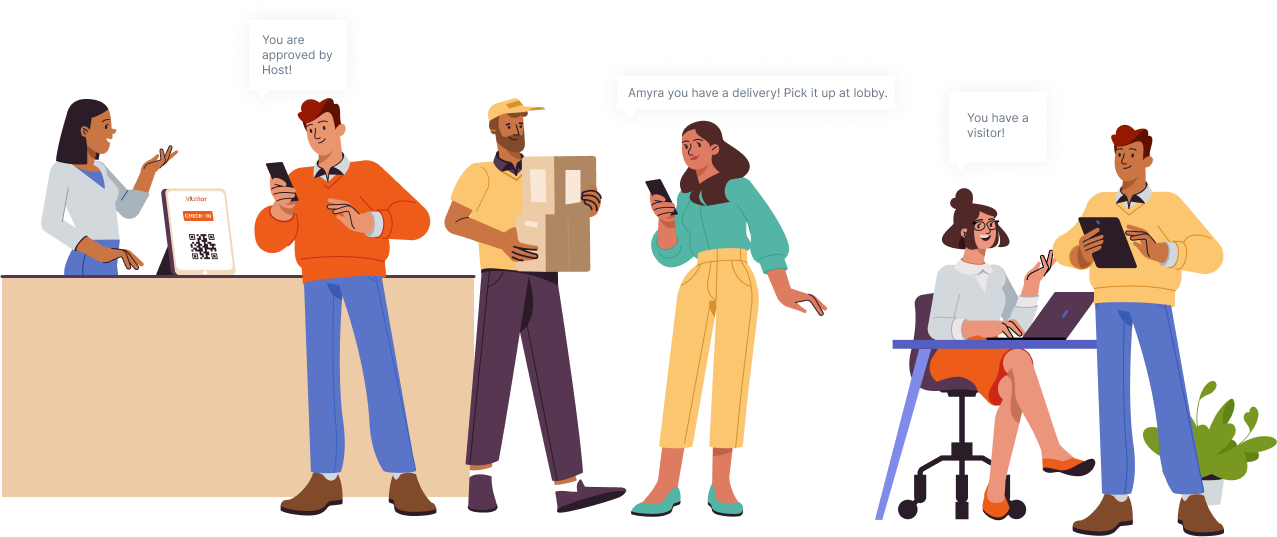
Host notification. When a client arrives, their attorney receives an instant notification by email, SMS, or app alert. This eliminates the need for a receptionist to announce the visitor’s name across the office.
Visitor photo capture. The system captures a visitor photo at check-in, creating a visual record that helps with identification and security without requiring the visitor to wear a badge through the building.
Pre-registration. Attorneys or their assistants pre-register visitors, including any special instructions such as “escort to Conference Room B” or “do not schedule same-day visits with [other client].” This information flows to reception staff in advance.
Compliance-ready audit logs. Every visit is logged with timestamps, host details, signed documents, and visitor identity information. These logs support compliance with Bar association ethics rules, GDPR, HIPAA, and firm-specific data governance policies.
Learn more about how Vizitor strengthens workplace security management for professional services firms.
Comparison: Paper-Based vs. Digital Visitor Management for Law Firms
| Feature | Paper Logbook | Digital VMS (Vizitor) |
|---|---|---|
| Visitor privacy | Names visible to all visitors | Private, encrypted records |
| NDA signing | Paper forms, manual filing | Digital signatures, auto-stored |
| Host notification | Phone call or walk to reception | Instant automated notification |
| Visitor photo capture | Not available | Automatic at check-in |
| Audit trail | Incomplete, difficult to search | Complete, timestamped, searchable |
| Multi-office support | Separate systems per office | Unified platform across locations |
| After-hours check-in | No process or paper-only | Self-service kiosk with full logging |
| Ethical wall support | Manual calendar management | Automated scheduling conflict alerts |
| GDPR/HIPAA compliance | Difficult to demonstrate | Built-in data handling controls |
Use Cases in Legal Practice
Case 1: High-profile litigation. A firm handling a class action lawsuit needs to ensure that media, opposing counsel, and the firm’s own clients never encounter each other in the lobby. Vizitor’s scheduling and routing features allow the office manager to assign different arrival times and waiting areas for each group.
Case 2: Due diligence data room visits. During a merger, multiple parties need access to a physical data room within the firm’s office. Vizitor tracks exactly who enters and exits the data room, how long they stayed, and what time they arrived, creating a defensible record if document access is ever questioned.
Case 3: Expert witness visits. An expert witness arrives for a preparation session. At check-in, they sign a confidentiality agreement on the tablet, their photo is captured, and the lead attorney receives an instant notification. The visit is logged for billing and compliance purposes.
Case 4: Multi-office client visit. A corporate client visits the firm’s Chicago office for a meeting arranged by a partner based in Boston. The Boston-based assistant pre-registers the client in Vizitor, and the Chicago reception team sees all relevant details, including which conference room to use and which local attorneys will attend.
Best Practices for Law Firm Visitor Management
-
Eliminate shared sign-in sheets immediately. This is the single most impactful step a firm can take to protect client confidentiality at the front desk.
-
Require digital NDA signing for all visitors. Even delivery personnel should acknowledge basic confidentiality obligations before entering office areas.
-
Use pre-registration for all expected visitors. This allows reception staff to prepare, reduces wait times, and prevents scheduling conflicts with ethical wall clients.
-
Set data retention policies. Configure the system to automatically purge visitor records after the period required by regulation or firm policy, supporting GDPR’s data minimization principle.
-
Train all staff on the system. Every attorney, paralegal, and administrative assistant who hosts visitors should know how to pre-register guests and manage visit requests.
For firms with high client traffic, a queue management system can further streamline the arrival experience.
Frequently Asked Questions
How does a visitor management system protect attorney-client privilege?
The system eliminates shared sign-in sheets where one client could see another client’s name. Each visit is recorded in a private, encrypted database. The system can also use matter codes instead of client names, and it controls notification routing so that only authorized staff are alerted to a client’s arrival. These measures reduce the risk of inadvertent disclosure that could compromise privilege.
Can the system handle confidentiality agreements at check-in?
Yes. Vizitor presents customizable NDAs or confidentiality acknowledgment forms on the check-in screen. Visitors read and sign digitally. The signed document is stored with the visit record and can be retrieved at any time. Firms can configure different agreements for different visitor types, such as clients, opposing counsel, and vendors.
Is the system compliant with GDPR and HIPAA?
Vizitor is designed with data protection at its core. For GDPR compliance, the system supports consent collection at check-in, data access requests, automatic data purging after configurable retention periods, and data processing records. For HIPAA, visitor data is encrypted at rest and in transit, access is role-based, and audit logs track every data access event.
How do multi-office firms maintain consistent visitor management?
Vizitor operates as a centralized cloud platform. All offices connect to the same system, so a partner in any location can pre-register visitors at any other office. Firm-wide reporting, consistent branding, and uniform security policies are maintained across all locations. Each office can also have location-specific configurations for local requirements.
What happens if the system goes offline?
Vizitor includes offline capability for critical check-in functions. Visitor data entered during an outage syncs automatically when connectivity is restored. For firms that require continuous operation, on-premise backup options are available.
Conclusion
For law firms, visitor management is not an administrative convenience. It is a professional obligation. Protecting client confidentiality, maintaining ethical walls, and documenting every visit are responsibilities that paper logbooks cannot reliably fulfill.
Vizitor gives law firms a visitor management system that matches the standard of care they apply to everything else: thorough, confidential, and audit-ready.
Request a demo to see how Vizitor works in a legal office environment, or review pricing for professional services firms.
Try Vizitor Free
No credit card required. Setup in under 5 minutes. Manage visitors, queues, meeting rooms, and more.
Start Free TrialSee Vizitor in action check-in a visitor in under 30 seconds
Trusted by 500+ businesses. QR check-in, badge printing, NDA signing. Plans from $36/mo.