Security Guard vs Visitor Management System: Do You Need Both?


Table of Content
Try Vizitor for Free!
Should you hire security guards or install a visitor management system? The question comes up in budget meetings, board rooms, and facility planning sessions every quarter. It frames security as a binary choice - people or technology, labor or software - and that framing is almost always wrong.
The more useful question is: what does each do that the other cannot, and where do they overlap? When you understand the distinct capabilities of security guards and visitor management systems, the answer shifts from “either/or” to “both, configured correctly.”
This guide breaks down the roles, strengths, limitations, and costs of security guards and visitor management systems, then explains how combining them creates a security posture that neither achieves alone. For the complete security framework, visit our workplace security management hub.
What Security Guards Do
A security guard is a human operator deployed to protect people, property, and information through physical presence, observation, judgment, and intervention.
Core security guard responsibilities include:
- Physical deterrence - the visible presence of a uniformed guard discourages criminal activity, trespassing, and policy violations
- Real-time judgment - guards assess ambiguous situations, de-escalate conflicts, and make decisions that algorithms cannot
- Emergency response - guards provide immediate on-scene response to fires, medical emergencies, active threats, and natural disasters
- Access control enforcement - guards verify identities, check credentials, and deny entry to unauthorized individuals
- Patrol and surveillance - guards physically traverse premises to identify vulnerabilities, suspicious activity, and maintenance issues
- Visitor interaction - guards greet visitors, provide directions, manage sign-in processes, and serve as the human face of workplace security
- Incident documentation - guards create reports that become legal and compliance records
Security guards bring something no technology replicates: the ability to read context, exercise judgment, and physically intervene. A camera can see a fight. A guard can stop one. For a deep dive into guard operations, see our security guard management guide.
What a Visitor Management System Does
A visitor management system (VMS) is a technology platform that automates the process of registering, identifying, screening, tracking, and managing every person who enters a facility.
Core VMS capabilities include:
- Pre-registration - visitors register before arrival, reducing lobby wait times and enabling advance screening
- Identity verification - photo capture, ID scanning, and watchlist screening at check-in
- Badge printing - automated visitor badges with photo, host name, access zones, and expiration time
- Host notification - automatic alerts to the employee being visited when their guest arrives
- Visitor tracking - real-time visibility into who is on-premises at any moment
- Compliance documentation - digital visitor logs that satisfy regulatory requirements (ITAR, HIPAA, SOX, C-TPAT)
- Watchlist screening - automatic checking of visitor information against internal deny lists and, where permitted, external databases
- Emergency evacuation lists - instant real-time roster of all visitors on-site during an emergency
- Analytics - visitor volume trends, peak times, host patterns, and check-in duration metrics
A visitor management system brings something no guard replicates: the ability to process, screen, and document hundreds of visitors per day with perfect consistency, zero fatigue, and complete data capture. Learn more on our visitor management system page.
Security Guard vs Visitor Management System: 10-Factor Comparison
The following table compares security guards and visitor management systems across the dimensions that matter most for workplace security.
| Factor | Security Guard | Visitor Management System |
|---|---|---|
| Physical deterrence | Strong - visible human presence deters threats | Minimal - kiosks and cameras are less intimidating |
| Judgment and de-escalation | Strong - trained to read situations and intervene | None - cannot assess ambiguous situations |
| Emergency response | Immediate - physical intervention, first aid, evacuation assistance | Alerting only - can trigger notifications but cannot physically respond |
| Visitor processing speed | 2–5 minutes per visitor (manual log) | 30–60 seconds per visitor (self-service kiosk) |
| Consistency | Variable - depends on individual guard attention and fatigue | Perfect - same process every visitor, every time |
| Scalability | Linear - each additional guard is a significant recurring cost | Highly scalable - system handles volume without proportional cost increase |
| Watchlist screening | Manual - relies on guard memory or printed lists | Automatic - instant database comparison at check-in |
| Data and analytics | Minimal - handwritten logs, limited aggregation | Comprehensive - real-time dashboards, trend analysis, compliance exports |
| 24/7 availability | Requires shift coverage (3 guards per post for round-the-clock) | Always on - no shift changes, no callouts, no fatigue |
| Cost (annual, per entrance) | $50,000–$80,000+ per guard (salary, benefits, training, equipment) | $2,000–$10,000 per year (software + hardware) |
Neither column wins across every factor. Security guards dominate in physical capabilities. Visitor management systems dominate in consistency, scalability, and data. That asymmetry is precisely why the answer is not one or the other.
Why the Answer Is “Both”
Framing the question as “security guard vs visitor management system” creates a false dichotomy. The two serve fundamentally different functions:
- Guards handle the unpredictable. Confrontations, emergencies, judgment calls, physical presence - these require a human operator.
- A VMS handles the predictable. Visitor registration, identity verification, badge creation, host notification, compliance logging - these are repeatable processes that benefit from automation.
When you rely solely on guards, you waste expensive human attention on tasks a machine performs better - checking IDs, printing badges, logging visitor data. When you rely solely on a VMS, you have no physical response capability when something goes wrong.
The optimal security posture combines both: guards focus on judgment-dependent tasks while the VMS automates process-dependent tasks. This is not a compromise. It is how each resource operates at its highest value.
According to the 2025 ASIS International Workplace Security Survey, organizations using both security guards and a visitor management system report 34% fewer unauthorized entry incidents compared to organizations using guards alone.
5 Ways a VMS Makes Security Guards More Effective
A visitor management system does not replace security guards - it amplifies their capabilities. Here is how.
1. Eliminates Manual Check-In Burden
Without a VMS, guards spend a significant portion of their shift processing visitors - checking IDs, writing in logbooks, making phone calls to hosts, printing manual badges. This desk work pulls them away from patrol, surveillance, and the situational awareness that justifies their presence.
With a VMS handling check-in, guards are free to focus on observation, deterrence, and response - the tasks only they can perform.
2. Provides Instant Watchlist Alerts
A guard reviewing a printed deny list for every visitor is slow and error-prone. A VMS checks every visitor name, photo, and ID against watchlists automatically and instantly. When a match occurs, the system alerts the guard - who then exercises the judgment and physical capability to handle the situation.
The VMS identifies. The guard acts. Each does what it does best.
3. Delivers Real-Time Visitor Intelligence
A VMS gives guards information they cannot otherwise access:
- Who is currently on-site and where
- Which visitors are overdue (checked in but not checked out)
- Which hosts have visitors arriving today
- Which areas have unusual visitor volume right now
This intelligence transforms the guard from a reactive gatekeeper into a proactively informed security operator.
4. Automates Compliance Documentation
Guards often spend the final hour of their shift completing paperwork - visitor logs, daily activity reports, compliance forms. A VMS captures visitor data automatically, generating audit-ready records without guard involvement. This frees guard time and eliminates documentation gaps.
For more on how security guard management software features support daily operations, see our feature guide.
5. Enables Faster Emergency Response
During an emergency, the first question is always: who is in the building? With paper logs, answering that question takes minutes - minutes that matter. A VMS provides a real-time evacuation list instantly, allowing guards to account for all visitors and coordinate emergency response without searching through logbooks.
Cost Comparison: Guards-Only vs Guards + VMS
Understanding the financial picture clarifies why combining guards with a VMS is not just operationally superior but economically rational.
Guards-Only Cost Model (Single Entrance, 24/7)
| Cost Component | Annual Cost |
|---|---|
| Guard salaries (3 guards for 24/7 coverage) | $150,000–$210,000 |
| Benefits and insurance | $30,000–$50,000 |
| Training and certification | $5,000–$10,000 |
| Equipment (radios, uniforms, supplies) | $3,000–$6,000 |
| Supervision and management overhead | $15,000–$25,000 |
| Total annual cost | $203,000–$301,000 |
Guards + VMS Cost Model (Single Entrance, 24/7)
| Cost Component | Annual Cost |
|---|---|
| Guard salaries (2 guards - VMS handles check-in volume) | $100,000–$140,000 |
| Benefits and insurance | $20,000–$34,000 |
| Training and certification | $4,000–$8,000 |
| Equipment (radios, uniforms, supplies) | $2,000–$4,000 |
| Supervision and management overhead | $10,000–$18,000 |
| VMS software and hardware | $3,000–$8,000 |
| Total annual cost | $139,000–$212,000 |
In many cases, the VMS reduces total security cost by enabling a smaller guard team to achieve better outcomes. The VMS cost is a fraction of a single guard’s annual compensation, yet it can reduce the required guard count by freeing guards from desk-bound visitor processing.
Real-World Integration Scenarios
Corporate Office (200–500 Employees)
Setup: One security guard at the main lobby, VMS kiosk for visitor self-check-in, secondary entrances secured with access control.
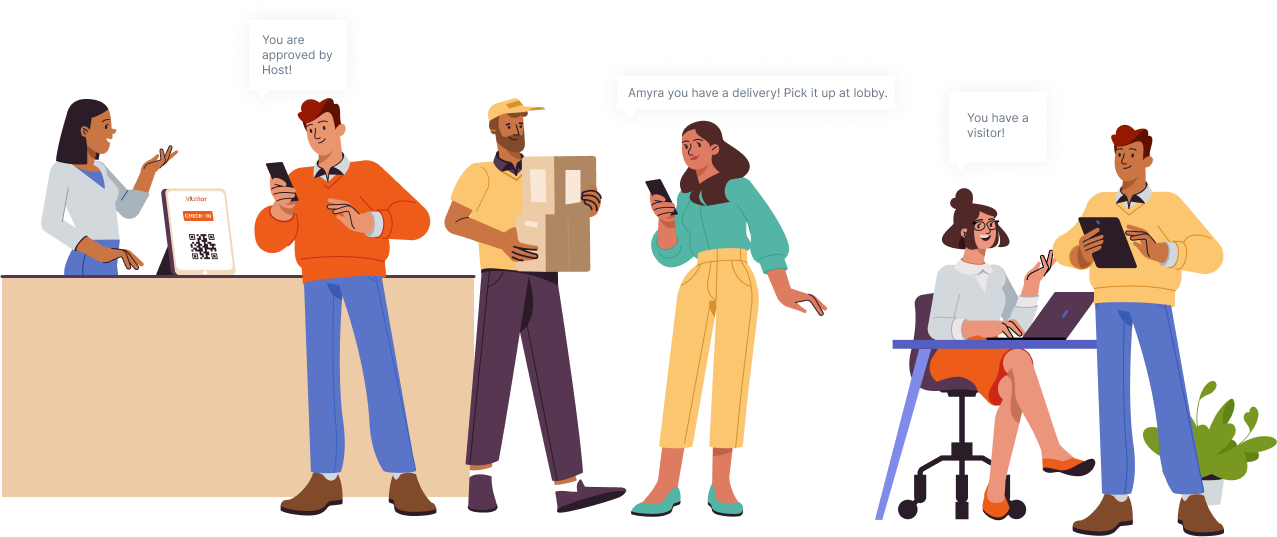
How it works: Visitors pre-register online. On arrival, they check in at the VMS kiosk - ID scan, photo capture, badge print - in under 60 seconds. The guard monitors the lobby, watches for tailgating, handles deliveries, and responds to VMS watchlist alerts. The guard is not trapped at the desk processing visitors; the VMS handles that.
Manufacturing Facility (ITAR/C-TPAT Compliant)
Setup: Security guard at the gatehouse, VMS with mandatory citizenship verification and NDA signing, escort assignment for restricted areas.
How it works: The VMS enforces compliance workflows - citizenship screening, document signing, safety video completion - before the visitor receives a badge. The guard verifies the badge, assigns the escort, and maintains physical control of the entry point. Compliance documentation is captured automatically by the VMS, eliminating the guard’s paperwork burden.
Multi-Tenant Office Building
Setup: Building security guard in the main lobby, per-tenant VMS instances for each company, shared access control system.
How it works: Each tenant’s visitors check in through their company’s VMS configuration. The building guard monitors the lobby and responds to escalations. The VMS routes visitor notifications to the correct tenant and floor. The guard does not need to maintain separate visitor lists for every company in the building.
Healthcare Facility
Setup: Security guard at the emergency department entrance, VMS at the main visitor entrance with patient privacy screening, restricted ward access managed by access control + VMS.
How it works: The VMS screens visitors against patient consent records (who is allowed to visit which patient), captures visitor photos, and prints time-limited badges. The guard maintains physical security at the high-risk ED entrance and responds to VMS alerts for denied visitors, flagged individuals, or visitors attempting to access restricted wards.
Frequently Asked Questions
Can a visitor management system completely replace security guards?
No. A visitor management system automates visitor processing, screening, and documentation, but it cannot physically intervene during an emergency, de-escalate a confrontation, or exercise real-time judgment in ambiguous situations. Organizations that remove guards entirely in favor of technology-only solutions lose physical deterrence and response capability. The most effective approach is combining guards with a VMS so each handles what it does best.
How does a VMS help during a security emergency?
During an emergency, a visitor management system provides an instant real-time list of every visitor currently on-site, including their name, photo, host, and last known check-in location. This evacuation roster allows security guards and emergency responders to account for all non-employees without searching through paper logs. Some VMS platforms also support emergency notification broadcasts to all checked-in visitors and their hosts.
What size company needs both a guard and a VMS?
There is no strict threshold, but most security professionals recommend a VMS for any organization receiving more than ten visitors per day. The guard decision depends on risk profile and physical security needs. A low-risk office with twenty daily visitors may only need a VMS. A facility handling sensitive materials, even with five daily visitors, likely needs both a guard and a VMS for compliance and physical security reasons.
Do security guards resist working with visitor management systems?
Initial resistance sometimes occurs, particularly among guards accustomed to manual processes. However, most guards quickly recognize that a VMS removes the least interesting part of their job - repetitive visitor processing - and allows them to focus on patrol, observation, and security tasks. Successful implementation includes guard input during system selection and training that positions the VMS as a tool that supports the guard rather than replaces them.
Build a Security Strategy That Uses Both
The question was never really “security guard vs visitor management system.” It was always “how do we deploy each where it creates the most value?” Guards bring judgment, presence, and physical capability. A VMS brings consistency, speed, and data. Together, they deliver workplace security that neither achieves alone.
Request a demo to see how Vizitor’s visitor management platform integrates with guard operations to create a unified security solution for your workplace.
Try Vizitor Free
No credit card required. Setup in under 5 minutes. Manage visitors, queues, meeting rooms, and more.
Start Free TrialSee Vizitor in action check-in a visitor in under 30 seconds
Trusted by 500+ businesses. QR check-in, badge printing, NDA signing. Plans from $36/mo.