Workplace Experience: How to Turn Your Office Into a Place People Choose
This article argues that workplace experience, not attendance policy, is what actually brings people into the office. It defines workplace experience as the combination of space, technology, and process, distinguishes it from the broader concept of employee experience, and cites Gallup's Q12 meta-analysis (183,806 business units) showing engaged teams see 23% higher profitability, 18% higher productivity, 10% higher customer loyalty, and 78% less absenteeism, plus Gallup data showing hybrid workers report higher engagement than fully remote or fully on-site staff. It walks through what a friction-free office day looks like, how to measure experience with data already available, and low-budget ways to improve it, closing with why return-to-office mandates underperform experience-led approaches.


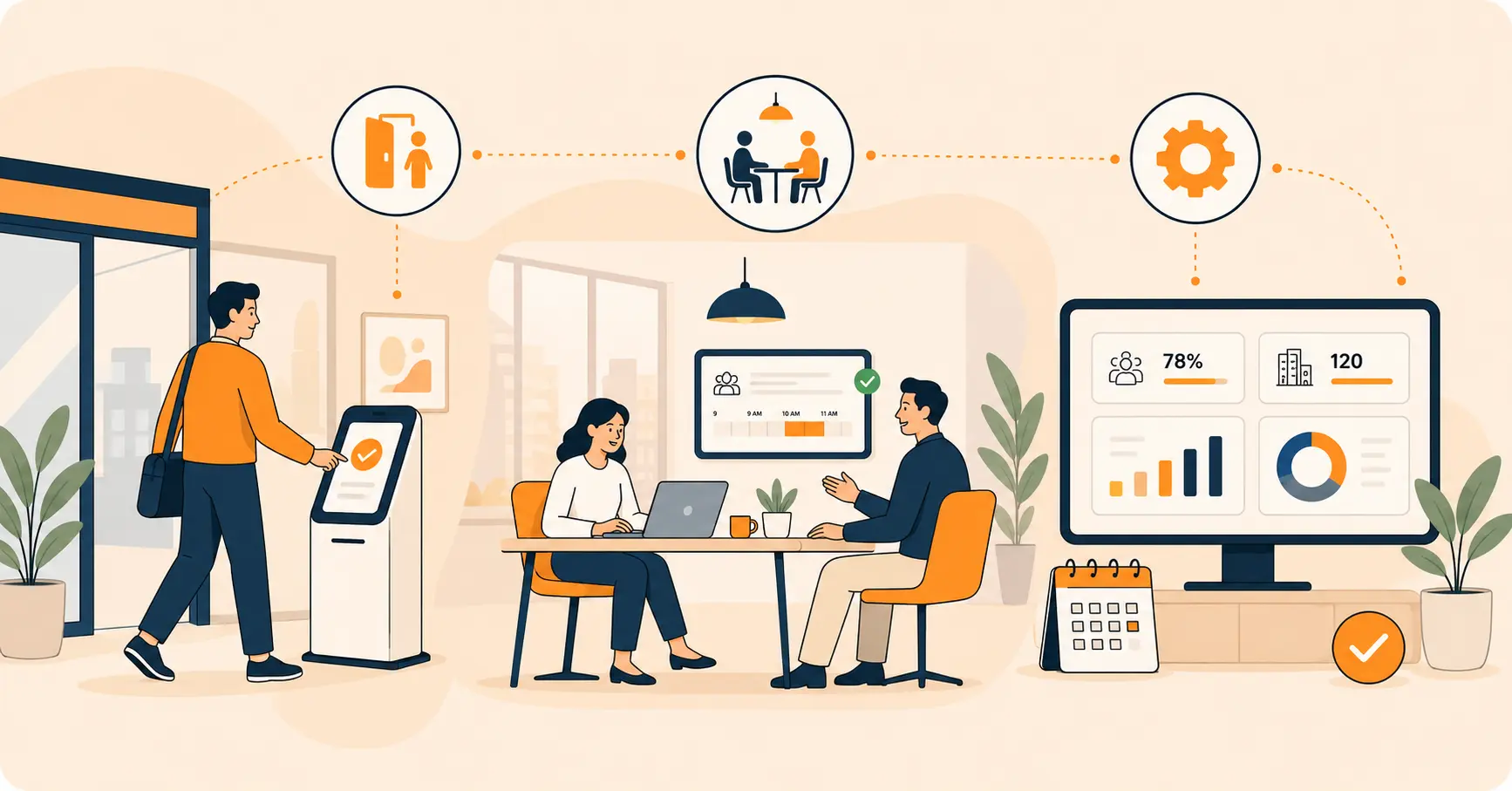
Table of Content
Try Vizitor for Free!
Only 31% of US employees are engaged at work, the lowest Gallup has recorded in a decade. At the same time, roughly 22.6% of workers still teleworked at least part of the week as of March 2026, per the Bureau of Labor Statistics. Put those two numbers together and you get the real question facing every office manager right now: when people can work from anywhere, what makes the office worth the trip?
The answer isn’t a stricter policy. It’s the experience of being there. Workplace experience is how employees feel and perform while they’re onsite, shaped by three things working together: the space (layout, comfort, flow), the technology (the tools people actually use to get things done), and the process (the policies and small daily interactions that decide whether a day runs smoothly or grinds). A good workplace experience is the quiet reason someone books a desk on a Tuesday instead of staying home. Get it right, and presence follows on its own.
Key takeaways
- Workplace experience is built from three things: space, technology, and the people-side process that ties them together.
- Gallup’s Q12 meta-analysis (183,806 business units) finds top-quartile engaged teams see 23% higher profitability, 18% higher productivity, 10% higher customer loyalty, and 78% less absenteeism than bottom-quartile teams.
- Hybrid workers are among Gallup’s most engaged groups at 34%, ahead of both fully remote (32%) and fully on-site staff (29%).
- Forcing attendance backfires: return-to-office mandates track with no measurable performance gain and a real hit to job satisfaction.
- You can measure and improve experience with data you already have, from occupancy to booking patterns.
Think of workplace experience as everything between walking through the door and heading home. Was there a desk ready? Did the meeting room work on the first try? Could someone find a quiet corner when they needed to focus? None of that is glamorous. All of it decides whether the office feels like a destination or a chore.
It helps to separate two terms people often blur. Employee experience is the full journey with a company, from the first interview to the exit conversation. Workplace experience is the narrower, physical slice of that: the actual hours spent onsite. This piece stays focused on the office itself.
Why does this framing matter for presence? Because you can’t policy your way to a workplace people want. You can only design one.
Why does workplace experience decide who shows up?
Because experience and engagement are the same lever, and engagement drives every outcome leaders care about. Gallup’s Q12 meta-analysis, covering 183,806 business units across 53 industries and 90 countries, found top-quartile engaged teams deliver 23% higher profitability, 18% higher productivity, 10% higher customer loyalty, and 78% less absenteeism than bottom-quartile teams (Gallup, 2024).
Now look at where engaged people actually work. Gallup research finds hybrid employees report the highest engagement at 34%, ahead of fully remote staff at 32% and fully on-site staff at 29% (Gallup via Facilities Dive, 2023).
The most engaged people aren’t the ones chained to a desk five days a week. They’re the ones who get to choose, and who find the office genuinely useful on the days they come in. Presence isn’t the goal, it’s a symptom. When the experience is good, people come in because it helps them. When it’s bad, no mandate holds for long.
What does a good workplace experience actually look like?
It looks like a day with no snags. That sounds small, but friction is what quietly pushes people back to their kitchen table. The walkthrough below is an illustrative example of a well-designed day, not a specific customer account, broken into the moments that matter.
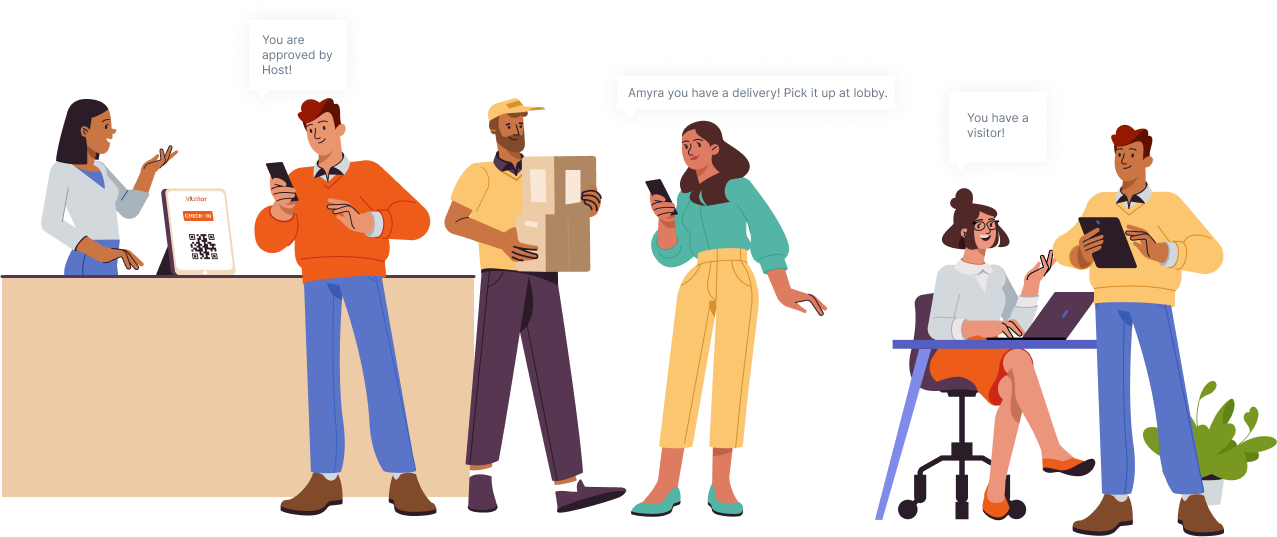
Arrival. Someone books a desk from their phone the night before and knows exactly where they’re sitting. A visitor they invited gets a check-in link, so reception isn’t scrambling when the guest arrives. No guesswork, no wandering the floor at 9am looking for a free spot.
Getting to work. The Wi-Fi connects on the first try. The desk has what they need. If they booked a specific zone to sit near their team, they’re actually near their team.
Meetings. They find and book a room in seconds, and the room they booked is real, not double-booked or held by a ghost meeting nobody showed up to. Our conference room booking software auto-releases no-shows for exactly this reason, because a “reserved” sign on an empty room is one of the most common daily annoyances in any office.
Focus and breaks. There’s a quiet spot when a task needs deep work, and a decent place to step away when it doesn’t. Small thing, big difference.
Leaving. Desk checkout is automatic, so the space frees up for tomorrow without anyone chasing it. They glance at their booking for the next visit and head out.
Notice what’s missing from that day: hunting for a room, fighting with a booking tool, or feeling like the trip in wasn’t worth it. That’s the whole game.
How do you measure workplace experience?
You measure it with the data your office already generates every day, then you act on it. The mistake most teams make is treating experience as a vibe you can only capture in an annual survey. It isn’t. Most of it shows up in hard numbers.
Start with these:
- Occupancy versus bookings. How many booked desks or rooms actually got used? The gap is your ghost-booking rate, and it tells you where space is being hoarded or wasted.
- Attendance split. How many people are genuinely onsite versus remote on any given day? Self-reported numbers lie. Verified check-in data doesn’t. Our attendance management system separates work-from-home and work-from-office with location-confirmed check-ins, so you plan around what’s real.
- Room utilization by size. Are two people camping in a ten-seat boardroom while smaller rooms book out days ahead? That mismatch is a fixable design flaw.
- Peak-day patterns. Most hybrid offices spike Tuesday through Thursday. Knowing your peaks lets you match desks, catering, and cleaning to actual demand.
- Direct feedback. Numbers tell you what’s happening. People tell you why. A quick visitor and employee feedback tool closes that loop.
Once you can see the patterns, the fixes get obvious. You stop guessing and start adjusting.
The mistake worth naming here is measuring the wrong thing well. A team that tracks total badge swipes but not the ghost-booking rate can look busy while quietly wasting half its floor. A team that tracks room bookings but not room no-shows can look fully utilized while people are actually working from the lobby couch because every “booked” room turned out to be empty. Pair each count with the gap metric that explains it, the same way the appointment-versus-abandonment pairing matters for queues.
How do you improve workplace experience without a big budget?
You remove friction first, because that’s free and it moves the needle fastest. Fancy renovations are nice. They’re also rarely the thing standing between your team and a good day. Here’s where to start, in order.
1. Make booking effortless. If reserving a desk or room takes more than a few taps, people give up and stay home. Simple, mobile-first booking is the single highest-return fix in most offices.
2. Right-size your space with real data. Use your occupancy numbers to convert that dead boardroom into two smaller rooms, or turn assigned desks nobody uses into bookable ones. Our space management software shows live occupancy so you’re deciding on facts, not a hunch.
3. Fix the tech that people touch daily. Slow Wi-Fi and clunky apps are morale leaks. Employee frustration with workplace tools is a well-documented problem across multiple industry surveys, so cleaning up the basics pays off immediately even without a specific number attached to your own office.
4. Design for different kinds of work. People need quiet zones and collaboration corners, not one uniform sea of desks. You don’t need a redesign to carve these out, just intention.
5. Actually close the feedback loop. Ask what’s getting in the way, then tell people what you changed. Nothing builds trust faster than a small fix that followed a real complaint. Nothing kills it faster than silence.
The point here is simple: chase friction, not features.
Does better workplace experience actually bring people back?
Yes, and the evidence says it works far better than forcing it. When companies try to solve presence with a mandate, the data gets ugly. A University of Pittsburgh study of S&P 500 firms found that return-to-office mandates followed stock-price declines, produced no measurable gain in company value, and lowered job satisfaction (Pitt Business, 2024).
Now compare that with flexibility done well. A Stanford randomized trial found hybrid schedules deliver productivity on par with full-time office work while cutting resignations by about a third (Stanford, 2024). The lesson isn’t “remote wins.” It’s that people reward a good experience with their presence and their effort, and they punish a bad one with the door.
So the office manager’s real job right now isn’t enforcement. It’s making the office the obvious choice on the days it counts. Build the experience, and attendance stops being a fight.
Bring it together with Vizitor
Workplace experience lives or dies on the small operational stuff: booking a desk, finding a room, tracking who’s really in, and acting on what the data shows. Vizitor runs visitors, desks, rooms, attendance, and analytics from one platform, so the data behind each of the metrics above shares the same live source instead of five disconnected spreadsheets.
That connection matters more than it sounds. A ghost-booking rate calculated from one system and an attendance split pulled from another rarely get compared, because reconciling two exports is exactly the kind of friction this whole article argues against. When occupancy, booking, and attendance data already live together, the comparison that actually changes a policy decision, like whether Tuesday’s mandate is producing collaboration or just a longer commute, takes a glance instead of a spreadsheet project.
The bottom line
Presence isn’t something you demand. It’s something you earn, one good day at a time. When the space works, the tools work, and the small stuff runs without friction, people come in because the office helps them, not because a policy says so.
The good news is that most of this is measurable and fixable with what you already have. Start with the friction your team complains about most, use your own occupancy and attendance data to guide the fixes, and keep listening.
Frequently Asked Questions
See Vizitor in action check-in a visitor in under 30 seconds
Trusted by 500+ businesses. QR check-in, badge printing, NDA signing. Plans from $36/mo.