What Businesses Actually Pay for Ignoring Workplace Risk
This page explains what workplace risk management is and quantifies the financial cost of not having it including IBM's $4.88 million average data breach cost, Liberty Mutual's $58.8 billion annual workplace injury figure, and EY's $922,131 per 1,000 employees in payroll error costs. It covers four cost categories (physical access, compliance, operational, and reputational), five types of workplace risk through real workplace scenarios, and a five-step plan for building a risk management process. Vizitor is presented as the physical access control layer, QR-based visitor check-in, blocklist screening, real-time occupancy visibility, and automated attendance tracking at the point where physical, compliance, and operational risk converge.



Table of Content
Try Vizitor for Free!
Introduction
Most businesses don’t decide to skip risk management. They just never formally start it.
There’s no moment where a leadership team sits down and decides that data breaches, unauthorized visitors, and compliance failures aren’t worth planning for. It happens quietly, through deferred conversations, spreadsheet workarounds, and the comfortable assumption that nothing serious has happened yet, so nothing serious probably will.
That assumption is expensive.
The average cost of a data breach reached $4.88 million in 2024, according to IBM. The most serious workplace injuries cost US employers $58.8 billion a year in direct workers’ comp costs alone, per Liberty Mutual’s 2025 Workplace Safety Index. GDPR fines can reach 4% of global annual revenue for a single violation. And 40% of businesses that experience a major disruptive event never reopen, according to FEMA.
None of these costs are inevitable. Most of them are preventable. But prevention requires something most organizations don’t have until after they need it: a functioning workplace risk management process.
What Is Workplace Risk Management?
Workplace risk management is the process of identifying what could go wrong across your people, operations, facilities, and data and putting controls in place before something does.
It isn’t a policy document that lives in a shared drive. It isn’t an annual safety meeting with a sign-in sheet. It’s an ongoing discipline that touches every part of the organization: HR, facilities, IT, legal, and operations because risk doesn’t respect department lines.
The goal isn’t to eliminate risk. No process can do that. The goal is to make deliberate, documented decisions about which risks to reduce, which to transfer to an insurer, and which to accept. And to have evidence, real, timestamped, auditable evidence that those decisions were made and acted on.
Organizations that do this well spend less when incidents happen. They recover faster. They satisfy regulators without scrambling. And they rarely face the kind of crisis that results from a risk that everyone knew existed but nobody formally owned.
IBM Cost of Data Breach Report, 2024: The average cost of a data breach reached $4.88 million in 2024 across 604 organizations globally. Companies with documented incident response plans saved an average of $2.66 million per breach compared to those without. The presence or absence of a formal risk management structure was the single largest differentiator in breach cost outcomes.
What It Actually Costs When Risk Goes Unmanaged
This is the part most risk management guides skip. They tell you what risk management is and how to do it. They rarely tell you, with real numbers, what you’re actually paying when you don’t.
| Risk category | What it costs | Source |
|---|---|---|
| Data breach (average, global) | $4.88 million per breach | IBM Cost of a Data Breach Report, 2024 |
| Serious workplace injury (US, direct costs) | $58.8 billion a year, industry-wide | Liberty Mutual Workplace Safety Index, 2025 |
| GDPR violation | Up to 4% of global annual revenue | GDPR enforcement framework |
| OSHA willful/repeat violation | Up to $165,514 per violation (2026) | OSHA 2026 penalty schedule |
| Payroll/attendance errors (1,000 employees) | $922,131 a year | EY payroll error research, 2022 |
| Small business closed by a disaster | 40% never reopen | FEMA |
None of these numbers assume the worst case. They’re averages and industry data, the kind of cost that shows up whether or not you were prepared for it.
The Cost of Physical Access Failures
Your front door is where risk becomes visible. It’s where the outside world meets your employees, your data, and your assets. And for most organizations, it’s the least controlled point in the entire operation.
Picture this: a contractor arrives at your office, signs a paper log with an illegible name, and spends the next three hours in an area they shouldn’t have access to. Nobody screened them. Nobody verified their identity. The paper log, if it survives, has no timestamp and no host signature. If something goes missing: a laptop, access credentials, physical files, you have no record of who was in the building or when.
That scenario plays out more often than most organizations want to admit. Workplace violence affects approximately 2 million US workers annually, according to OSHA, and a meaningful proportion of those incidents involve external parties who had no business being on-site.
The cost of a digital check-in system and a documented visitor screening process is a fraction of a single serious incident. This is preventable risk at its most straightforward.
OSHA, Workplace Violence: approximately 2 million US workers are affected by workplace violence annually, a figure that carries direct liability, compliance, and operational implications for organizations without documented physical access management procedures.
The Cost of Compliance Failures
Compliance risk is treated like a legal department problem. It isn’t. Legal gets called in after the fact which is always more expensive than managing it before.
Here’s what compliance failures actually look like in dollar terms. GDPR fines reach 4% of global annual revenue per violation. HIPAA penalties run from $100 to $50,000 per violation, with annual caps up to $1.9 million per violation category. OSHA serious-violation citations reach $16,550 per violation in 2026; willful or repeat violations reach $165,514. ITAR violations carry criminal penalties of up to $1 million and potential imprisonment.
What makes compliance costs particularly damaging is the compounding. One incident, an unauthorized visitor accessing a restricted area can simultaneously trigger OSHA, HIPAA, and GDPR exposure depending on your industry. Each regulatory body responds independently. Legal fees, remediation costs, and operational disruption stack on top of the fines themselves.
And then there’s the evidence problem. Documented risk management processes, visitor logs, screening records, access controls, audit trails are what regulators and auditors accept as proof of compliance. Organizations that can’t produce them face a presumption of non-compliance. That presumption, in a formal proceeding, is very expensive to argue against.
OSHA Penalty Schedule 2026: serious-violation citations carry penalties up to $16,550 per violation, with willful or repeat violations reaching $165,514. GDPR fines applied to organizations operating in or serving EU markets can reach 4% of global annual turnover per violation. Both frameworks explicitly require documented risk assessment and control procedures as conditions of compliance.
The Cost of Operational Risk
Operational risk is the cost category organizations consistently underestimate. It doesn’t announce itself. It accumulates quietly in the everyday processes that seem fine until they’re audited.
Your receptionist is managing a busy lobby. They skip the watchlist check for three visitors because it’s manual and they’re overwhelmed. Nobody notices. The visitors were legitimate. But the check didn’t happen, the record doesn’t reflect it, and if it ever needs to be demonstrated that screening was consistent, it can’t be.
Your attendance data is maintained in a spreadsheet. Different managers update it on different schedules. By payroll, three employees have incorrect hours. The corrections take HR six hours. This happens every cycle. Ernst & Young found that a 1,000-employee company loses $922,131 a year to payroll error corrections alone. At 500 employees, that’s not a rounding error. It’s real money leaking out through a process nobody owns.
In an emergency evacuation, your fire warden asks who’s in the building. Nobody knows for certain. The visitor log is a clipboard. The employee attendance is incomplete. The building is cleared but the accountability record doesn’t exist.
Operational risk is insidious precisely because it doesn’t feel like risk while it’s happening. It feels like a normal day.
EY Payroll Research, 2022: one in five US payrolls contains an error, each costing an average of $291 to fix. Across a 1,000-employee company, EY’s year-long study put the total annual cost of correcting these errors at $922,131. EY identified manual data entry as the primary source, a direct operational risk with downstream compliance implications under FLSA recordkeeping requirements.
The Cost of Reputational Damage
A data breach generates press coverage. A workplace incident involving an unscreened visitor triggers a regulatory investigation that becomes a public record. A compliance failure covered in an industry publication affects client confidence in ways that don’t show up on a balance sheet until contracts aren’t renewed.
IBM’s research found that the reputational and customer loss component of a data breach, separate from the direct remediation cost, accounts for a significant portion of long-term financial impact, particularly in customer-facing industries. Healthcare organizations, financial institutions, and professional services firms face an additional layer: reputational damage with regulators affects licensing, audit terms, and contract eligibility for years.
The organizations that recover fastest are those that can demonstrate a structured response, evidence that the risk was identified beforehand, that controls were in place, and that the incident is being addressed systematically. That evidence only exists if the risk management process existed before the incident.
You can’t reverse-engineer documented compliance. Either it was there or it wasn’t.
IBM Cost of Data Breach Report, 2024: Customer turnover and reputational damage following a data breach contribute significantly to total breach impact beyond direct remediation costs particularly in healthcare and financial services. IBM found that organizations with strong security posture and tested incident response plans recovered to pre-breach operational performance measurably faster than those relying on reactive responses.
Here’s the Uncomfortable Truth
None of this is complicated.
The risks described above are not obscure. They’re well-documented, well-understood, and consistently flagged by auditors, insurers, and compliance consultants. The controls that address them are not exotic. Digital visitor management, automated attendance tracking, watchlist screening, audit-ready logs, these are not enterprise-only tools. They’re available to organizations of every size.
Most businesses aren’t exposed to these risks because they lack the knowledge to manage them. They’re exposed because nobody has formally owned the problem yet. Risk management fails most often not at the strategy level but at the point where a policy exists on paper and a different, more convenient behavior exists in practice.
The front door is where that gap shows up first. And most visibly.
The 5 Types of Workplace Risk With Real Scenarios
Physical and access risk.
A visitor walks in, signs nothing verifiable, and moves through your building unchallenged. Nobody knows who they were, where they went, or when they left. This is physical access risk and it’s the most common entry point for both security incidents and compliance failures.
Compliance and regulatory risk.
An audit requests your visitor logs for the past six months. You have paper clipboards, some with illegible entries and none with timestamps. The auditor notes the gap. The note becomes a finding. The finding becomes a fine. OSHA, GDPR, HIPAA, and ITAR all require documented, verifiable access records.
Cyber and data risk.
An unauthorized visitor accesses a workstation left unlocked in a meeting room. They’re in the building for 40 minutes. The credential exposure isn’t discovered until two weeks later, when unusual access patterns flag in your security system. Physical and cyber risk are not separate problems.
Operational risk.
Three employees’ attendance records are incorrect this pay cycle. The corrections take HR four hours. This happens every pay period. Nobody tracks the cumulative cost because it never appears as a single line item only as recurring friction that everyone accepts as normal.
Reputational risk.
A former employee, terminated for cause six months ago walks into your office and reaches the second floor before anyone realizes who they are. No alert fires. The internal blocklist wasn’t connected to the sign-in process. The story gets shared among staff. The incident report goes to your board.
How to Build a Workplace Risk Management Plan That Actually Works
Start with your front door, not a framework.
Most risk management advice tells you to begin with a comprehensive audit. That’s right in theory but organizations that start with the most visible, most immediate risk control (physical access) build momentum faster and see results sooner. Fix the front door first. Then expand outward.
Document what you already have.
Before adding new controls, map what’s in place. Sign-in procedures, watchlist checks, attendance processes, incident reporting even if they’re informal, document them. You can’t improve what you haven’t recorded, and you can’t demonstrate compliance with a process that only exists in someone’s head.
Make controls automatic, not optional.
The most reliable risk control is one that runs every time without depending on someone remembering to do it. A digital visitor system that logs every arrival automatically is more reliable than a receptionist who’s also managing three other tasks. Automation closes the gap between policy and practice.
Build the audit trail from day one.
Timestamped, tamper-evident records are what regulators, insurers, and legal counsel accept as evidence. Set up your systems to generate these automatically. If you ever need them, you’ll have them instantly. If you never need them, you’ve lost nothing.
Review quarterly, not annually.
Risk changes faster than annual reviews can track. Set a quarterly calendar reminder to check three things: Has anything in your operations changed that introduces new risk? Have any regulations in your industry changed? Has anything happened: an incident, a near-miss, a complaint that suggests a control isn’t working? These three questions, answered honestly four times a year, keep your risk management current.
How Vizitor Reduces Workplace Risk at the Point of Entry
The moment someone walks through your door, Vizitor creates a timestamped, verified, searchable record. Not because someone remembered to write it down because the system does it automatically.
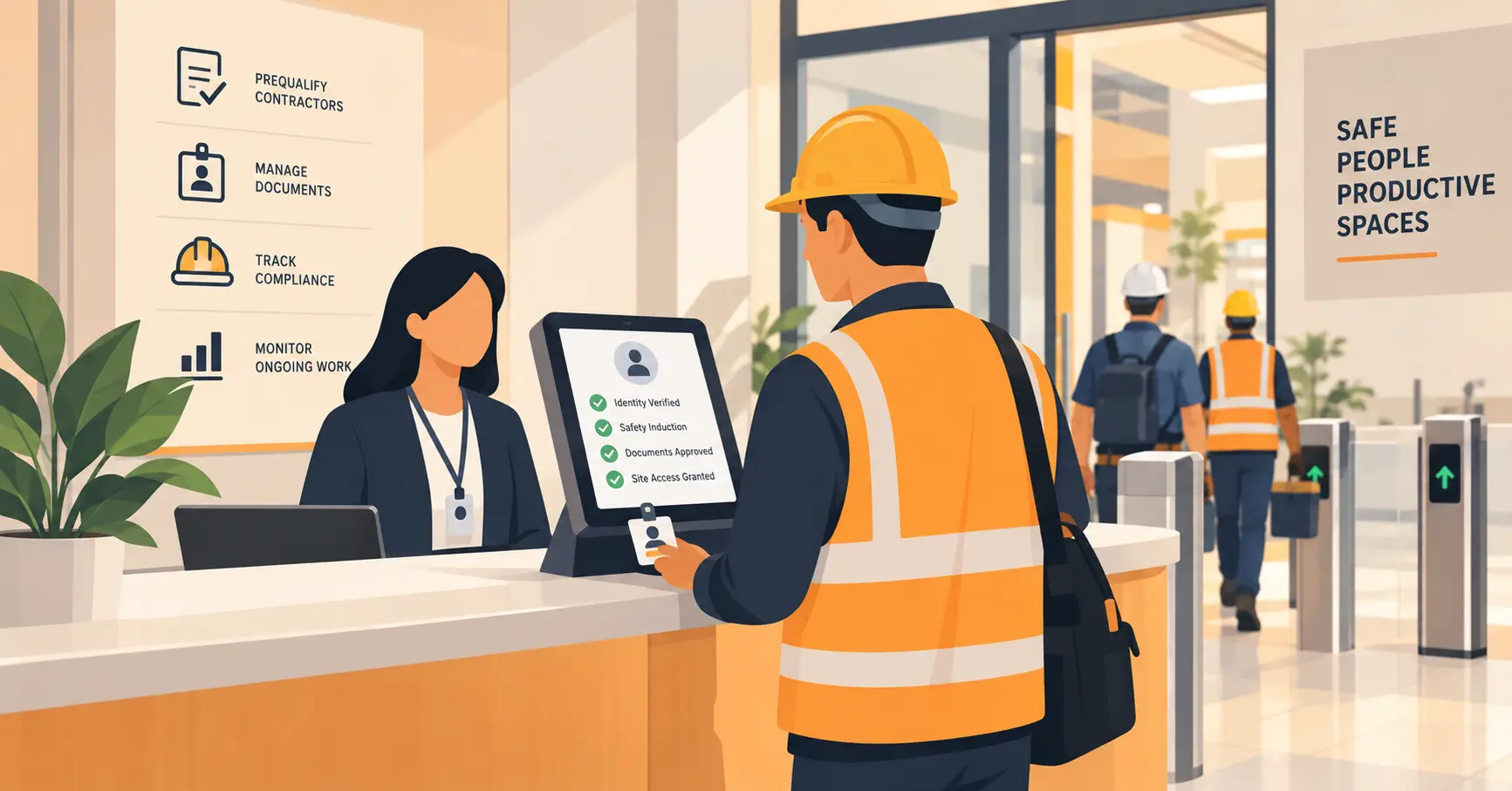
Every visitor scans a QR code, enters their details, and is logged instantly. Arrival time, name, purpose of visit, host notification all captured without manual entry. If a regulator asks who was in your building on a specific date, you have a complete answer in seconds.
Before access is granted, the visitor’s name is checked against your internal blocklist. If there’s a match: a former employee, a previously flagged individual, anyone you’ve designated as restricted, your designated staff are alerted in real time. The check runs every time, automatically. It doesn’t get skipped when the lobby is busy.
The dashboard shows exactly who is on-site right now across every location updated in real time. For emergency evacuations, safety headcounts, and space utilization reporting, you’re working with actual data instead of estimates.
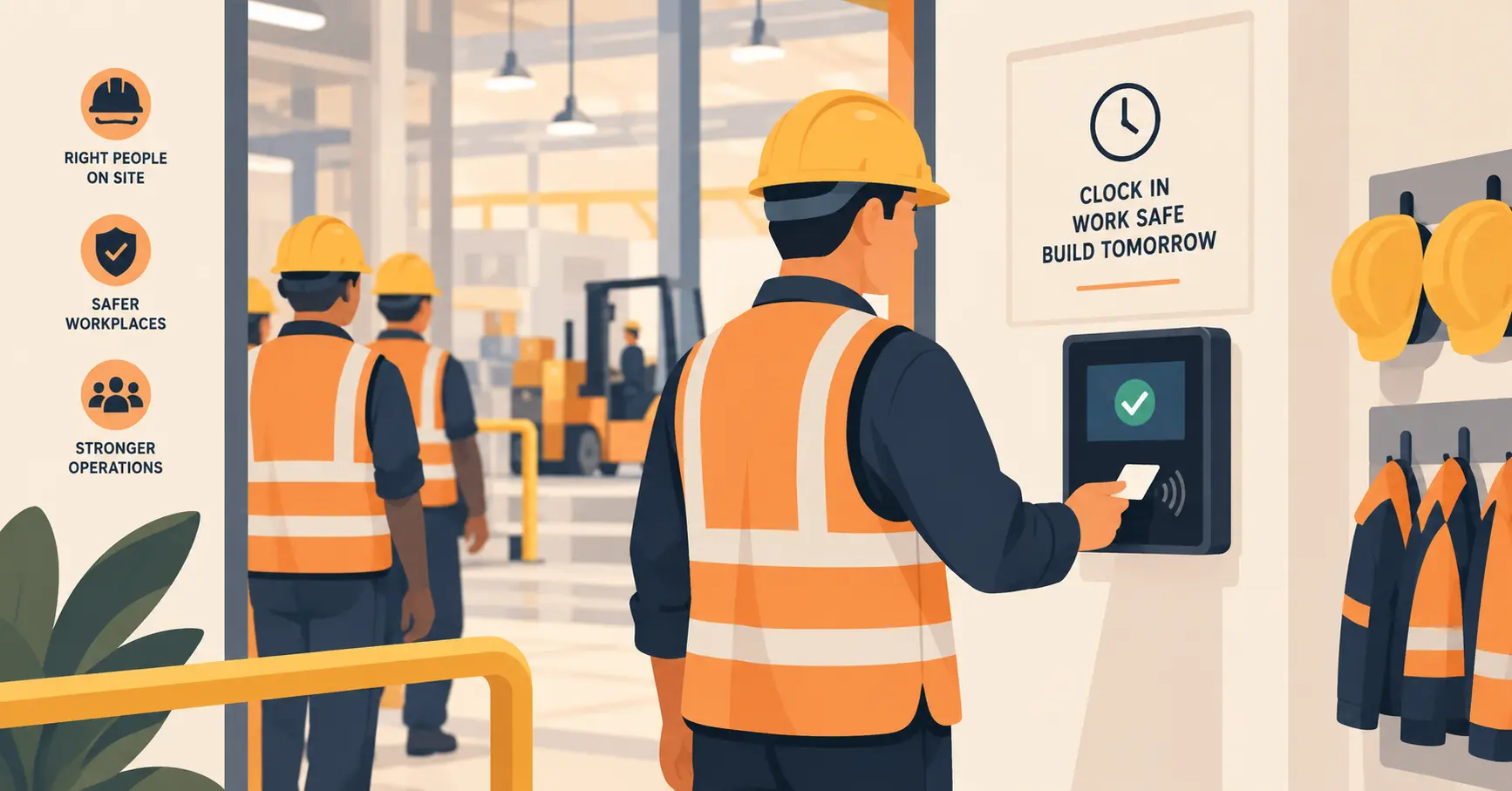
The same QR-based check-in works for employees. Every arrival and departure is timestamped automatically. The data feeds directly into your attendance records, no manual entry, no end-of-day updates, no spreadsheet reconciliation. The payroll errors that cost $291 each to fix stop at the source.
Vizitor isn’t a risk management platform in the broad sense. It’s a control at the specific point where physical, compliance, and operational risk all converge, your front door. It makes that control consistent, documented, and auditable. Every time.
The Front Door Is Where the Cost Difference Starts
Workplace risk management doesn’t protect you from everything. No process does. What it does is ensure that when something goes wrong and in any organization operating at scale, something eventually will you’re responding with preparation and documentation rather than improvisation.
The cost of skipping it isn’t zero. It’s deferred. It accumulates in undetected compliance exposure, operational inefficiencies, and vulnerabilities that only become visible when something activates them. The front door where physical access either gets controlled or doesn’t is where that cost difference starts.
And it’s where the fix starts too. A digital check-in. A watchlist screen. A timestamped record that exists whether you need it today or six months from now.
Risk management that only exists on paper isn’t risk management. The controls need to run every time not most of the time.
See how Vizitor reduces workplace risk at the point of entry →
Frequently Asked Questions
See Vizitor in action check-in a visitor in under 30 seconds
Trusted by 500+ businesses. QR check-in, badge printing, NDA signing. Plans from $36/mo.