Employee Experience, Explained for HR: Meaning, Examples, and the Office's Place in It
An HR-focused guide to employee experience (EX): the sum of three environments (cultural, technological, physical), and where HR's authority actually sits across them, owning culture, sharing technology, coordinating (not owning) the physical side. It covers real examples of companies treating EX as a discipline, Airbnb's Chief Employee Experience Officer role and Cisco's moments-that-matter team, how to measure EX beyond annual surveys, and the research-backed case for why the office still matters for onboarding and mentorship, not blanket attendance mandates.


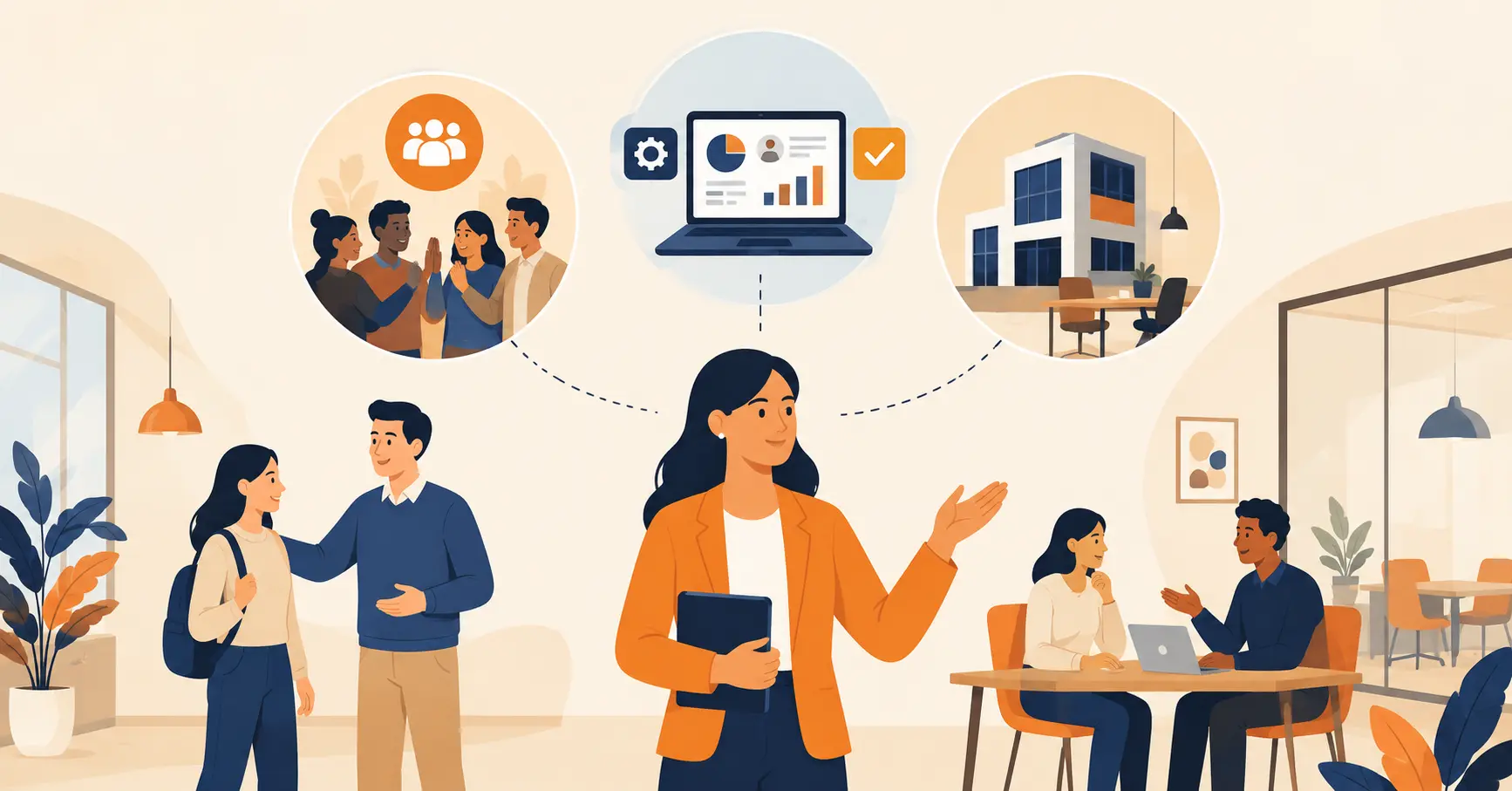
Table of Content
Try Vizitor for Free!
Employee experience is the sum of everything an employee notices, feels, and remembers about working somewhere. It runs from the first job posting they read to the exit interview on their last day. It’s built from three environments that operate at the same time:
- Cultural environment: values, leadership behavior, and how decisions actually get made
- Technological environment: the tools, systems, and IT friction employees deal with daily
- Physical environment: the office, the desk, the meeting rooms, and the front-desk process for visitors and deliveries
Get all three roughly right and people barely notice. Get one badly wrong and it’s the only thing they talk about.
This is written for HR leaders, People Ops teams, and adjacent roles: Head of People, Workplace Experience Manager, HR Business Partner. These are the people who end up owning this conversation without necessarily owning every lever that shapes it.
Maybe you’ve been asked to explain a dip in engagement scores after a return-to-office mandate. Maybe you need to make the retention case for hybrid flexibility to leadership. Either way, this article covers:
- What the term actually means
- Real examples of companies that treat it as a deliberate discipline
- Where HR’s actual authority sits across the three environments
- An honest, research-backed look at why the physical office still earns a place in the mix, even when HR doesn’t control the facilities budget
Where HR actually sits across the three environments
Here’s the organizational reality most EX frameworks skip: HR doesn’t own all three environments equally. Pretending otherwise is where a lot of EX initiatives quietly stall.
HR’s authority splits unevenly across the three environments:
- Culture: HR owns this directly: values, onboarding design, performance processes, and internal communications about how the company operates.
- Technology: HR shares this with IT. The HR tech stack (the HRIS, the benefits portal, the applicant tracking system) is HR’s call, but the laptop, network, and general software environment employees deal with all day usually isn’t.
- Physical space: HR coordinates here rather than owns it. Facilities, real estate, and often IT control the actual budget and vendor decisions for desks, rooms, and building operations, even though HR is frequently the one fielding employee complaints about it.
That mismatch, being accountable for the outcome without controlling the budget, is exactly why Airbnb’s move (below) put HR and facilities under one person instead of leaving them to coordinate informally. Most companies won’t restructure that far. But naming the mismatch explicitly, in a retention conversation with leadership, for example, is usually more productive than an HR team quietly trying to fix a facilities problem with a culture initiative.
Employee experience, meaning
Employee experience (often shortened to EX) is broader than most people assume when they first hear the term. It’s not a synonym for perks. It’s also not the same as employee engagement or employee satisfaction, even though the three get used interchangeably in casual conversation.
Satisfaction measures how content someone is with specific aspects of their job. Engagement measures how invested and motivated someone is in their work. Employee experience is the upstream cause of both: it’s the full set of interactions, environments, and moments that shape whether someone ends up satisfied and engaged in the first place. Think of EX as the input and engagement as one of the outputs, not two words for the same thing.
The most widely used framework for breaking EX down splits it into three environments. It was developed by Jacob Morgan and refined by researchers like Josh Bersin:
Cultural environment. The values, norms, and unwritten rules of how the organization actually operates, not the ones printed on the careers page. This is the slowest environment to change and the one with the most leverage over everything else.
Technological environment. The tools, systems, and infrastructure employees touch every day: the laptop setup, the collaboration software, the HR system, how long it takes IT to fix something broken. This is usually the fastest environment to improve. Because employees interact with it constantly, small improvements here are noticed quickly.
Physical environment. The actual workplace: desks, meeting rooms, the front-desk experience for visitors and vendors, how deliveries get handled. It also covers whether a hybrid office actually has enough space on the days people choose to come in. This is the environment most visible to guests and easiest for a facilities or workplace team to directly control.
Real examples of companies treating this as a discipline
The clearest signal that a company takes employee experience seriously is organizational: whether anyone actually owns it. Airbnb renamed its Chief HR Officer role to Chief Employee Experience Officer in 2015. Mark Levy took on the role, with a mandate that combined traditional HR functions like recruiting and talent development with real estate, facilities, and internal communications under one seat (Forbes, 2015). The point wasn’t a title change for its own sake. It was putting the physical and cultural environments under the same accountable person, instead of splitting them across HR and facilities with no single owner.
Cisco took a similar structural step. In 2019, it formed a dedicated employee experience team built around identifying “moments that matter”: specific touchpoints like a first day, a promotion, or a parental leave return. These moments have a disproportionate effect on how someone feels about the company, compared to the hundreds of smaller, forgettable interactions that make up most of a work week.
That “moments that matter” concept is worth borrowing even without a dedicated EX team. Instead of trying to improve everything at once, map the handful of moments that actually shape perception: a new hire’s first week, the day someone returns from leave, the visitor experience when a candidate comes in for a final-round interview. Fix those specifically before spreading effort thin across everything else.
Employee journey mapping is the practical tool behind this. It plots every touchpoint from a candidate’s first application through onboarding, day-to-day work, internal moves, and eventual exit. Each point then gets flagged as currently good, neutral, or actively damaging.
Here’s a useful starting list of moments that matter, borrowed from how Cisco and similar programs frame it:
- The offer and pre-boarding period before day one
- The actual first day: does a desk, an account, and a working laptop already exist, or is day one spent waiting on IT?
- The first performance review
- A promotion or internal move
- A return from parental or medical leave
- The exit process: how someone leaves shapes what they say about the company afterward, including to future candidates
How employee experience actually gets measured
Annual engagement surveys remain common, but they measure a lagging outcome, not the moments that caused it. Programs that treat EX as an ongoing discipline lean on a few more specific signals instead:
- eNPS: employee Net Promoter Score, tracked at specific moments rather than once a year
- Retention by tenure stage: a spike in exits at the six-month mark points to an onboarding problem, not a compensation one
- Pulse surveys: sent right after a specific moment, like a new hire’s first month or a return from leave
- Exit interview themes: qualitative patterns, not just an overall sentiment score
The pattern worth noticing: the most useful EX metrics are tied to a specific moment or tenure stage, not a single company-wide average. An average engagement score can look stable while one specific stage, say, the first 90 days, is quietly driving most of the actual turnover.
Why the office still matters
Given how much of employee experience lives in culture and technology, both of which work fine remotely, it’s a fair question whether the physical environment leg still pulls its weight. The research says yes. But not for the reason most return-to-office mandates assume.
A study of software engineers at a Fortune 500 firm found that sitting near teammates increased the coding feedback engineers received by 18.3%. The largest gains went to junior and early-career staff, and the benefit disappeared once even one team member was remote (NBER, 2023). That’s a mentorship and onboarding effect, not a blanket productivity one. It lines up with where “moments that matter” tend to cluster: the first weeks in a new role, not the two-hundredth day doing familiar work.
That distinction matters because forcing broad attendance doesn’t reliably buy back that benefit. A randomized trial of 1,612 workers at Trip.com found employees on a hybrid schedule were just as productive as full-time office staff. Resignations also fell 33% among the hybrid group (Stanford, 2024). A University of Pittsburgh study of S&P 500 firms found something similar: return-to-office mandates produced no measurable gain in firm value, only a drop in job satisfaction (Pitt Business, 2024).
Put together, the honest conclusion is narrower than “the office matters” or “the office doesn’t matter.” The office earns its place for specific jobs: onboarding, mentorship, culture transmission, and the kind of dense collaboration that’s genuinely harder over video. It doesn’t earn its place as a default policy applied to every day, regardless of what that day’s work actually requires.
That’s also why “why the office still matters” and “why everyone must be in five days a week” are different claims, even though mandates often conflate them. An office that’s genuinely useful for the moments that need it can still be nearly empty on an ordinary Wednesday, when nobody has an onboarding session, a client visit, or a team working session scheduled. That’s a sign the space is being used deliberately, not a sign it’s failing.
Where the physical environment intersects with everyday operations
The physical leg of employee experience is also the one most shaped by unglamorous, operational details that rarely make it into an EX strategy deck. Is a desk actually available when someone books it? Does a meeting room show as free but is actually occupied? Does a visitor or vendor at the front desk get a smooth or chaotic first impression of the building? Does a package sit unclaimed for days?
None of that is exciting to write into a culture statement. But it’s exactly what people remember about a bad office day. Vizitor’s guide to workplace experience and office presence goes deeper into measuring and improving that operational layer specifically. This article’s focus is broader, the full employee journey, not just the days someone is physically in the building, but the two overlap exactly where the physical environment leg of EX lives.
Vizitor’s own role sits squarely in that physical-environment layer. It’s typically facilities or IT who implements it, not HR directly. What that gives HR is the data, not the tool. That means real attendance patterns instead of a policy assumption from attendance tracking, actual desk and meeting room usage instead of a guess about whether hybrid days are working, and a smoother visitor first impression for the candidates and new hires HR is trying to impress. That’s usually enough for the retention and onboarding conversations HR actually needs to have, without HR needing to own the underlying facilities relationship. It doesn’t touch the cultural or technological environments directly. No single vendor honestly can, since those depend on leadership behavior and internal tooling choices specific to each company.
Common mistakes in employee experience programs
- Treating EX as an annual survey. A yearly engagement survey measures the outcome; it doesn’t tell you which specific touchpoint needs to change before the next survey looks the same.
- Getting handed accountability without authority. This is the one HR teams hit most often: owning all three environments on paper, but only controlling the budget for one. An EX initiative that doesn’t get facilities and IT genuinely aligned, not just informed, improves culture while the physical and technological gaps actually driving complaints stay exactly as broken as before.
- Over-indexing on the physical environment. It’s the most visible and measurable, so it gets the most attention, while culture, which usually has the largest actual effect on whether someone stays or leaves, gets under-invested.
- Copying another company’s perks or programs. A ping-pong table doesn’t fix a broken onboarding process. Imported culture initiatives from a very different company rarely transplant cleanly.
- Measuring sentiment without closing the loop. Running a survey, finding a real problem, and then not visibly acting on it is worse for trust than not asking at all. It teaches people that feedback doesn’t lead anywhere.
When you don’t need a formal employee experience program
A very small company, a handful of people who all know each other well, usually doesn’t need a dedicated EX function, a journey map, or a moments-that-matter framework. Deliberate structure starts earning its keep at a certain point. That’s when the company gets big enough that leadership can no longer personally track how every new hire’s first month is going, or when growth adds enough locations and roles that experience starts varying wildly by team without anyone noticing.
That threshold isn’t a fixed headcount number so much as a loss of direct visibility. A 15-person company where the founder personally welcomes every new hire has a functioning, if informal, employee experience process by default. The same company at 150 people, spread across two offices, with a founder who no longer meets every new hire in the first week, has quietly lost that default. Nothing deliberate has replaced it, and that’s usually the point EX stops being optional.
The throughline
Employee experience is bigger than any one team can own alone. That’s exactly why it usually needs a name and an accountable owner, the way Airbnb and Cisco gave it one, rather than assuming culture, technology, and physical space will stay aligned on their own. The office is one leg of that experience, not the whole of it. It earns its keep for specific moments, onboarding, mentorship, real collaboration, rather than as a blanket attendance requirement.
If you’re the one who ends up fielding complaints about the physical side of employee experience, visitors, desks, rooms, and attendance, without owning the budget to fix it, book a demo to see the kind of data that makes that conversation with facilities and leadership easier.
Frequently Asked Questions
See Vizitor in action check-in a visitor in under 30 seconds
Trusted by 500+ businesses. QR check-in, badge printing, NDA signing. Plans from $36/mo.