Why Paper Sign-In Sheets Fail at the Muster Point
A muster point also called an assembly point or assembly area is a pre-designated outdoor location where all building occupants gather after an emergency evacuation so safety personnel can confirm everyone made it out. The term originates from military mustering, meaning assembly for roll call. Paper sign-in sheets fail muster point accountability because they capture incomplete information, do not track departures, are physically inaccessible during an evacuation, and lack the detail first responders need full name, photo, and last known location. As of January 2025, serious OSHA violations carry penalties up to $16,550 per violation and willful violations up to $165,514. A digital visitor management system solves all four failure points. Vizitor maintains a real-time on-site roster of every visitor and contractor currently checked in, accessible from any device at the muster point, with photos and last known access areas included.



Table of Content
Try Vizitor for Free!
Every building has a muster point. Most buildings have a visitor sign-in sheet. What most buildings do not have is a reliable connection between the two.
When a fire alarm sounds and everyone evacuates, the employee headcount is manageable, floor wardens have rosters, people know their teams. That baseline only holds if the underlying clock-in system was built for a safety headcount in the first place, rather than for payroll alone. The harder question is the one that gets asked next: who else was in the building?
The contractor who arrived at 9am for the server room. The vendor rep waiting in the second-floor conference room. The job candidate in for an interview. The delivery driver who signed in and never signed out.
A floor warden with a clipboard and a spiral notebook cannot answer that question accurately. The notebook is at the front desk, inside the building. The names in it are first names only. There is no departure record. Nobody knows which of those names represent people who are still inside.
This is the visitor accountability gap. It exists in most offices, most campuses, and most facilities that rely on paper sign-in. And it is the gap that matters most when an incident commander asks: is everyone out?
The stakes are highest on a large campus, where multiple gates, dorms, and research buildings all need the same real-time headcount. That’s why more schools and universities are pairing muster-point accounting with visitor management systems built for campus safety, so the evacuation list and the sign-in data are the same record, not two separate ones.
OSHA’s 29 CFR 1910.38 requires employers to account for everyone at the assembly area including visitors and contractors, not just employees. This article explains what a muster point is, what that accountability requirement means in practice, and what it takes to close the gap between who signed in and who made it out.
What Is a Muster Point?
A muster point also called an assembly point or assembly area, is a pre-designated outdoor location where all building occupants gather following an emergency evacuation. Its purpose is specific and critical: to give safety personnel a fixed location where they can confirm every person who was inside the building has made it out.
The term comes from military language, where mustering meant assembling troops for a roll call. In a workplace context, it serves the same function. Everyone goes to a single, known location. Someone takes attendance. Anyone unaccounted for triggers a search.
Federal workplace safety regulations do not use the term “muster point,” but they do require every employer covered by OSHA’s emergency action plan standard to have procedures for accounting for all employees after an evacuation and that process needs a physical location.
What OSHA Actually Requires
Every employer must maintain a written Emergency Action Plan that includes, at minimum procedures for reporting fires and emergencies, evacuation procedures and exit route assignments, procedures for employees who remain to operate critical operations, and procedures to account for all employees after evacuation.
The fourth element, accounting for everyone after evacuation is what makes a muster point functionally necessary. You cannot account for people without telling them where to go.
Here is what most facilities managers know about the regulation.
Here is what most of them miss.
OSHA’s evacuation planning guidance explicitly states: “Visitors also should be accounted for following an evacuation and may need additional assistance when exiting. Some employers have all visitors and contractors sign in when entering the workplace and use this list when accounting for all persons in the assembly area.”
Visitors. Not just employees. And OSHA’s language goes further:
Employers must “establish a method for accounting for non-workers, such as suppliers, clients, outside contractors, customers, and other visitors to the work site.”
This is not a suggestion buried in supplemental guidance. It is a compliance obligation. The method OSHA recommends is a sign-in list. The question every safety coordinator should be asking is whether their current sign-in method can produce an accurate, usable list in the middle of an emergency.
The Visitor Accountability Gap Nobody Talks About
Employee headcounts at muster points are straightforward in principle. Employees are on a roster. Floor wardens know their teams. Absences are noticed quickly. The system is imperfect, but it has a baseline of structure.
Visitors are fundamentally different.
A visitor arrives, writes their name in a book, and proceeds to the third floor for a meeting. There is no floor warden responsible for them. The person who checked them in has moved on to other tasks. The host who invited them may be in a different part of the building. When the alarm sounds, the visitor follows the nearest crowd out of the nearest exit and ends up at a muster point where nobody knows their name, nobody recognises their face, and nobody can confirm whether they are the person listed in the notebook or whether they left two hours ago.
There are four specific points where paper visitor logs fail muster point accountability:
Incomplete information at entry. A paper sign-in sheet captures what the visitor chooses to write. Many people write only a first name. Contractors often skip the form entirely if no one is watching. Delivery personnel rarely sign in at all. The list that exists at the moment of the alarm is not a record of who is in the building, it is a record of who was compliant enough to complete a form on their way in.
No departure tracking. A paper log records arrivals. It almost never records departures. Every visitor who signed in this week is on the list regardless of whether they are still in the building. During a headcount, this creates false positives, the safety coordinator is searching for people who left hours ago while someone still inside goes untracked.
Physical inaccessibility in an emergency. The visitor notebook is at the front desk. The front desk is inside the building. The muster point is in the parking lot. In a real emergency, nobody goes back inside to retrieve a notebook. The person responsible for the headcount arrives at the muster point with nothing and attempts to reconstruct the list from memory, from calling the front desk, or from asking other employees who they saw in the building that morning.
Illegibility under pressure. Even when a paper log is retrieved, handwriting varies, names are abbreviated, and the information density needed to identify an individual to a first responder: full name, physical description, last known location, is almost never present.
What First Responders Actually Need From You
When an incident commander arrives at a muster point, they ask a specific question: is everyone out, and if not, who is unaccounted for, where were they last seen, and what do they look like?
The names and last known locations of anyone unaccounted for get passed to the incident commander typically a fire captain or senior emergency responder on scene. That information determines whether rescue teams re-enter the building.
The stakes of that determination are not abstract. A rescue team re-entering a burning building based on inaccurate visitor data creates serious risk. A rescue team that fails to re-enter because a visitor’s presence was not documented leaves a person inside.
Neither outcome is acceptable. Both are preventable.
The information first responders need for each unaccounted individual is: full name, a physical description or photo, the area of the building they were accessing, and the approximate time of their last known location. A paper sign-in sheet containing only a first name and an arrival time provides none of what is operationally required.
Why Hybrid and Multi-Shift Offices Make This Harder
The visitor accountability gap existed when everyone was in the office five days a week. Hybrid work has made it significantly more complex.
On any given Tuesday, a mid-sized office might have sixty percent of its normal headcount on site but a full calendar of external meetings, contractor visits, and vendor deliveries. The ratio of visitors to employees is higher. The number of staff who are familiar with each visitor is lower. Floor wardens may not be present on every floor. The receptionist who signed in the morning’s visitors may have moved to a different task by the time the afternoon evacuation occurs.
Multi-location organisations face a compounded version of the same challenge. If a fire alarm triggers at the Chicago office while the facilities manager is in New York, they need to access the Chicago visitor log remotely in real time to answer the incident commander’s questions. A paper log at a front desk in Chicago is not accessible from New York.
What a Digital Visitor Log Changes at the Muster Point
A digital visitor management system does not change the muster point. It changes the list you arrive with.
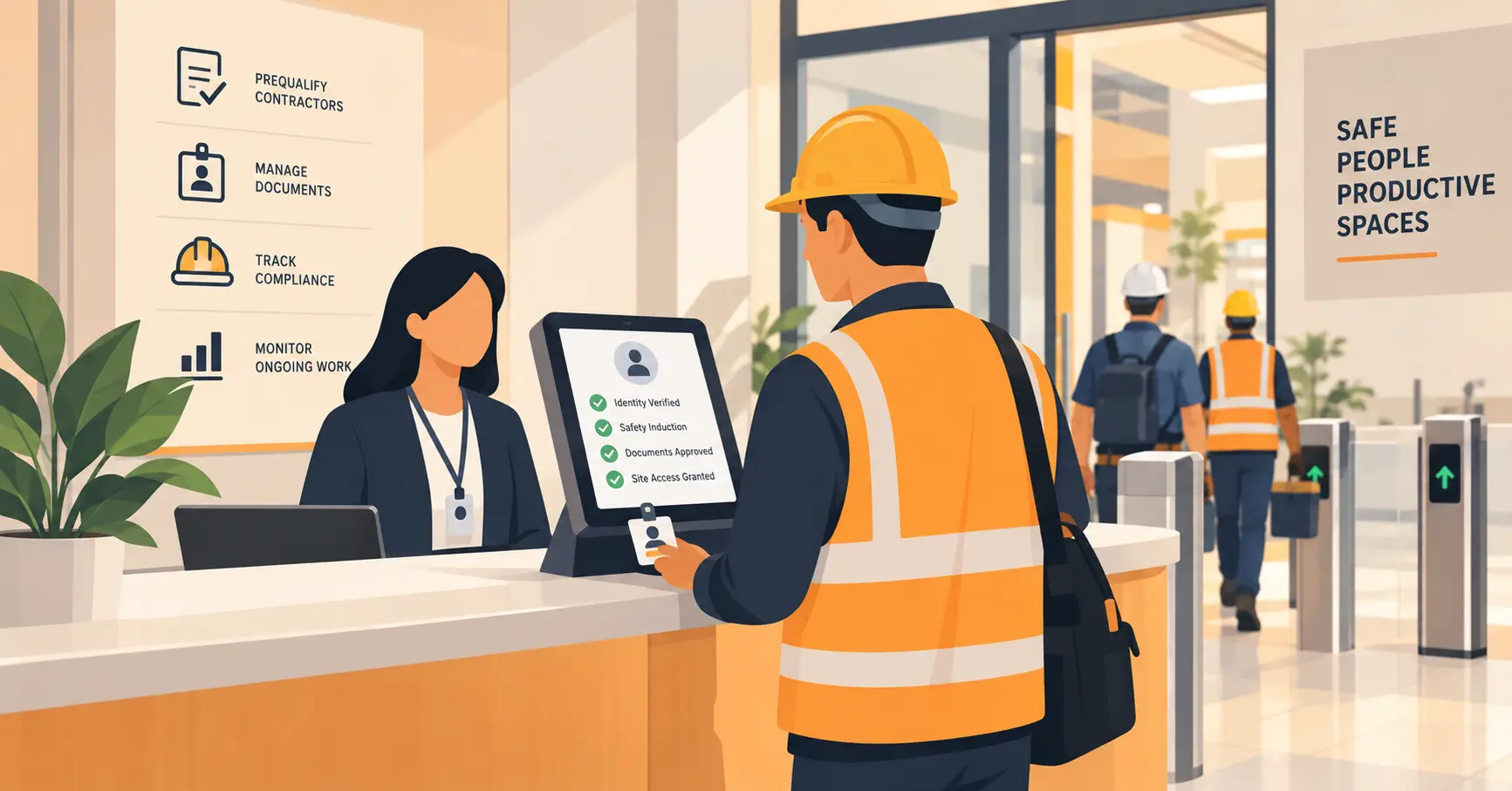
When every visitor checks in through a digital system; scanning a QR code, entering details at a tablet kiosk, or completing a pre-registration before arrival, several things become true simultaneously that are never true with a paper log:
The list is live. It reflects the current state of the building, not the state of the sign-in sheet from this morning. Every check-in is timestamped. Every departure closes the record. The number of people currently in the building is not an estimate based on a clipboard, it is a count with names, photos, and access areas attached.
The list is accessible from anywhere. A digital visitor log is accessible on any device with an internet connection. The facilities manager or safety coordinator pulls the current occupancy on their phone at the muster point without going back inside, without calling anyone, without waiting for anyone to retrieve a notebook.
The list contains what first responders need. Each record includes the visitor’s full name, a photo taken at check-in, the time of arrival, the host they are visiting, and the area of the building they accessed. When the incident commander asks for a description of the unaccounted individual, you can provide it from your phone in under thirty seconds.
Contractors are not exempt. A digital system captures contractor check-ins with the same consistency it captures visitor check-ins regardless of who is watching the front desk when the contractor arrives. The contractor who walked in, skipped the paper form, and took the elevator to the server room is on the list if the kiosk was their entry point.
How Vizitor’s Live Roster Works in an Emergency
Vizitor’s visitor management system maintains a live, real-time on-site roster of every person currently checked in accessible from the Vizitor admin dashboard on any phone, tablet, or computer.
During an emergency evacuation:
1. The safety coordinator opens Vizitor on their phone at the muster point.
No one returns to the building. No one calls the front desk. The live roster is accessible from outside the building the same way it is accessible from inside from any device, immediately.
2. The current occupancy list shows every visitor, contractor, and vendor checked in and not yet checked out.
Each record includes full name, photo, arrival time, host name, and the entry point they used. Anyone who departed before the alarm is already off the list.
3. The coordinator cross-references the live roster against the people at the muster point.
Any visitor not present at the assembly area is immediately identifiable by name and photo, the same information the incident commander needs to make a re-entry decision.
4. The full list can be shared with first responders in seconds.
The on-site roster is exportable as a real-time list, giving the fire captain accurate names, photographs, and last known access areas for every unaccounted individual.
For organisations with multiple locations, each building’s roster is separate and accessible to the relevant floor warden or safety coordinator for that location while a facilities manager in a central location can access all sites simultaneously.
The OSHA Compliance Argument
Beyond the operational case, there is a compliance case that facilities managers cannot ignore.
As of the most recent adjustment effective January 2025, the maximum penalty for a serious OSHA violation is $16,550 per violation, while willful or repeated violations can reach $165,514 per violation. Multiple deficiencies, an incomplete emergency action plan, inadequate visitor accountability procedures, untrained wardens, can each draw a separate citation.
OSHA’s own evacuation planning guidance explicitly recommends visitor sign-in as the mechanism for visitor accountability at assembly areas. A facility that relies on a paper sign-in notebook that does not capture last names, does not track departures, and is physically inaccessible during an evacuation has a defensible gap between their stated EAP and their actual capability.
A digital visitor management system that produces a live, accurate, accessible roster of everyone in the building is not just operationally better than a paper log. It is the documented, auditable evidence that the facility has implemented the visitor accountability procedure OSHA’s guidance recommends.
Building a Muster Point Protocol That Actually Accounts for Everyone
A compliant, functional muster point visitor accountability process has four components:
A reliable check-in process for every visitor, contractor, and vendor.
Self-service tablet kiosks eliminate the human bottleneck at the front desk. Whether a receptionist is present or not, every visitor who enters through a staffed entry point completes a digital check-in. Pre-registration allows expected visitors to complete details before arrival ensuring that even if the kiosk has a queue at the time of their visit, their record exists.
Departure tracking.
Check-out closes the visit record and removes the visitor from the live on-site roster. Whether check-out happens at the kiosk, at the door, or is logged by the host, every departure should be captured so the muster point roster reflects current occupancy rather than cumulative arrivals.
Mobile-accessible roster.
The roster used for the muster point headcount must be accessible without returning to the building. A phone-accessible digital roster removes the single biggest operational failure of paper-based systems.
Regular drills that include visitor scenarios.
Most evacuation drills test employee headcount procedures. Few test what happens when a contractor is unaccounted for, when a visitor arrived through a secondary entrance, or when the safety coordinator needs to share visitor data with an incident commander. Building visitor scenarios into drill procedures reveals gaps before a real incident does.
The Bottom Line
The muster point headcount is the moment your emergency preparedness plan either works or it does not. For employees, a roster and trained wardens provide a reasonable baseline. For visitors, contractors, and vendors, the baseline is whatever sign-in process you have in place and for most facilities, that process produces a list that cannot survive contact with a real emergency.
OSHA requires you to account for everyone at the assembly area. Not everyone with an employee badge. Everyone.
The difference between a paper notebook and a live digital visitor log is the difference between passing the list to the incident commander and asking the incident commander to make a life-safety decision without it.
Frequently Asked Questions
See Vizitor in action check-in a visitor in under 30 seconds
Trusted by 500+ businesses. QR check-in, badge printing, NDA signing. Plans from $36/mo.