Why Virtual Queues Beat Physical Lines for Customers
This page compares virtual and physical queues across customer experience, business impact, and operational efficiency. It explains that physical queues require customers to stand in one place while virtual queues let customers hold their position digitally and wait anywhere. Key verified data includes: 84% of consumers avoid businesses where they expect a wait, 69% have left a physical queue before being served, and customers who receive real-time updates perceive their wait as 35% shorter even when actual wait time is unchanged. The page covers when each queue type works best, the psychology of certainty and control that makes virtual queues feel faster, and industry applications across healthcare, banking, retail, government, and hospitality. Vizitor is presented as a QR-based virtual queue management system with a real-time staff dashboard requiring no app download from customers.


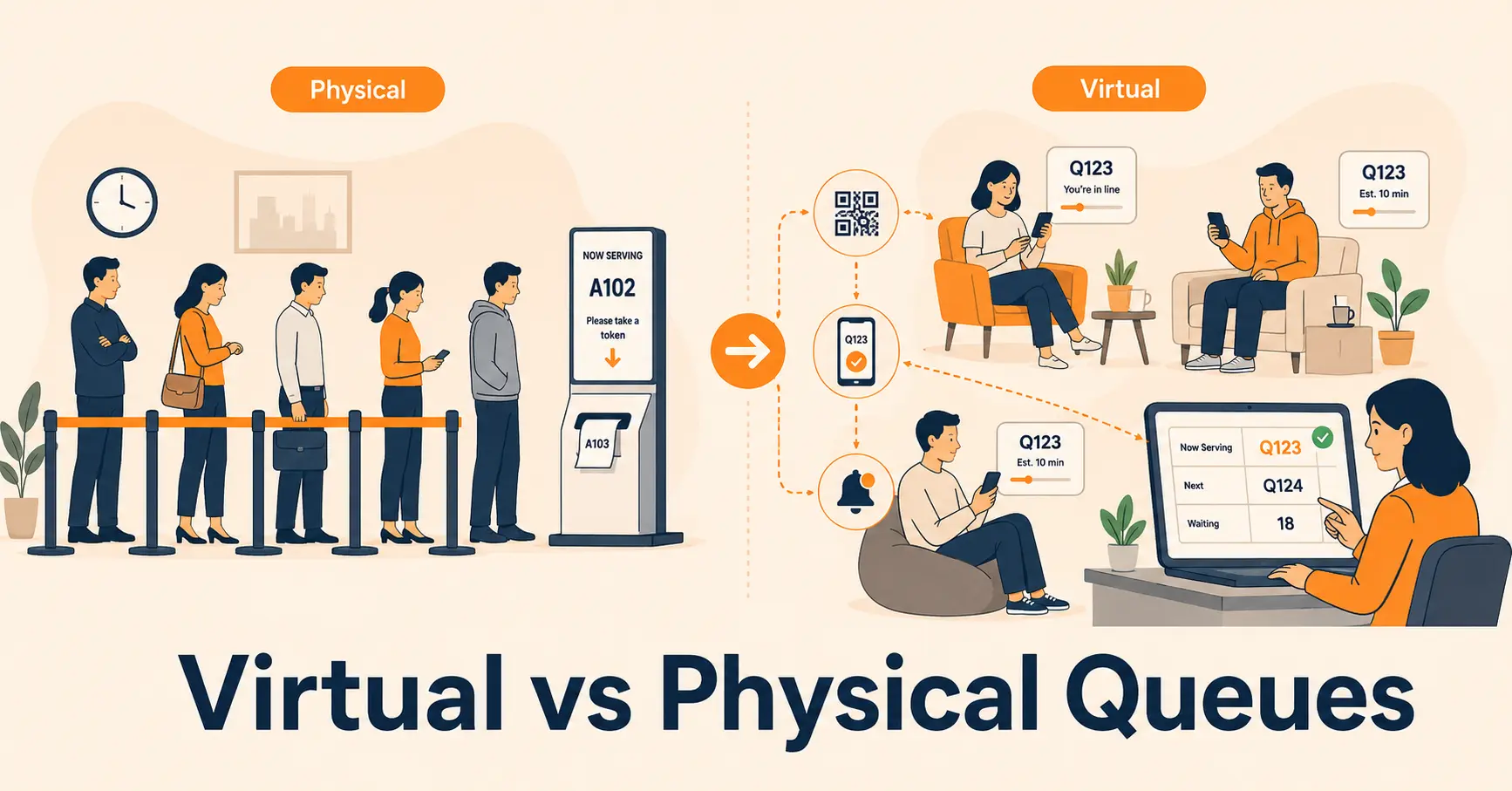
Table of Content
Try Vizitor for Free!
Introduction
Standing in a line is one of the most universal experiences in the world.
Banks, hospitals, shops, government offices, airports. Everywhere people need a service, a queue forms. And everywhere a queue forms, frustration follows.
The average customer will wait just eight minutes before walking away. That’s the breaking point. After eight minutes with no update, no estimate, and no control, most people give up.
The solution isn’t faster service. It’s smarter queuing.
This guide breaks down the difference between physical and virtual queues, what each one is, where each works, and what the data says about which one customers actually prefer.
What Is a Physical Queue?
A physical queue is a line of people waiting in the same place for the same service. First come, first served. You show up, you take your place, and you stand there until it’s your turn.
Physical queues are simple. No technology required. No setup. No training.
Everyone understands how they work because we’ve all been in one.
They work well in predictable, low-volume situations. A small cafe at 7am. A post office in a quiet town. A short line at a cash register. When wait times are under five minutes and the flow is steady, a physical queue does its job.
The problem is that most real-world situations aren’t predictable or low-volume. And that’s where physical queues start to fall apart.
What Is a Virtual Queue?
A virtual queue does the same thing a physical queue does, it organizes who gets served next. The difference is where people wait.
In a virtual queue, customers join remotely. They scan a QR code, text a number, use an app, or check in at a kiosk. The system gives them their position and an estimated wait time. Then they go do whatever they want: sit down, grab a coffee, browse a nearby store, wait in their car. When their turn is coming up, they get a notification and head back.
They don’t stand in a line. They hold a place in one.
The service order is the same. First registered, first served. What changes is the experience. Instead of standing and watching a line not move, customers are free to use their time. That changes everything about how waiting feels.
Physical vs Virtual Queues: Side by Side
| Parameter | Physical Queue | Virtual Queue |
|---|---|---|
| Where customers wait | On their feet, in one place | Anywhere they choose |
| Join method | Show up and stand in line | QR code, SMS, app, kiosk, or web link |
| Wait time visibility | None, they guess from the line length | Real-time position and estimated wait time |
| Notifications | None | SMS, app alert, or display notification |
| No-show if wait is too long | Very likely | Less likely, they’re already committed |
| Space needed | Large physical area for the line | Minimal |
| Staff management | Manual, staff watch and call names | Automated, system manages the queue |
| Customer freedom during wait | None | Complete |
| Data and analytics | None | Full reporting on wait times, volume, peaks |
| Fairness | Clear, visible order | Clear, digital order is transparent |
The Real Cost of Physical Queues
Physical queues feel free. No software to buy. No system to set up. Just rope off an area and let people file in.
But the hidden cost is massive.
84% of consumers avoid a business if they think they’ll have to wait in line.
That’s Waitwhile’s finding from a survey of 1,000 US consumers in 2025. These customers never even walk through the door. They see the queue from outside and leave.
Of the people who do join a physical queue, 69% leave before reaching the front. They run out of patience and walk out empty-handed.
And of those who leave, 39% go straight to a competitor. They don’t come back later. They go next door.
The math is brutal. A restaurant losing just 10% of its weekly walk-ins to queue abandonment, at an average spend of $45 per head loses around $46,800 in revenue per year, according to ScanQueue’s 2026 analysis. And restaurants aren’t even the worst affected. Retail queues are now four times more common than in any other industry, with the frequency of retail waits up 28% since 2023, according to Waitwhile.
There’s a staff impact too. 68.5% of retail workers regularly face frustrated or angry customers and long wait times are the top cause, per Waitwhile’s Employee Sentiment Report. Queues don’t just cost customers. They burn out the people serving them.
What Virtual Queues Actually Change
Virtual queues don’t make service faster. But they make waiting feel completely different. And that difference shows up directly in customer behavior.
Customers wait longer when they’re in control.
A 2025 study in the Journal of Service Research found that customers who received real-time queue position updates perceived their wait as 35% shorter than those who received no updates even when the actual wait time was identical. The wait didn’t change. The feeling of it did.
59% of customers are willing to wait longer.
If they receive progress updates, according to Waitwhile. They’re not asking for faster service. They’re asking to not stand in the dark.
Fewer customers leave.
Virtual queuing reduces no-show rates by 28% when customers receive “your turn is coming” alerts, according to data compiled by ScanQueue. Someone who joined a virtual queue is already committed to the service. Giving them a heads-up keeps them engaged instead of letting frustration build to a walk-out.
Customers spend more while they wait.
This one surprises most businesses. When customers can leave the physical queue, they spend 18% more at nearby businesses while waiting, according to a 2024 study in the International Journal of Retail and Distribution Management. A customer waiting 20 minutes in a virtual queue at a clinic doesn’t stand frustrated in a waiting room. They walk to the coffee shop next door. They come back in a better mood. And they’re more likely to return.
Staff work better.
Companies implementing virtual queue systems report 22% productivity gains in the first six months and a 31% improvement in staff utilization, according to QueueHub’s 2026 analysis. When staff aren’t managing a restless physical line, they focus on delivering service. That’s what they’re actually there for.
The Psychology Behind Each Type
Why does a virtual queue feel so much better?
It comes down to three things: certainty, control, and fairness.
Certainty.
When you’re standing in a physical line, you don’t know how long it will take. You estimate from the number of people ahead of you. But you can’t see if the person at the front is taking two minutes or twenty. Uncertainty makes time feel slower. A virtual queue gives you a number and an estimate. Your brain has something to work with.
Control.
In a physical queue, you’re stuck. You can’t leave without losing your place. You can’t do anything useful. You can only stand there. A virtual queue gives you your time back. You still wait but you wait on your own terms. That feeling of control reduces frustration significantly.
Fairness.
Both types operate on first-come, first-served. But in a physical queue, fairness can be disrupted, someone cuts in, a different line moves faster, a staff member calls someone from the back. In a well-run virtual queue, the order is transparent and digitally enforced. No disputes. No uncertainty about whether you’ve been jumped.
These three factors: certainty, control, fairness explain why the wait time doesn’t actually need to change for the experience to improve.
When Physical Queues Still Make Sense
Virtual queues are not always the right answer. There are situations where a physical queue is the simpler, better choice.
Very short wait times.
If the average wait is under three minutes, a virtual queue adds more friction than it removes. A fast-food drive-through at a quiet hour doesn’t need a digital queue. The physical line is over before the app experience would even start.
Low-tech visitor base.
If a significant portion of your visitors don’t use smartphones or feel uncomfortable with digital processes, a physical queue is more inclusive. This matters in healthcare facilities, government offices, and any service with an older or less tech-comfortable audience. The fix is a hybrid model, kiosk check-in or staff-assisted entry into the virtual queue not forcing everyone through a digital-only process.
Simple, identical service steps.
Where every customer interaction is the same and brief, a grocery express checkout, a transit ticket gate physical queues move fast enough that virtual queuing doesn’t add value.
When Virtual Queues Are the Better Choice
For most service businesses, the case for virtual queuing is strong.
When wait times exceed five minutes.
Once waiting crosses that threshold, customer frustration starts to build. A virtual queue keeps customers engaged and informed instead of stewing.
When space is limited.
Physical queues take up room. In a small clinic, a compact bank branch, or a busy retail floor, a line of people creates crowding, disrupts other customers, and stresses staff. A virtual queue moves the waiting somewhere else.
When you serve repeat visitors.
People who visit regularly: patients at a clinic, customers at a neighborhood salon, clients at a government office are exactly who benefits most from a system that recognizes them, tracks their preferences, and reduces friction over time.
When staff are already stretched.
Managing a restless physical queue takes attention and energy. A virtual system handles the flow automatically, freeing staff to focus on service rather than crowd management.
When you need data.
A physical queue tells you nothing. A virtual queue tells you everything: peak hours, average wait times, service duration, abandonment points, and trends over weeks and months. That data is what lets you schedule staff intelligently and improve over time.
When you operate across multiple locations.
A virtual queue system gives a central view of customer flow across every site. A physical queue at each location gives you nothing.
Industries Making the Switch
Virtual queuing has moved from a tech novelty to standard practice across a wide range of industries.
Healthcare: Hospitals and clinics worldwide use virtual queues to manage patient flow. Waiting in a waiting room with other sick people is one of the most disliked experiences in healthcare. Virtual queues let patients wait outside, in their car, or at home until the moment they’re needed.
Banking and financial services: Branch visits still happen, and they still generate queues. Virtual queuing in banks allows customers to join remotely, be served in order, and spend the wait on their phone or outside rather than in a crowded waiting area.
Retail: The global retail sector is increasingly adopting virtual queuing, particularly in high-street stores and service counters. Waitwhile’s data shows that 45% of customers in a virtual queue continue shopping while they wait turning dead wait time into active revenue.
Government services: Passport offices, licensing departments, and local government service centers have been among the most aggressive adopters of virtual queuing because their queues are long and their visitor bases are diverse. SMS-based joining (no app required) makes this accessible to everyone.
Restaurants and hospitality: Particularly for waitlists at restaurants without a reservation system. Virtual waitlists let guests explore a nearby area while they wait for a table, rather than crowding a lobby.
Events and attractions: Theme parks were early adopters. Digital queuing for rides allows guests to book a ride slot and spend the wait experiencing other parts of the park. This model is now spreading to museums, exhibitions, and tourist attractions globally.
How Vizitor’s Virtual Queue Works
Vizitor’s queue management system replaces the physical line with a simple digital process, no app required on the customer side.
When a customer arrives, they scan a QR code displayed at the entrance. A browser page opens on their phone. They enter their name, select a service if needed, and they’re in the queue in under 15 seconds. They receive their position and an estimated wait time immediately. Then they wait wherever they choose.
On the staff side, the real-time dashboard shows who’s waiting, in what order, and for how long updated continuously. When it’s someone’s turn, staff call them through directly from the dashboard. No physical line to manage. No paper tickets. No calling out names to a crowded room.
For businesses already using Vizitor for visitor management, attendance tracking, or meeting room booking, the queue management runs from the same platform, one view of everything happening in the building.
Weighing Vizitor against other options first? See how the top queue management tools and solutions stack up on price and features before you commit to one.
Conclusion
Physical queues have served us well for a long time. They’re simple, fair, and universally understood.
But they were built for a world where people had time to stand still. Most people today don’t. Customer patience is shorter than it’s ever been. The data is clear: businesses that rely entirely on physical queues are losing customers before they even get served.
Virtual queues don’t solve every problem. They work best when wait times are meaningful, when customer volume is significant, and when the business wants real data on what’s happening at every service point.
What they do, reliably and measurably is give customers back their time. And customers who feel their time is respected come back.
Frequently Asked Questions
See Vizitor in action check-in a visitor in under 30 seconds
Trusted by 500+ businesses. QR check-in, badge printing, NDA signing. Plans from $36/mo.