Why Visitors Judge Your Office Within Seconds of Arrival
First impressions in offices form in under a second, driven by cleanliness, reception behavior, and how smooth the check-in feels. This piece breaks down the real psychology behind that snap judgment, where most offices get it wrong, and how a smoother arrival experience changes what visitors, clients, and new hires decide about you before anyone says a word.


Table of Content
Try Vizitor for Free!
Before a receptionist smiles, before anyone says hello, before a visitor even signs in, their brain has already made a call. Professional, or a little off. Organized, or barely holding together. That call happens in about a tenth of a second, and almost nothing you say afterward fully overrides it.
First impression psychology in offices is the study of how visitors, clients, and new hires form snap judgments about a workplace before any real interaction happens. It matters because those judgments set the emotional tone for everything that follows, from a client’s trust in your reliability to a new hire’s read on your culture.
Smart workplaces don’t leave that tenth of a second to chance. They design for it, often starting with the one thing every visitor experiences before a single conversation: how they get through the door.
Why First Impressions Form So Fast
In 2006, Princeton psychologists Janine Willis and Alexander Todorov ran a simple experiment. They showed people a face for just 100 milliseconds, one-tenth of a second, and asked them to rate its trustworthiness and competence. Those snap ratings barely changed even when people were given as much time as they wanted to look. The brain had already decided.
This ability has a name: thin slicing. Psychologists Nalini Ambady and Robert Rosenthal coined the term in 1992, showing that people can predict real outcomes, like a teacher’s end-of-year ratings, from a few seconds of silent video. Small amounts of information, read fast, turn out to be surprisingly reliable.
Offices trigger the same reflex. A visitor’s brain scans the space for a handful of signals before any conversation starts: how clean and organized it looks, how staff carry themselves, how smooth the check-in feels, what technology is visible at the door, and the general tone of the room. A smooth entry reads as trust. A confusing one reads as friction. Neither requires a word to be spoken.
The Cues Your Brain Reads First
The environment speaks before anyone does. Lighting, layout, and how tidy the space looks all signal what the company values, before a single interaction confirms or denies it.
Reception behavior sets the emotional tone next. A welcoming posture and a genuine smile tell a visitor they’re expected and valued. A distracted, scripted greeting tells them the opposite, no matter how polished the words are. What the front desk is wearing feeds into that same read; a front office dress code that actually matches the brand does some of this work before a greeting even happens.
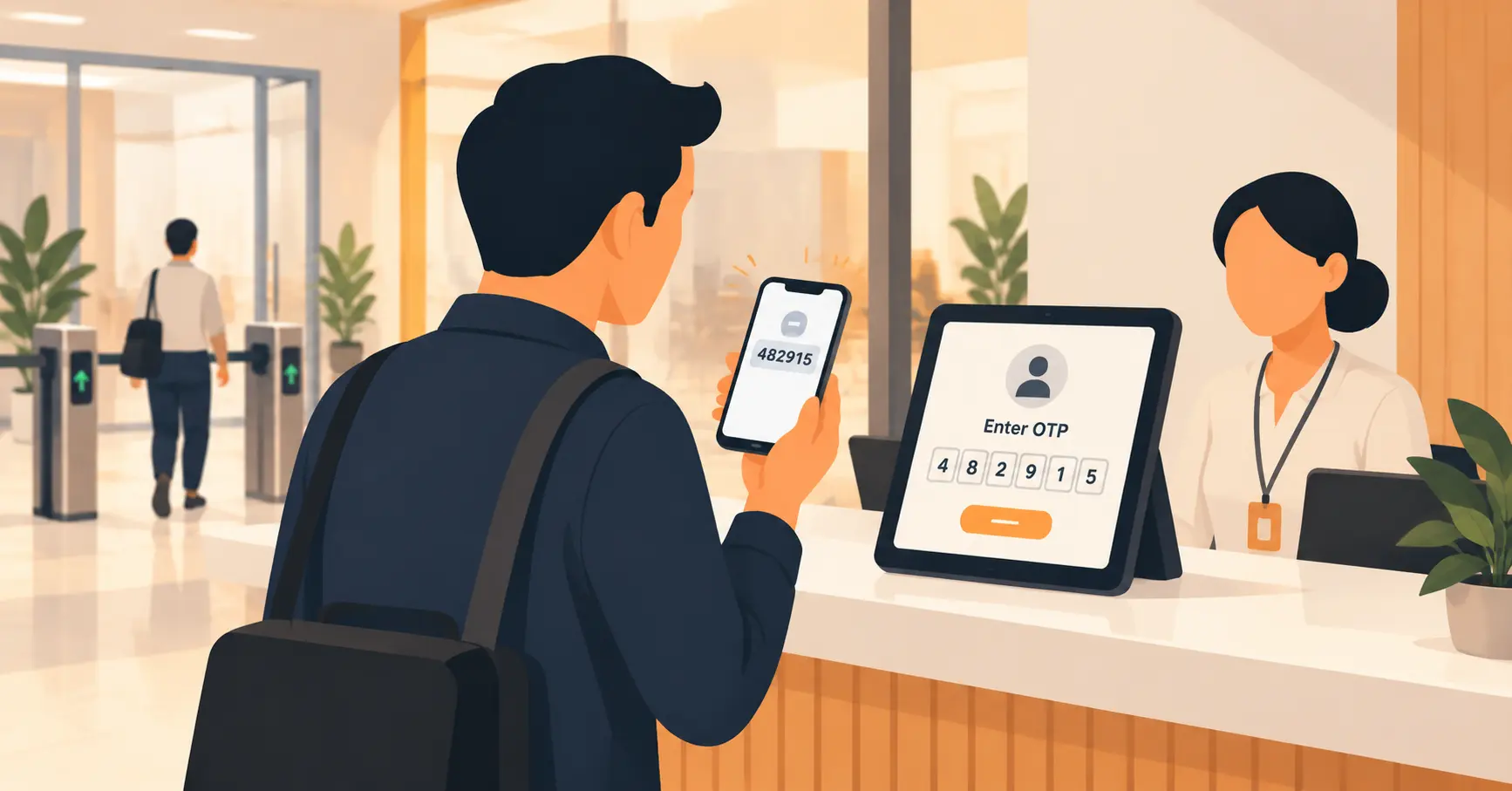
Then comes the check-in itself, and it carries more psychological weight than most offices realize. A clipboard and a pen say the workplace hasn’t updated its process in years. A fast, guided digital check-in says the opposite: organized, current, and worth trusting with more than just a signature.
The Two Things People Are Actually Judging
Psychologists Susan Fiske, Amy Cuddy, and Peter Glick spent years studying how people judge others, and they kept finding the same two dimensions everywhere: warmth and competence. Warmth is whether you can be trusted. Competence is whether you can deliver. People judge strangers, brands, and workplaces on both, almost always within seconds.
An office reception area is a warmth-and-competence test disguised as small talk. A friendly greeting signals warmth. A fast, error-free check-in signals competence. Offices that nail one and miss the other still leave visitors unsettled, because a warm room with a chaotic sign-in process reads as disorganized, and an efficient sign-in with a cold greeting reads as impersonal. Both pieces have to land.
This is where a visitor management system earns its keep. It cannot make your team friendlier, but it can guarantee the competence half of the equation every single time: instant logging, instant host notification, no fumbling with a binder while a client waits.
First Impressions Now Start Before Anyone Arrives
Here’s what most offices forget: the impression doesn’t start at the door anymore. It starts with the website, the meeting invite, the pre-registration link, the wayfinding instructions, and the QR code sent ahead of the visit.
When a visitor arrives to find their name already logged, their host already notified, and check-in finished in seconds, they feel something specific: anticipation, met with delivery. That combination builds trust faster than a polished lobby ever could on its own, because it proves the organization was thinking about the visit before the visit happened.
Why It Matters for Clients, Hires, and Leaders
For a client, a smooth arrival signals reliability. If the front door runs well, they assume the account will too.
For a new employee, day one sets an expectation for company culture that’s hard to shake later. A chaotic first morning predicts, fairly or not, a chaotic year.
For leaders touring investors or partners through the office, an organized entrance reflects on the whole organization. A visitor rarely separates the front desk from the business behind it.
Common Mistakes Offices Make With First Impressions
Spending on decor, ignoring the process. New furniture and better lighting help, but a beautiful lobby with a five-minute sign-in wait still reads as disorganized. Visitors judge the process as hard as they judge the room.
Treating friendliness as the whole job. A warm greeting covers half the test. If the check-in behind it is slow or confusing, competence fails and the good first half gets forgotten.
Ignoring the pre-visit window. Offices that only think about the physical lobby miss every impression formed earlier, through a confusing invite, a broken pre-registration link, or no instructions at all.
Scripting greetings until they sound robotic. Over-trained “welcome to our office!” lines read as performance, not warmth. Visitors notice the difference between genuine and rehearsed almost instantly.
Assuming one good meeting erases a bad arrival. It doesn’t, or not fully. Early information tends to stick harder than anything that follows, so the fix is a better arrival, not a better recovery.
When First Impressions Matter Less
Not every visit needs the full treatment. A vendor who has been on-site every week for two years has already formed their impression. What matters more for them is consistency, not novelty.
High-security facilities, like data centers or pharmaceutical plants, are a similar case. Thorough screening and documentation matter more than a fast, frictionless entrance, and visitors in those settings generally expect the extra steps rather than resent them.
And for fully remote or single-location companies with almost no walk-in traffic, investing heavily in physical reception design is a lower priority than getting the digital first touch right, since that’s the interaction that actually happens at scale.
How to Engineer a Better First Impression
Start with the entry experience itself. A modern check-in system removes hesitation, paperwork, and the awkward wait at a desk.
Digital logs help too, beyond the obvious speed gain. Instant, accurate records make visitors feel like the organization takes their visit seriously.
The physical space still matters. Take a hard look at how your reception measures up, and browse these ideas for a stunning office reception area if the room itself needs work.
Train front-desk staff on the small behaviors: eye contact, tone, and a greeting that sounds like it’s meant for this specific person. And keep the meeting room ready before the visitor arrives, so the good first impression carries through instead of stalling at the next door.
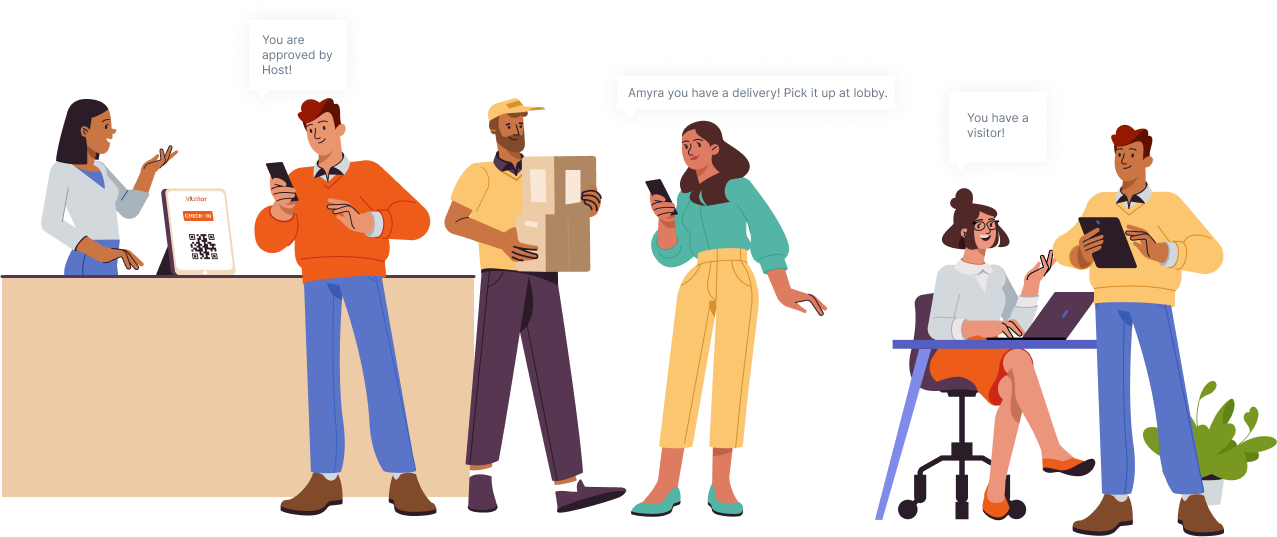
A client and a delivery driver need very different versions of this, though, and treating every arrival the same is its own mistake. For a fuller breakdown of how to receive different visitor types in the workplace, from clients and candidates to contractors and couriers, worth a read once the basics above are in place.
How Vizitor Helps
A good first impression should feel effortless to the visitor, not forced. That’s the specific problem Vizitor is built to solve.
It replaces paper sign-in with a fast digital check-in, notifies hosts the moment a guest arrives, and gives reception teams a calmer process to run instead of a stack of forms. None of that makes a receptionist warmer. What it does is guarantee the competence half of the first-impression test never fails, so the warmth your team already brings actually gets to land.
The best first impression isn’t the one that happens by accident. It’s the one that was designed to happen the same way, every time, whether the visitor is a new client or the fiftieth person through the door that week.
The front door is only the start of it. For the rest of the picture, from reception design to what happens after check-in, see how to design an office experience that impresses visitors end to end.
Ready to see it in practice? Start a free trial or get in touch to walk through how Vizitor fits your front desk.
Try Vizitor Free
Setup in under 5 minutes. Manage visitors, queues, meeting rooms, and more.
Start Free TrialFrequently Asked Questions
See Vizitor in action check-in a visitor in under 30 seconds
Trusted by 500+ businesses. QR check-in, badge printing, NDA signing. Plans from $36/mo.