The Hidden Cost of Double-Booked Meeting Rooms: What 90 Days of Workplace Data Reveals


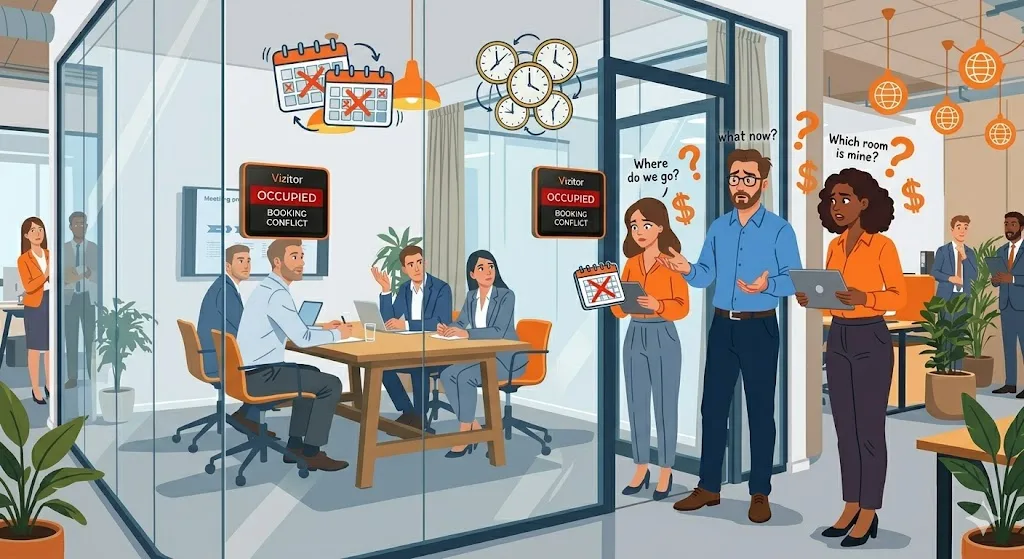
Table of Content
Try Vizitor for Free!
You walk up to a meeting room at 10:00 AM, laptop ready, a client call starting in five minutes. Someone else is already inside. Their booking ended fifteen minutes ago. They have not left.
This is not a rare event. For most offices running on calendar-based booking, this is Tuesday.
The frustrating part is that meeting room conflicts are rarely caused by a genuine shortage of space. They are caused by a gap between what the booking system shows and what is actually happening on the floor. And that gap, when you start tracking it properly, turns out to be expensive in ways that most facilities and operations teams are not measuring.
Here is what 90 days of workplace data consistently reveals about double-booked rooms, and what you can do about it.
The Booking System Is Lying to You
This might sound dramatic, but it is the most accurate way to describe what happens in most organisations.
A calendar integration shows a room as booked from 9:00 to 10:00 AM. The meeting was actually cancelled over Slack the day before. Nobody updated the calendar. The room sits empty for an hour while three people on the same floor assume it is occupied and scramble for an alternative.
This is called a ghost booking, and research across workplace analytics deployments shows that ghost meetings and no-shows leave somewhere between 30% and 45% of all booked meeting room minutes unused. In a separate analysis of hybrid office environments, the booking-to-occupancy ratio dropped from 0.85 in 2023 to just 0.71 in 2025, meaning that today, nearly 30% of all booked rooms go unused on any given day.
The booking system is not broken. It is simply doing what it was built to do: record intent. It was never designed to track whether that intent became reality.
What Double-Booked Actually Looks Like in Practice
The classic double-booking scenario, two calendar invites claiming the same room at the same time, is the version most people picture. Good booking software largely prevents this. But it is not the scenario causing the most friction.
The more common and more expensive version is this:
A recurring team meeting was quietly abandoned three months ago. Nobody cancelled the recurring room block. Every Thursday at 2:00 PM, a conference room sits locked in a calendar as occupied while the team that supposedly booked it works from home or meets informally at someone’s desk.
Or: a 12-person boardroom gets booked by two people for a quick catch-up because it was the only available room showing on the system. Six smaller rooms that would have been perfectly adequate are technically free but not visible through the booking interface.
Both of these are double-booking problems in effect, even if they are not double-bookings in the technical sense. They block space that other people need, and they create the perception of scarcity when scarcity does not actually exist.
The Numbers Behind the Friction
Meeting room inefficiency tends to stay invisible until someone starts measuring it. When organisations do start measuring, the numbers are consistently striking.
Industry utilisation data shows that while rooms are technically booked at rates of 70% to 80% on paper, actual measured occupancy across most office environments sits between 40% and 60%. CBRE’s 2025 global workplace data found average space utilisation at 53%, with North American offices averaging as low as 36%.
No-show rates, the percentage of bookings where nobody ever arrives, run between 25% and 40% across organisations tracked in workplace analytics research. One set of sensor-based deployment data put the figure closer to 40%, meaning nearly half of all booked rooms see nobody walk through the door.
The mismatch is not a people problem. It is a systems problem. Employees cancel meetings in messaging tools rather than calendars. Hybrid schedules shift without triggering booking updates. Recurring meetings stay on the calendar long after the underlying project has ended. None of this is malicious. It is just how people actually behave when the booking system does not close the feedback loop.
What This Costs in Real Terms
Meeting room waste rarely appears as a budget line. It surfaces as ambient friction: delayed decisions, rescheduled client calls, and the quiet frustration of walking five floors to find an empty room only after checking three that were occupied.
The time cost alone is significant. Research from SoftwareFinder found that employees waste an average of 146 hours per year in meetings that do not add value, translating to roughly $6,280 in annual salary per person. When you layer in the additional time spent searching for rooms, rescheduling blocked meetings, and resolving calendar conflicts, the per-employee cost climbs further.
For a 300-person office where even 15% of the workforce spends 20 minutes per week navigating room availability friction, that is 45 people multiplied by roughly 16 hours per year, which amounts to 720 person-hours annually. At an average fully loaded cost of $50 per hour, that is $36,000 per year in one office, before accounting for delayed decisions or meetings that had to be broken into multiple sessions because space was not available when needed.
For multi-site organisations running five or more locations, these numbers compound quickly into six-figure annual waste.
There is also the real estate dimension. A standard 8 to 12 person conference room costs an estimated $10,000 to $25,000 per year in rent and overhead before furniture and maintenance are included. If that room runs at an effective utilisation of 35% because of ghost bookings and no-shows, the organisation is paying for capacity it is not actually using.
Why the Problem Gets Worse in Hybrid Environments
Hybrid work has made meeting room management considerably harder.
When attendance is unpredictable by design, employees treat room bookings as insurance rather than commitments. They book a room on Monday for a Wednesday meeting because they are not sure who will be in the office. By Tuesday, the meeting has moved to a video call, but the room remains blocked. The booking-to-occupancy decline tracked from 2023 to 2025 is largely driven by this behaviour.
Asana’s 2024 State of Work Innovation research found that individual contributors’ time in unproductive meetings jumped 118% between 2019 and 2024, partly because hybrid environments have made meetings the default coordination tool even when they are unnecessary. The more meetings get scheduled speculatively, the more room bookings accumulate without corresponding usage.
The result is a workplace where people complain that there are never any rooms available, while facilities data shows that most rooms are sitting empty for a significant portion of the day.
Three Things That Actually Fix It
Organisations that see genuine improvement in meeting room availability over a 90-day improvement cycle tend to have three things in place.
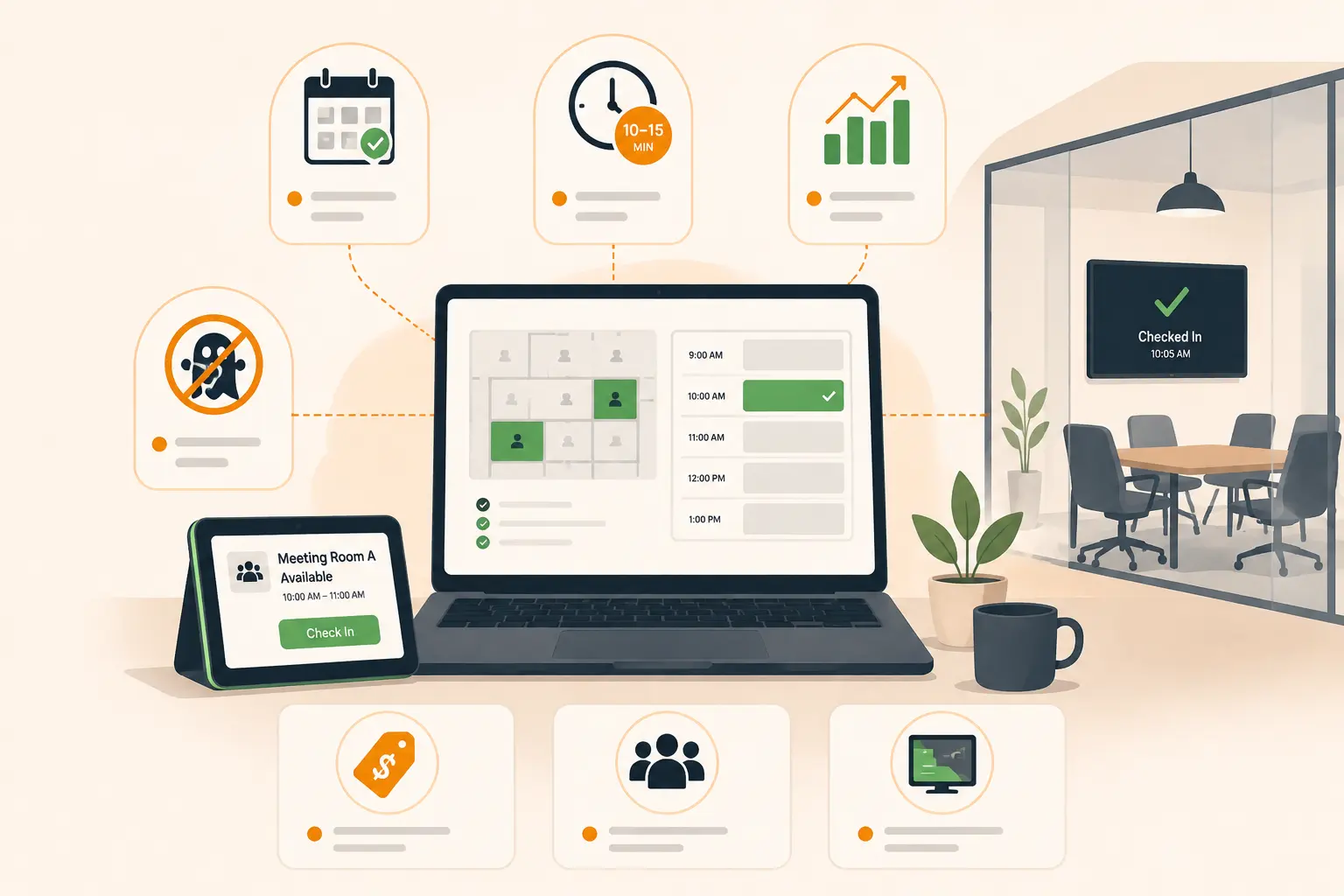
Mandatory check-in with automatic release. This is the single highest-impact change available. When attendees are required to confirm their presence within a defined window after the booking start time, typically 10 to 15 minutes, and the room releases automatically if no check-in occurs, ghost booking friction drops sharply. Multiple implementation studies cite this as the fastest available fix for phantom availability gaps. The key is that it must be automatic. Manual cancellation policies rely on individual behaviour change, and individual behaviour change is the slowest and least reliable lever.
Visible room status at the point of need. A digital display mounted outside each room showing real-time status, the current booking, the next available slot, and whether check-in has happened changes how people interact with meeting space. It makes the gap between calendar status and actual occupancy visible. When someone can see at a glance that a room showing as booked has not had a check-in, they can make an informed decision about whether the space is genuinely in use. Room display panels and mobile floor plans that show live status rather than calendar status remove the guesswork that drives most room-hunting friction.
Unified data across booking, attendance, and space usage. Calendar booking data alone tells you what people intended to do. Sensor data or check-in data tells you what actually happened. When these are connected in a single system, facilities managers can identify specific patterns: which rooms have the highest no-show rates, which days create the most conflict, which departments are booking far more than they use. That data changes the conversation from we need more rooms to we need better release policies on Thursdays between 1:00 and 3:00 PM.
The Multi-Site Dimension
For organisations managing meeting rooms across multiple locations, the same problems multiply.
When each site runs on a different booking system, or worse, a combination of shared calendars, local spreadsheets, and informal processes, the utilisation data never consolidates into anything useful. Head office has no way to distinguish between a genuine room shortage in one location and a ghost booking problem that looks like a shortage.
Standardising room booking across sites, with consistent check-in requirements, consistent release windows, and consistent reporting, creates the cross-site visibility that makes real estate decisions reliable. Without it, organisations regularly expand meeting space in response to complaints while leaving the underlying behavioural and system problems unchanged.
What to Do in the Next 90 Days
If meeting room friction is a consistent issue in your organisation, the evidence suggests this sequence produces the fastest measurable improvement.
Start by auditing your actual no-show rate. Pull your last 90 days of room bookings and cross-reference with any available check-in or occupancy data. If your system cannot tell you whether meetings actually started, that is the first gap to close.
Next, implement automatic room release with a check-in requirement. Set a grace period of 10 to 15 minutes. This single change, applied consistently, addresses the majority of ghost booking friction without requiring a culture change campaign.
Then make room status visible at the room itself, not just on a desktop booking portal. The goal is reducing the gap between what the calendar shows and what people can verify with their own eyes when they walk up to a door.
Finally, start tracking utilisation by room, by day, and by time window rather than tracking aggregate booking rates. The insight that one room has a 40% no-show rate while another runs at 90% actual occupancy is far more actionable than an organisation-wide average.
The hidden cost of double-booked meeting rooms is not primarily in the conflicts themselves. It is in the decisions that get delayed, the time spent searching for alternatives, and the real estate being paid for at full price while sitting empty. Over 90 days, that cost is entirely measurable. Over several years, it compounds into a competitive disadvantage that never appears on any single report.
Frequently Asked Questions
What is the average no-show rate for booked meeting rooms?
Research across multiple workplace analytics deployments puts the average meeting room no-show rate between 25% and 40%. Some sensor-based studies have found rates approaching 40%, meaning nearly half of all bookings result in an empty room. The rate tends to be higher in hybrid office environments where booking is used speculatively rather than as a firm commitment.
What is a ghost booking in a meeting room context?
A ghost booking is a meeting room that appears reserved on a calendar but sits physically empty because the meeting was cancelled informally, moved to a video call, or simply never started, without the calendar booking being released. Ghost bookings are the primary driver of perceived room scarcity in offices that have adequate physical supply but poor booking discipline.
How does automatic room release work?
Automatic room release requires attendees to check in at the room within a defined grace period after the booking start time, commonly 10 to 15 minutes. If no check-in is recorded, the system automatically releases the reservation and makes the room available for others to book. This removes the dependency on individuals proactively cancelling, which research consistently shows most people do not do.
Why has meeting room utilisation dropped in hybrid offices?
Hybrid work patterns have made attendance less predictable, leading employees to book rooms speculatively as a precaution rather than as a firm commitment. When schedules change and meetings shift to video calls, the room booking often remains in place uncancelled. Data tracking booking-to-occupancy ratios from 2023 to 2025 shows a measurable decline in actual room usage despite maintained booking levels.
What is the real financial cost of meeting room inefficiency?
The costs accumulate across several areas: time lost searching for available rooms, delayed decisions when appropriate space is unavailable, and real estate costs for space running at low actual occupancy. Research estimates that employees waste an average of 146 hours per year in unproductive meetings alone. When room-hunting and rescheduling time is added to this across a larger workforce, the total annual cost for a mid-size organisation can reach tens of thousands of dollars per site.
How many rooms does an office actually need?
Most organisations that audit actual utilisation rather than booking rates find they have adequate physical supply but significant policy and system gaps. Improving automatic release, check-in requirements, and booking visibility often resolves the perception of shortage without adding new space. The right number of rooms depends on actual measured demand during peak periods, not on average booking rates or headcount ratios.
Conclusion
Meeting room double-bookings are rarely a space problem. They are an information problem: the gap between what the booking system records and what is actually happening in the room.
The data from workplace analytics across hybrid office environments is consistent. Between 25% and 40% of booked rooms go unused due to no-shows and ghost bookings. Actual occupancy rates run well below booking rates in most organisations. And the cost, in wasted time, delayed decisions, and real estate paid for but underused, is measurable and significant.
The organisations that close this gap most effectively are the ones that treat booking as the beginning of the loop, not the end of it. Check-in confirmation, automatic release, real-time status visibility, and unified utilisation data are the tools that bring the system in line with reality.
If you want to see how Vizitor’s meeting room booking system handles the full cycle, from real-time availability and calendar integration through to occupancy data and conflict prevention, you can explore the platform and request a demo.
See Vizitor in action check-in a visitor in under 30 seconds
Trusted by 500+ businesses. QR check-in, badge printing, NDA signing. Plans from $36/mo.
Latest Blog
The Hidden Cost of Double-Booked Meeting Rooms: What 90 Days of Workplace Data Reveals
Tue, May 26, 2026
Double-booked meeting rooms cost organisations more than most teams realise. Discover what 90 days of workplace data reveals about ghost bookings, no-shows, and how to fix meeting room inefficiency.
Know more