Visitor Management in 2026: What 1.4 Million Check-Ins Reveal
This page is an original data report combining Vizitor's proprietary platform data with verified third-party market research on the visitor management system industry in 2026. Vizitor platform data covers 1,381,942 total check-ins, 200,000 automatically generated digital e-badges, 4.6% physical badge printing adoption, 1.4% NDA feature adoption, and 60,670 NDAs signed. External market data draws from Fortune Business Insights, Mordor Intelligence, Precedence Research, and Future Market Insights, citing a global VMS market of $2.09-$2.35 billion in 2025 growing at 12-14% CAGR, with North America holding 37-40% market share, cloud-based deployment at 72%, healthcare at 24.9% industry share, and SMEs as the fastest-growing segment at 16-17.5% CAGR.


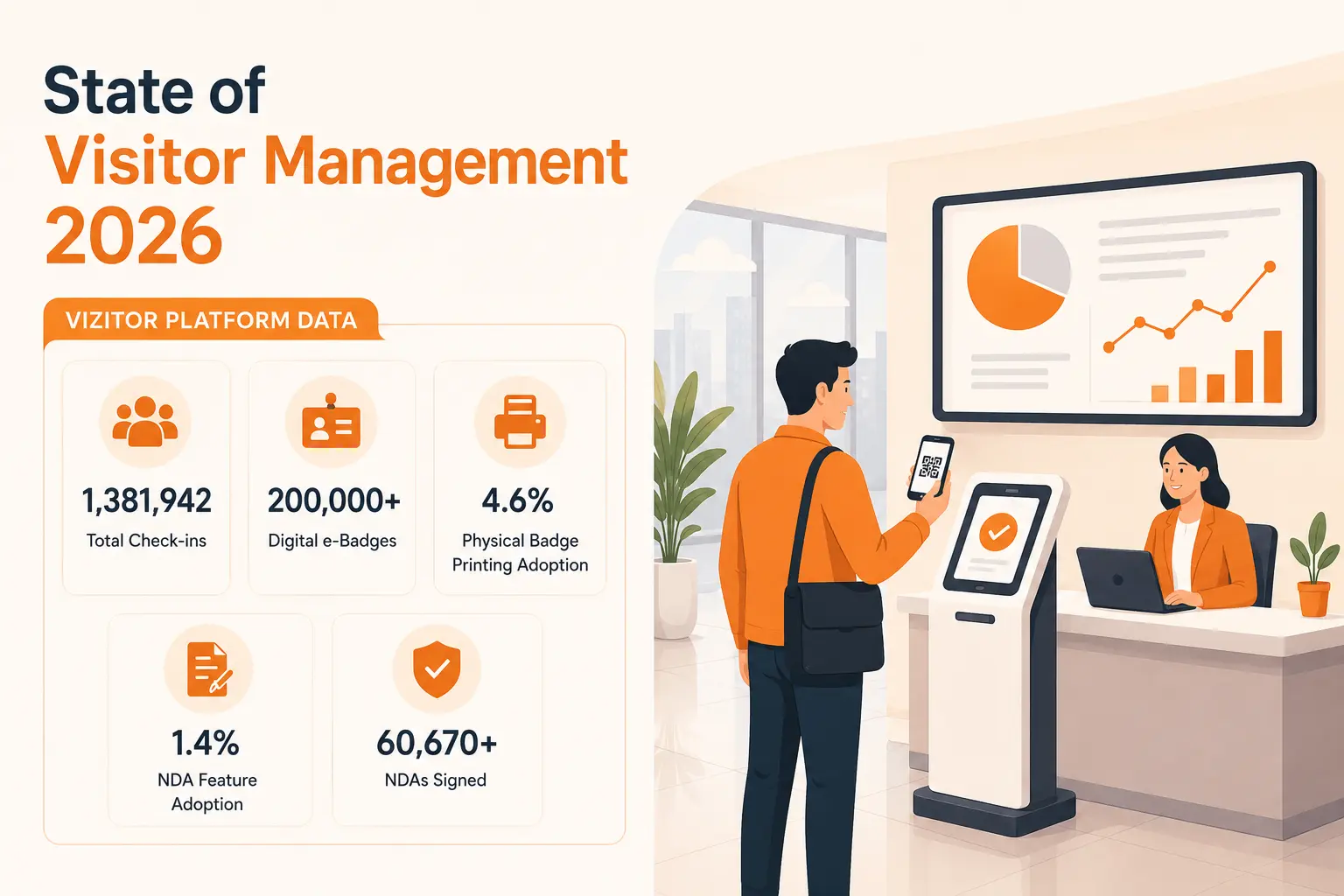
Table of Content
Try Vizitor for Free!
Introduction
Visitor management has moved from a reception desk accessory to a security and compliance infrastructure. The paper logbook for decades, the default at the front door of most organizations is being replaced by a digital layer that verifies identity, logs arrivals, issues credentials, signs documents, and integrates with building access systems in real time.
This report draws on two data sources: Vizitor’s internal platform data from over 1.38 million visitor check-ins processed across its customer base, and verified market research from Fortune Business Insights, Mordor Intelligence, Precedence Research, and Future Market Insights published between 2025 and mid-2026.
The goal is to give facilities managers, security directors, HR leaders, and operations teams an accurate picture of where visitor management actually stands in 2026 not where vendor marketing says it stands. For the front-line version of these numbers, see why manual check-in still fails at scale. New to the category? Our guide to how visitor management software actually works is the place to start.
1. The Market in Numbers
Multiple independent research firms have sized the visitor management system market in 2025 and 2026. Their methodologies differ, producing a range rather than a single consensus figure but the direction is consistent across all of them.
Market size estimates, 2025:
- Fortune Business Insights: $2.16 billion
- Mordor Intelligence: $2.09 billion
- Precedence Research: $2.35 billion
Market projections:
- Fortune Business Insights: $6.77 billion by 2034 (13.56% CAGR)
- Mordor Intelligence: $4.22 billion by 2031 (12.05% CAGR)
- Precedence Research: $9.90 billion by 2035 (14.20% CAGR)
- Future Market Insights: $6.9 billion by 2036 (11.7% CAGR)
The spread in projections reflects different scope definitions some include hardware, some are software-only, some include adjacent markets. What all four firms agree on: the market is growing, accelerating, and not slowing down.
The drivers are also consistent across sources: hybrid work creating variable occupancy that paper logs cannot track, rising compliance mandates requiring verified visitor records, and touchless check-in moving from pandemic-driven preference to permanent expectation.
2. How People Arrive: The Check-In Shift
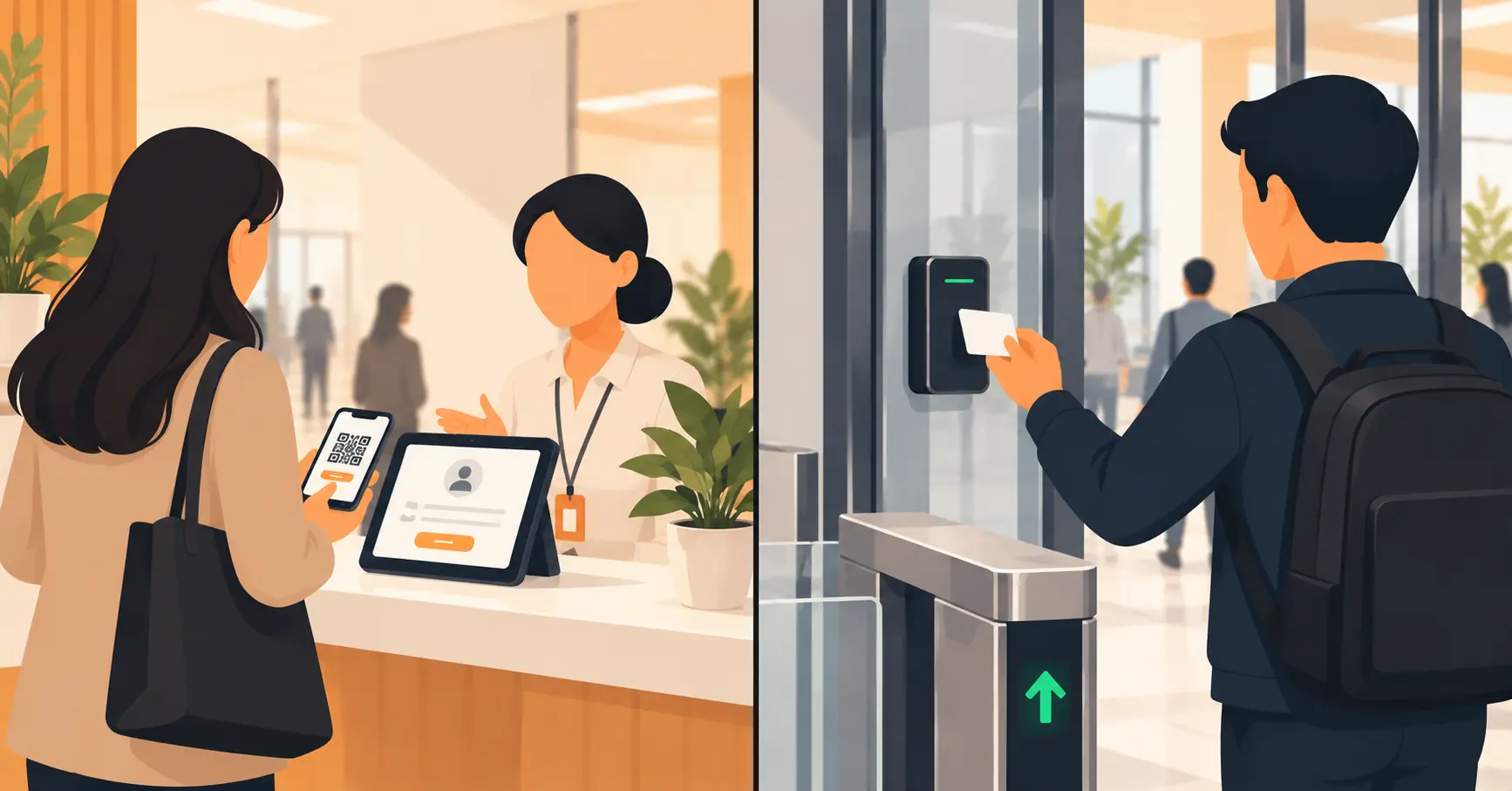
Across those 1.38 million check-ins, the dominant method is the QR code; no app, no shared device, no paper. A visitor scans with their phone camera, completes check-in on their own device, and is logged in under 15 seconds.
Picture the pre-registered version: a guest gets a unique QR code by email before arriving, scans on arrival, and check-in is done before they reach the desk, host notified automatically, digital badge issued to their phone. Total interaction: under 15 seconds. The manual alternative: write your name, wait for reception to call the host, wait for the host to come down routinely runs 3-5 minutes. At 50 visitors a day, that’s 2-4 hours of front-desk time recovered daily.
3. The Badge: Digital Has Won
The clearest signal in the platform data is the collapse of physical badge printing.
- 4.6% of organizations on the Vizitor platform enable physical badge printing.
- 200,000 digital e-badges have been generated automatically, by default, with no configuration.
Read that again: fewer than 1 in 20 organizations on the platform choose to print a physical badge. This isn’t a preference survey, it’s revealed behavior, how organizations actually configure check-in when given the choice.
Physical badges aren’t vanishing entirely. Data centers, defense contractors, pharmaceutical plants, and regulated healthcare still print them because they integrate with door readers and turnstiles. But for most corporate offices, professional-services firms, schools, and healthcare administration buildings, the badge printer has quietly become optional infrastructure. The e-pass does the same job: identity, host, purpose, authorization on the visitor’s own phone, and it’s instantly revocable with a cleaner audit trail. If you’re budgeting for badge hardware you rarely use, this is worth a look.
4. NDA Adoption: The Feature Most Offices Have Never Turned On
One of the most striking findings from Vizitor’s platform data is the gap between NDA feature availability and NDA feature adoption.
The feature is available across all Vizitor plans. Any customer can enable it. Yet only 1.4% of organizations have turned it on.
Among those that have, adoption tells a different story: 60,670 NDAs have been signed at the point of visitor check-in. That is not a trial feature collecting dust, it is a live, actively used workflow in the organizations that have enabled it.
What this gap means:
Visitor NDAs require visitors to review and digitally sign a non-disclosure agreement before being granted access to the facility. This is standard practice in sectors where intellectual property, proprietary client information, confidential product development, or sensitive business operations are regularly visible to external parties.
The 1.4% adoption rate does not mean 98.6% of organizations do not need NDAs. It more likely means 98.6% of organizations have not yet formalized visitor NDA collection as part of their standard entry process even when their existing visitor management platform makes it a checkbox configuration.
For context: any organization that hosts clients, vendors, or contractors in a space where confidential information is visible has a potential IP exposure gap if visitors are not signing an NDA before entering. This includes:
- Startups showing unreleased products to potential investors
- Law firms hosting client meetings in shared conference rooms
- Tech companies where contractors work alongside internal teams
- Healthcare organizations where vendors access clinical areas
- Manufacturing facilities where process IP is visible from the floor
The NDA at check-in is not a legal nicety. In a dispute over information misuse, it is the document that establishes what was known, when, and by whom.
The 60,670 number is also significant in what it confirms: when organizations do enable the feature, visitors sign. The adoption rate among enabled customers is strong. The friction is not on the visitor side, it is on the organizational decision to enable the feature in the first place.
5. Compliance Is Driving Adoption Not Preference
Both the platform data and the market research point the same way: compliance is now the primary driver of formal visitor management ahead of convenience or lobby aesthetics. Organizations don’t leave the paper logbook because they want a nicer entrance. They leave because a HIPAA audit found a gap, a SOC 2 auditor flagged the absence of verified visitor records, or an OSHA emergency plan needs headcounts they can’t produce.
Industry and segment shares below are from Mordor Intelligence and Precedence Research (2026) confirm against the primary reports before publishing:
- Healthcare: 24.9% of the market - driven by HIPAA verified-access requirements.
- IT & Telecom: 28% of revenue - high visitor volume, high-security environments.
- Large enterprises: 65% of revenue; SMEs growing fastest (16-17.5% CAGR) as SaaS pricing removes the capital barrier.
6. The Cloud Default
Cloud-based visitor management now dominates new deployments by a significant margin.
72% of the global VMS market uses cloud-based deployment as of 2025. This figure has grown consistently year over year since 2020. The remaining 28%, on-premise deployments serve organizations with strict data residency requirements: government agencies, defense contractors, regulated financial institutions, and healthcare organizations in jurisdictions with specific data sovereignty laws.
For the vast majority of organizations, cloud deployment is the default for a straightforward reason: it removes the infrastructure cost that historically made visitor management a large-enterprise capability. A cloud-based VMS requires no on-site servers, no dedicated IT maintenance, and no capital hardware investment to deploy at a new location. Adding a site is a configuration task, not a procurement project.
7. The AI and Biometrics Shift
Artificial intelligence is moving from an add-on feature to a standard component of enterprise visitor management deployments.
Current AI applications in visitor management, all in active use as of 2026:
Real-time watchlist screening.
AI matches visitor identity information against internal blocklists, denied-party databases, and government watchlists in sub-second intervals at check-in. The accuracy advantage over manual processes is significant, AI achieves consistent screening regardless of lobby volume, time of day, or staff fatigue.
Facial recognition check-in.
Biometric check-in allows pre-registered visitors to complete entry with a facial scan no QR code, no kiosk interaction. US CBP’s processing of 807 million travelers with facial biometrics by November 2025 has normalized the technology. Corporate lobby deployments are following.
Predictive occupancy analytics.
AI analyzes historical visit patterns to forecast peak visitor times, enabling facilities teams to staff proactively rather than reactively. Early deployments report measurable reductions in lobby congestion during high-traffic periods.
Automated documentation.
AI identifies recurring visitor query patterns and auto-generates knowledge base content, reducing manual administrative maintenance of visitor management configurations.
What AI still doesn’t do reliably: judgment on edge cases. A visitor who shares a name with a blocklist entry, or a contractor with disputed credentials, still needs a human. Automation handles the routine; the exceptions need people.
8. Regional Picture: Where Adoption Is Concentrating
North America leads at 37-40% of global VMS revenue in 2025, driven by OSHA compliance requirements, insurer incentives, and high enterprise spending on workplace technology.
Asia-Pacific is the fastest-growing region at 12.6% CAGR (Mordor Intelligence) led by India’s Smart Cities Mission, China’s PropTech buildouts, Japan’s touchless kiosk adoption, and Australia’s school visitor log mandates.
Europe moves more carefully. GDPR elevates the compliance use case but complicates cloud rollout, steering some deployments toward local data centers. Slower growth but stronger engagement once systems are in place.
Middle East is accelerating fast. Dubai’s citywide biometric hotel check-in program, 15.7 million guests processed in ten months, signals the scale of the region’s ambition in this category.
9. What’s Coming: The Trends That Will Define 2027 and Beyond
The zero-touch lobby.
Check-in completes before the visitor arrives: identity verified, documents signed, host notified. Geofenced entry, where a visitor’s phone triggers check-in automatically near the entrance, is already in early commercial deployment.
The integrated building.
Visitor management is merging into broader building intelligence platforms, sharing one data layer with access control, space booking, occupancy monitoring, and emergency management rather than running as a standalone product.
Compliance as competitive advantage.
Organizations with verified, audit-ready visitor records will face fewer compliance hurdles and lower insurance premiums. Visitor management is moving from nice-to-have into formal compliance checklists.
SME formalization.
The fastest-growing segment is not enterprise, it is smaller organizations replacing paper and spreadsheets with formal systems. As SaaS pricing falls, the size threshold for adopting a VMS is dropping toward 20 employees and below. See how the main visitor management software alternatives compare on price before you shortlist a vendor.
Physical badge printing as niche hardware.
The 4.6% physical printing adoption rate is a leading indicator. Within three to five years, badge printers will be specialized infrastructure for high-security environments not standard lobby equipment.
Vizitor by the Numbers: Platform Data Summary
The following data reflects Vizitor’s platform as of mid-2026:
| Metric | Number | What It Indicates |
|---|---|---|
| Total visitor check-ins processed | 1,381,942 | Platform scale and reliability track record |
| Digital e-badges generated (automatic) | 200,000 | Digital-first adoption is the default, not the exception |
| Physical badge printing enabled | 4.6% of customers | Hardware-based badging is becoming specialized, not standard |
| NDA feature enabled | 1.4% of customers | Significant adoption gap relative to IP protection need |
| NDAs signed at check-in | 60,670 | High usage intensity among NDA-enabled customers |
These figures are drawn from live platform data and represent actual usage patterns not projected adoption rates or survey responses.
Methodology
Vizitor platform data: cumulative activity across the Vizitor customer base as of mid-2026, total check-ins, e-badge generation, feature-adoption rates (share of active accounts with NDA signing / physical badge printing enabled at configuration level), and NDA completion volume.
Third-party research: market size, CAGR, regional and vertical shares from Fortune Business Insights (2025), Mordor Intelligence (Feb 2026), The Business Research Company (2026), and Future Market Insights (June 2026). Where firms report different figures for the same metric, all are shown with source attribution rather than choosing one.
Conclusion
Visitor management in 2026 is a compliance and security function, not a reception convenience. The platform data tells three stories the market forecasts miss. First: physical badge printing is already functionally optional for most organizations, 95.4% of those on the Vizitor platform haven’t enabled it. Second: NDA signing at check-in is dramatically underused relative to the IP risk it addresses, 1.4% adoption, but 60,670 signatures prove it works where it’s on. Third: the e-pass is the new default; 200,000 issued automatically, by organizations that never bought a printer.
But the real headline isn’t paper vs. digital, that fight is over. It’s digital vs. fully configured. Most organizations are running their front door at a fraction of its capability. The ones that close that gap in 2026 will have cleaner audits, fewer incidents, faster lobbies, and a front door that works like the operational system it actually is.
This platform data is one slice of a bigger picture. For our mid-year look at how offices are actually changing in 2026, the same shift toward configured, connected systems shows up in meeting rooms, deliveries, and daily attendance too.
Frequently Asked Questions
See Vizitor in action check-in a visitor in under 30 seconds
Trusted by 500+ businesses. QR check-in, badge printing, NDA signing. Plans from $36/mo.