Queue or Que? The Correct Spelling and Why Waiting Feels Long
This page explains the spelling difference between queue and que, queue is the correct English word for a waiting line; que is a Spanish and French word meaning "what" with no standard English meaning. It covers the etymology of queue, the psychology of waiting based on David Maister's Laws of Service, and how uncertainty, unfairness, and unoccupied time make waits feel longer than they are. Vizitor is presented as a QR-based virtual queue management solution that addresses waiting psychology through real-time position updates and digital check-in.


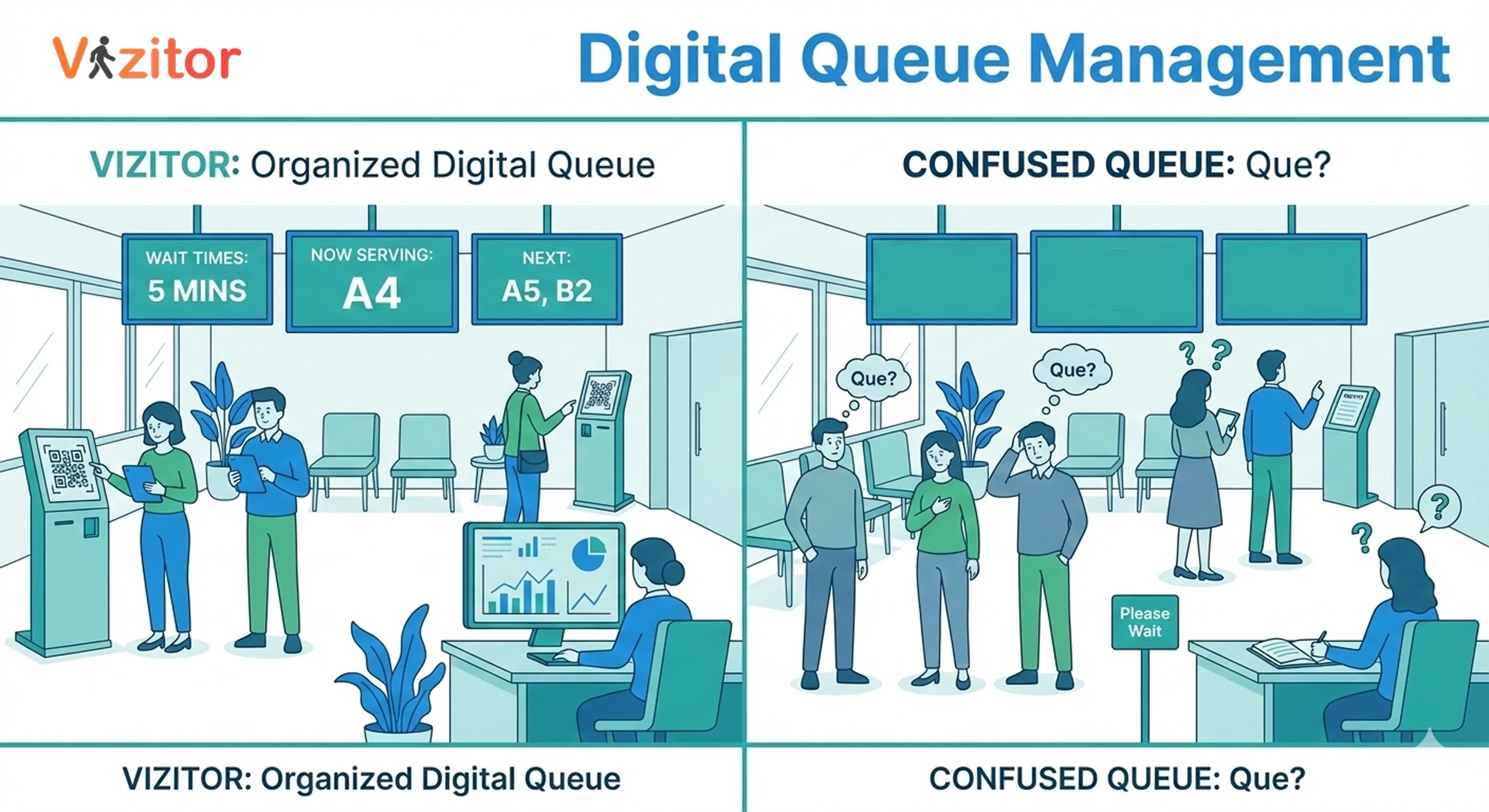
Table of Content
Try Vizitor for Free!
Queue and que are not the same word and in English, only one of them means a line of people waiting.
People mix them up constantly because they sound identical. But the correct English word for a waiting line is always queue. “Que” is a Spanish and French word meaning “what” or “that.” It has no standard meaning in English.
That’s the short answer. But the more interesting question isn’t how to spell the word, it’s why waiting in a queue feels so painful, and what actually determines whether customers walk away frustrated or come back again.
Queue vs Que: What’s the Correct Spelling?
Queue is the correct English spelling when you mean a line of people or things waiting their turn. It’s used as both a noun (“there was a long queue”) and a verb (“we queued for an hour”). Pronounced exactly like the letter Q /kjuː/, it applies to physical lines, digital waiting lists, and computer processing sequences.
Que has no standard meaning in English. In Spanish, it means “what,” “that,” or “which” depending on context. In French, it works similarly as a conjunction. In English, it occasionally appears as an informal abbreviation for Quebec or as a casual shorthand but in professional or formal writing, it is always incorrect when you mean a waiting line.
The confusion is common because the words are homophones, they sound exactly the same. It’s the same problem as “their” and “there,” or “you’re” and “your.” The spelling differs; the sound doesn’t.
Quick reference:
| Word | Language | Meaning | Example |
|---|---|---|---|
| Queue | English | A waiting line or sequence | “Please join the queue at the door.” |
| Que | Spanish | “What” or “that” | “Qué pasa?” (What’s happening?) |
| Que | French | “That” or conjunction | “Je sais que tu es là.” |
| Cue | English | A signal or prompt | “That was my cue to speak.” |
Where Did the Word “Queue” Come From?
Queue entered English from the Old French word coe or queue, meaning “tail.” The visual logic is clear, a line of people standing one behind another looks exactly like a tail extending from a central point.
The word has been part of English since the early 1700s, initially describing a braided hairstyle popular in the 18th century, the literal tail of hair worn by soldiers and aristocrats. By 1837, it had settled into its modern meaning: an ordered line of people waiting for service.
Today the word spans far beyond physical lines. In computer science, a queue is a data structure where items are processed in the order they arrive; first in, first out. Every time a document waits to print, an email sits in a send queue, or a streaming service buffers your next episode, you’re looking at a queue.
The word “que” followed a different path entirely through Spanish and French, where it became one of the most common words in both languages, carrying no relationship to waiting lines whatsoever.
The Agony of the Traditional Queue
Traditional queues create real, measurable costs on both sides of the counter. Americans spend an estimated 37 billion hours a year waiting in line, according to The New York Times. That time doesn’t disappear quietly: frustrated customers leave bad reviews, abandon the line mid-wait, and avoid coming back.
The abandonment threshold is well documented. According to Qminder, citing ICMI research, 73% of customers would abandon a purchase if forced to queue for more than five minutes. Staff feel the pressure from the other side of the counter, too: a chaotic, unmanaged line means more stressed employees, more time spent on crowd control instead of service, and less consistent quality from one transaction to the next. The pattern holds across retail counters, government offices, and healthcare waiting rooms alike.
The Psychology of Waiting: Why a Queue Feels Longer Than It Is
Here’s the part that matters for businesses: the length of a queue and the feeling of that queue are two completely different things. People regularly overestimate how long they’ve waited by around 36% compared to actual elapsed time, a gap The New York Times traced back to research on waiting-line psychology. Two people waiting the same amount of time can have completely different experiences, one tolerant, one furious, based entirely on what information they have access to.
David Maister, a Harvard Business School researcher, identified the foundational principles of waiting psychology in his 1985 paper, “The Psychology of Waiting Lines”. Four decades on, his propositions remain the standard framework service-operations researchers use to explain why customers abandon queues and what actually fixes it.
Unoccupied time feels longer than occupied time. A person standing in a featureless line with nothing to look at, read, or do will consistently report that they waited longer than they actually did. The same wait time, with a screen showing queue position or a phone to interact with, feels shorter. This is why theme parks post wait times at the entrance to rides not to warn you, but to give your brain something concrete to process.
Uncertain waits feel longer than known waits. Not knowing how long the wait will be is consistently rated as more stressful than a longer wait with a defined endpoint. A customer told “approximately 15 minutes” tolerates that wait more calmly than a customer told nothing, even if the actual wait turns out to be identical. Uncertainty removes the brain’s ability to manage expectation and that alone inflates the perceived wait time.
Unexplained waits feel longer than explained waits. When something causes a delay and no one says why, customers fill the silence with negative assumptions; incompetence, poor staffing, unfairness. When the same delay is explained (“our system is processing an unusually high volume”), tolerance increases significantly. The explanation doesn’t need to be detailed. It just needs to exist.
Unfair waits generate anger, not just frustration. A person who has waited 20 minutes and watches someone who arrived later get served first does not simply feel impatient. They feel wronged. Queue fairness first-come, first-served is the behavioral contract between a business and its customers. When it’s violated, even once and even innocently, the emotional response is disproportionate to the practical inconvenience.
Solo waits feel longer than group waits. Waiting alone feels longer than waiting with companions. This is partly distraction, but it’s also social validation, a group waiting together confirms that the wait is expected and normal. A single person waiting alone has no such signal.
Queue vs No Queue: Why the Answer Isn’t to Eliminate Waiting
A common instinct is to frame queue management as the effort to eliminate waiting entirely. That’s not achievable and it’s not actually the goal.
Waiting happens whenever demand exceeds capacity. This is a mathematical reality, not a failure of management. The goal of queue management isn’t to remove waiting. It’s to remove the psychological harm of waiting: the uncertainty, the unfairness, the invisibility.
Maister’s framework explains why: customers who wait in a well-managed, transparent queue with regular updates tend to report higher satisfaction than customers who get faster service in a chaotic, unmanaged environment. Perceived fairness and information access carry more weight than raw speed.
This is the practical shift modern queue management systems deliver. The wait doesn’t get shorter. The experience of it does. For a full breakdown of how to evaluate and choose one, see the complete guide to queue management systems.
How Modern Queue Management Addresses the Psychology
Every principle identified in waiting psychology maps directly to a feature in modern queue management.
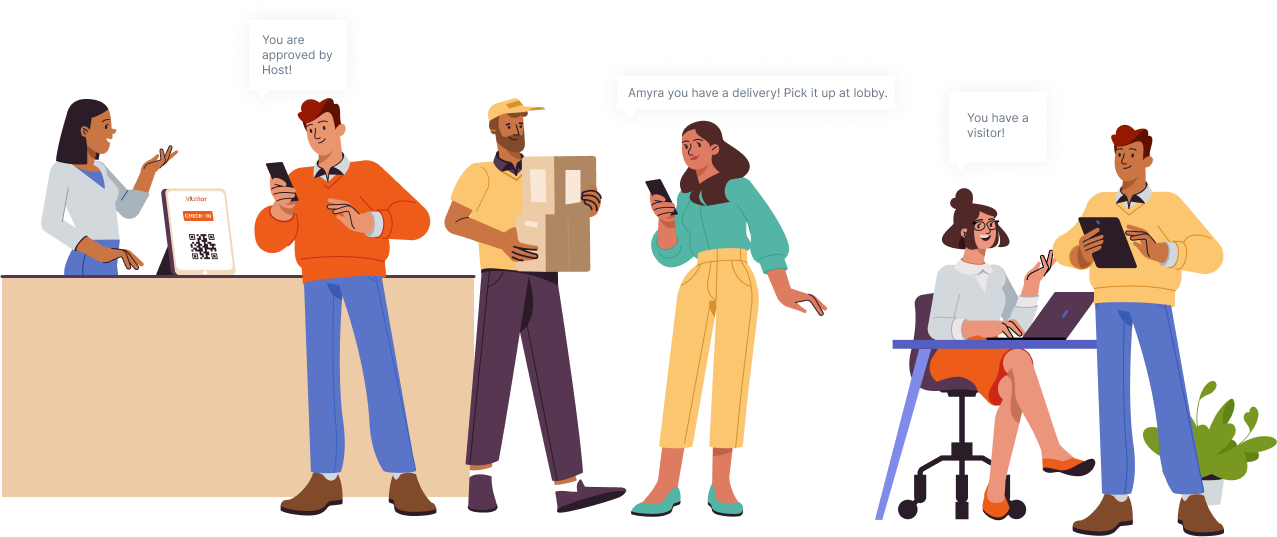
Virtual queuing removes the need to stand in a physical line. Customers join remotely via QR code or a web link and wait wherever they choose, and no app installation is required to do it. The physical act of standing is removed, which eliminates the most viscerally frustrating form of unoccupied waiting.
Real-time position updates address uncertainty directly. A customer who can see “you are 4th in the queue, estimated wait: 9 minutes” has converted an uncertain wait into a known one. Perceived wait time drops. Abandonment drops with it.
Automatic notifications handle the explanation problem. When a delay occurs, the system notifies waiting customers automatically before they ask, before frustration builds. The explanation doesn’t require a staff member to make an awkward announcement. It happens in the background.
First-come, first-served digital processing eliminates fairness violations. The queue is visible, ordered, and honest. Customers can see their position. The system enforces the order. The behavioral contract holds.
The Future Is Queue-Less, Almost
Physical lines are being replaced rather than eliminated outright. Customers join a queue from their phone, get real-time position updates, and wait wherever suits them instead of standing in place. AI-driven forecasting is a growing part of that shift too, predicting peak periods and recommending staffing levels before a line actually forms, a lead time a paper sign-in sheet never gave managers. Cloud-based systems let multi-location businesses manage every site’s queue from a single dashboard, and self-service kiosks with multilingual support are becoming standard, part of a broader shift toward modern alternatives to take-a-number systems.
The data these systems generate is itself a business asset: arrival patterns, service times, and abandonment points become visible instead of anecdotal. The direction is consistent across vendors: fewer physical lines, more visibility into what’s actually happening in them, and queue systems that connect to the rest of a business’s operations rather than running in isolation.
How Vizitor Manages Queue Psychology in Practice
Vizitor’s queue management system addresses the core principles of waiting psychology through QR-based digital check-in and a real-time staff dashboard.
When a customer arrives, they scan a QR code and join the queue digitally. They receive an immediate confirmation of their position. They can then wait anywhere they choose, a seat in the lobby, their car, a nearby area rather than standing in a physical line. The uncertainty that inflates perceived wait time is removed at the moment of check-in.
On the staff side, the dashboard shows who is waiting, in what order, and for how long, in real time, from any device. Service staff call customers through in the order they joined. The fairness signal is built into the system structure, not dependent on individual staff judgment in the moment.
For offices, healthcare facilities, service centres, and any location managing walk-in visitor flow, Vizitor replaces the frustration of unmanaged waiting with a process that respects both the customer’s time and the staff’s ability to deliver consistent service.
Conclusion
Queue and que sound identical but serve entirely different purposes.
A “queue” represents order.
“Que?" represents doubt.
But the word is only the starting point. Understanding why queues frustrate people; uncertainty, unfairness, invisibility, unoccupied time is what separates a business that loses customers at the door from one that retains them through the wait.
The psychology is consistent across every service environment and every culture. People don’t leave because they waited. They leave because they didn’t know how long they’d wait, didn’t feel the system was fair, and had nothing to do while they found out.
Modern queue management solves these problems directly not by making waiting disappear, but by making it transparent, ordered, and bearable.
Try Vizitor Free
Setup in under 5 minutes. Manage visitors, queues, meeting rooms, and more.
Start Free TrialFrequently Asked Questions
See Vizitor in action check-in a visitor in under 30 seconds
Trusted by 500+ businesses. QR check-in, badge printing, NDA signing. Plans from $36/mo.