Solving Diagnostic Lab Queues with Smart Management
This article explains why diagnostic labs face a distinct queue problem from hospitals, driven by a concentrated morning fasting rush and colliding sample and report collection queues. It details the queue management features that matter for labs, such as department-wise routing, staff notifications, and audit-ready logging, and shows how Vizitor addresses these needs.


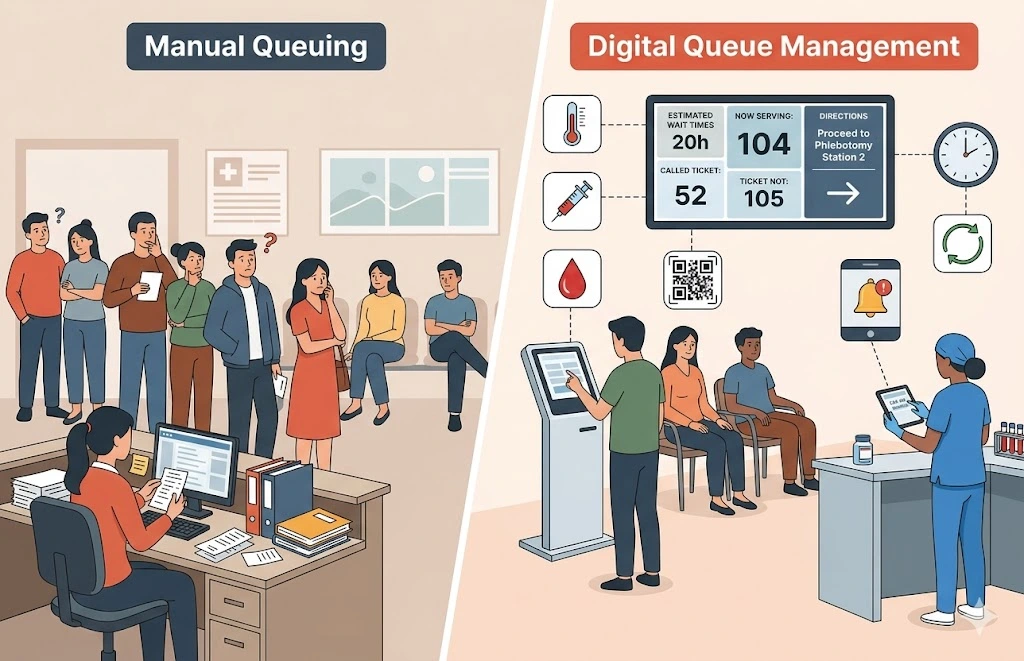
Table of Content
Try Vizitor for Free!
Anyone who has visited a major diagnostic lab or pathology collection centre at 7 AM on a weekday knows what diagnostic lab queues actually look like.
Fifty to seventy people, most of them fasting since the night before, standing in a queue that snakes outside the door. One receptionist is handling registration. Two phlebotomists are collecting samples in three rooms. Someone is asking about home collection. Someone else is here to pick up a report from yesterday. A senior citizen wants priority. A patient with an insurance referral is at the wrong counter. The receptionist is calling token numbers nobody hears.
This is daily reality at most of the thousands of patient service centres operating across India. The country has seen rapid expansion of organised diagnostic chains, with leading networks now operating 200 to 300 clinical laboratories each and thousands of patient service centres across the country. Multiply this across every major chain and the hundreds of regional players, and the queue problem at Indian diagnostic labs becomes one of the largest unsolved operational problems in the healthcare sector.
This guide explains why diagnostic lab queues fail at scale, what features actually matter in a queue management system for sample collection environments, and how the right setup transforms the 7 AM rush from a daily crisis into a controlled workflow.
Why Diagnostic Labs Have a Queue Problem Hospitals Do Not
Diagnostic labs and pathology centres are often grouped together with hospitals in healthcare discussions. They should not be. The operational model is completely different, and the queue management requirements that work for a hospital OPD do not solve what a diagnostic lab faces every morning.
Hospitals see patients spread throughout the day, which is why the benefits of queue management systems in hospitals look different from a lab’s. Diagnostic labs concentrate 60 to 70 percent of their daily walk-ins between 6:30 AM and 10:30 AM. This is the fasting sample window. Patients who needed blood glucose, lipid profile, or fasting insulin tests have not eaten since the previous night. They arrive early because they want to break their fast as soon as possible, and they all arrive in the same three-hour window.
That window then collides with a second wave starting around 2 PM, when patients return to collect reports from samples submitted earlier. The lab is now running two completely different queues at the same time, served by the same front desk staff. The morning queue is about getting in fast. The afternoon queue is about getting documents out fast. Neither queue can be managed efficiently when both are happening at one reception counter with paper tokens.
This is on top of the other queue layers that exist simultaneously at any diagnostic lab. Home collection phlebotomists are picking up samples from residences and dropping them at the lab. TPA and insurance verification cases need separate handling. Senior citizens and persons with disabilities expect priority. Walk-in test requests need menu consultation before payment. Each of these workflows wants attention from the same front desk.
The pathology testing segment now accounts for 65 to 72 percent of the entire India diagnostic labs market according to industry research reports from 2025. The market is worth USD 18.55 billion in 2025 and projected to reach USD 37.13 billion by 2032 at a CAGR of 10.42 percent. The volume is growing fast. The queue problem is growing faster.
The Five Queue Failures That Cost Diagnostic Labs Revenue Every Day
Patients walk out when the morning queue looks too long
A fasting patient who walks into a collection centre at 8:30 AM and sees 40 people ahead of them does the math. Even if each sample takes 4 minutes, they are looking at two and a half hours of waiting on an empty stomach. Many of them turn around and go to the nearest competitor. Or they decide to come back tomorrow, which often means they do not come back at all.
Customer wait time data confirms this pattern across industries. 73 percent of customers say waiting is the most frustrating part of visiting a business (Zendesk CX Trends, 2025), and 86 percent will leave or switch providers when wait times feel unreasonable (Loris Customer Expectations Survey, 2025). In a diagnostic lab context, the patient is fasting, often anxious about test results, and comparing your wait against another lab three minutes away. This is why patient wait time analysis matters so much for healthcare facilities in general.
Two queues collide at one counter
Most major chains now offer home sample collection. Phlebotomists go out, collect samples, and return to the lab to drop them off and pick up their next assignment. When this coordination happens at the same front desk that is handling patient queues, the result is constant interruption. The receptionist stops mid-patient-registration to confirm a home collection address. The phlebotomist waits while the receptionist finishes with a walk-in.
A queue management system with mobile staff notifications removes the front desk from this coordination entirely. The home collection team gets their next assignment on their phone. The in-centre staff focuses on in-centre patients.
TPA, insurance, and corporate billing add hidden queue load
Insurance-covered patients need verification before sample collection. TPA, or third party administrator, cases require pre-authorisation lookup. Corporate health checkup patients have packaged tests that need to be matched against their company’s covered list. Each of these adds 5 to 10 minutes per patient at the registration counter.
In manual systems, these patients sit in the same queue as cash-paying walk-ins, which creates resentment when a paperwork-heavy patient is being processed while five others wait behind. Department-wise queuing solves this by routing insurance and TPA cases to a separate workflow that runs in parallel.
No data means no improvement next week
The most underestimated cost of poor queue management at diagnostic labs is the absence of data. Without records, the centre manager cannot answer the most basic operational questions. Which test types take the longest to collect? Which days have the highest peak volume? At what hour does the queue actually start backing up? Which phlebotomist completes the most samples per hour? Without this information, every staffing decision is a guess.
A digital queue management system captures all of this automatically. Peak hour patterns, sample type frequencies, average service times, and staff performance data are all recorded without any manual reporting effort.
What Features Actually Matter in a Queue Management System for Diagnostic Labs
Not every queue management system handles the specific operational reality of a diagnostic lab. These are the features that matter most.
Department-wise queue routing
Sample collection, report collection, billing, insurance verification, and home collection coordination should each run as separate queues. A single undifferentiated queue cannot manage the simultaneous workflows that happen at every busy collection centre.
Real-time staff notifications
When a patient is registered for sample collection, the assigned phlebotomist should be notified instantly on their device. Not via a shouted name. Not by walking back to check the registration desk. A push notification in under one second to the right staff member is the standard.
One-tap acceptance with team-wide notification clearing
When one phlebotomist accepts a patient, the notification clears for the rest of the team immediately. No two staff approach the same patient. No patient waits unattended because everyone assumed someone else was handling them.
Inter-counter transfer support
Patients often need to move between counters. The sample collection patient finishes and needs to go to billing. The report collection patient has a question that needs to be routed to a specialist staff member. One-tap transfer keeps these movements organised and logged.
Centralised multi-centre dashboard
A diagnostic chain operating multiple collection centres needs one dashboard showing live queue activity across every centre. The operations head should see which centres are running peak loads, which have idle capacity, and where staff redistribution would help most. Without this, the chain is just a collection of independent centres with no operational coordination.
Automatic audit-ready logging
Every patient interaction must be logged with timestamp, sample type, staff identifier, and total time. This data supports operational improvement and creates the documentation trail required for NABL accreditation and quality compliance reviews.
No hardware requirement
Most diagnostic chains operate from rented spaces with tight footprints. Installing kiosks, ticket printers, and display screens at every centre adds capital expense and maintenance overhead that chains running on thin margins cannot easily absorb. A cloud-based queue management system running on Android and iOS devices that staff already use removes this barrier entirely.
How One Collection Centre Transformed Its Morning Rush
The operational impact of a digital queue management system at a diagnostic lab is measurable from day one. Vizitor deployments in high-traffic service environments have documented 50 percent reduction in average wait times and 30 percent improvement in staff efficiency when manual call-outs and paper tokens are replaced.
For a collection centre handling 300 patients per day, that translates into specific outcomes. Patient walkouts during peak hours drop sharply because the queue actually moves. Front desk staff stop spending their mornings managing crowd flow and start focusing on patient experience. Centre managers see operational patterns they could not see before, which informs better staffing decisions for the next week, not the next quarter.
The compliance side matters too. Diagnostic labs operating under NABL accreditation are subject to quality audits that include patient flow documentation. A digital queue system produces this documentation automatically. A paper register does not.
How Vizitor Handles Queue Management for Diagnostic Labs
Vizitor’s queue management system was designed for multi-counter, multi-department service environments which is exactly what a diagnostic lab is. Department-wise token generation handles sample collection, report collection, billing, and insurance verification as separate workflows running in parallel. Real-time push notifications reach the right phlebotomist or staff member in under one second. One-tap acceptance and inter-counter transfers keep the workflow organised even during peak load.
Beyond queue management itself, Vizitor integrates with visitor management, mailroom management for sample transfers between centres, attendance for phlebotomist tracking, and reporting analytics in one platform. The centre manager handles every operational workflow from one dashboard rather than juggling four separate tools.
The deployment is fast. No hardware. No IT project. No kiosks. Most diagnostic centres are operational within 30 minutes of creating an account.
About Vizitor
Vizitor is a workplace management platform trusted by 500+ workplaces across 15+ countries. The platform unifies visitor management, queue management, mailroom management, meeting room booking, desk booking, and attendance into one system.
Frequently Asked Questions
See Vizitor in action check-in a visitor in under 30 seconds
Trusted by 500+ businesses. QR check-in, badge printing, NDA signing. Plans from $36/mo.