Practical Tips for Building a Culture of Punctuality at Work
This blog explains why punctuality is one of the most reliable signals of professionalism at work and where most advice on "just be on time" quietly fails. It covers 10 practical strategies for building punctuality as a personal habit, 5 strategies for managers building a culture of it, how remote and hybrid work changed the failure modes, and where strict punctuality enforcement backfires. It closes with how a digital attendance system like Vizitor's gives managers the data to enforce punctuality fairly instead of by anecdote.


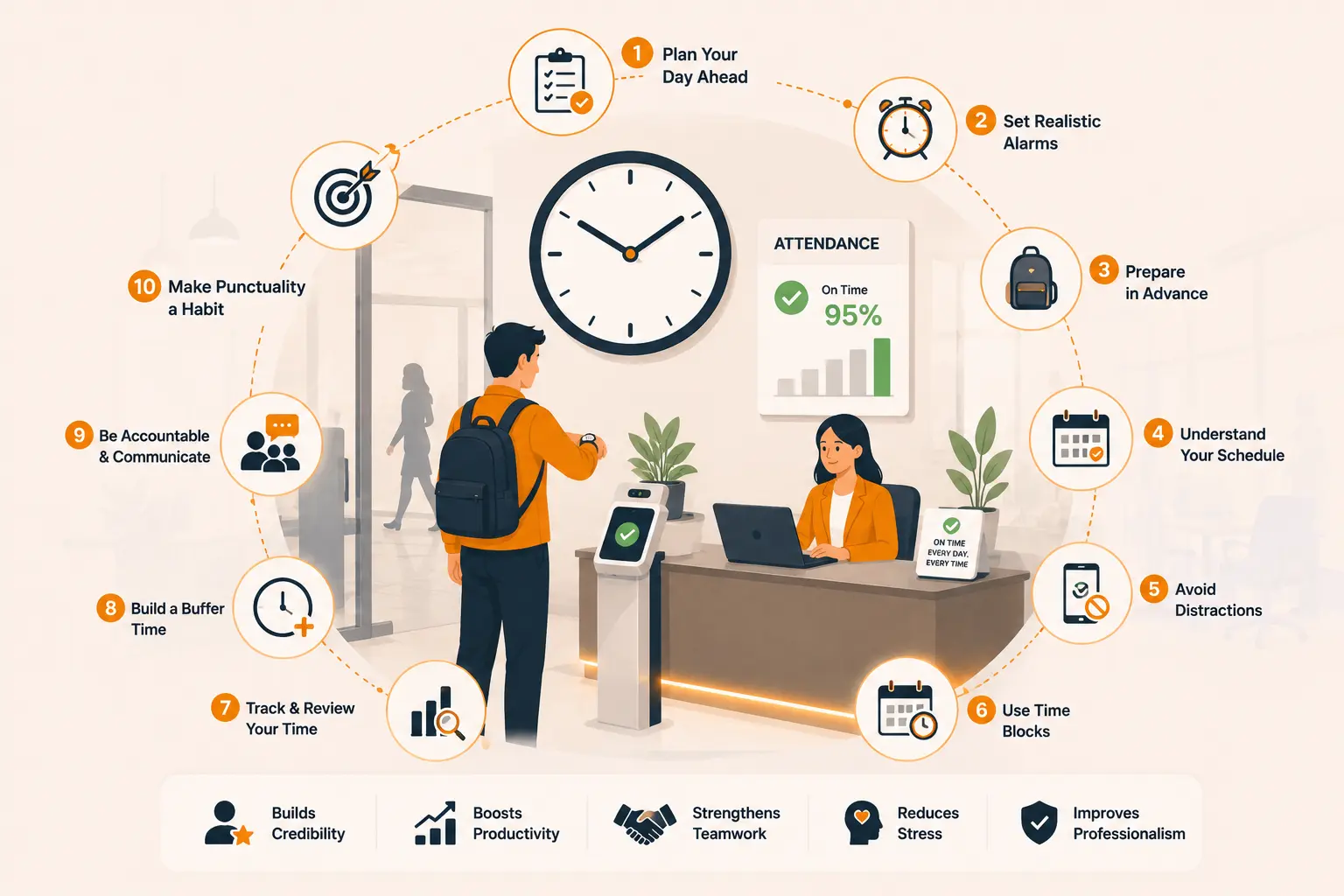
Table of Content
Try Vizitor for Free!
Being fifteen minutes late to a client call doesn’t just cost fifteen minutes. It costs the other person’s read on whether you can be trusted with the next deadline. That’s the part most “just wake up earlier” advice on punctuality skips: the damage isn’t the delay, it’s what the delay tells people about you.
Punctuality in the workplace means consistently arriving on time for work, meetings, deadlines, and commitments, not because a clock says so, but because it is the cheapest, most visible signal of reliability a colleague ever gets from you. A Harvard Business School study of more than 25 million shift timecards across 500-plus US retail stores (Caleb Kwon and Ananth Raman) found that a 1% rise in lateness and absenteeism was tied to a 2.3% decline in daily sales, and a 1% rise in tardiness alone corresponded to roughly 1% lower sales per transaction, evidence that this is a widespread operational issue, not a minor personal failing.
This piece covers what punctuality actually signals, where individual habits break down, ten strategies that hold up under real schedule pressure, five things managers need to do differently, how remote work changed the failure modes, and, honestly, where strict punctuality rules do more harm than good.
What Is Punctuality in the Workplace?
Punctuality in the workplace means arriving on time for work, meetings, and deadlines, and finishing tasks within the timelines you agreed to. It is considered a core soft skill across corporate offices, healthcare, retail, manufacturing, and service industries because it is one of the few professional behaviors a colleague can observe directly, without needing to evaluate the quality of your work first.
It shows up as:
- Arriving before work hours begin, or logging in on time for remote roles
- Being present at meetings at the scheduled minute, not five minutes after
- Meeting deadlines consistently, not “technically” at 11:47 PM
- Communicating early when a delay is unavoidable, instead of going quiet
Why Punctuality Matters More Than the Clock
Punctuality functions as a trust shortcut. Nobody can verify your competence in a first meeting, but everyone can verify whether you showed up when you said you would, and people extrapolate from that one data point more than is fair. Richard Branson made a version of this argument in a widely read 2015 essay on being on time: “If you want to be more productive, then start at the start: get there on time,” framing punctuality as a discipline that compounds into how effectively you delegate, organize, and communicate, not just a courtesy.
The practical effects show up in a few consistent places. Meetings that start on time protect everyone else’s calendar, not just yours, since a 15-minute-late start compounds across every attendee’s day. Teams that treat deadlines as firm make fewer end-of-sprint scrambling mistakes, because rushed work under time pressure is measurably more error-prone than paced work. And managers read a pattern of lateness as a proxy for how you’ll handle bigger responsibilities, fairly or not, because it’s the easiest signal they have.
None of this requires believing punctuality is a moral virtue. It requires recognizing that in the absence of other information, colleagues use it as one.
Why Most People Get Punctuality Wrong
Most punctuality advice fails because it treats lateness as a discipline problem when it’s usually a measurement problem. A few specific ways this goes wrong:
Treating “I’ll leave at 9” as a plan. Without a defined buffer, any delay (a slow elevator, a stuck door) turns an on-time departure into a late arrival. A plan needs a buffer built in, not just a departure time.
Underestimating task duration instead of tracking it. Most people guess how long their morning routine or commute takes rather than timing it once and using the real number. The gap between guessed and actual time is where most lateness originates.
Fixing the morning after the pattern is already public. By the time a manager mentions lateness, colleagues have usually noticed for weeks. Waiting for the conversation to trigger change means the trust damage already happened.
Treating every late arrival as equivalent. Being two minutes late to a standup and being fifteen minutes late to a client pitch carry entirely different costs, but both get lumped into “I’m bad at being on time,” which makes the problem feel unfixable instead of contextual.
Solving it with willpower instead of a system. “I’ll just try harder” doesn’t survive a bad traffic day. A written buffer rule, a night-before routine, or a calendar alert does, because it doesn’t depend on motivation in the moment.
10 Proven Strategies to Master Punctuality and Time Management
Punctuality is a learnable skill, not a fixed trait. These strategies work because they replace intention with structure.
1. Find Your Actual Failure Point, Not a Generic Cause
Most people blame “bad time management” for lateness, but that’s too vague to fix anything. Spend one week writing down what you were doing 15 minutes before each time you were late, not just the fact that you were late. A pattern usually surfaces fast: you’re thrown off by the same 10-minute task, packing a bag, finding parking, waiting on a slow app to load, that you’ve never actually timed. Write down the actual minutes, not a rounded guess, because the gap between “about ten minutes” and “fourteen minutes, every single day” is exactly the gap between a buffer that works and one that doesn’t. Once you know the real bottleneck, you’re solving one specific problem instead of trying to become “a punctual person” in the abstract.
2. Anchor Your Departure to an Event, Not a Clock Time
“I’ll leave by 8:40” is easy to talk yourself out of the moment 8:40 arrives and you’re mid-task. Anchoring your departure to something concrete, like leaving when the coffee finishes brewing, or closing the laptop the instant the second alarm goes off, removes the negotiation entirely. A clock number is abstract, and abstract things are easy to override. A physical trigger isn’t.
3. Size Your Buffer to the Failure, Not to a Round Number
A flat “add 10 minutes” rule helps if your problem is traffic, and does nothing if your problem is decision fatigue over what to wear. Match the buffer to what you actually found in step one. If your bottleneck is a 12-minute commute that turns into 25 minutes twice a week, buffer 15 minutes specifically on the two unpredictable days, not every day. Precision beats a generic rule here, because a buffer that’s oversized everywhere just gets treated as slack and quietly disappears. If a fifteen-minute buffer sits unused four days out of five, most people quietly start treating it as spare time rather than protection, which is how the buffer disappears exactly on the day it was built for.
4. Handle Two-Minute Tasks Immediately, Not Later
The two-minute rule, a productivity idea popularized by David Allen’s “Getting Things Done” method, says that if a task takes less than two minutes, you do it now instead of adding it to a list. Applied to punctuality, that means replying to the scheduling message the second you see it instead of telling yourself you’ll get to it later, because “later” is exactly when three of these pile up and quietly eat the 15 minutes you needed to leave on time.
5. Build Your Routine Around Your Worst Day, Not Your Best
Most morning-routine advice assumes every day is equally easy, but it isn’t. If Mondays are genuinely harder because of weekend disruption, or the day after a late meeting always runs behind, prep specifically for that day the night before: clothes out, bag packed, first task already decided. Optimizing your routine for your best day and hoping the bad ones work out the same way is how a routine that “usually works” fails on exactly the days it matters most.
6. Let Your Calendar Enforce What Willpower Won’t
Set two reminders for anything that matters, one the night before and one 15 minutes ahead, and build small buffer blocks between back-to-back meetings so a five-minute overrun on one doesn’t cascade into lateness for the next. This isn’t about installing more apps. It’s about moving the decision out of the exact moment you’re most likely to talk yourself out of it, when you’re mid-task and the meeting is already starting. A calendar tool doesn’t fix lateness by itself. It fixes the one moment where good intentions usually lose, the fifteen minutes before something starts, when it’s easiest to convince yourself you have time for one more thing.
7. Say No Before You’re Already Behind
Overcommitment shows up as lateness two steps removed: you say yes to a favor, a call, or a “quick” request, and the actual cost lands on whatever comes right after it. Decline early, when it’s still a calendar decision, rather than late, when it’s already an apology. A simple “I can’t take this on right now without being late for something else” protects the commitment you already made, and it’s a more honest answer than pretending you can fit everything in.
8. Sort Your Day With the Eisenhower Matrix, Not a Gut Feeling
Split today’s tasks into four buckets: urgent and important, do it now; important but not urgent, schedule it; urgent but not important, hand it off if you can; neither, drop it. Most chronic lateness on deadlines traces back to spending the morning inside the fourth bucket and running out of runway for the first. The matrix doesn’t make you faster. It stops you from spending your buffer on the wrong thing.
9. Track the Pattern, Not Just the Day
A single late arrival tells you almost nothing. A log of every late arrival for a month, with the day of week and the specific cause next to each one, tells you whether the problem is Mondays, a specific meeting, or a specific person you’re always waiting on. Most people give up on tracking after one good week and conclude they’re “fixed.” The pattern only becomes visible once it survives a good week or two, not before. Feed what the log tells you back into strategy one. A pattern that keeps pointing at the same 10-minute task, the same meeting, or the same day of the week means you haven’t actually fixed the root cause yet, you’ve just gotten better at logging it.
10. Make the Win Visible, Not Just Felt
Punctuality is a habit that pays off slowly and invisibly, which makes it easy to let slide the first time something else feels more urgent. Give yourself something concrete to notice: a habit tracker, a note to a manager or partner about a month of on-time arrivals, or simply reviewing your own lateness log and watching the number drop. The reward doesn’t need to be large. It needs to be visible enough that the habit feels like it’s working before the real payoff, the promotion, the trust, the calmer mornings, shows up on its own.
These ten strategies fix the individual side of punctuality. But an employee who’s mastered every one of them still shows up “late” if the culture around them treats 9:15 as basically 9:00. That’s a different problem, and it belongs to the manager, not the employee.
5 Strategies for Managers: Building a Culture of Punctuality
The employee tips above won’t matter if your workplace culture rewards lateness. Managers set the tone; your team’s punctuality is, ultimately, your responsibility.
1. Set written expectations on day one
The biggest source of inconsistent punctuality enforcement is unclear expectations. If “on time” isn’t defined, everyone uses their own definition, and enforcement becomes arbitrary.
In your employee handbook and onboarding documents, spell out:
- What “on time” means (e.g., logged in or at desk by 9:00 AM sharp; meetings start at the scheduled minute, not 5 minutes after)
- How lateness should be communicated (e.g., Slack message to manager within 15 minutes of the start time)
- What constitutes a pattern (e.g., late more than 3 times in a rolling 30-day window)
- The progressive consequences (verbal conversation → written warning → PIP → termination, with documentation at each step)
When expectations are written, enforcement becomes consistent. When enforcement is consistent, people respect it.
2. Identify patterns, not punish symptoms
A single late arrival is rarely the problem. A pattern is. And the pattern usually has a root cause that punishment won’t fix.
Before reacting to chronic lateness, ask: is this happening on specific days (Mondays after long weekends, Fridays before a deadline)? Is it happening only for certain meetings (the 8:30 AM standup, but never the 10:00 AM client call)? Is it correlated with personal life events (a recent move, a parental change, a new commute)?
Using data instead of anecdote requires a digital attendance system that captures actual arrival times. Without measurement, you’re working from impressions, and impressions are biased. Our breakdown of what attendance data reveals that managers usually miss covers how to read those patterns before they become a bigger problem.
3. Have the conversation
Most managers avoid the lateness conversation because they don’t know how to start it. They wait too long, hope it resolves itself, then escalate suddenly and damage the relationship. Better: have an early, low-stakes conversation when the pattern first appears.
- Name the specific pattern (with dates) so the employee can’t dismiss it as a vibe
- Open with empathy before authority; the employee feels seen, not attacked
- Invite root-cause discussion rather than demanding behavior change
The conversation often surfaces a fixable, non-disciplinary cause: a childcare schedule changed, a partner started a new job, a transit route shifted. The fix is operational, not disciplinary.
If the root cause is genuinely a discipline issue (the employee admits they just don’t prioritize being on time), you’ve gathered the evidence and the conversation record for any subsequent action.
4. Address root causes, not symptoms
When patterns surface, fix the cause rather than punishing the effect. Common root causes and the manager response:
- Transportation: Flexible start times (e.g., “anywhere between 8:30 and 9:30”) often solve commute lateness entirely
- Childcare: Discuss whether a slightly later start with a slightly later end would work
- Sleep / health: Approach with care; offer EAP resources if available
- Workload / burnout: Often the late employee is the overloaded one, not the unmotivated one; audit their plate before escalating
- Cultural / personality fit: Some people are genuinely not 9-to-5 morning people. Where the role allows, lean into when they’re at their best.
The goal isn’t to make every employee identical. It’s to make the team reliably on time for the things that genuinely matter.
5. Use data, not anecdote
Without objective measurement, every “that employee is always late” complaint becomes a he-said-she-said. With data, the conversation gets easy.
A digital attendance and visitor management system captures every check-in and check-out automatically, generates pattern reports (who’s late most often, on which days, by how many minutes), and removes manager bias from enforcement. When you can show an employee an exported report with timestamps, the conversation moves from “I feel like you’ve been late” to “You were late 7 times in the last 30 days, by an average of 14 minutes, here’s the data.”
Fair enforcement requires fair measurement. The systems exist. Use them.
Punctuality in Remote and Hybrid Work
The rise of remote work has not eliminated punctuality; it’s relocated the failure modes.
Common remote punctuality failures:
- Joining video meetings 2-3 minutes late with the camera off, claiming “connection issues”
- Saying “I’ll send that today” and sending it at 11:47 PM, technically on time, practically useless
- Letting Slack and email accumulate for hours without response when you’re nominally “working”
- Scheduling cross-time-zone meetings without checking whose evening you’re consuming
- Marking calendars “focus time” and then being unavailable for genuine urgencies
The fixes are mostly cultural, not technological. Define what punctuality means in a remote context (camera on for video meetings, response windows for messages, deadline behavior). Then enforce consistently.
For hybrid teams especially, document everything. Remote workers can’t read the room; they need explicit expectations more than office workers do.
When Strict Punctuality Enforcement Doesn’t Work
None of this means every team needs the same rigid rules, and pretending otherwise is where a lot of punctuality policy backfires.
Rigid clock-in enforcement makes sense where someone else is genuinely waiting on you: shift-based retail and hospitality roles, customer-facing front desks, healthcare shifts, safety-critical manufacturing lines. In those settings, minutes of lateness have a direct, visible cost to someone else.
It makes far less sense for deep-focus knowledge work where output, not clock-in time, is what matters. Forcing a software engineer or a writer into a strict 9:00 AM start when their best work happens at 10:30 doesn’t produce better work; it produces resentment and clock-watching compliance. Before adding tracking to a team like this, it’s worth asking whether tracking attendance helps or hurts culture in your specific context, because the research on this is mixed: workers who understand why they’re monitored tend to accept it, while workers who feel surveilled report meaningfully more stress, even when the actual data collected is identical.
Strict enforcement also fails when it isn’t paired with flexibility for the handful of legitimate reasons people run late: a genuine emergency, a one-off transit failure, a documented health issue. A policy with zero tolerance for context isn’t fair enforcement, it’s just rigid, and employees can tell the difference.
Master Punctuality, Master Trust
Punctuality is more than arriving on time; it’s one of the few professional signals a colleague can verify without needing to evaluate your actual work. Build the habit with a buffer and a system, not willpower, and it compounds into a reputation for reliability that outlasts any single meeting.
Implementing structured systems can improve punctuality across a whole team, not just one motivated individual. Vizitor’s Attendance & Visitor Management System gives organizations the data to enforce punctuality fairly:
- Automate attendance tracking for better accountability
- Improve time management and reduce inefficiencies
- Support a structured, professional, and productive workplace
Start improving workplace punctuality and efficiency today with a smarter, more reliable system.
Try Vizitor Free
No credit card required. Setup in under 5 minutes. Manage visitors, queues, meeting rooms, and more.
Start Free TrialFrequently Asked Questions
See Vizitor in action check-in a visitor in under 30 seconds
Trusted by 500+ businesses. QR check-in, badge printing, NDA signing. Plans from $36/mo.