Is Your Visitor Sign-In Breaking India's DPDP Act?
This article explains what India's DPDP Act actually requires of a visitor sign-in process, paper or digital, and gives a six-point compliance check covering data minimization, notice, real consent, security safeguards, retention and erasure, and breach readiness. It clarifies the Act's phased enforcement timeline (notified November 2025, consent-manager provisions from November 2026, full enforcement from May 2027), explains why paper registers fail the check by default, and is explicit that digital tools provide mechanisms but don't automatically make an organization compliant, since the organization running the front desk, not the software vendor, is the legal Data Fiduciary. It includes the Section 33 penalty schedule and closes with practical first steps and a clear legal disclaimer.


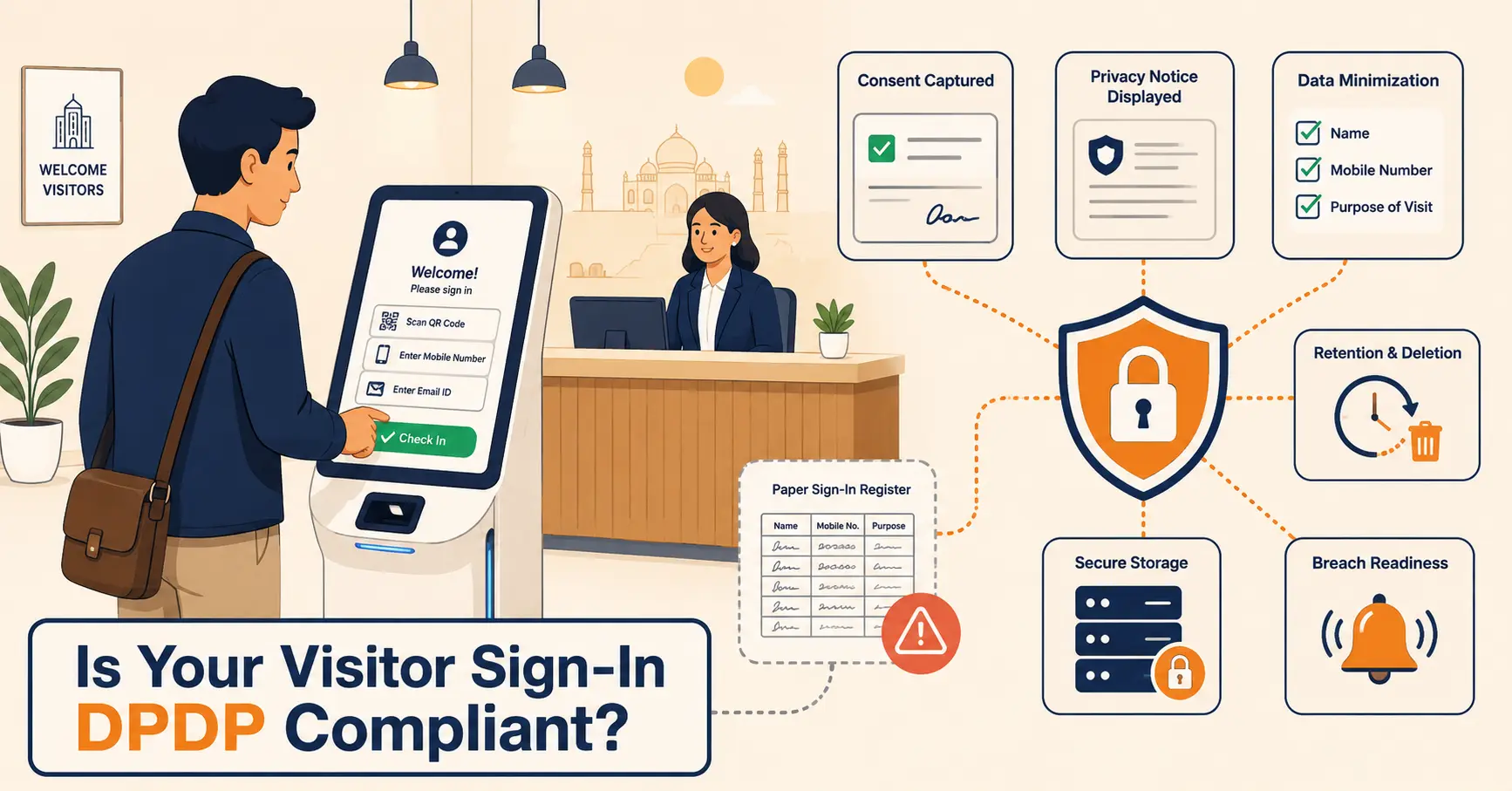
Table of Content
Try Vizitor for Free!
A visitor sign-in is DPDP compliant only if it does six specific things: collects no more data than the visit actually requires, gives visitors clear notice of what’s collected and why, captures real consent rather than an implied tick-box, secures that data against unauthorized access, deletes it on a defined schedule instead of keeping it forever, and can produce a breach notification within 72 hours if something goes wrong. Most visitor logs, paper or digital, fail at least one of these six by default.
That’s not a scare tactic, it’s a description of how India’s Digital Personal Data Protection Act, 2023 (DPDP Act) actually works, and it applies the moment a front desk writes down a name and phone number, whether that happens in a bound register or on a tablet. This article explains what the law requires, what’s actually enforceable right now versus what’s still being phased in, and how to check your own front desk against it, honestly, without assuming a piece of software solves the problem by itself.
One thing worth saying plainly before anything else: this is general information about a real law, not legal advice. DPDP compliance depends on your specific data flows, industry, and risk profile, and the details here should be confirmed with your own legal counsel or data protection officer before you rely on them for a compliance decision.
Does the DPDP Act actually apply to a visitor register?
Yes. The DPDP Act governs personal data, and a visitor’s name, phone number, company, photograph, or ID number are all personal data under the Act, regardless of whether they’re collected on a tablet, a QR form, or a paper register that later gets typed into a spreadsheet (DPDP Act, 2023). The Act explicitly covers digital personal data and non-digital data that is later digitized, which covers almost every visitor log in practice.
Three roles matter here. The Data Principal is the visitor, the person the data is about. The Data Fiduciary is the organization that decides why and how the data gets collected, which in almost every case is the office, hospital, school, or facility running the front desk, not the software vendor whose tool they happen to use. A Data Processor is anyone processing data on the fiduciary’s behalf under instruction. This distinction matters because compliance responsibility sits with the organization running the front desk. A visitor management platform can make that responsibility easier or harder to meet, but it cannot absorb the legal obligation on your behalf.
Where things actually stand: the phased timeline
This is the part most compliance checklists skip, and it’s the single most important thing to get right before you act on anything else here.
The DPDP Act was passed and received presidential assent in August 2023, but an Act without notified rules mostly sits dormant. That changed on November 13, 2025, when India’s Ministry of Electronics and IT (MeitY) formally notified the Act alongside the Digital Personal Data Protection Rules, 2025 (PIB, 2025). But notification doesn’t mean every obligation is enforceable on day one. The rollout happens in three phases:
In plain terms: as of today, the Data Protection Board of India exists and can hear grievances, but most of the substantive obligations, the notice requirements, the consent standards, the breach-reporting duties, become fully enforceable on May 13, 2027, eighteen months after the notification date (Lexology, 2025).
That gap is not a reason to wait. Building a real notice-and-consent flow, a retention schedule, and an access-control policy takes months, not a weekend, and the organizations that start now will have working, tested processes by the time enforcement actually begins. The ones that wait until early 2027 will be building under deadline pressure with a live regulator watching.
The six-point check: is your visitor sign-in actually compliant?
Run your current process, paper or digital, against these six requirements. Each one traces to a specific obligation in the Act.
1. Data minimization. Collect only what the visit actually requires. A courier delivering a package doesn’t need the same data as a contractor getting building access for a week. The Act requires processing to be limited to what’s necessary for the specified purpose (Section 4).
2. Notice. Visitors need to be told, in clear and plain language, what’s being collected, why, and how to exercise their rights, before or at the point of collection. The notice should be available in the visitor’s preferred language among the 22 scheduled languages or English, and should include contact details for raising a complaint (Section 5).
3. Real consent, not implied consent. Consent must be free, specific, informed, unconditional, and unambiguous, given through a clear affirmative action, not a pre-checked box or an assumption that showing up means agreeing. Visitors also need a straightforward way to withdraw consent later (Section 6).
4. Security safeguards. Whatever holds the data, a register, a spreadsheet, a cloud database, needs reasonable security measures against unauthorized access, alteration, or loss. This is the single most heavily penalized failure under the Act.
5. Retention and erasure. Data should be kept only as long as the stated purpose requires, then deleted. A visitor log with three years of entries and no deletion policy is a liability sitting in storage, not an asset.
6. Breach readiness. If a breach happens, the Data Protection Board must be notified, followed by affected individuals, within a 72-hour window (DPDP Rules, 2025). That timeline only works if you already know what data you hold and who’s affected, which means the readiness has to exist before the breach, not after.
Why paper registers fail this test by default
A bound visitor register fails multiple points on that list simultaneously, and it’s worth being specific about why, because the failure is structural, not a matter of bad luck.
There’s no notice. Nobody hands a visitor a privacy statement before they sign a physical book. There’s no real consent mechanism, just an implicit assumption that signing means agreeing to whatever happens to that data next. There’s no access control: the next ten visitors who walk up to that same desk can read the name, phone number, and company of everyone who signed in before them, which is itself an exposure of personal data to people who have no reason to see it. There’s no retention policy in most offices; registers pile up in a drawer for years because nobody assigned anyone to delete them. And there’s no way to produce a clean breach notification, because nobody can say with confidence exactly whose data was exposed or when.
None of that means a paper register is automatically illegal. It means the burden of proving compliance without any of these mechanisms is much higher, and in practice, most paper-based front desks simply aren’t set up to prove it.
Where digital tools help, and where they don’t fix anything automatically
Digital visitor management removes some of the paper-register failures by design. A tablet-based check-in can show a notice screen before capturing data, log a specific consent action with a timestamp, restrict who can view visitor records, and enforce an automatic deletion schedule instead of relying on someone remembering to shred old records.
But switching to software doesn’t automatically make an organization compliant, and this is the part vendors tend to skip. A digital system with no configured retention limit just keeps every visitor record forever, which is the same underlying failure as the paper drawer, just in a database instead of a cabinet. A digital consent screen that’s worded as dense legal boilerplate nobody reads doesn’t meet the “clear and plain language” bar. A system where every staff member can export the full visitor list to a spreadsheet defeats the purpose of access controls the moment that export happens. The tool creates the capability; the organization still has to configure and operate it correctly.
Vizitor’s security and compliance page documents specific, verifiable capabilities relevant to this: consent captured at check-in and stored per visitor record, and role-based visibility over who inside an organization can see visitor data. Those are real, feature-backed mechanisms that support points 2, 3, and 5 above. They are not, on their own, a DPDP compliance certificate, and no visitor management vendor can honestly claim otherwise, because compliance is a function of how an organization configures and governs the tool, not a checkbox the tool ships with. As of this writing, Vizitor’s public security page documents ISO 27001 certification and GDPR-aligned practices; it does not carry a DPDP-specific certification, and neither should this article imply that it does.
What non-compliance actually costs
The DPDP Act’s penalty structure sits in Section 33, read with the Schedule to the Act, and enforcement runs through the Data Protection Board of India after an inquiry finds a violation “significant.”
| Violation | Maximum penalty |
|---|---|
| Failure to implement reasonable security safeguards (leading to a breach) | Up to ₹250 crore |
| Failure to notify the Board and affected individuals of a breach | Up to ₹200 crore |
| Non-compliance with other obligations under the Act or Rules (the residual/catch-all category) | Up to ₹50 crore |
| A Data Principal’s failure to comply with their own duties under the Act | Up to ₹10,000 |
(Figures per DPDPA.com’s Section 33 and Schedule breakdown, corroborated by multiple independent legal-compliance trackers. These are ceilings the Board may impose, not fixed fines, and the Board can adjust the amount based on the nature and severity of the violation.)
These are per-instance ceilings, not a single annual cap, and a single incident that breaches several obligations at once, poor security plus a missed notification, for example, can be assessed against more than one row in that table.
Common mistakes organizations make
The first mistake is assuming DPDP only applies to large enterprises or fully digital operations. The Act doesn’t carve out an exemption by company size or by whether your process is paper-based; it applies to anyone processing personal data of individuals in India.
The second is treating consent as something collected once and valid forever. If the purpose of processing changes, or if data collected before the Act’s provisions took effect is still being used, the Rules require a retrospective notice bringing that older data under the same notice-and-consent standard.
The third is confusing “we bought compliant software” with “we are compliant.” A tool with the right features unused, misconfigured, or ignored, provides no protection at all. Retention settings left at “never delete,” consent screens nobody actually reads before tapping through, and export permissions handed to every staff member all defeat the purpose of the underlying feature.
The fourth is waiting for May 2027 to start. The phased timeline is a runway, not a reason to delay. Notice language, consent flows, retention schedules, and staff training all take real time to build and test properly.
How to actually get started
Start with an honest audit of what your front desk currently collects, whether that’s still necessary, how long it’s kept, and who can see it. From there: write a plain-language notice, build a real consent step instead of an implied one, set and enforce a retention limit, restrict access to visitor records to the people who genuinely need it, and document a breach-response process before you need one. None of these require legal jargon or a six-month project; they require someone actually owning the task.
If you’re doing this on Vizitor, the security and compliance settings documented earlier (consent capture, access roles, data handling) are the ones to configure toward these goals. For the broader privacy landscape beyond DPDP specifically, including GDPR and CCPA considerations, Vizitor’s guide to visitor data privacy and how visitor management systems keep data compliant cover that wider ground.
The honest bottom line
A DPDP-compliant visitor sign-in isn’t a feature you buy, it’s a process you build: minimal data collection, real notice, real consent, real security, a real deletion schedule, and a plan for the day something goes wrong. The enforcement clock has a specific date on it, May 13, 2027, but the work of getting there doesn’t wait for a deadline to start being worth doing.
If part of that work involves rebuilding how your front desk actually operates, book a demo to see the specific consent, access-control, and data-handling settings Vizitor makes available, and confirm with your own counsel how they fit into your organization’s compliance program.
Frequently Asked Questions
See Vizitor in action check-in a visitor in under 30 seconds
Trusted by 500+ businesses. QR check-in, badge printing, NDA signing. Plans from $36/mo.