What India's New Labour Codes Actually Change for Contract Workers
A guide to what India's four consolidated labour codes change for facilities managing contract workers on site, with heavy emphasis on what is genuinely settled nationally (the OSH Code's contract-labour threshold rising from 20 to 50 workers under Section 45, aggregated across all contractors at one establishment, a single multi-state license valid for five years, and welfare obligations shifting toward the principal employer) versus what still varies by state, since state rules are notified unevenly and reporting on exact state status conflicts. Includes a practical checklist for facilities teams and an explicit disclaimer that this is general information, not legal advice.


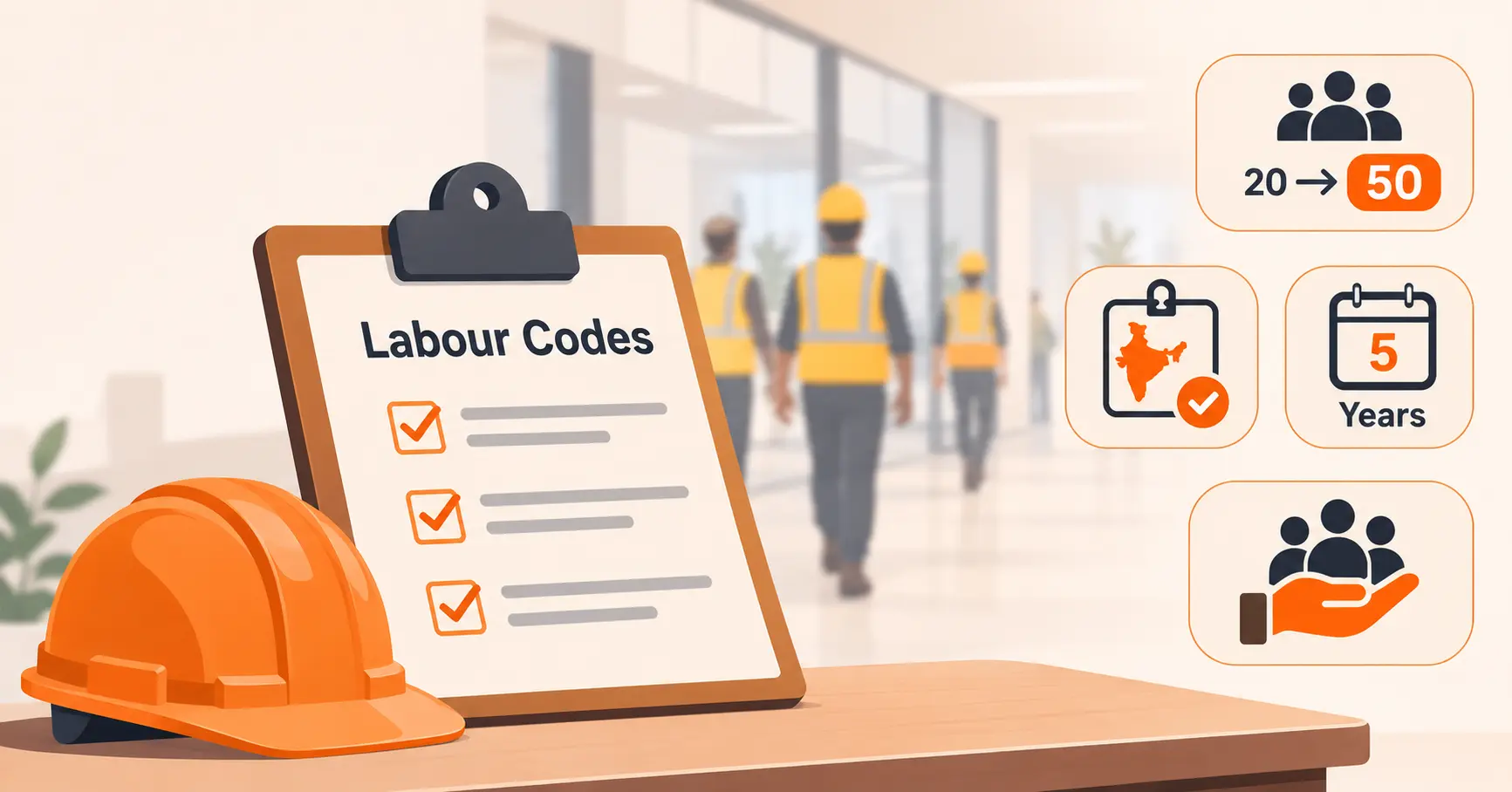
Table of Content
Try Vizitor for Free!
This is general information, not legal advice. Labour codes, their rules, and state notifications are genuinely unsettled as this is written, and reports on exact state-by-state status conflict with each other. Verify your specific state’s current rules with a labour law professional before making compliance decisions.
With that said, here is what has actually changed, and what it means for a facility managing contract workers on site.
The Four Codes, Briefly
India consolidated 29 older central labour laws into four codes. All four took effect on 21 November 2025. The central government notified the rules under all four on 8 May 2026.
| Code | Year | What It Covers |
|---|---|---|
| Code on Wages | 2019 | Minimum wages, timely payment, bonus rules |
| Industrial Relations Code | 2020 | Hiring, layoffs, trade unions, dispute resolution |
| Code on Social Security | 2020 | Provident fund, ESI, gratuity, and benefits for gig and platform workers |
| Occupational Safety, Health and Working Conditions (OSH) Code | 2020 | Workplace safety and contract labour, the one that matters most here |
The OSH Code matters most for a facility with contract workers on site. It absorbed the old Contract Labour (Regulation and Abolition) Act, 1970. Its contract-labour rules are what actually changes day-to-day record-keeping and liability.
What Changed: The 50-Worker Threshold
Section 45 of the OSH Code replaces the old licensing rule with one uniform number. Here’s the direct comparison:
| Old: CLRA Act, 1970 | New: OSH Code, 2020 | |
|---|---|---|
| License needed once a contractor employs | 20+ workers (some states already used 50) | 50+ workers, same number nationwide |
| How the headcount is counted | Varied by state | At the establishment level, across every contractor there combined |
| License type | One license per establishment served | One license valid across states, for 5 years |
| License renewal | Annually | Every 5 years |
| How you apply | Manual, state by state | Electronically, via the Shram Suvidha Portal |
The counting rule matters more than the number itself. Five contractors supplying eight to ten workers each at the same site can cross 50 combined, even if no single contractor comes close on its own. A facility that assumed it was under the threshold because each vendor contract looks small may not actually be. A separate work-specific license also exists for project-based jobs, like a one-off construction or expansion.
What Changed: Welfare Obligations Moved to the Principal Employer
Under the CLRA Act, welfare facilities, cleanliness, first aid, a canteen where applicable, were generally the contractor’s job. The OSH Code moves that obligation to the principal employer: the entity that actually runs the establishment where contract workers are present. Legal commentary on this point agrees: a principal employer can’t hand this liability off to the staffing vendor just by writing it into a contract.
This is the detail with the most practical weight for a facilities or security team. Say a contractor’s worker gets injured, or a welfare requirement goes unmet. The establishment running the site now carries more direct exposure than it did under the old framework. That’s true no matter what the service agreement with the contractor says.
Why State Variation Actually Matters Here
Labour is a concurrent subject in India’s constitution. Both the central government and individual states have authority over it. The central codes took effect nationally, but each state still has to notify its own procedural rules before the framework fully applies there. Until a state does, its older state-specific rules generally keep governing.
This is genuinely unsettled territory right now. Different trackers and legal publications report different counts of which states have notified final rules, and the same state sometimes shows up as “done” in one source and “pending” in another. Here’s the reported picture as of the most recent available tracking, treat every row as provisional:
| State | Reported status (mid-2026, unconfirmed) |
|---|---|
| Gujarat | Reported as one of the earliest to notify final rules under all four codes |
| Bihar | Reported as having notified final rules |
| Arunachal Pradesh | Reported as having notified final rules |
| Karnataka | Reported as notified across all four codes |
| Maharashtra | Reported as having made substantial progress |
| West Bengal | Reporting is inconsistent, treat as unconfirmed |
None of this replaces checking your own state’s official labour department notification directly. Don’t assume the 50-worker threshold or the single-license system applies to your establishment today just because the central codes are in force. Confirm your state’s actual status first.
A Practical Checklist for Facilities Managing Contract Workers
- Do you know your aggregate contract worker headcount at this establishment, combined across every vendor, not per contractor? This is what determines whether the 50-worker threshold applies, and it’s easy to miss if each vendor contract is tracked separately.
- Has your state notified its OSH Code rules, and do you know what governs you until it does?
- Is your contractor’s license current under whichever framework actually applies in your state right now?
- Are welfare facilities, cleanliness, first aid, canteen access where applicable, actually being provided to contract workers at your site, not assumed to be the contractor’s problem?
- Can you produce an accurate, dated record of which contract workers were on site on a given day, if asked during an audit or after an incident? This is the record-keeping question a principal employer increasingly owns, and a manual sign-in process structurally struggles to answer it reliably.
Where Vizitor Fits
Vizitor doesn’t offer legal compliance certification for India’s labour codes. No visitor or contractor management vendor can promise that. What it does is keep a digital, timestamped, searchable record of every contractor and contract worker who checked in and out of a site, across multiple vendors on the same premises. Liability for what happens on-site now sits more directly with the principal employer, so having an accurate answer to “who was actually here, and when” matters more than it used to. For organizations also navigating India’s DPDP Act requirements on the data side, the same check-in record needs to handle both obligations correctly, not just one.
Keep an Audit-Ready Record of Every Contractor On Site
Track contract worker check-ins across every vendor at your establishment, with a timestamped record you can produce on demand.
Frequently Asked Questions
See Vizitor in action check-in a visitor in under 30 seconds
Trusted by 500+ businesses. QR check-in, badge printing, NDA signing. Plans from $36/mo.