What You Owe the People You Don't Employ
Duty of care doesn't stop at the people on your payroll. It covers visitors, contractors, delivery drivers and candidates too, across the UK (Occupiers' Liability Acts 1957/1984, HSWA 1974 s.3), the US (premises liability, OSHA's General Duty Clause and Multi-Employer Citation Policy) and India (Factories Act 1948, the new labour codes). Uses the 2015 Alton Towers Smiler crash, which cost Merlin Attractions Operations Ltd a £5 million fine under HSWA s.3(1) for harm to visitors, not employees, to show the duty follows the person, not the contract. Covers the four practical obligations this creates, why unrecorded care is hard to distinguish from no care at all in an investigation, and a 6-point checklist to start closing the gap.


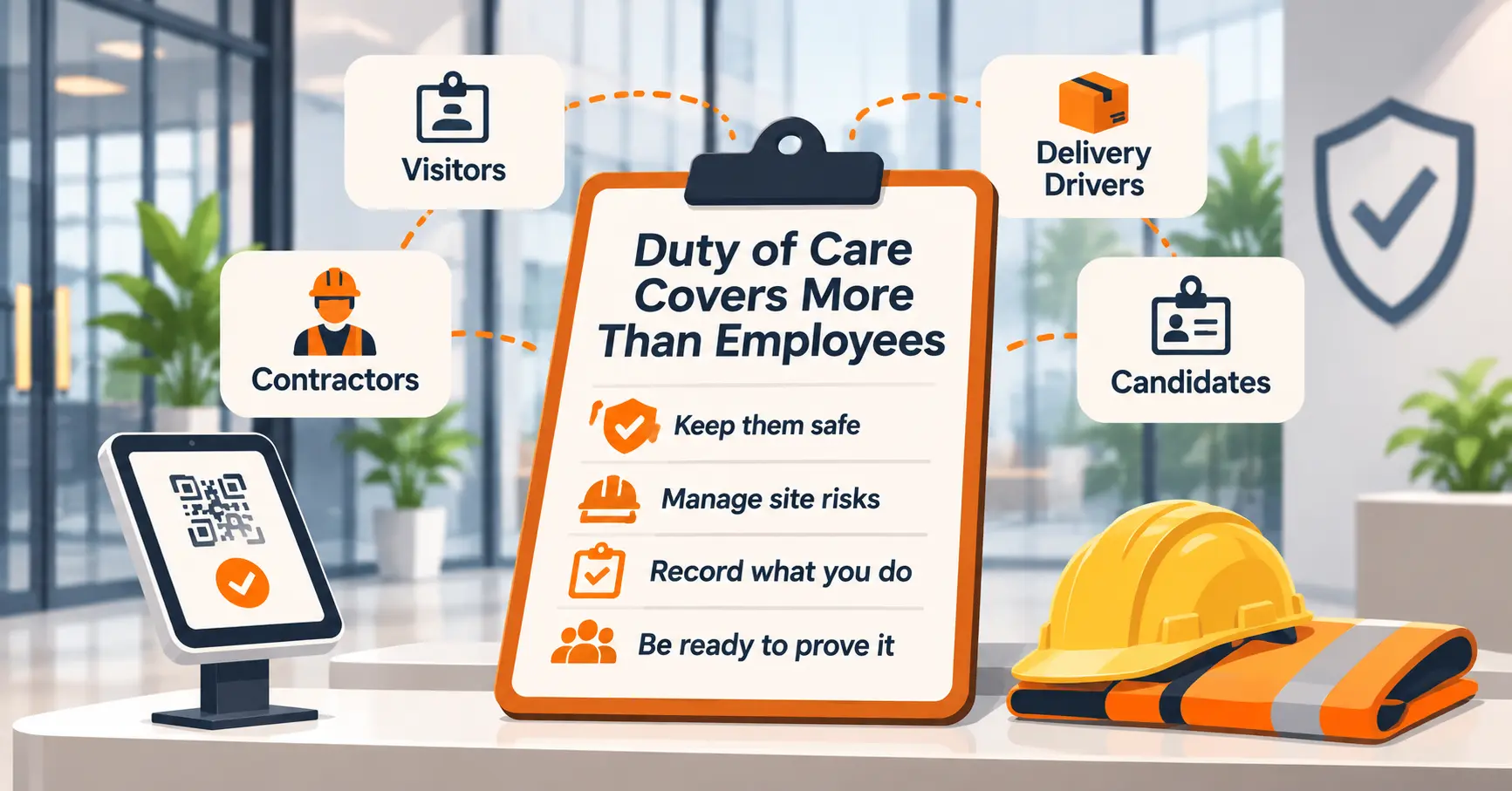
Table of Content
Try Vizitor for 10 Days!
Key Facts
Duty of care is the legal obligation to take reasonable care to avoid foreseeable harm to anyone your operations affect, whether or not they're on your payroll.
- The legal baseline: Duty of care covers visitors and contractors, not just employees, across UK, US and Indian law.
- The cautionary case: Merlin Attractions Operations Ltd was fined £5 million plus roughly £70,000 in costs in September 2016 under HSWA 1974 s.3(1), the section that protects non-employees, after 16 visitors were injured on the Alton Towers Smiler (Crown Court sentencing remarks).
- The scale of it: 104 people who were not at work were killed in work-related incidents in Great Britain in 2025/26 alone, HSE's own category for exactly the non-employees this duty covers (HSE).
A delivery driver slips on a wet warehouse floor. A contractor gets hurt near machinery he was never told about. A fire alarm goes off and the roll call misses the two interview candidates still in the building.
In each case, the first questions from the regulator, the insurer and the lawyer are the same. Who was on your site? When did they arrive? What were they told about the risks? And what did you do to keep them safe?
Those questions sit on top of a legal idea most workplaces know by name but few have thought through for the people they don’t employ: duty of care.
This is practical guidance, not legal advice. The principle travels well across borders; the citations don’t, so check the regime that applies to your sites.
What Duty of Care Actually Means
Duty of care is the legal obligation to take reasonable care to avoid acts or omissions you can reasonably foresee would harm others. In a workplace, that duty is obvious for employees. What catches organizations out is that it doesn’t stop there.
Your duty of care extends to everyone your operations can affect: visitors, contractors, delivery drivers, interview candidates, clients, even in some circumstances trespassers. The exact source of the duty varies by country, but the shape is remarkably consistent:
United Kingdom. The Occupiers’ Liability Act 1957 requires occupiers to take reasonable care that visitors are reasonably safe for the purposes of their visit. The Health and Safety at Work etc. Act 1974, section 3, goes further: every employer must conduct its undertaking so that people not in its employment are not exposed to risks to their health or safety. The Occupiers’ Liability Act 1984 adds a limited duty even toward trespassers.
United States. Premises liability law in every state holds property owners and occupiers responsible for foreseeable harm to lawful visitors, with the strictest duties owed to invitees such as customers and contractors. OSHA’s General Duty Clause and its Multi-Employer Citation Policy mean you can be cited for hazards that injure a contractor’s employee on your site, even though that person never appeared on your payroll.
India. Occupier liability in tort covers visitors, and for factories the Factories Act 1948 places health and safety duties on the “occupier” that extend across the premises. The Act’s own definition of “worker” explicitly includes anyone employed through an agency, including a contractor, which is how contract labour ends up covered. The newer labour codes keep the principal employer answerable for contract workers’ safety and welfare.
The Alton Towers Lesson: The Duty Follows the Person, Not the Contract
On 2 June 2015, two carriages collided on the Smiler rollercoaster at Alton Towers in Staffordshire, England. Sixteen people were injured; two young women each lost a leg.
The company operating the park, Merlin Attractions Operations Ltd, was not prosecuted for failing its employees. It was prosecuted under section 3(1) of the Health and Safety at Work Act 1974, the section that protects other people: guests, members of the public, anyone the business affects. Merlin pleaded guilty, and in September 2016 was fined £5 million plus roughly £70,000 in costs, one of the largest fines of its kind in the UK leisure industry at the time.
The Health and Safety Executive’s case was not that Merlin set out to hurt anyone. It was that the company failed to take the reasonable care it owed people on its premises. The injured riders were visitors. That was the whole point of the charge.
The lesson generalizes far beyond theme parks. If your business can foreseeably affect someone’s safety, you owe them care, whether they signed your employment contract, a supplier agreement, or nothing at all.
What Your Duty of Care Covers on Site
In practice, the duty to visitors and contractors breaks into four everyday obligations.
1. Safe premises and honest warnings. Fix what you can, and clearly warn about what you can’t: wet floors, vehicle routes, restricted areas, live work. A warning your visitor never saw is hard to distinguish from no warning at all.
2. Safe systems of work. Contractors doing risky work need more than a badge. Inductions, method statements, permits to work and supervision arrangements are how you show the job was controlled, not just the person. Our complete guide to contractor management systems shows how inductions, documents and permits fit into one flow.
3. Emergency accountability. If the building evacuates, you are responsible for everyone inside it, including the people who don’t appear on any staff list. That means a live record of who is on site, and a roll call that uses it. Our guide to muster points and why your visitor log matters walks through how that works.
4. Care with their information. Duty of care also covers what you collect at the door. Visitor names, photos, ID numbers and vehicle plates are personal data, and careless handling is its own breach of care. See our guide to data privacy in visitor management for the retention and consent side.
The Proof Problem: If It Isn’t Recorded, It Didn’t Happen
Here is the uncomfortable part. Most organizations do more for visitor safety than they can prove.
After an incident, “we always tell contractors about the machine area” means very little next to a signed, timestamped acknowledgement. “The building was evacuated in four minutes” means very little if the roll call was a paper register with half the afternoon’s visitors missing a check-out.
The records that actually demonstrate duty of care are mundane:
- Who was on site, and when. Accurate arrival and departure times for every visitor and contractor, not just the ones who remembered to sign out.
- Who was responsible for them. The host or engaging manager for each visit.
- What they were told. Safety briefings, site rules, NDAs and induction content, with evidence each person saw and acknowledged them.
- Who you kept out. Screening against internal watchlists and denied-party lists, with a record of every check.
- How you accounted for them in an emergency. A roll call run from a current list, not from memory.
Paper sign-in books fail this test quietly. Entries are illegible, fields get skipped, check-outs never happen, and the book itself sits in a cupboard at the exact site the investigator wants records from. The duty of care may have been real. The evidence says otherwise. Our complete guide to visitor management systems breaks down what a digital log captures that paper can’t.
| What an investigator asks | Paper register | Digital visitor log |
|---|---|---|
| Who was on site at 3:40 pm? | Illegible entries, skipped check-outs | Timestamped check-in and check-out, searchable in seconds |
| What was this contractor told? | “We always brief them” | Signed induction acknowledgement, dated and named |
| Was anyone screened? | No record | Automatic watchlist check logged for every visit |
| Was everyone evacuated? | Headcount from memory | Roll call against the live on-site list |
| Who approved this visit? | Unknown | Host recorded on every pass |
Common Mistakes That Quietly Break the Duty
- Treating contractors as someone else’s problem. The staffing agency holds the employment contract; you hold the premises. Courts and regulators routinely find the occupier owes care anyway.
- Briefing the first visit and assuming the rest. A contractor inducted in January and back in November on a different job is a different risk.
- Evacuating employees and guessing about visitors. If your roll call only covers staff, your plan has a hole the size of your lobby.
- Collecting data you don’t protect. A visitor book left open on the front desk exposes every name in it. Care applies to information too.
- Keeping records you can’t retrieve. A register nobody can find, read or search is close to no register at all.
A Duty-of-Care Checklist to Start This Week
- List every category of non-employee who enters your sites: visitors, contractors, vendors, deliveries, candidates.
- For each category, write down what they’re told about site risks today, and what proof exists that they were told.
- Run a drill roll call using your actual visitor records and count how many people you couldn’t account for.
- Check your sign-in records for a random day last month: could you produce a clean on-site list for 2 pm?
- Assign one owner for visitor and contractor records at each location.
- Review what personal data you collect at check-in and how long you keep it.
Where Vizitor Fits
Vizitor’s visitor management system is built around the records side of duty of care. Every check-in is timestamped with a named host, visitors acknowledge NDAs and site rules digitally, and watchlist screening runs on each visit rather than the first one. For contractors, the contractor management system gates entry on document expiry, so a lapsed insurance certificate or induction blocks check-in instead of slipping past a busy desk, and every acknowledgement stays attached to the person it belongs to. If the building evacuates, the emergency evacuation management roll call runs from the live list of everyone on site, visitors and contractors included.
What it doesn’t do is the care itself. It won’t fix your wet floor, write your risk assessment or supervise a hot work permit. The duty stays with you; the system makes sure you can show you took it.
See the Records Your Front Desk Could Be Producing
Walk through timestamped check-ins, induction acknowledgements, and roll calls with your own visitor types.
Frequently Asked Questions
See Vizitor in action check-in a visitor in under 30 seconds
Trusted by 500+ businesses. QR check-in, badge printing, NDA signing. Plans from $36/mo.