What Transparent Attendance Tracking Does to Team Culture
This page answers whether office attendance tracking helps or hurts workplace culture; the direct answer is both, depending on transparency and intent. It covers the business case for measuring attendance, the documented risks of covert monitoring, the transparency framework that separates helpful from harmful tracking, and what good attendance measurement looks like in practice. Vizitor is presented as a QR-based attendance tracking tool that captures check-in and check-out data without device monitoring or surveillance.


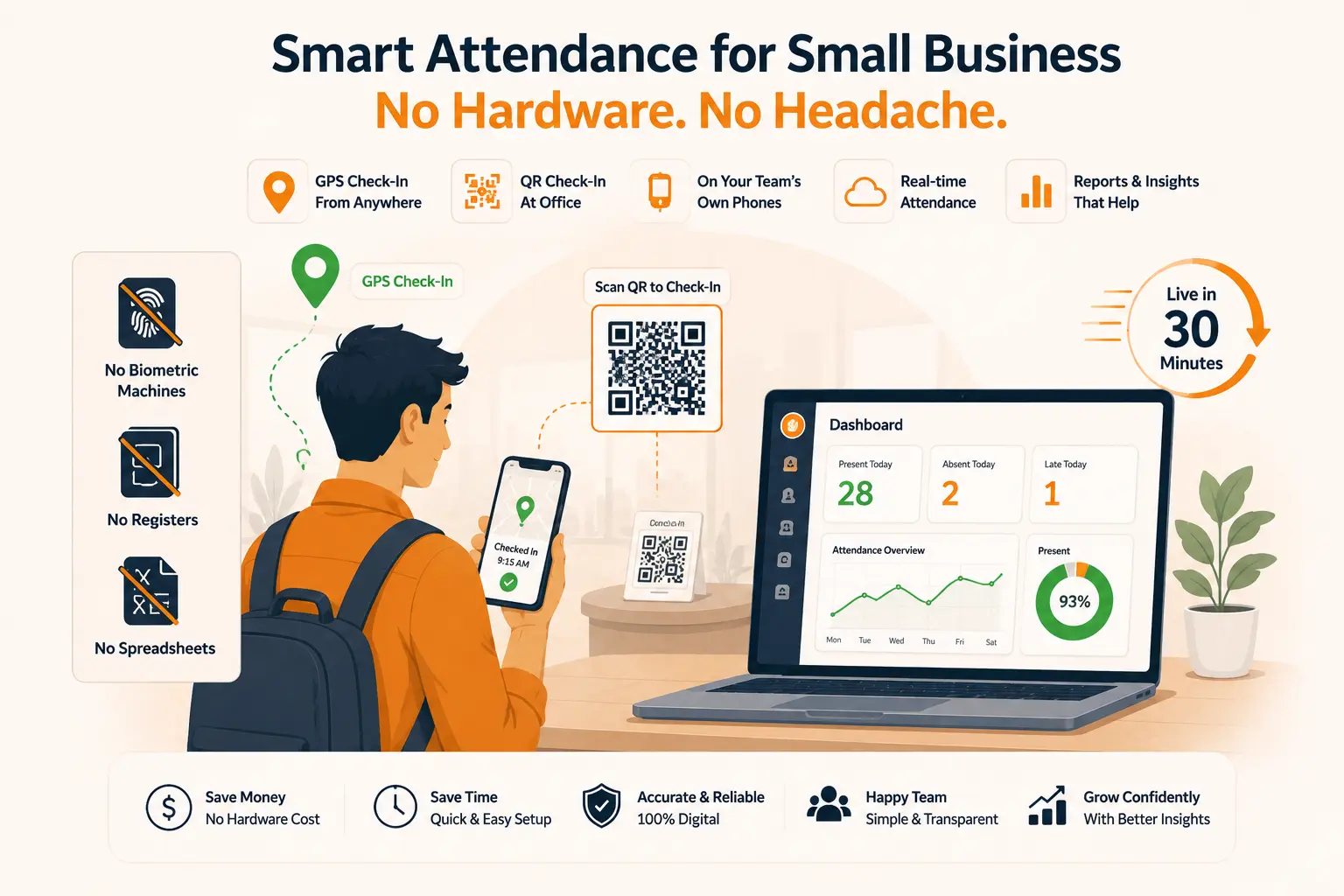
Table of Content
Try Vizitor for Free!
The answer isn’t yes or no. It’s both depending entirely on how you do it.
Most companies now measure office attendance. In 2026, 69% of US employers tracked attendance compliance, up from 45% the year before. Some report stronger accountability and clearer expectations as a result. Others report resentment, disengagement, and the departure of high performers.
Same tool. Opposite outcomes.
The difference isn’t the tracking. It’s the transparency, the intent, and how employees are treated throughout the process. When done openly and fairly, attendance tracking reinforces a culture of shared accountability. When done covertly or punitively, it signals that leadership doesn’t trust its own people.
This article breaks down what the research shows, where the line between helpful and harmful sits, and what organizations can do to make attendance measurement strengthen their culture rather than quietly erode it.
What the Research Says About Attendance Tracking and Culture
More companies are tracking attendance than at any point in recent history. In 2026, 69% of organizations measured attendance policy compliance, up sharply from 45% in 2024, according to CBRE’s Americas Office Occupier Sentiment Poll. Enforcement actions more than doubled in the same period, from 17% to 37%. The trend is accelerating, not levelling off.
Most employees are more open to monitoring than the debate suggests. Nine in ten say they accept data collection when they understand its purpose and how it benefits them. That finding is consistent across multiple independent studies. The problem isn’t monitoring. It’s monitoring without explanation.
The cultural damage begins when employees discover tracking they weren’t told about. A 2025 ExpressVPN survey of 1,500 US workers found that 56% reported stress from workplace surveillance. Only 22% knew they were being monitored despite 74% of employers using monitoring tools. That gap causes the damage. Not the tracking itself.
CBRE, 2025 Americas Office Occupier Sentiment Poll: In 202,6 69% of US companies measured office attendance compliance, up from 45% the previous year. Enforcement actions rose from 17% to 37% in the same period. CBRE identified the absence of policy and enforcement as the primary factor keeping office attendance below stated employer expectations.
How Attendance Tracking Builds Culture
Attendance tracking strengthens culture when it creates fairness. When some employees follow the policy and others don’t, those who comply feel penalized for doing the right thing. Consistent measurement removes that inequity. It signals that expectations apply equally, regardless of seniority, role, or relationship with management. That’s a powerful culture signal in organizations where favoritism is a known concern.
Clear expectations lower stress, not raise it. When employees know the rule, three days a week, specific anchor days, they can plan their lives around it. Vague policies do the opposite. They create constant uncertainty about whether compliance is enough. Specific, measured expectations are less stressful than ambiguous ones that shift with each manager.
Attendance data also makes offices work better for the people in them. When you know which days are busiest, you can match desks, rooms, and collaborative spaces to real demand. Employees notice when the office is designed around how they actually work. That investment reads as culture, proof that the organization is paying attention.
Crown Workspace Survey, June 2025: A survey of 1,250 workers and decision-makers across multiple countries found that 91% would come into the office more frequently if the space better met their needs. Three-quarters cited furniture, layout, and space flexibility as essential to their productivity and well-being. The study was conducted by Crown Workspace and reported by Facility Executive.
How Attendance Tracking Hurts Culture
Attendance tracking damages culture when employees discover it without warning. That discovery moment, finding out you’ve been monitored without being told creates a trust deficit that rarely recovers. It doesn’t fade quickly. In many cases, it marks the beginning of an employee’s decision to leave the organization.
The exit risk is real and documented. When monitoring increases without prior disclosure, 49% of employees say they would consider quitting. Top performers have the most options. They act on that intent fastest. The organizations least able to absorb attrition are often the ones most affected by this dynamic.
Attendance tracking also backfires when it substitutes for real performance management. Showing up is not the same as contributing. Organizations that factor presence into promotions without measuring output send a clear message: visibility matters more than results. That message drives away people capable of delivering more from a flexible arrangement.
ExpressVPN Workplace Surveillance Survey, 2025: Among 1,500 US workers surveyed, 56% reported stress and anxiety caused by workplace surveillance. Only 22% of employees knew they were being monitored, despite 74% of employers using tracking tools. The same study found that 49% of employees would consider leaving if workplace monitoring increased, a direct link between covert tracking and attrition risk.
Transparency Is the Deciding Factor
Transparency is the single variable that determines whether attendance tracking helps or hurts culture. This isn’t an opinion. It’s a consistent finding across multiple independent research programs. Employees who are told about monitoring before it starts respond fundamentally differently than those who discover it later.
Transparent tracking requires telling employees three things before you start. First, what data is being collected. Second, who has access to it. Third, what it will and will not be used for. A plain-language statement in a team meeting or an employee handbook update covers this obligation in most cases. The goal is simple: nobody should be surprised.
In regions governed by GDPR, PDPA, or similar data protection laws, transparency is a legal requirement not a best practice. Employers in the EU, UK, Singapore, and Australia must disclose what employee data they collect, why, and how long they keep it. Non-disclosure carries regulatory risk. But even in markets without those requirements, transparency is the most reliable predictor of positive employee response.
Workplace Monitoring Research, 2025 (WorkTime): Ninety percent of employees say they accept employer data collection when they understand its purpose and how it benefits them. Employees who discover monitoring they were not informed about react significantly more negatively than those told in advance, a gap consistently linked to lower engagement scores, reduced trust in management, and higher turnover intent.
What Good Attendance Tracking Looks Like in Practice
Good attendance tracking captures one thing: when someone arrived and when they left. It records check-in and check-out times. It does not monitor screen activity, communication content, or movement within the building. That boundary matters to employees. It also keeps the system within the scope most data protection frameworks allow without additional legal disclosure requirements.
Employees should always have access to their own records. This serves two purposes. It lets them catch errors, digital systems occasionally produce incorrect entries. It also removes the secrecy that makes monitoring feel like surveillance. Visible data is a tool. Hidden data is a threat. The distinction is felt, not just understood.
Consistent enforcement is the evidence that the policy is fair. If the stated expectation is three days a week and senior leaders are in the office once a week, the policy loses credibility. Visible inconsistency destroys the fairness signal faster than almost any other single management failure. Apply the same standard at every level of the organization. The same principle applies specifically to lateness; see our guide to building a culture of punctuality for how managers turn that fairness principle into a day-to-day practice.
CBRE Global Head of Occupier Research Julie Whelan, August 2025: Employers currently seek an average of 3.2 in-office days per week; employees average 2.9. Whelan noted that companies and employees are getting close to being “on the same page” about office attendance expectations, a narrowing gap she attributed to clearer policy communication and more consistent, visible enforcement across organizational levels.
How Vizitor Tracks Attendance Without Surveillance
Vizitor records employee attendance through a QR-based check-in at the office entrance and also provides touchless attendance management system option. The system logs who arrived, at what time, and when they left. Everything is captured automatically. No manual entry. No end-of-day updates. No spreadsheet reconciliation. Every record carries a timestamp from the moment of check-in.
The real-time dashboard gives HR and facilities teams a live view of building occupancy. Managers see who is in the office across locations from a single screen. The full log is exportable for payroll processing, compliance documentation, and space utilization reporting. Nothing requires manual compilation after the fact.
Vizitor doesn’t monitor device activity, screen time, or movement within the building. That boundary is deliberate. Attendance tracking and employee surveillance serve different purposes. Vizitor handles the first. The simplicity of what it captures, arrival, departure, timestamp is what keeps it culturally safe for the organizations using it. It measures presence. It doesn’t watch people.
See how Vizitor tracks office attendance → Start a free trial
Conclusion
Attendance tracking doesn’t help or hurt culture by itself. It’s a neutral tool. What determines the outcome is the transparency behind it, the consistency of enforcement, and whether the data is used only for the purposes employees were told it would be used for.
The research is clear. Ninety percent of employees accept monitoring when they understand its purpose. Fifty-six percent report stress when they discover tracking they weren’t informed about. The gap between those two outcomes is almost entirely a communication decision.
Done right, attendance tracking supports payroll accuracy, compliance documentation, space planning, and safety without making employees feel watched. Done poorly, it accelerates the exit of the people most capable of choosing to leave.
The right system captures what you need, tells employees clearly what it records, and doesn’t try to do the work that performance management should be doing.
See how Vizitor tracks attendance accurately and transparently →
Frequently Asked Questions
See Vizitor in action check-in a visitor in under 30 seconds
Trusted by 500+ businesses. QR check-in, badge printing, NDA signing. Plans from $36/mo.