Contractor Compliance Management for Industrial Facilities
A practical guide to contractor compliance management for industrial plants, organized around three layers: the contractor company (prequalification and insurance), the individual worker (training and induction records), and the specific job (permits, lockout/tagout exchange, confined space coordination and hot work). It uses the 2024 PEMEX Deer Park refinery incident to show why document tracking alone falls short, maps each layer to OSHA's Process Safety Management contractor paragraphs, offers an illustrative three-tier risk table, and lists four leading measures to review. It also covers common mistakes, a five-step starting plan, and says honestly when a spreadsheet is enough and when software will not fix a weak permit process.


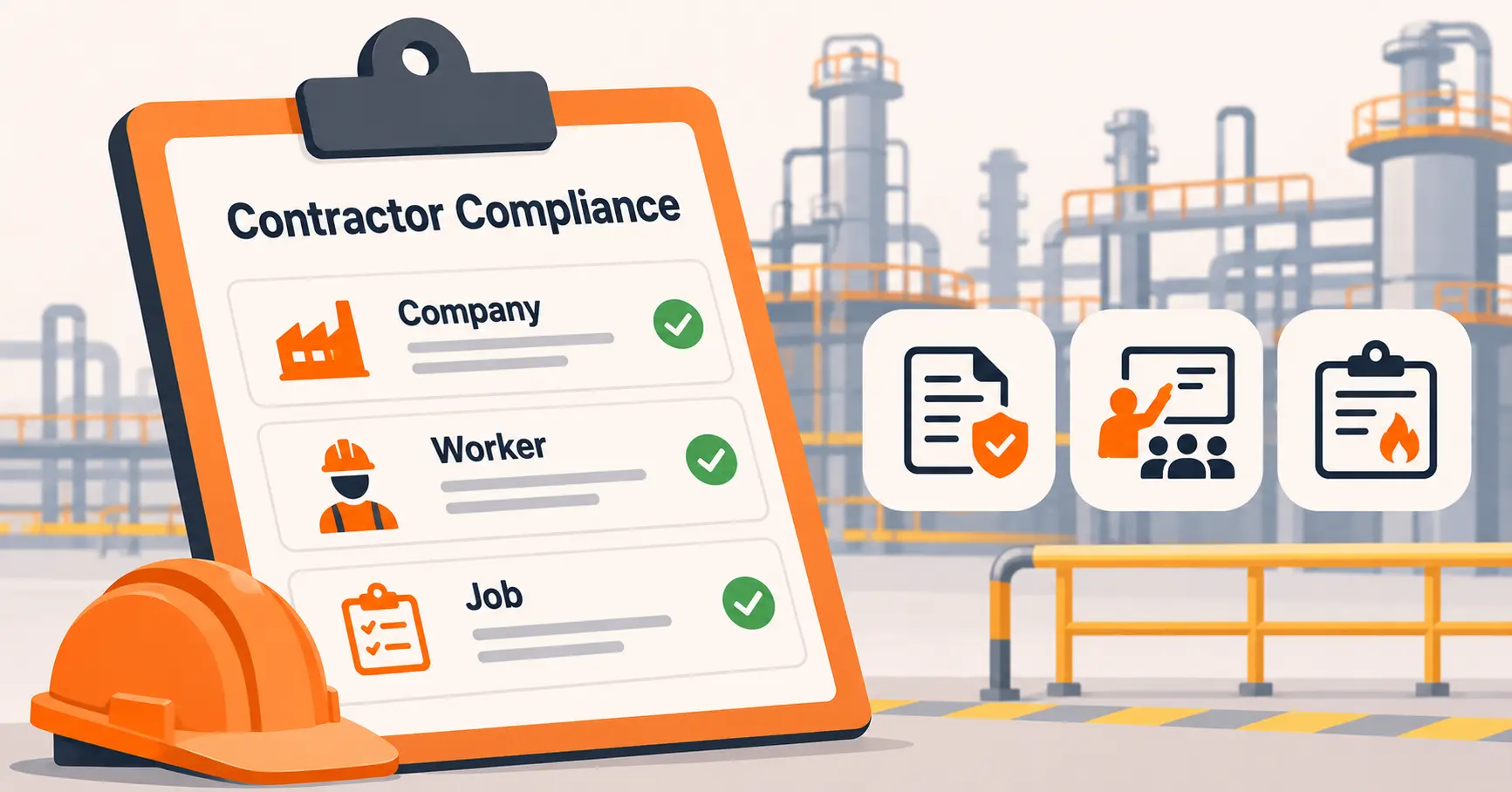
Table of Content
Try Vizitor for Free!
Every contractor on your site can hold valid insurance, a current induction and a clean badge, and still open the wrong flange. Documents prove a company is qualified. They don’t prove a job is controlled.
Contractor compliance management for an industrial facility is the process of proving, before and during every job, that the contractor company is qualified, each worker is trained and current, and the specific task is permitted and controlled, then keeping the records to show it. Most industrial contractor compliance programs cover the first two and stop. This guide covers all three, and says where software helps and where it doesn’t.
Why most programs stop one layer too early
Ask a plant to show its contractor compliance and you usually get a binder or a spreadsheet: insurance certificates, license copies, a list of who completed induction. That is real work, and it is the layer auditors ask about first.
It is also not where industrial incidents tend to happen. On 10 October 2024, at the PEMEX refinery in Deer Park, Texas, contract workers opened a flange on the wrong piping during maintenance in the Amine Unit. The pipe held pressurized hydrogen sulfide. Two contract workers died, and shelter-in-place orders went out across Deer Park and Pasadena. The U.S. Chemical Safety Board’s final report, released in February 2026, found that the equipment was never positively identified before the piping was opened.
The Board’s findings read like a list of job-level gaps. The refinery issued a broad work permit covering multiple jobs with varying hazards and no clear hold points. Workers had been reassigned from a shutdown unit to a partially operating one containing hydrogen sulfide, and because the units sat close together they believed they were still in the safe area. The report names turnaround contractor management as one of its safety issues.
Nothing in that account says the contractors lacked insurance. The failure sat between the paperwork and the pipe. That’s the gap a three-layer model is built to close.
The three layers: company, person, job
Think of contractor compliance as three questions, each with a different owner and a different expiry clock.
| Layer | The question | Typical records | Usual owner |
|---|---|---|---|
| Company | Is this contractor fit to be hired? | Insurance, licences, safety performance data, safety program | Procurement and EHS |
| Person | Is this individual cleared to be here today? | Training and induction record, ID, medical or fitness certificates where required | EHS, security, front gate |
| Job | Is this task controlled right now? | Work permits, isolation records, entry and hot work permits, hazard briefings | Maintenance and operations |
A program that owns only the first row is a vendor file. A program that owns all three is a control system.
Layer 1: The company
This is prequalification. For processes covered by OSHA’s Process Safety Management standard, 29 CFR 1910.119(h)(2)(i) tells the employer to obtain and evaluate information on the contract employer’s safety performance and programs when selecting a contractor. In practice that means asking for more than a certificate: incident history, written safety program, and how the firm trains its own people.
Keep the company layer boring and dated. Every document gets an expiry, an owner and a renewal reminder. If you want the gap-by-gap version of what slips here, our guide to contractor access compliance gaps walks through the five most common.
Layer 2: The person
Companies get approved. People walk through the gate. The person layer ties a specific individual to the training they actually received.
For covered processes, 1910.119(h)(3)(iii) is specific about what the record must hold: the identity of the contract employee, the date of training, and the means used to verify the employee understood it. A signature on an attendance sheet doesn’t verify understanding. A short quiz or a supervised walk-through does.
Two things go wrong here. First, induction gets recorded once and never expires, so a worker inducted two years ago and a worker inducted this morning look identical. Second, the record sits with the contractor’s office, not with you, so you can’t produce it when a regulator or insurer asks. Our contractor check-in checklist covers the front-gate mechanics for this layer.
Layer 3: The job
This is the layer office-style tools never reach, the one the Deer Park findings point at, and where contractor safety management is actually tested. It is a set of exchanges between you and the contractor, each backed by a record.
- Hazards and emergency plan. Under 1910.119(h)(2)(ii) and (iii), the host informs contractors of known fire, explosion and toxic release hazards related to their work and the process, and explains the emergency action plan.
- Controlled entry. Paragraph (h)(2)(iv) calls for safe work practices that control the entrance, presence and exit of contract employees in covered process areas. That is a gate and zone rule, not a document rule.
- Hot work. Paragraph (k) requires a hot work permit for hot work on or near a covered process. The permit must record the dates authorized and the object being worked on, and stay on file until the work is done.
- Lockout/tagout. Under 29 CFR 1910.147(f)(2), when outside servicing personnel do covered work, the on-site employer and the outside employer must inform each other of their lockout or tagout procedures, and the host must ensure its own employees understand and comply with the outside employer’s restrictions.
- Confined spaces. Under 29 CFR 1910.146(c)(8) and (c)(9), the host tells the contractor that permit spaces exist, coordinates entry operations, and debriefs the contractor afterward. The contractor reports back on hazards it met or created.
Notice the pattern. Every one of these is a two-way exchange that has to leave a trace. If the debrief happened but isn’t recorded, it didn’t happen, as far as an auditor is concerned.
Tier your contractors, or you will over-police the easy ones
Treating the pallet-delivery driver and the turnaround welding crew the same wastes everyone’s time and teaches front-desk staff to wave things through. Tiering fixes that. The table below is an illustrative structure, not a regulatory requirement. Set your own thresholds with your EHS lead.
| Tier | Typical work | Company layer | Person layer | Job layer |
|---|---|---|---|---|
| 1 | Deliveries, short service visits, no process areas | Basic insurance on file | Site safety briefing, escorted | None beyond escort |
| 2 | Routine maintenance in non-process areas | Insurance, licences, light prequalification | Induction with verification, badge with expiry | Work order with scope and zone |
| 3 | Process areas, hot work, confined space, energy isolation | Full prequalification, safety performance review | Induction plus task-specific training records | Permits, isolation exchange, hazard briefing, debrief |
Tier 3 is where your attention should live. The test for any tier is simple: if this person made the most likely mistake for this job, what would the worst outcome be? Match the controls to that answer, not to the contractor’s invoice size.
One discipline matters more than the table. Re-tier when the scope changes. The Deer Park workers were effectively working in a higher-risk setting than the one they’d been briefed for, because they moved between units without a fresh briefing. A contractor approved for Tier 2 work who is asked to do one Tier 3 task needs Tier 3 controls for that task.
Evaluate and log, because that is what an audit asks for
Paragraph 1910.119(h)(2)(v) has the host periodically evaluate contract employers’ performance in meeting their obligations, and (h)(2)(vi) has it maintain a contract employee injury and illness log for the contractor’s work in process areas. Even if your process isn’t covered, those two habits are good practice for any industrial site.
Four leading measures give you something to review without inventing a scoring system:
- Entry validity. What share of contractor entries happened with every required document current at the moment of entry?
- Gate catches. How many expired or missing documents did the gate stop, versus how many were found later?
- Permit closure. How many Tier 3 permits closed with a recorded debrief?
- Evaluation completion. How many contractors had a completed evaluation after their last job?
Don’t chase a target number you can’t defend. Track the trend, and look hard at the entries that failed the first test, because each one is a conversation with a contractor about what changed.
Common mistakes
- One broad permit for many jobs. The Deer Park report singles out a permit covering multiple jobs with varying hazards and no clear hold points. One permit per hazard and a named hold point is slower and safer.
- Briefing the crew, not the reassignment. People get moved mid-shift. Every move into a different unit or hazard class needs its own briefing and record.
- One induction for everyone. A visitor needs exits and an assembly point. A contractor needs site hazards, zone limits and permit rules. Combining them either overloads the guest or under-briefs the worker.
- Checking documents once, at approval. Insurance, certifications and medicals expire on different dates. A check at the start of the contract says nothing about month eight.
- Records that live with the contractor. If the proof sits in their office, you can’t produce it when asked.
- Treating compliance as a purchasing step. The contract is signed in procurement. The risk shows up on the shop floor six weeks later.
When this is more than you need
A plant with a few repeat contractors, one gate and a calm maintenance schedule can run this on a well-kept register and a named owner. Don’t buy contractor management software to feel organized.
Software also won’t fix the job layer by itself. If your permits are broad and your hold points are vague, a dashboard will faithfully record the same weak process. Fix the permit first. And whether OSHA’s PSM paragraphs apply to your plant at all depends on whether you operate a covered process, which is a question for your EHS lead, not for a blog post. If you work under a different regime, the principle holds but the rules differ. Plants in India, for example, should read what the labour codes change for contract workers on site.
A contractor compliance checklist to start this week
- List every contractor on site this month and assign each a tier.
- For Tier 3, pull the last three permits and check for hold points and a recorded debrief.
- Sample ten contractor workers and see whether each has a dated induction record that names the person.
- Name one owner for the approved-contractor list.
- Set expiry reminders for every document that has an end date.
If you want the legal backdrop on who answers for a contractor’s violation, our guide to OSHA contractor compliance requirements covers the multi-employer rules. Gate-level steps are in the check-in checklist linked above. For plants weighing check-in tools, see how visitor management for manufacturing handles factory floors.
Where Vizitor Fits
Vizitor’s contractor management system is contractor management software that covers the company and person layers at the gate, and it feeds the job layer clean records. It gates check-in on document expiry, so an expired insurance certificate or induction blocks entry instead of passing a busy desk. Expiry alerts fire at 90, 60 and 30 days, and a compliance dashboard with a risk register ranks contractors by risk across locations. The compliance report exports in under 60 seconds, which is the “produce it before the meeting ends” test.
What it doesn’t do is replace your permit-to-work, lockout/tagout or confined space procedures. Those stay with maintenance and EHS. For how the platform handles data protection, see the security and compliance page.
Book a demo to see contractor documents, expiry gating and the compliance report run against your own contractor list.
Frequently Asked Questions
See Vizitor in action check-in a visitor in under 30 seconds
Trusted by 500+ businesses. QR check-in, badge printing, NDA signing. Plans from $36/mo.