Coffee Badging Explained: The RTO Workaround Employees Use
This page explains coffee badging, the practice of briefly showing up to the office to satisfy attendance requirements before leaving to work remotely and presents verified data showing how widespread it has become. Key findings include that 58% of US workers have done it at least once, 75% of companies report struggling with it, and 47% of managers admit to doing it themselves. The page argues that coffee badging is a symptom of offices that don't offer enough value to make employees stay, not a discipline problem and that enforcement consistently backfires. Vizitor is presented as an attendance tracking tool that helps organizations understand real occupancy patterns and use that data to improve the office experience rather than police individual behavior.



Table of Content
Try Vizitor for Free!
Your Employees Are Coffee Badging. And Honestly, It’s Not Entirely Their Fault.
You set the policy. Three days in the office, minimum. Clear, simple, non-negotiable.
So why does the office still feel half-empty on most mornings?
Because a growing number of your employees have figured out the loophole. They show up. They swipe their badge. They grab a coffee, wave at a few colleagues, maybe sit at a desk for 45 minutes. Then they quietly leave and finish their actual workday from home.
That’s coffee badging. And according to a survey of 2,000 American workers cited by Fortune, more than 58% have done it at least once. Nearly half do it regularly.
This isn’t a fringe behavior by a handful of disengaged employees. It’s a workplace trend that’s now happening at three out of four companies across the US.
And here’s the thing most leaders are getting wrong: it’s not mainly a discipline problem. It’s a signal.
So What Exactly Is Coffee Badging?
Coffee badging is when an employee comes into the office just long enough to satisfy the appearance of compliance with a return-to-office policy then leaves to work remotely for the rest of the day.
The name comes from the two actions involved: badging in (physically swiping your access card at the door) and grabbing a coffee while you’re there. Badge swiped. Box checked. Done.
The term was coined by Owl Labs in their 2023 State of Hybrid Work report when they noticed employees weren’t returning to offices in the traditional 9 to 5 sense. Instead, they were making brief appearances often at different times of day just to maintain the technical record of having shown up.
It’s the workplace equivalent of signing a school attendance sheet and then leaving through the side door. Except the side door is your car, and the school is a 30-floor office building with a cafeteria and a ping-pong table nobody uses.
How Big Is This Actually?
Bigger than most leaders realize.
44% of hybrid workers in the US acknowledge coffee badging. More than 58% of respondents in a survey of 2,000 American workers admit to having done it at least once. And 75% of companies report struggling with employees coffee badging.
According to Owl Labs’ 2025 State of Hybrid Work report, 43% of hybrid workers regularly coffee badge, with another 12% planning to try it. Do the math: over half of your hybrid workforce is either doing it or planning to.
And it’s not just junior staff. One study found that even 47% of managers admitted to coffee badging themselves.
That last number is important. When nearly half the people who are supposed to be enforcing the policy are also circumventing it that’s not a compliance problem. That’s a policy credibility problem.
Why Are Employees Doing It?
Not because they’re lazy. The reasons are more practical than that.
The commute is expensive and time-consuming.
According to Owl Labs, workers spend an average of $51 a day when they come into the office. That’s over $400 a month for hybrid workers going in just eight days. For people commuting long distances, the math makes staying home feel obviously rational.
They believe they’re more productive at home.
Around 60% of employees who coffee badge say they work better remotely, according to Owl Labs. For deep, focused work writing, coding, analysis, anything requiring concentration, many find the home environment genuinely better than an open-plan office full of distractions.
The office doesn’t give them a compelling reason to stay.
This is the honest one. When employees arrive and find that their teammates are either remote or in back-to-back video calls anyway, and there’s no collaborative work actually happening in the room, the office stops feeling valuable. Leaving starts feeling logical.
Coffee badging is what happens when employees are mandated to be somewhere they don’t see a real reason to be.
The Real Kicker: Most Employers Catch It And Don’t Care
Among those who’ve been caught coffee badging, 56% report their employer didn’t mind. Only 13% faced any negative consequences.
Read that again. More than half of employees caught coffee badging experienced zero consequences.
This is the clearest sign that something is broken not in the employees, but in the policy itself. If the people responsible for enforcing the policy look the other way when they catch it, what does that say about how much they actually believe in it?
It says the policy exists for appearances. And employees know it.
Samsung didn’t look the other way. Samsung went further for parts of its US semiconductor business, enforcing five days on-site and rolling out attendance tools to curb coffee badging. Amazon started having direct one-on-one conversations with employees who weren’t putting in meaningful office time. Both companies went public about it. Both still had the problem.
Enforcement didn’t fix it. Because enforcement never fixes a symptom.
Coffee Badging Is a Symptom. Here’s What It’s Actually Telling You.
When nearly half your workforce is technically showing up but immediately leaving that’s not rebellion. That’s feedback.
It’s telling you that the office experience isn’t valuable enough to stay for. That the commute cost isn’t being offset by anything meaningful on the other side. That showing up feels performative rather than purposeful.
The companies that are losing this battle are treating it as a behavior to eliminate. The companies getting it right are treating it as data to understand.
There’s a meaningful difference between an employee who spends three hours in the office doing real collaborative work and an employee who badges in, checks their phone for 40 minutes, and leaves. Your badge scan system almost certainly can’t tell the difference between those two people.
That’s the gap coffee badging exposes. You’re measuring presence. You’re not measuring whether the presence is doing anything.
What Actually Works and What Doesn’t
What doesn’t work: more surveillance.
Stricter badge monitoring, mandatory sign-in times, attendance tracking linked to performance reviews these approaches consistently produce the same outcome. Employees feel watched, resentment builds, and the best ones who have the most job market options, start looking elsewhere.
Companies with strict RTO had 13% higher turnover, according to ZipRecruiter data. Eight in ten companies admitted they lost talent due to RTO mandates. Enforcement has a cost, and it’s a high one.
What does work: making the office worth staying in.
This sounds obvious. It’s surprisingly rare.
The offices that are seeing genuine voluntary engagement not just compliance, genuine engagement share a few things in common. In-office days are structured around collaborative work that actually benefits from being together. Teams coordinate so that when people come in, their colleagues are there too. The space is designed for what people actually need: meeting rooms for real collaboration, quiet zones for focused work, social areas that make informal connection easy.
When the office delivers something the home setup can’t: mentorship, collaboration, the informal conversations that move projects forward people stay. Not because they have to. Because it’s worth it.
Coffee badging stops being necessary when employees understand why they’re being asked to come in and see genuine value in being there.
The Generational Layer Worth Knowing
Not all coffee badging looks the same. The behavior splits interestingly across generations.
Millennials are the most likely generation to coffee badge, according to Owl Labs. This makes sense given the timeline, Millennials hit their career stride during the pandemic, built productive remote work habits, and are now being asked to give them up for office mandates they weren’t consulted on.
Gen Z, counterintuitively, is less likely to coffee badge. 80% of Gen Z workers who go into the office regularly say the choice is theirs, not their employer’s. Younger workers are increasingly choosing to be in the office not because they’re told to, but because they’re looking for the mentorship, connection, and career acceleration that proximity to colleagues provides.
This generational contrast reveals something important. The workers who are resisting office mandates are often the ones who know from experience that they can work just as well at home. The workers choosing to come in voluntarily are the ones still building that experience. The right office policy probably looks different for those two groups.
Where Attendance Tracking Actually Helps
Here’s the nuance that gets missed in the coffee badging conversation.
The problem isn’t that employers want to know who’s in the office. That’s a reasonable operational need for space planning, safety headcounts, and understanding whether your real estate is being used. The problem is when attendance data gets used as a proxy for performance, or when it’s collected in ways employees didn’t know about.
Attendance tracking that builds trust looks like this: employees know it exists, they can see their own records, and the data is used to improve the office not to judge the individual.
When you can see that Tuesdays and Wednesdays are packed and Mondays and Fridays are ghost towns, you can design around that. You can coordinate team anchor days, right-size your space, and create the density of colleagues that makes office days worth the commute.
That’s the difference between using attendance data to understand your workplace and using it to police your employees. One produces insight. The other produces resentment.
How Vizitor Approaches Attendance
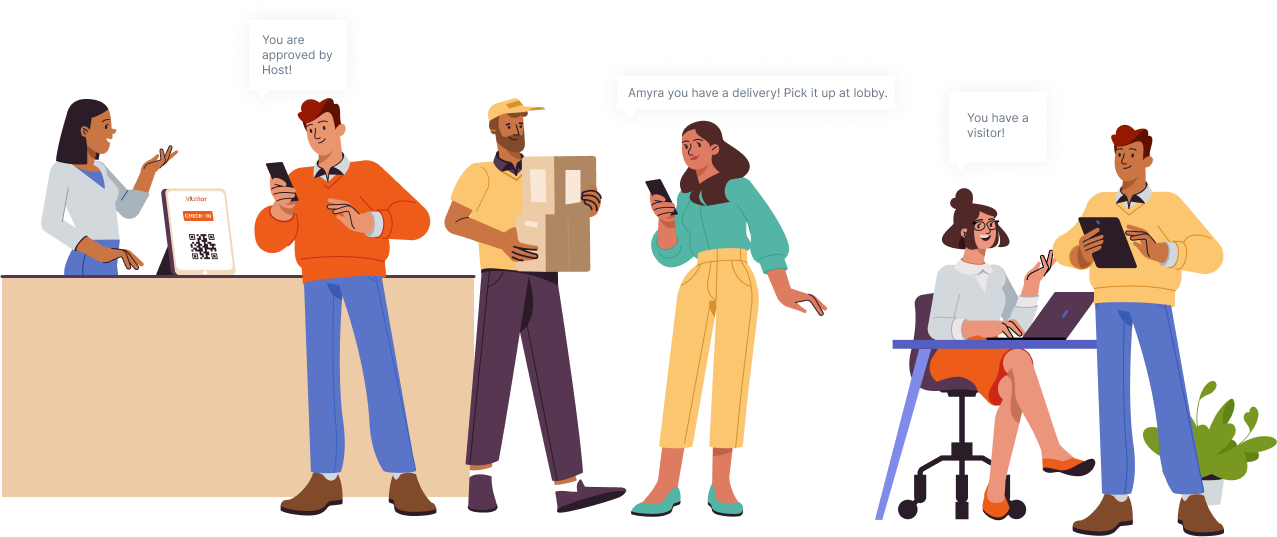
Vizitor’s QR-based check-in captures employee attendance at the office entrance automatically every arrival timestamped, every departure logged, no manual entry required.
The data goes to a real-time dashboard that gives HR and facilities teams an accurate picture of who’s actually in the building by day, by location, by team. Not badge-swipe data that could mean anyone was there for any length of time. Actual check-in records.
For organizations trying to understand their real occupancy versus their mandated occupancy, to see the coffee badging gap in actual numbers rather than gut feeling that data is useful. Not to punish. To understand.
If Tuesdays show 85% occupancy and Fridays show 18%, that tells you something worth acting on. If certain teams consistently appear on the same days while others are scattered across the week, that’s coordination data. If your meeting rooms are booked but empty, that’s a different problem the same platform can surface.
The goal isn’t to know that someone badged in at 9:04 and left at 9:47. The goal is to build an office that’s worth staying in past 9:47.
See how Vizitor tracks office attendance →
Conclusion
Coffee badging isn’t going away by itself. Three out of four companies are dealing with it, and the trend has been building for two years. Stricter policies haven’t stopped it. Real-time monitoring hasn’t stopped it. Direct conversations haven’t stopped it.
What changes the behavior is changing the experience.
When the office offers something that home can’t: real collaboration, mentorship, informal connections that matter to careers people stay. Not because they’re required to. Because it’s worth the commute.
The data from your attendance system can tell you who swiped in and when. That’s a starting point. The more useful question is what happens between swipe-in and swipe-out and whether anything in your office is compelling enough to stretch that window.
Coffee badging is your employees telling you something. The companies paying attention are using that information to build better offices. The ones ignoring it are writing stricter policies that will generate the same data next quarter.
It also fits a pattern well beyond attendance. For the wider pattern of ownership and readiness changes across 2026 offices, coffee badging is really a symptom of the same policy-credibility gap showing up in meeting rooms, visitor flow, and delivery handling.
Frequently Asked Questions
See Vizitor in action check-in a visitor in under 30 seconds
Trusted by 500+ businesses. QR check-in, badge printing, NDA signing. Plans from $36/mo.