15 Best Meeting Room and Conference Room Booking Software
This is a criteria-led comparison of 15 meeting room and conference room booking tools, with a full pros and cons section for each drawn from real G2 and Capterra reviews plus vendor feature pages, not marketing copy. It covers Vizitor, Archie, Skedda, Envoy, Robin, Eden, Officely, deskbird, YAROOMS, Joan, OfficeSpace, Tactic, Cloudbooking, Kadence, and Smartway2, naming specific reviewer complaints like calendar-sync bugs, pricing transparency, and setup friction alongside genuine strengths for each tool, and honestly flagging the few ratings that couldn't be independently verified rather than guessing a number. It closes with a buying framework covering integration fit, scope, and no-show handling.


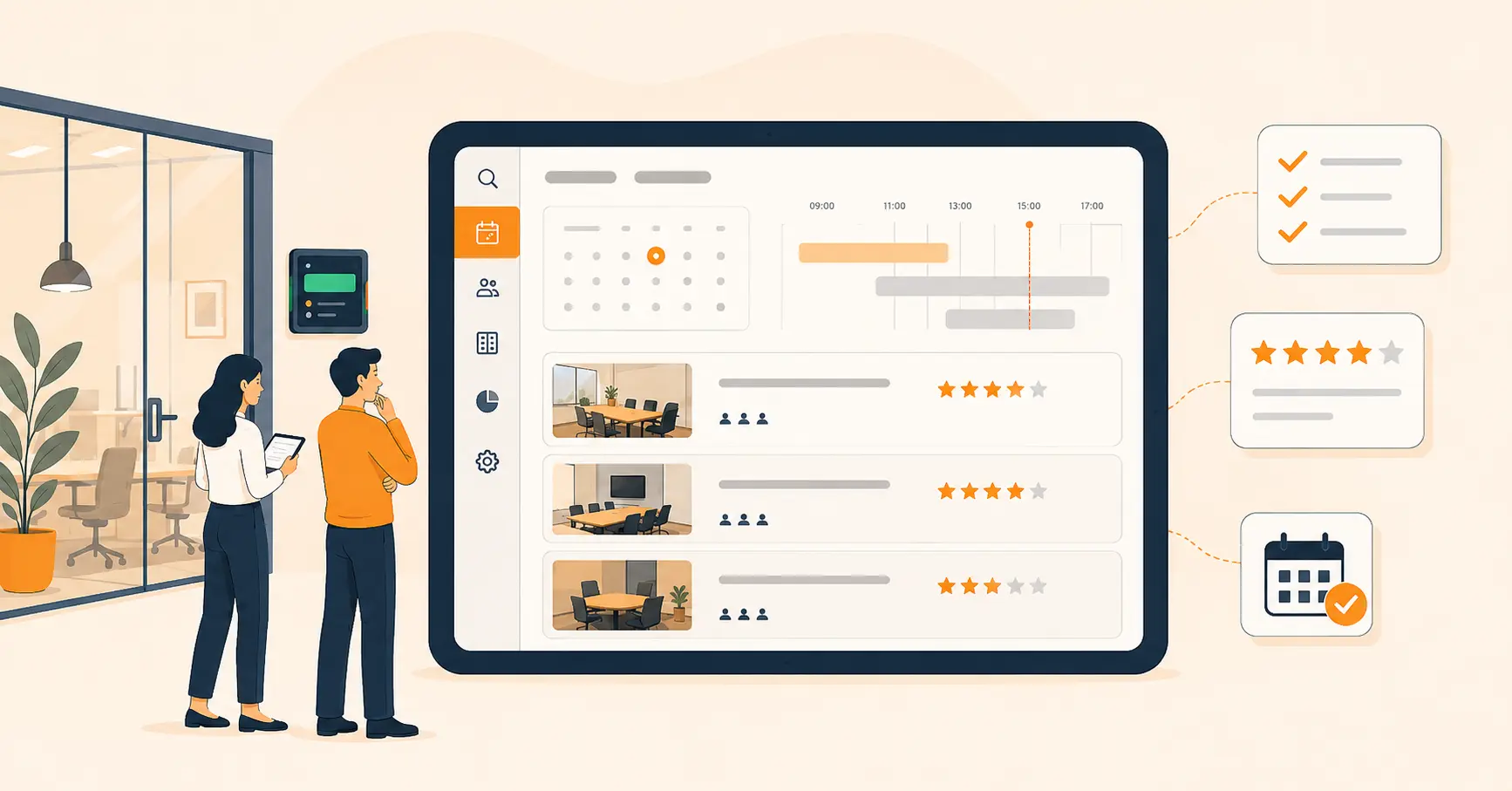
Table of Content
Try Vizitor for Free!
Search “meeting room booking software” and “conference room booking software” and you’ll find largely the same market, just described by two different habits of speech: meeting room is the more common phrase globally, conference room shows up more in US-based offices, and most of the 15 tools below answer to both names depending on who’s asking. The short answer: Vizitor, Archie, Skedda, Envoy, Robin, Eden, Officely, deskbird, YAROOMS, Joan, OfficeSpace, Tactic, Cloudbooking, Kadence, and Smartway2 cover the real range from small-office simplicity to enterprise-scale room and desk management.
This list is built from criteria, not a popularity contest: how easy booking actually is for the person trying to grab a room in the next five minutes, how deep the calendar and workplace-tool integrations go, whether the tool supports room displays and no-show handling, and what real users on G2 and Capterra actually say once the free trial ends. Ratings below are current as of this research and can shift over time, so treat them as directional rather than exact to the decimal. One quick disclosure: this is Vizitor’s blog, so Vizitor is listed first, the same way every vendor-run comparison in this space ranks itself first.
All 15 tools here are paid platforms (most with a free trial). If free or self-hosted, open-source software is a hard requirement rather than a nice-to-have, our roundup of free and open-source meeting room booking tools covers that narrower angle in more depth than makes sense to repeat here.
Quick comparison
| Tool | Best for | G2 / Capterra |
|---|---|---|
| Vizitor | Room booking bundled with visitor management, queue, and reception | Capterra 4.7 |
| Archie | Coworking operators and access-controlled offices | G2 4.9 / Capterra 4.8 |
| Skedda | Straightforward booking for SMBs, schools, and shared spaces | G2 4.8 / Capterra 4.8 |
| Envoy | Enterprise integrations and compliance-heavy environments | G2 4.4 |
| Robin | Large organizations needing a full workplace platform | G2 4.4 / Capterra 4.7 |
| Eden | Combined workplace ops (tickets, visitors, rooms) | G2 4.7 / Capterra 4.8 |
| Officely | Slack- or Teams-native teams that don’t want a new app | G2 4.6 / Capterra 4.8 |
| deskbird | Budget-conscious hybrid teams wanting simple booking | G2 4.5 / Capterra 4.7 |
| YAROOMS | Growing companies standardizing hybrid scheduling | G2 4.3 / Capterra 4.6 |
| Joan | Teams that want physical e-paper room displays | G2 4.5 / Capterra 4.8 |
| OfficeSpace | Large, complex campuses doing space planning and moves | Capterra 4.8 |
| Tactic | Enterprise teams wanting a modular workplace platform | G2 4.7 / Capterra 4.7 |
| Cloudbooking | UK/EU offices needing room and desk booking together | G2 4.3 |
| Kadence | Hybrid teams scheduling in-office days alongside rooms | G2 4.5 / Capterra 4.6 |
| Smartway2 | Microsoft/Outlook-first enterprises | G2 4.1 (small sample) / Capterra 4.5 |
1. Vizitor
Capterra: 4.7/5
Vizitor’s meeting room booking sits inside a broader workplace platform that also runs visitor check-in, queue management, desk booking, and mailroom tracking from the same system. The honest best-for here isn’t “best room booking UX in isolation,” it’s for teams who want the room calendar, the front-desk visitor log, and department queue routing to share one connected system instead of stitching three tools together.
Pros
- Reviewers consistently describe it as easy to use, with minimal time needed to learn the interface
- Real-time host and booking notifications across email, SMS, and WhatsApp
- Rated cost-effective relative to the feature set
Cons
- Some reviewers want more customization options
- Fewer enterprise-grade integrations than platform-scale competitors like Envoy or Robin
- Cloud-based, so it depends on a stable internet connection at the front desk
Key features: meeting room booking with Google Calendar and Outlook sync, desk reservation with live occupancy, QR-based visitor check-in, badge printing, digital signature capture, delivery tracking, multi-location support.
Booking a room, seeing which rooms are actually in use versus just reserved, and auto-releasing no-shows all live in Vizitor’s meeting room booking system, and the same platform covers conference room scheduling for teams who use that term instead. For a closer look at what switching from a manual process actually changes day to day, Vizitor’s guide to manual vs. smart room booking walks through it directly.
This is the entry to look at closely if your team is already running (or planning to run) visitor check-in, front-desk queues, or desk booking on Vizitor, since adding room booking to an existing setup is a configuration change, not a new vendor relationship, a new login, or a new dataset to keep in sync with everything else.
2. Archie
G2: 4.9/5 · Capterra: 4.8/5
Archie has built a strong reputation specifically with coworking operators and offices that need tight access-control integration alongside room booking, plus a native Slack bot for booking without leaving chat.
Pros
- Real-time room availability on tablets, which reviewers credit for eliminating double-bookings
- Straightforward interface with minimal training needed
- Fast, accurate Outlook/Google Calendar sync
Cons
- Can’t edit a booking once it’s made
- Learning curve for complex, multi-floor office layouts during initial setup
- White-labeling costs extra, and coworking-tier pricing feels expensive to some reviewers
Key features: no-show auto-release, room display panels, Outlook/Google Calendar sync, recurring bookings, QR-code check-in, capacity and amenity filters, booking buffer times.
3. Skedda
G2: 4.8/5 · Capterra: 4.8/5
Skedda is aimed at straightforward space booking rather than a full workplace suite, which makes it a common choice for SMBs, universities, and libraries booking shared spaces without needing deep enterprise integrations.
Pros
- Outlook integration called out specifically by reviewers
- Responsive live-chat support, one of its highest-rated categories on G2
- Easy adoption of the floor-plan booking view
Cons
- Initial “space sharing” configuration has a learning curve for complex layouts
- Pricing feels steep at scale, especially flagged by smaller organizations like nonprofits
- Visitor/room check-in scores relatively lower than other categories on G2, a comparative weak point
Key features: auto-release for unclaimed bookings, tablet display panels, two-way Outlook/Google Calendar sync, recurring bookings, QR/email/Wi-Fi check-in, buffer time between bookings, Zoom/Teams/Meet meeting links.
4. Envoy
G2: 4.4/5 (for the room-booking product specifically)
Envoy built its name in visitor management and has extended into room booking with the same enterprise-grade integration depth and compliance focus that defines the rest of its platform.
Pros
- Reviewers rate it easy to use despite its platform depth
- One-tap booking plus check-in from a tablet, Slack, or Teams
- Real-time occupancy insight tied into broader space analytics
Cons
- Pricing runs expensive, with features like SSO and emergency notifications gated behind Premium/Enterprise tiers
- Booking rules configure only at the location level, no quotas, buffers, or approval workflows out of the box
- Occasional mobile app glitches disrupting the booking flow
Key features: no-show auto-release, one-tap booking and tablet/Slack/Teams check-in, Bluetooth-based nearest-room detection on mobile, Google/Outlook calendar sync, resource filtering by whiteboard, display, or projector.
5. Robin
G2: 4.4/5 · Capterra: 4.7/5
Robin positions itself as a full workplace platform for large organizations, covering room booking, desk booking, and workplace analytics together.
Pros
- Intuitive navigation and seamless calendar integration, per reviewers
- “Abandoned meeting protection” (automatic release of ghost bookings) frequently praised as a standout
- Customizable recurring-meeting settings
Cons
- Custom, quote-based pricing criticized as expensive and hard to budget for in advance
- Room-display refresh bugs that reportedly require restarting the unit
- Editing interactive floor plans is time-consuming and often needs vendor support, especially after an office redesign
Key features: smart room suggestions by capacity and resources, door-side check-in, abandoned meeting protection, Google/Outlook calendar sync, Slack/Teams booking and reminders, digital signage displays.
6. Eden (Eden Workplace)
G2: 4.7/5 · Capterra: 4.8/5
Eden combines room and desk booking with internal ticketing and visitor management in one workplace-operations platform.
Pros
- Modern, easy-to-use interface
- Slack integration for booking directly from chat
- Responsive customer support, with reviewers noting the team acts on feedback
Cons
- Some reviewers describe the room-booking flow itself as confusing enough that employees skip it
- Missing “favorite rooms” and usage-forecasting features, with limited advanced reporting
- Slack integration occasionally buggy
Key features: floor-plan room view, recurring reservations, no-show auto-release, amenity and equipment filtering, required check-in/check-out, hallway display panels, Google Calendar and Outlook 365 sync.
7. Officely
G2: 4.6/5 · Capterra: 4.8/5
Officely’s whole pitch is booking without leaving the tools your team already lives in, Slack or Microsoft Teams, rather than adopting a separate booking app.
Pros
- Books rooms directly inside Teams, Microsoft 365, Outlook, or Slack with no separate login
- Reviewers describe booking as fast with minimal fuss
- Easy to see who’s in or out for hybrid-team coordination
Cons
- At least one reviewer noted room reservation wasn’t fully available in the app at the time of review (reportedly in active development)
- Bugs when editing or switching bookings, described by a reviewer as “messy to administer”
- Mobile app loading speed and calendar-integration issues tied to certain hosting setups
Key features: real-time room availability at a glance, amenity filtering, direct booking from Teams/Outlook with guest invites, conflict and double-booking prevention.
8. deskbird
G2: 4.5/5 · Capterra: 4.7/5
deskbird focuses on affordable, easy-to-adopt hybrid scheduling that covers both desks and rooms.
Pros
- Real-time sync with Outlook, Google Calendar, and Teams to prevent double-bookings
- Reviewers cite ease of use, personalizable floor plans, and clean integrations
- Ease-of-use scores especially well in its Capterra breakdown
Cons
- A G2 reviewer described it as “troubled by bugs,” specifically flagging Outlook sync for room bookings
- Analytics described as basic, with limited granularity for larger teams
- Double bookings reportedly still occur occasionally, and initial setup is described as fairly long
Key features: filter rooms by availability, capacity, and equipment; drag-and-drop rescheduling with organizer auto-notification; recurring meetings; check-in with auto-release for no-shows; external guest invites.
9. YAROOMS
G2: 4.3/5 · Capterra: 4.6/5
YAROOMS has built a genuinely large footprint in the workplace-management space, covering hybrid scheduling, room and desk booking, and visitor management, with particular strength in Microsoft Teams integration.
Pros
- Quick-book flow that reviewers say reserves a room in a couple of clicks
- Consistently praised for ease of use and an intuitive interface
- Customer service highlighted as responsive
Cons
- Tiered pricing that reviewers say jumps significantly as an organization grows
- Some reviewers call the interface design dated, which hurts overall satisfaction scores
- Mobile limitations viewing floor plans and timelines on smaller screens
Key features: real-time double-booking prevention synced across Outlook, Google Calendar, and Teams; automatic video-link creation on room booking; auto-release of no-show bookings via a configurable check-in window.
10. Joan
G2: 4.5/5 · Capterra: 4.8/5
Joan differentiates itself with hardware: e-paper room-display panels that show live booking status right outside the door.
Pros
- The e-paper display lets staff see room status and book instantly from the device itself
- Devices are reportedly easy to set up in minutes regardless of technical experience
- Praised for ease of use and an intuitive interface
Cons
- Battery life shorter than the advertised spec in practice, with some reviewers needing recharges every few weeks on busy or mesh-networked rooms
- Hardware described as expensive on top of the software subscription, and a pricing-model change reportedly increased costs for offices with fewer rooms
- The e-ink touchscreen is described as a bit laggy, needing firm force to register a tap
Key features: 6-inch and 13-inch e-paper display models with real-time availability shown on the door and one-tap booking from the device; wireless, rechargeable, cable-free wall mounting; sync with Google Calendar, Office 365, and Exchange/Outlook.
11. OfficeSpace
Capterra: 4.8/5 (G2 figures for this product varied significantly between sources and couldn’t be confirmed to one authoritative number — check their live G2 profile directly if that matters to your evaluation.)
OfficeSpace is built for large, complex facilities doing serious space planning, moves, and room management at scale, not just booking a conference room for an hour.
Pros
- One place to book desks and rooms across mobile, desktop, Slack, Teams, room screens, or Outlook
- Named “Easiest to Use” and “Best Meets Requirements” in recent G2 category awards
- Responsive customer support, per reviewers
Cons
- Opaque, per-user pricing that requires a custom quote, with no published free trial
- Implementation timelines described as long, officially around 35 days but reportedly closer to 60 in practice
- Floor-plan changes reportedly require OfficeSpace staff rather than being self-service, and at least one reviewer noted no mobile app
Key features: real-time availability with instant booking from any device, auto-release for no-show or “ghost” meetings, AI-informed room suggestions based on usage patterns, kiosk check-in via iPad or Android tablet, Outlook and Google Calendar integration.
12. Tactic
G2: 4.7/5 · Capterra: 4.7/5
Tactic markets itself as a modular workplace platform for enterprise teams, letting organizations pick and combine room booking with other workplace modules rather than buying a fixed bundle.
Pros
- Reviewers describe the booking system as intuitive, enabling quick room and seat reservations
- Integrates with Google Calendar, Microsoft Outlook, and Slack
- Responsive support team and integration quality frequently praised
Cons
- System slowness or latency reported during peak-hour simultaneous access
- Occasional glitches where a reserved room or desk still shows as available, causing double-booking
- Notifications and reminders described as inconsistent, with occasional login issues
Key features: filter rooms by capacity, layout, floor, and equipment; book recurring or ad-hoc meetings from Tactic, Outlook, or Google; room-display tablets with live availability, on-the-spot check-in, and auto-release of no-show meetings; book AV equipment or catering alongside the room.
13. Cloudbooking
G2: 4.3/5 (Capterra’s current rating for Cloudbooking couldn’t be independently verified during research — their product page wasn’t accessible directly, so no figure is stated here rather than guessing one.)
Cloudbooking is a UK/EU-based platform covering room and desk booking together, commonly evaluated by European offices that want both under one system with regional data-hosting considerations in mind.
Pros
- Reviewers rate it easier to use and administer than some larger competitors
- Interactive floor-map booking lets users click the exact desk or room location on a visual map
Cons
- Specific reviewer-sourced complaints for the room-booking module weren’t clearly documented in the sources checked; that itself is worth noting rather than assuming the product has no drawbacks
Key features: two-way calendar sync with Exchange/Outlook and Google Workspace; NFC-enabled digital room displays with LED status indicators and check-in/check-out; automatic no-show cancellation; interactive 3D floor plans across mobile, web, and kiosk.
14. Kadence
G2: 4.5/5 · Capterra: 4.6/5
Kadence centers on hybrid work scheduling, coordinating which days teams come in alongside the room and desk bookings that go with those days.
Pros
- Interactive floor plans show real-time booked/available status
- Book directly inside Outlook, Teams, or Google Workspace, with a Slack integration for reserving spaces
- Quick setup, with some reviewers completing onboarding in a day
Cons
- One reviewer specifically noted conference room reservation lagged behind desk booking in maturity at the time of review
- No calendar-view option, only a list view, per reviewer requests
- No ability to add notes to a guest booking
Key features: capacity and amenity filters, real-time no-show detection with automatic room release and configurable check-in grace windows, room-utilization analytics at the portfolio level, Outlook/Google Calendar and Teams booking plugin.
15. Smartway2 (HubStar Connect)
G2: 4.1/5 (based on a small sample of reviews) · Capterra: 4.5/5
Smartway2, now positioned under the HubStar Connect name in some markets, is built specifically for Microsoft-first organizations wanting deep, bidirectional Outlook calendar sync.
Pros
- Real-time booking sync across Outlook, displays, and signage
- Reporting and analytics for space utilization praised by reviewers
- A vendor case study cites a customer reducing no-show rates substantially through reminders and check-in requirements (a vendor-reported figure, not an independent reviewer statistic)
Cons
- The Outlook add-in reportedly loses connection often and stops syncing, requiring reconfiguration
- Limited customization options
- Interface described by a reviewer as looking a little dated, and floor preferences must be reselected manually each booking rather than saved as a default
Key features: book from Outlook, web, mobile, or digital display panels; automated room recommendations based on size, equipment, and catering needs; approval workflows and a rules engine per room; recurring meeting booking.
How to actually choose between these
Start with what’s already in your stack. A Slack-native team evaluating Officely will have a very different setup experience than an Outlook-first enterprise evaluating Smartway2, and picking against the grain of your existing tools creates ongoing friction no feature list captures.
Next, be honest about scope. If the real problem is “we need to book conference rooms without double-booking,” a specialist like Skedda or Officely solves that directly without paying for space-planning or visitor-management features you won’t use. If the actual problem spans visitors, queues, desks, and rooms together, a bundled platform removes the cost of stitching three or four point solutions together and keeping their data in sync. Vizitor’s guide to smart practices for the meeting room booking process is a good next read once you’ve narrowed down what you actually need.
One more thing worth checking before signing anything: how each tool actually handles no-shows and unclaimed bookings. This sounds like a minor detail until you’ve watched a “reserved” room sit empty for thirty minutes because nobody built in an automatic release policy. Ask any shortlisted vendor specifically how their no-show handling works, not just whether the feature exists on a checklist, since the implementation details vary more than the marketing pages suggest, and the pros/cons above show that even well-rated tools have real, specific rough edges reviewers have hit.
Picking the right room booking software for your team
The 15 tools above cover most of the real range in this market, from single-purpose room schedulers to full workplace platforms, and the pros and cons above come from what actual users report, not marketing copy. A pattern worth noticing: nearly every tool on this list, including well-rated ones, has at least one specific, recurring complaint about calendar sync reliability, pricing transparency, or setup friction. That’s not a reason to distrust ratings, it’s a reason to read past the star score into the actual reviews for any tool you shortlist.
A short trial or pilot with real bookings still beats any comparison article, this one included. Run a two-week pilot with your actual meeting volume, and pay attention to whether the specific cons listed above for your shortlisted tools actually show up in your own use, since that’s where these tools differentiate from each other in daily use, not in the feature list.
If you want the fuller evaluation framework behind this list, our guide to choosing the right meeting room booking software walks through the criteria, the rollout steps, and the mistakes buyers make before they ever get to a shortlist like this one.
If room booking is one piece of a bigger front-desk and workplace puzzle, book a demo to see how Vizitor handles meeting rooms, conference rooms, visitors, queues, and desk booking in one connected platform.
Frequently Asked Questions
See Vizitor in action check-in a visitor in under 30 seconds
Trusted by 500+ businesses. QR check-in, badge printing, NDA signing. Plans from $36/mo.